
lovethailand home >North Travel Attractions >Chiang Mai Travel Attractions >Saraphi >Chom Phu > Wat Mae Salap
TL;DR: Wat Mae Salap is located at No. 33, Moo 7, Ban Mae Salap, Chomphu Subdistrict, Saraphi District, Chiang Mai Province 50140, open Daily, hours 08.00 – 17.00.

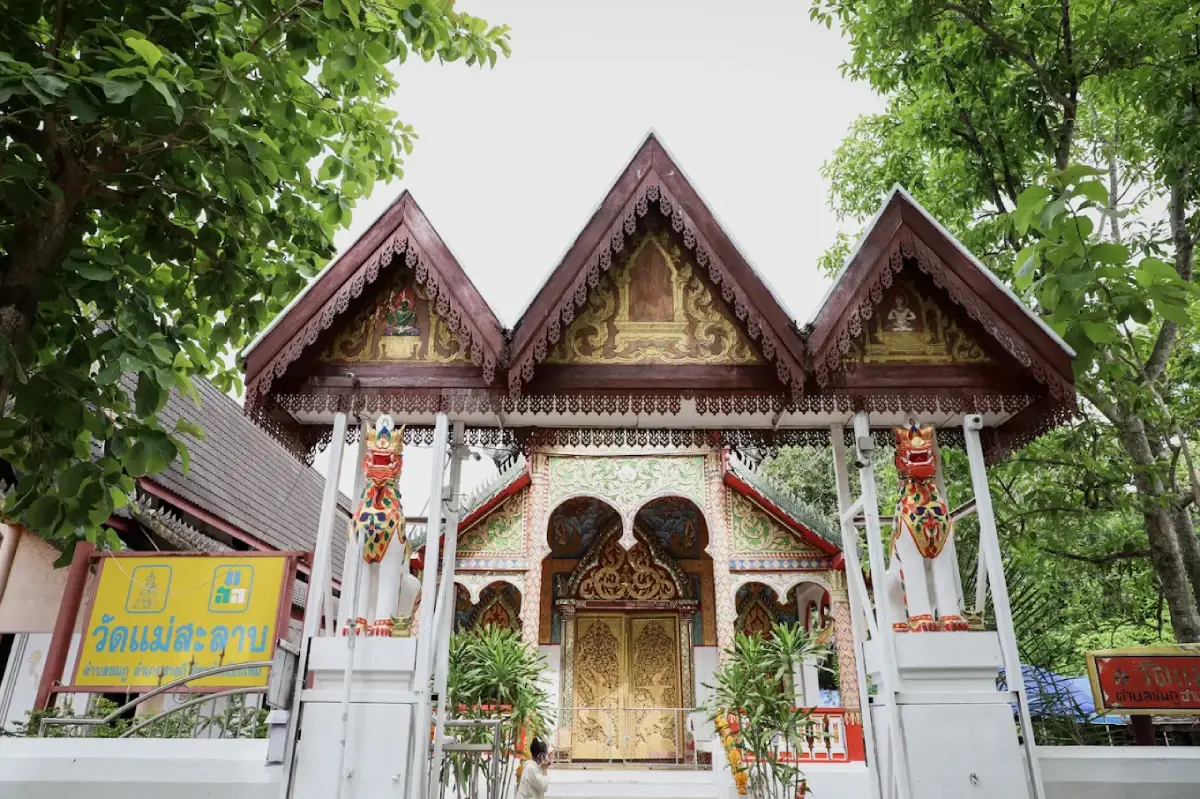
Wat Mae Salap
Open Days: Daily
Opening Hours: 08.00 – 17.00
Wat Mae Salap is located at No. 33, Moo 7, Ban Mae Salap, Chomphu Subdistrict, Saraphi District, Chiang Mai Province 50140. It is a local Buddhist temple under the Mahanikaya sect, covering 8 rai of land. The temple was officially established in 1813 and received its royal consecrated boundary, or Wisungkhamsima, in 1976. The current abbot is Phra Athikan Wichai Watthano. Wat Mae Salap is an old community temple of Chomphu Subdistrict, closely connected with the Mae Salap waterway, the Phaya Kham irrigation system, local agriculture, and the spiritual life of Ban Mae Salap.
Wat Mae Salap is suitable for visitors who want to understand Saraphi through a living community temple. Ban Mae Salap is a village in Chomphu Subdistrict, where village roads, irrigation routes, waterways, agriculture, and Buddhist temples are closely connected. The temple is not only a place for worship; it is also a place for merit-making, Dhamma listening, annual traditions, and community gatherings.
The temple’s history is strongly linked with the Mae Salap waterway. The water source is associated with Mueang Phaya Kham, named after Phaya Kham Bamrung Rat, a title connected with agricultural and irrigation responsibilities in the past. This background shows that the temple and village developed within a landscape where water management, farming, and community life were deeply connected.
The founding story of Wat Mae Salap mentions Khru Ba Jinna, a wandering monk, and Pha Khao Ki, a white-robed practitioner. They came from the northern side of Chiang Mai, paid respect at Doi Suthep, and traveled along the Mae Salap waterway on their way toward Phra That Hariphunchai. Khru Ba Jinna stopped at the site of the present temple. Local villagers developed faith in his conduct and invited him to stay for the rains retreat. Together with the monk and the white-robed practitioner, the villagers built monastic structures, and the temple was established in 1813.
This origin story gives Wat Mae Salap a deeper cultural meaning. It links a wandering monk’s journey, pilgrimage routes between Doi Suthep and Hariphunchai, the Mae Salap waterway, and the faith of local villagers. The temple therefore began not simply as a formal institution, but as a sacred community space shaped by religious devotion and local geography.
The temple’s official establishment in 1813 gives Wat Mae Salap more than two centuries of history. It has stood through the transformation of Saraphi from an agricultural community dependent on waterways and irrigation routes into a district closely connected with Chiang Mai city. The temple’s value lies not only in its age, but also in its continuity as a place where local Buddhist life has been maintained for generations.
The granting of Wisungkhamsima in 1976 was an important religious milestone. A Wisungkhamsima is a consecrated monastic boundary used for important Buddhist ceremonies. Receiving this boundary confirmed Wat Mae Salap’s formal religious status and strengthened its role as a complete Buddhist institution for the community.
The temple land covers 8 rai, giving Wat Mae Salap enough space to support village religious activities. In northern Thai communities, a temple is not only a place for worship. It supports merit-making, food offerings, funerals, annual festivals, Dhamma listening, and social cooperation. Wat Mae Salap therefore functions as both a religious space and a community gathering place for Ban Mae Salap.
The early monastic structures at Wat Mae Salap were built through the combined faith of Khru Ba Jinna, Pha Khao Ki, and local villagers. This construction transformed the site from a resting place for a wandering monk into a functioning community temple. The temple has continued to serve the religious life of Ban Mae Salap ever since.
The atmosphere of Wat Mae Salap is that of a calm village temple. Visitors should come with the intention of paying respect, making merit, and understanding community Buddhist life rather than expecting large-scale tourist infrastructure. The temple’s charm lies in its history, its connection with the Mae Salap waterway, and its role as a spiritual center for local residents.
Phra Athikan Wichai Watthano, the abbot of Wat Mae Salap, plays an important role in caring for the temple, guiding ceremonies, coordinating with local residents, and keeping the temple as a peaceful center of faith. In a community temple, the abbot’s role is closely connected with everyday village life and annual Buddhist activities.
Wat Mae Salap serves Ban Mae Salap through Buddhist holy day merit-making, food offerings, Dhamma listening, Buddhist Lent, the end of Buddhist Lent, Kathin, robe-offering ceremonies, Songkran, water-pouring ceremonies for elders, and Yi Peng. These events help keep Lanna Buddhist culture alive and maintain close social ties within the village.
Buddhist Lent is an especially important season for temples in Chomphu Subdistrict. Chomphu Subdistrict Municipality and the local cultural council have included Wat Mae Salap, Moo 7, among the nine temples of Chomphu Subdistrict visited for candle-offering activities. This confirms the temple’s continuing role in the religious and cultural network of the subdistrict.
Wat Mae Salap is also closely connected with the local environment. Community activities around the waterway in front of the temple show how the temple remains part of village water management and environmental care. This connection matches the temple’s origin story, which is tied to the Mae Salap waterway and the Phaya Kham irrigation context.
The main appeal of Wat Mae Salap is its layered local history. It brings together Khru Ba Jinna, Pha Khao Ki, the Mae Salap waterway, village faith, agricultural life, and more than two centuries of Buddhist continuity. Visitors can come to make merit, pay respect, and use the temple as a starting point for understanding the wider temple network of Chomphu Subdistrict.
Getting There is convenient because the temple is located in Saraphi District, not far from Chiang Mai city. Visitors can travel from Chiang Mai city toward Saraphi and Chomphu Subdistrict, then continue to Ban Mae Salap, Moo 7. Private car, motorcycle, or local transport can be used. The route is suitable for a half-day or full-day cultural trip combining several temples and community attractions in Chomphu.
Wat Mae Salap can be combined with nearby temples and places such as Wat Pa Pao, Wat Si Don Mun, Wat Buppharam, Wat Tha Ton Kwao, Wat Phaya Chomphu and Wang Matcha Phaya Chomphu, Wat Thung Khi Suea, Lan Sai Fai Hin, and Wiang Kum Kam. A meaningful route can begin at Wat Mae Salap to understand the waterway and village-temple relationship, continue to Wat Phaya Chomphu for local legend and the fish sanctuary, and then visit Wat Thung Khi Suea or Wat Tha Ton Kwao for more layers of Chomphu community history.
Wat Si Don Mun and Wat Pa Pao help visitors understand nearby village temples in the same subdistrict. Wat Buppharam reflects local faith in temple founding. Wat Tha Ton Kwao connects with riverside community history, while Wat Phaya Chomphu offers a temple museum, monument, and fish sanctuary. Together, these places reveal the diversity of Saraphi’s temple and community landscape.
Restaurants near Wat Mae Salap include local eateries in Chomphu, northern Thai food shops, cafés, and restaurants in Saraphi. Accommodations can be found in Saraphi and nearby Chiang Mai areas, making the temple easy to include in a cultural route that also covers Wiang Kum Kam, Chiang Mai city, or Lamphun.
Visitors should dress modestly, speak quietly, avoid disturbing monks or local residents, and respect the temple’s religious areas. If visiting during Buddhist Lent, Kathin, robe-offering ceremonies, or community events, visitors should follow temple guidance and local etiquette. Wat Mae Salap is an active community temple, and a calm, respectful visit is the best way to appreciate its history and living role.
In summary, Wat Mae Salap is a Mahanikaya community temple in Ban Mae Salap, Moo 7, Chomphu Subdistrict, Saraphi District, Chiang Mai Province. It is open daily from 08.00 to 17.00. Officially established in 1813 and granted its Wisungkhamsima in 1976, the temple is notable for its origin story involving Khru Ba Jinna, Pha Khao Ki, the Mae Salap waterway, and the faith of local villagers. It is a meaningful stop for merit-making, cultural learning, and community-based travel in Saraphi.
| Name | Wat Mae Salap |
| Type | Local Buddhist temple under the Mahanikaya sect |
| Location | No. 33, Moo 7, Ban Mae Salap, Chomphu Subdistrict, Saraphi District, Chiang Mai Province 50140 |
| Address | Ban Mae Salap, Moo 7, Chomphu Subdistrict, Saraphi District, Chiang Mai 50140, Thailand |
| Highlights | Old community temple linked with Khru Ba Jinna, Pha Khao Ki, the Mae Salap waterway, the Phaya Kham irrigation context, and local agricultural life |
| History | Officially established in 1813, giving the temple more than two centuries of Buddhist and community history |
| Key Founding Figures | Khru Ba Jinna, Pha Khao Ki, and Ban Mae Salap villagers who helped build monastic structures and establish the temple |
| Wisungkhamsima | Granted in 1976 |
| Temple Land | 8 rai |
| Local Context | Located in Ban Mae Salap, Moo 7, Chomphu Subdistrict, with strong connections to the Mae Salap waterway, Mueang Phaya Kham, and local agriculture |
| Important Areas | Worship areas, monastic structures for Buddhist activities, and community merit-making spaces of Ban Mae Salap |
| Abbot / Caretaker | Phra Athikan Wichai Watthano |
| Known Abbot Succession | 1. Phra Khru Ba Jinna 2. Phra Duang Kaeo 3. Phra Supha 4. Phra Moei 5. Phra Duang Di 6. Phra Duang Chan 7. Phra Khru Bunma Yanarangsi 8. Phra Athikan Wichai Watthano |
| Open Days | Daily |
| Opening Hours | 08.00 – 17.00 |
| Temple Contact | 086-923-2711 |
| Local Contact | Chomphu Subdistrict Municipality, Tel. 053-420-779 |
| Community Role | Spiritual center of Ban Mae Salap, place for merit-making, Dhamma listening, Buddhist Lent activities, annual traditions, and waterway-related community life |
| Merit Events / Traditions | Buddhist holy day merit-making, Buddhist Lent, end of Buddhist Lent, Kathin, robe offerings, Songkran, water-pouring ceremonies, Yi Peng, and Chomphu candle-offering activities |
| Travel Information | Travel from Chiang Mai city toward Saraphi and Chomphu Subdistrict, then continue to Ban Mae Salap, Moo 7. Private car, motorcycle, or local transport is suitable. |
| Nearby Tourist Attractions | 1. Wat Pa Pao (Rom Pa Tong), about 2–4 km 2. Wat Si Don Mun, about 3–5 km 3. Wat Buppharam, about 4–6 km 4. Wat Tha Ton Kwao, about 5–8 km 5. Wat Phaya Chomphu and Wang Matcha Phaya Chomphu, about 6–9 km 6. Wat Thung Khi Suea, about 6–9 km 7. Wiang Kum Kam, about 12–18 km |
| Nearby Restaurants / Chomphu and Saraphi Route | 1. Khrua Khun Ton Khon Sukhothai Mae Salap Chomphu Saraphi, about 1–3 km 2. Sarapee Coffee & Tea Ban Nong Pa Sae, about 4–7 km, Tel. 086-114-6644 3. Larb Lung Phueak Saraphi Chiang Mai, about 5–8 km 4. De’Chill Saraphi, about 6–9 km 5. Mike Cha Phaya Chomphu Saraphi, about 6–9 km 6. Suki Saraphi, about 10–14 km |
| Nearby / Saraphi and Chiang Mai Area Accommodations | 1. 9Roomz Hotel, about 10–15 km, Tel. 053-963-829, 095-446-0758 2. Baan Hom Samunphrai, about 10–15 km, Tel. 081-885-1429 3. Baan Saraphi, about 10–15 km, Tel. 053-321-942 4. Zen Retreat Chiang Mai Villa, about 12–18 km 5. Chiang Mai City Accommodations, about 15–22 km |
Frequently Asked Questions (FAQ)
Q: Where is Wat Mae Salap located?
A: Wat Mae Salap is located at No. 33, Moo 7, Ban Mae Salap, Chomphu Subdistrict, Saraphi District, Chiang Mai Province 50140.
Q: What are Wat Mae Salap’s opening days and hours?
A: The temple is open daily from 08.00 to 17.00.
Q: When was Wat Mae Salap established?
A: Wat Mae Salap was officially established in 1813.
Q: When did Wat Mae Salap receive its Wisungkhamsima?
A: Wat Mae Salap received its Wisungkhamsima in 1976.
Q: What is the main historical highlight of Wat Mae Salap?
A: Its main historical highlight is the founding story connected with Khru Ba Jinna, Pha Khao Ki, the Mae Salap waterway, and local villagers who helped build the temple’s early monastic structures.
Q: Who is the abbot of Wat Mae Salap?
A: The abbot is Phra Athikan Wichai Watthano.
Q: What is the main appeal of Wat Mae Salap?
A: The temple is notable as an old community temple linked with the Mae Salap waterway, the Phaya Kham irrigation context, agricultural life, and the Buddhist traditions of Ban Mae Salap.
Q: What nearby places can be combined with this visit?
A: Nearby route options include Wat Pa Pao, Wat Si Don Mun, Wat Buppharam, Wat Tha Ton Kwao, Wat Phaya Chomphu, Wat Thung Khi Suea, and Wiang Kum Kam.
 Category: ●Places of Worship
 Group: ●Temple
Last Update : 2 MonthAgo
 Last Update : 2 MonthAgo
 Click to Access the Navigation Map GPS

 Muang Chiang Mai(121)Chom Thong(47)Mae Chaem(25)Chiang Dao(33)Doi Saket(68)Mae Taeng(85)Mae Rim(69)Samoeng(29)Fang(71)Mae Ai(59)Phrao(70)San Pa Tong(103)San Kamphaeng(66)San Sai(73)Hang Dong(73)Hot(32)Doi Tao(22)Omkoi(11)Saraphi(74)Wiang Haeng(15)Chai Prakan(28)Mae Wang(32)Mae On(22)Doi Lo(33)Galyani Vadhana(1)


