
lovethailand home >North Travel Attractions >Chiang Mai Travel Attractions >Saraphi >Khua Mung > Wat Pak Mueang
TL;DR: Wat Pak Mueang is located at No. 68, Moo 3, Ban Pak Mueang, Khua Mung Subdistrict, Saraphi District, Chiang Mai Province 50140, open Daily, hours 08.00 – 17.00.

Wat Pak Mueang
Open Days: Daily
Opening Hours: 08.00 – 17.00
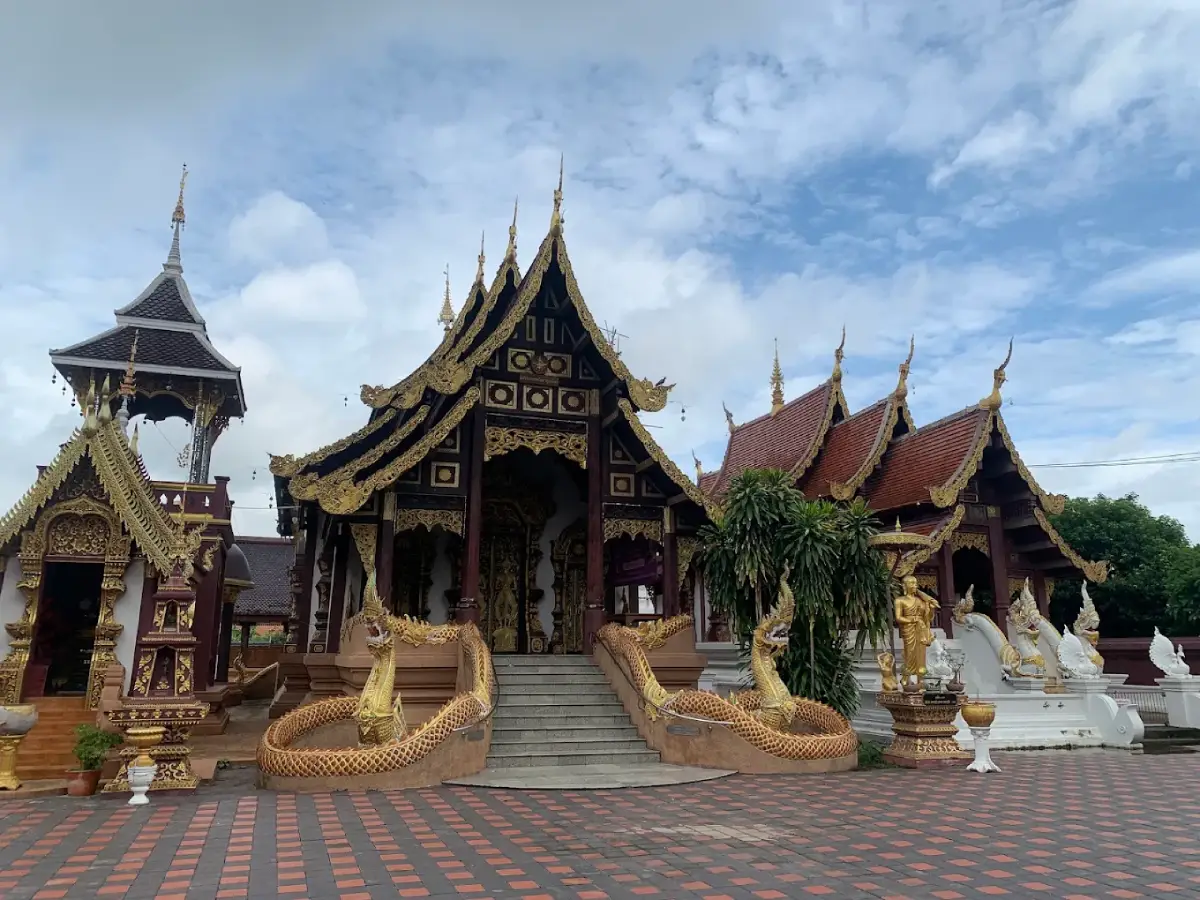
Wat Pak Mueang is located at No. 68, Moo 3, Ban Pak Mueang, Khua Mung Subdistrict, Saraphi District, Chiang Mai Province 50140. It is a local Buddhist temple under the Mahanikaya sect. The temple was officially established in 1857 and received its royal consecrated boundary, or Wisungkhamsima, in 2004. The current abbot is Phra Worachat Suchitto. Wat Pak Mueang is an old community temple of Ban Pak Mueang and Khua Mung Subdistrict, closely connected with old irrigation canals, agricultural life, Lanna palm-leaf manuscripts, and the religious identity of Saraphi.
Wat Pak Mueang is suitable for visitors who want to understand Saraphi through a real community temple rather than a major tourist site. Khua Mung Subdistrict lies not far from Chiang Mai city and has long been shaped by agriculture, local roads, irrigation canals, village temples, and Lanna cultural practice. Ban Pak Mueang is Moo 3 of Khua Mung Subdistrict, and the temple is one of the main community anchors linking local residents with Buddhist merit-making, ancestral memory, and cultural continuity.
The name “Pak Mueang” is directly connected with the local water system. In the past, two irrigation canals ran in front of the temple: the Chiang Mai canal and the Lamphun canal. The area was a point where water distribution was regulated, giving rise to the name “Pak Mueang.” This name reflects the importance of water in Saraphi’s agricultural landscape and shows how the temple is rooted in the everyday life of the community.
Older palm-leaf manuscripts record the temple under a longer name, often rendered as “Wat Pak Mueang Kaeo Kwang, Tha Chang, Pa Yang Chum.” This older name evokes a wider local landscape of canals, elephant routes or landing places, and yang tree areas. The later shorter name, Wat Pak Mueang, preserves the temple’s essential connection with the irrigation landscape. The presence of the temple name in palm-leaf manuscripts gives Wat Pak Mueang historical depth beyond oral memory.
The temple’s official establishment in 1857 makes Wat Pak Mueang one of the old temples of Khua Mung. However, its palm-leaf manuscript evidence points to an even deeper cultural role. A survey of manuscripts at the temple found a large number of palm-leaf texts. The oldest manuscript identified in the survey dated to 1816, and another manuscript recorded as copied at Wat Pak Mueang dated to 1817. This shows that Wat Pak Mueang has long functioned as a place of Buddhist learning, manuscript preservation, and local knowledge transmission.
The temple land covers 2 rai and 70 square wah under its land record, with the northern boundary adjoining a road, the southern boundary adjoining an alley, the eastern boundary adjoining an irrigation canal, and the western boundary adjoining a road. The temple also has four monastic land plots totaling 6 rai, 1 ngan, and 71 square wah. These details show how Wat Pak Mueang is woven into the local landscape of roads, alleys, canals, and village settlement.
Important structures at Wat Pak Mueang include a viharn, alms pavilion, monks’ residences, bell tower, scripture hall, and kitchen. The viharn serves as the main space for worship and Buddhist activities. The alms pavilion and kitchen support community merit-making events. The monks’ residences support monastic life. The bell tower marks the rhythm of temple life, while the scripture hall is especially meaningful in a temple known for its palm-leaf manuscript heritage.
The palm-leaf manuscripts of Wat Pak Mueang are one of its most important cultural treasures. The manuscript survey involved documentation, photography, registration, cloth wrapping, and proper binding of manuscripts. This work helped return local knowledge to the community and preserved texts connected with Buddhism, Lanna language, Dhamma learning, literature, and local history. For visitors interested in Lanna culture, this manuscript heritage is one of the temple’s most distinctive features.
The large number and age of the palm-leaf manuscripts show that Wat Pak Mueang was once an important local center of learning. Monks, novices, and knowledgeable villagers used temples like this to study Dhamma, copy manuscripts, and transmit knowledge in the Lanna script. These manuscripts are not merely old objects; they are evidence of a long intellectual and religious tradition that links the temple to the wider cultural history of northern Thailand.
Phra Worachat Suchitto, the current abbot of Wat Pak Mueang, plays an important role in caring for the temple and preserving its local memory. During the manuscript survey and presentation activities, he spoke about the temple’s history and background. This reflects the abbot’s role not only as a religious leader but also as a custodian of community history and Lanna manuscript heritage.
The known abbot succession of Wat Pak Mueang includes Phra Athikan Prawit Chinawaro, Phra Prasit Ratanayano, Phra Maha Narong Mongkhalo, and the current abbot, Phra Worachat Suchitto. These names show the continuity of temple care and Buddhist administration through different periods of community life.
Wat Pak Mueang serves Ban Pak Mueang in several important ways. It is a place for Buddhist holy day merit-making, food offerings, Dhamma listening, Buddhist Lent, the end of Buddhist Lent, Kathin, robe-offering ceremonies, Songkran, water-pouring ceremonies for elders, and Yi Peng. It is also a community space where villagers gather, support temple activities, and preserve local relationships across generations.
Songkran, water-pouring ceremonies, and Yi Peng are important traditions in Khua Mung and the wider Chiang Mai cultural area. As the village temple, Wat Pak Mueang supports these annual practices through merit-making and community gatherings. These traditions connect families, elders, monks, and younger generations while keeping local Buddhist culture alive.
The main appeal of Wat Pak Mueang is its combination of old temple history, irrigation-canal identity, and Lanna manuscript heritage. Visitors can pay respect in the viharn, observe the temple’s relationship with the surrounding village and canals, learn the origin of the name, and appreciate why palm-leaf manuscripts matter in northern Thai Buddhist culture. It is especially suitable for travelers interested in old temples, Lanna script, local history, and community-based cultural routes near Chiang Mai.
Getting There is convenient because the temple is located in Saraphi District, not far from Chiang Mai city. Visitors can travel from Chiang Mai city toward Saraphi and Khua Mung Subdistrict, then continue to Ban Pak Mueang, Moo 3. Private car, motorcycle, or local transport can be used. The route is suitable for a half-day or full-day cultural trip combining several temples in Khua Mung and Saraphi.
Wat Pak Mueang can be combined with nearby temples and cultural places such as Wat Si Mun Rueang, Wat Khua Mung, Wat Pa Duea, Wat Hua Dong, Wat Rai Dong Phuttharam, Wat Uthumphon Aram, and Wiang Kum Kam. A route beginning at Wat Pak Mueang helps visitors understand the village’s relationship with irrigation canals and manuscripts before continuing to other old temples in Khua Mung and the historical landscape of Wiang Kum Kam.
Wat Si Mun Rueang is especially relevant because it is also located in Ban Pak Mueang and was formerly known as Wat Pak Mueang Mai. Visiting both temples helps travelers understand the development of Buddhist communities within the same village area. Wat Pak Mueang represents the older canal-linked and manuscript-linked identity, while Wat Si Mun Rueang reflects a later phase of temple renewal in the community.
Restaurants around Wat Pak Mueang include local eateries in Khua Mung, made-to-order food shops, pizza shops, drink shops, and restaurants in Saraphi. Accommodations can be found in Saraphi and nearby Chiang Mai areas, making the temple easy to include in a cultural route that also covers Wiang Kum Kam, Saraphi, Chiang Mai city, or Lamphun.
Visitors should dress modestly, speak quietly, avoid disturbing monks or local residents, and avoid touching palm-leaf manuscripts or old documents without permission. If monks, novices, or villagers are holding temple activities, visitors should give them space and follow temple etiquette. A temple with manuscript heritage deserves especially careful and respectful behavior.
In summary, Wat Pak Mueang is a Mahanikaya community temple in Ban Pak Mueang, Moo 3, Khua Mung Subdistrict, Saraphi District, Chiang Mai Province. It is open daily from 08.00 to 17.00. Established in 1857 and granted its Wisungkhamsima in 2004, the temple is notable for its relationship with old irrigation canals, its Lanna palm-leaf manuscript heritage, its traditional temple structures, and its role as a spiritual and cultural center of Ban Pak Mueang.
| Name | Wat Pak Mueang |
| Type | Local Buddhist temple under the Mahanikaya sect |
| Location | No. 68, Moo 3, Ban Pak Mueang, Khua Mung Subdistrict, Saraphi District, Chiang Mai Province 50140 |
| Address | Ban Pak Mueang, Moo 3, Khua Mung Subdistrict, Saraphi District, Chiang Mai 50140, Thailand |
| Highlights | Old village temple connected with the Chiang Mai and Lamphun irrigation canals and a large collection of Lanna palm-leaf manuscripts |
| History | Officially established in 1857, with older palm-leaf manuscript evidence showing its long role in Buddhist learning and Lanna manuscript culture |
| Wisungkhamsima | Granted in 2004 |
| Temple Land | 2 rai and 70 square wah under land record S.K.1 No. 135, with four monastic land plots totaling 6 rai, 1 ngan, and 71 square wah |
| Boundaries | North: road South: alley East: irrigation canal West: road |
| Important Structures | Viharn, alms pavilion, monks’ residences, bell tower, scripture hall, and kitchen |
| Cultural Heritage | Large collection of palm-leaf manuscripts surveyed, photographed, registered, wrapped, and preserved as part of Lanna Buddhist heritage |
| Name Origin | The name comes from the temple’s location near two irrigation canals, the Chiang Mai canal and the Lamphun canal, at a water-distribution point called “Pak Mueang” |
| Former Name in Manuscripts | Wat Pak Mueang Kaeo Kwang, Tha Chang, Pa Yang Chum |
| Abbot / Caretaker | Phra Worachat Suchitto |
| Open Days | Daily |
| Opening Hours | 08.00 – 17.00 |
| Local Contact | Khua Mung Subdistrict Municipality, Tel. 053-429-622 |
| Community Role | Spiritual center of Ban Pak Mueang, place for merit-making, Dhamma listening, annual traditions, and preservation of Lanna palm-leaf manuscript knowledge |
| Merit Events / Traditions | Buddhist holy day merit-making, Buddhist Lent, end of Buddhist Lent, Kathin, robe offerings, Songkran, water-pouring ceremonies, and Yi Peng |
| Travel Information | Travel from Chiang Mai city toward Saraphi and Khua Mung Subdistrict, then continue to Ban Pak Mueang, Moo 3. Private car, motorcycle, or local transport is suitable. |
| Nearby Tourist Attractions | 1. Wat Si Mun Rueang, about 1–2 km 2. Wat Khua Mung, about 2–4 km 3. Wat Pa Duea, about 3–5 km 4. Wat Hua Dong, about 3–5 km 5. Wat Rai Dong Phuttharam, about 5–8 km 6. Wat Uthumphon Aram, about 5–8 km 7. Wiang Kum Kam, about 10–15 km |
| Nearby Restaurants / Khua Mung and Saraphi Route | 1. Pi Rung Khua Mung Moo 5, about 2–4 km, Tel. 061-065-7961 2. Rest Time Pizza Khua Mung, about 3–5 km, Tel. 081-472-0954 3. Raja Bubble Milk Tea Ban Khua Mung, about 3–5 km, Tel. 096-694-8874 4. Ro Noi Aroi Nae Rad Na @ Made to Order, about 3–6 km, Tel. 087-305-2840 5. Suki Saraphi, about 8–12 km, Tel. 081-033-1248 |
| Nearby / Saraphi and Chiang Mai Area Accommodations | 1. 9Roomz Hotel, about 8–12 km, Tel. 053-963-829, 095-446-0758 2. Baan Hom Samunphrai, about 10–15 km, Tel. 053-817-362, 081-885-1429 3. Baan Saraphi, about 8–12 km, Tel. 053-321-942 4. Ruenthip Resort, about 8–12 km, Tel. 098-556-6291 5. Zen Retreat Chiang Mai Villa, about 10–15 km |
Frequently Asked Questions (FAQ)
Q: Where is Wat Pak Mueang located?
A: Wat Pak Mueang is located at No. 68, Moo 3, Ban Pak Mueang, Khua Mung Subdistrict, Saraphi District, Chiang Mai Province 50140.
Q: What are Wat Pak Mueang’s opening days and hours?
A: The temple is open daily from 08.00 to 17.00.
Q: When was Wat Pak Mueang established?
A: Wat Pak Mueang was officially established in 1857.
Q: When did Wat Pak Mueang receive its Wisungkhamsima?
A: Wat Pak Mueang received its Wisungkhamsima in 2004.
Q: Why is the temple called Wat Pak Mueang?
A: The name comes from its location near two irrigation canals, the Chiang Mai canal and the Lamphun canal, at a water-distribution point known locally as Pak Mueang.
Q: What is the main highlight of Wat Pak Mueang?
A: The temple’s highlights include its old canal-linked history, Lanna palm-leaf manuscript collection, and traditional structures such as the viharn, alms pavilion, monks’ residences, bell tower, scripture hall, and kitchen.
Q: Who is the abbot of Wat Pak Mueang?
A: The abbot is Phra Worachat Suchitto.
Q: What nearby places can be combined with this visit?
A: Nearby route options include Wat Si Mun Rueang, Wat Khua Mung, Wat Pa Duea, Wat Hua Dong, Wat Rai Dong Phuttharam, Wat Uthumphon Aram, and Wiang Kum Kam.
 Category: ●Places of Worship
 Group: ●Temple
Last Update : 1 MonthAgo
 Last Update : 1 MonthAgo
 Click to Access the Navigation Map GPS
Wat Pak Mueang Map
Recommend

 Muang Chiang Mai(121)Chom Thong(47)Mae Chaem(25)Chiang Dao(33)Doi Saket(68)Mae Taeng(85)Mae Rim(69)Samoeng(29)Fang(71)Mae Ai(59)Phrao(70)San Pa Tong(103)San Kamphaeng(66)San Sai(73)Hang Dong(73)Hot(32)Doi Tao(22)Omkoi(11)Saraphi(74)Wiang Haeng(15)Chai Prakan(28)Mae Wang(32)Mae On(22)Doi Lo(33)Galyani Vadhana(1)


