
lovethailand home >North Travel Attractions >Chiang Mai Travel Attractions >San Pa Tong >Yu Wa > Wat Si Pan Ngoen
TL;DR: Wat Si Pan Ngoen is located at Ban Sala, Moo 11, Yu Wa Subdistrict, San Pa Tong District, Chiang Mai Province, open Daily, hours 08.00 – 17.00.

Wat Si Pan Ngoen
Open Days: Daily
Opening Hours: 08.00 – 17.00
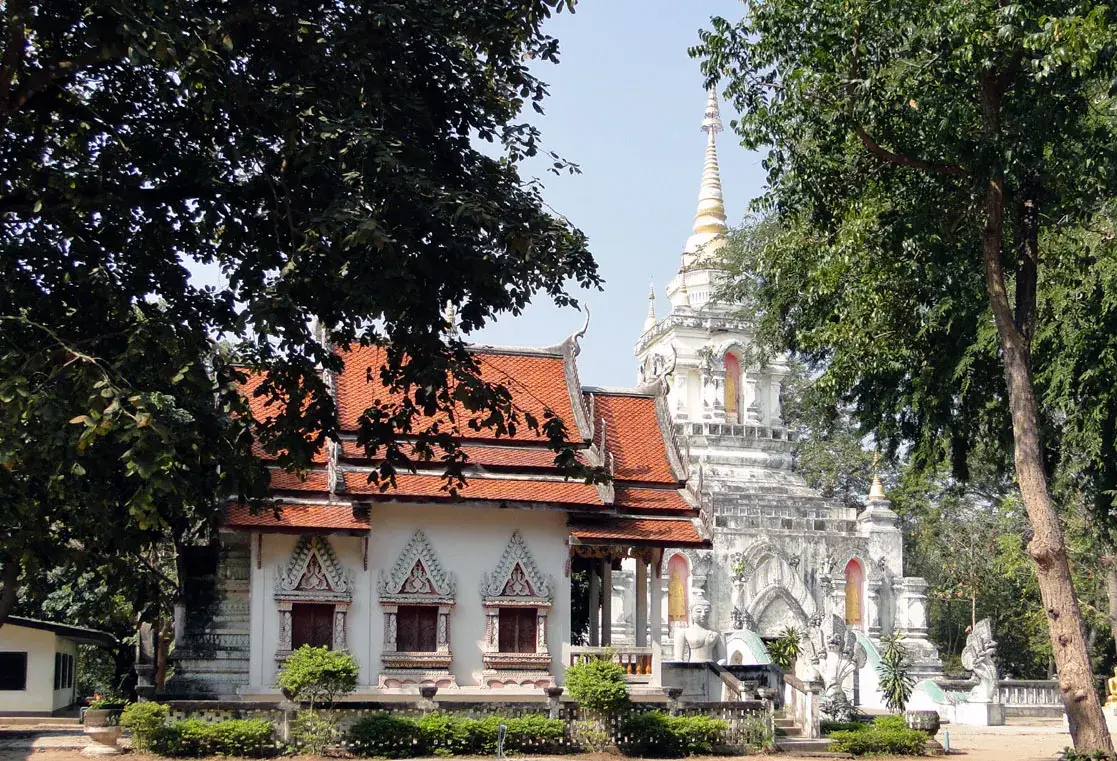
Wat Si Pan Ngoen is located at 133 Ban Sala, Moo 11, Yu Wa Subdistrict, San Pa Tong District, Chiang Mai Province. It is a local Mahanikaya Buddhist temple with important religious, educational, and local-historical roles. The temple was originally an abandoned temple called Wat Nong Pan Ngoen before the Ministry of Education elevated it to a temple with resident monks on September 18, 1969. It later developed into the present Wat Si Pan Ngoen, with Phra Khru Khantayaporn remembered as the key monk who restored the abandoned temple and helped bring it back into active religious use.
Wat Si Pan Ngoen is distinctive because its story is not limited to the revival of an abandoned temple. Local tradition also links the area with Wiang Tha Kan, describing it as a dependent settlement or frontier outpost of Wiang Tha Kan. Old accounts describe a surrounding wall, a central wooden cruciform viharn or Shan-style Thai Yai structure, and traces such as candlestick bases, stone, sand, and laterite. These layers give Wat Si Pan Ngoen a strong local-historical dimension.
The temple is located in Ban Sala, Moo 11, Yu Wa Subdistrict, an important area of San Pa Tong District. Nearby are San Pa Tong Wittayakhom School, San Pa Tong Hospital, community roads, and several old temples in Yu Wa, including Wat Makab Tong, Wat Rong Sran, Wat Si Koet, Wat San Pa Tong, Wat Ton Chok, Wat Ton Phueng, and Wat Ku Kham. Wat Si Pan Ngoen therefore belongs to a dense cultural landscape where religion, education, healthcare, roads, and community life are closely connected.
The temple land covers 42 rai, 1 ngan, and 40 square wah under Nor Sor 3 Kor document number 173, issued in 1978. This large area allows the temple to support many functions, including monastic residence, Buddhist education, merit-making, memorial rites, and community activities. The large temple area also fits the historical layers of an abandoned temple, a former fortified or frontier settlement, and later public land development in San Pa Tong.
The main temple structures include a merit-making hall, 22 monks’ residences, and Sala Ruam Jai, which was renovated in 1992. These buildings show that Wat Si Pan Ngoen is not only a worship site but also a monastic and educational center. The large number of monks’ residences reflects its capacity to support monks, novices, or Buddhist students, while the merit-making hall and Sala Ruam Jai support ceremonies and community gatherings.
Wat Si Pan Ngoen was originally known as Wat Nong Pan Ngoen, a name derived from a pond in the area. The pond contained 2 wells. Later, the water became shallow and salap grass covered the area, so local villagers also called it Nong Salap. This older name preserves the memory of the temple’s original water landscape, a common pattern in Lanna temple names that often refer to ponds, irrigation channels, trees, or landforms remembered by the community.
The temple’s deeper local tradition connects it with Wiang Tha Kan. Local accounts describe the area as a dependent settlement or frontier outpost of Wiang Tha Kan. It was said to have a surrounding wall and a central wooden cruciform viharn or Thai Yai-style structure. The temple was said to have been built in 757, with 2 founding lineages, Lua and Ngio, and with a Lua Wo group connected to local rulership at that time. These stories give the temple a wider historical imagination beyond its modern restoration.
References in local memory to candlestick bases, stone, sand, and laterite give the temple an additional material dimension. Laterite is often associated with old religious or settlement sites in northern Thailand. The story of laterite that continues to emerge every year adds a distinctive layer of local belief and cultural memory to Wat Si Pan Ngoen.
During its abandoned period, Phra Kham from Wat Ton Chok in Yu Wa Subdistrict came to stay at the site and intended to restore it as a temple. However, the effort did not succeed because a white-robed religious practice system was introduced, and the Buddhist holy days did not align with the accepted monastic calendar. This caused division among followers and required intervention by the Sangha authorities. The monk was later asked to leave the temple area.
Later, local education authorities informed the Sangha that a public land area of more than 3,000 rai was being divided for agricultural college use, a secondary school, and other government agencies. Within that land area was an abandoned temple. The San Pa Tong district Sangha authorities inspected the site and requested official approval to establish the temple. From that process, Wat Si Pan Ngoen was formally revived as a temple with resident monks.
Phra Khru Khantayaporn played an important role in this revival. He is remembered as the monk who restored the temple until it was elevated from an abandoned temple into a functioning temple with resident monks. Restoring an abandoned temple requires more than rebuilding structures. It requires religious leadership, community trust, coordination with the Sangha, and the ability to make the temple meaningful again for local people.
One of the temple’s major strengths is its educational role. Wat Si Pan Ngoen opened a Buddhist scripture school in 1975, a Pali section in 1976, and a general education section in 1993 under the name San Pa Tong Sueksa School. This makes the temple important not only as a place for worship but also as a learning space for monks, novices, and students connected with temple-based education.
The combination of Dhamma study, Pali study, and general education gives Wat Si Pan Ngoen a special role in San Pa Tong. It allows Buddhist learners to study religious knowledge together with modern academic subjects. This educational function is central to the temple’s identity and distinguishes it from smaller village temples that primarily serve local ritual needs.
San Pa Tong Sueksa School, opened as the general education section in 1993, is an important part of the temple’s history. It helped expand access to education for monks, novices, and learners within the temple system. This made Wat Si Pan Ngoen a temple that supports both Buddhism and broader community education.
The merit-making hall supports ceremonies, memorial rites, funeral-related activities, family merit-making, and community gatherings. In a village temple, this kind of hall connects religious practice with family and community life. It is where local people gather during important life events and Buddhist occasions.
The 22 monks’ residences make Wat Si Pan Ngoen larger in function than many small village temples. These residences support monks, novices, and temple-based students, allowing the temple to maintain daily religious routines and educational activities. They are an essential foundation for a temple with a strong learning role.
Sala Ruam Jai, renovated in 1992, reflects the shared faith of the community. The name means a hall of united hearts. It supports merit-making, meetings, community events, and religious gatherings. In the context of a temple restored from abandonment, this hall symbolizes the renewed life of Wat Si Pan Ngoen.
Wat Si Pan Ngoen is also connected with the route from Highway 108 toward the temple near San Pa Tong Hospital. This road connection makes the temple accessible from the main travel corridor of the district and connects it with schools, hospital facilities, and Ban Sala community life.
Although Wat Si Pan Ngoen was formerly called Wat Nong Pan Ngoen, the present Yu Wa Subdistrict also has another temple named Wat Nong Pan Ngoen. In this article, Wat Nong Pan Ngoen refers to the former name in the history of Wat Si Pan Ngoen, not the separate present-day temple of the same name in the same subdistrict.
Wat Si Pan Ngoen serves the community on several levels. Spiritually, it is a place for worship, merit-making, and reflection. Educationally, it supports Dhamma, Pali, and general education. Historically, it preserves stories of an abandoned temple, Wiang Tha Kan, Nong Pan Ngoen, Nong Salap, laterite, and its modern revival. Socially, it supports community gatherings, merit ceremonies, and memorial rites.
Religious events at Wat Si Pan Ngoen follow the rhythm of northern Thai village temple life. These include Buddhist holy days, Buddhist Lent, the end of Buddhist Lent, Kathin, Pha Pa, merit-making ceremonies, memorial rites, and educational activities. The merit-making hall, monks’ residences, and Sala Ruam Jai allow the temple to support these activities in an organized way.
Important things to see at Wat Si Pan Ngoen include the merit-making hall, Sala Ruam Jai, the large number of monks’ residences, the Buddhist education areas, and the historical layers from Wat Nong Pan Ngoen to Wat Si Pan Ngoen. Visitors interested in local history should pay attention to the temple’s stories about Wiang Tha Kan, the old pond, laterite, and the revival from an abandoned temple.
The temple is suitable for travelers interested in old temples, revived abandoned temples, Buddhist education, and temple routes in Yu Wa Subdistrict. It is located near Highway 108, San Pa Tong Hospital, San Pa Tong Wittayakhom School, and several other community temples, making it easy to include in a cultural itinerary.
Visitors should dress respectfully, speak quietly, and avoid entering monks’ private areas or educational buildings without permission. If classes, religious ceremonies, memorial rites, or temple activities are taking place, visitors should give priority to monks, students, and local residents. Wat Si Pan Ngoen is an active religious and educational site, so respectful conduct is essential.
Getting There is most convenient by private car, rental car, or local hired transport. From Chiang Mai city, take Highway 108, the Chiang Mai–Hot Road, toward San Pa Tong District. Continue into Yu Wa Subdistrict and Ban Sala, Moo 11. The temple is located at 133 Moo 11 near San Pa Tong Wittayakhom School and the route connected with San Pa Tong Hospital. When using a map application, search for “Wat Si Pan Ngoen Yu Wa San Pa Tong” to avoid confusion with the separate Wat Nong Pan Ngoen in the same subdistrict.
A suitable connected route begins at Wat Si Pan Ngoen and continues to Wat Makab Tong, Wat Rong Sran, Wat Si Koet, Wat San Pa Tong, Wat Ton Chok, Wat Ton Phueng, and the Yu Wa woodcarving craft center. For a broader historical route, visitors can continue to Ban Klang Subdistrict to visit Wat Sri Nawarat, Wat Tha Kan, and Wiang Tha Kan Archaeological Site.
Overall, Wat Si Pan Ngoen is an important temple of Yu Wa Subdistrict, San Pa Tong District, with religious, educational, and local-historical value. Its key strengths include its former identity as Wat Nong Pan Ngoen, its revival from an abandoned temple in 1969, its local stories connected with Wiang Tha Kan, its large temple land of 42 rai, 1 ngan, and 40 square wah, its merit-making hall, 22 monks’ residences, Sala Ruam Jai, Phra Khru Khantayaporn’s restoration role, and its Dhamma, Pali, and general education programs. It is suitable for travelers who want to understand Chiang Mai through Lanna village temples, temple-based education, and local community life in San Pa Tong.
| Name | Wat Si Pan Ngoen |
| Location | Ban Sala, Moo 11, Yu Wa Subdistrict, San Pa Tong District, Chiang Mai Province |
| Address | 133 Moo 11, Yu Wa Subdistrict, San Pa Tong District, Chiang Mai 50120, Thailand |
| Coordinates | Latitude 18.59481, Longitude 98.87300 |
| Highlights | A former abandoned temple once known as Wat Nong Pan Ngoen, revived as a temple with resident monks on September 18, 1969; connected with Wiang Tha Kan, a wooden cruciform or Thai Yai-style viharn tradition, laterite stories, a merit-making hall, 22 monks’ residences, Sala Ruam Jai, and temple-based Buddhist education |
| History | Originally an abandoned temple called Wat Nong Pan Ngoen; officially elevated to a temple with resident monks on September 18, 1969 and developed into the present Wat Si Pan Ngoen |
| Former Name | Wat Nong Pan Ngoen, with the old pond area also remembered as Nong Salap |
| Name Origin | The former name Wat Nong Pan Ngoen came from an old pond in the temple area, which had 2 wells; after the pond became shallow and salap grass covered it, the area was also called Nong Salap |
| Temple Land | Temple land covers 42 rai, 1 ngan, and 40 square wah under Nor Sor 3 Kor document number 173, issued in 1978 |
| Landscape | A large community temple in Ban Sala, Moo 11, Yu Wa Subdistrict, connected with San Pa Tong Wittayakhom School, San Pa Tong Hospital, community roads, and old temple routes in San Pa Tong |
| Main Areas / Zones | Merit-making hall, 22 monks’ residences, Sala Ruam Jai, Buddhist scripture school area, merit-making area, and community religious activity spaces |
| Important Structures | Merit-making hall, 22 monks’ residences, and Sala Ruam Jai renovated in 1992 |
| Sacred Objects / Local Evidence | Local stories mention candlestick bases, stone, sand, laterite, and traces linked with an older religious site connected with Wiang Tha Kan or a Wiang Tha Kan frontier outpost |
| Abbot / Restorer | Phra Khru Khantayaporn played the key role in restoring the abandoned temple until it was elevated to a temple with resident monks |
| Education / Community Role | Buddhist scripture school opened in 1975; Pali section opened in 1976; general education section opened in 1993 under the name San Pa Tong Sueksa School |
| Local Importance | A spiritual and educational center of Ban Sala, Moo 11, Yu Wa Subdistrict, linking temple restoration, local history, Buddhist education, and community life in San Pa Tong |
| Travel Information | Travel from Chiang Mai city via Highway 108, the Chiang Mai–Hot Road, toward San Pa Tong. Continue into Yu Wa Subdistrict and Ban Sala, Moo 11. Private car, rental car, or local hired transport is recommended. |
| Current Status | A registered Mahanikaya community temple serving Moo 11, Yu Wa Subdistrict |
| Open Days | Daily |
| Opening Hours | 08.00 – 17.00 |
| Main Contact Number | 053-824-034 |
| Facilities | Merit-making hall, monks’ residences, Sala Ruam Jai, merit-making area, educational area, and community religious activity spaces |
| Nearby Tourist Attractions | 1. Wat Makab Tong, about 1 km 2. Wat Rong Sran, about 2 km 3. Wat Si Koet, about 3 km 4. Wat San Pa Tong, about 4 km 5. Wat Ton Chok, about 5 km 6. Yu Wa Woodcarving Craft Center, about 6 km |
| Nearby Restaurants | 1. Tam Sang Phochana Near San Pa Tong Hospital, about 4 km, Tel. 093-154-8468 2. Nong Ple Made-To-Order Food Behind San Pa Tong Hospital, about 4 km, Tel. 095-467-7147 3. Naracha Chak San Pa Tong Branch, about 4 km, Tel. 093-209-8939 4. Khunnai Gallery San Pa Tong, about 4 km, Tel. 061-316-5599, 081-960-5911 5. Thoe Na Cha Chob Tam Sang San Pa Tong, about 5 km, Tel. 096-694-7277 6. Cafe Vintage1980 San Pa Tong, about 6 km, Tel. 096-084-0462 |
| Nearby Accommodations | 1. Non Bao Bao San Pa Tong Accommodation, about 4 km 2. Oxford Hotel, about 4 km, Tel. 091-069-9557 3. Fun Rak Resort, about 5 km, Tel. 061-936-4951 4. Home Thai Resort, about 5 km, Tel. 063-952-8228 5. Tai Resort Sanpatong, about 6 km, Tel. 063-096-7000 6. Kaomai Lanna Resort, about 8 km, Tel. 053-481-201 |
Frequently Asked Questions (FAQ)
Q: Where is Wat Si Pan Ngoen located?
A: Wat Si Pan Ngoen is located at 133 Ban Sala, Moo 11, Yu Wa Subdistrict, San Pa Tong District, Chiang Mai Province.
Q: What was the former name of Wat Si Pan Ngoen?
A: Wat Si Pan Ngoen was originally an abandoned temple called Wat Nong Pan Ngoen before being restored and elevated to a temple with resident monks on September 18, 1969.
Q: How is Wat Si Pan Ngoen connected with Wiang Tha Kan?
A: Local tradition describes the area as a dependent settlement or frontier outpost of Wiang Tha Kan, with stories of an old wall, wooden cruciform or Thai Yai-style viharn, laterite, stone, sand, and religious objects.
Q: What are the main things to see at Wat Si Pan Ngoen?
A: Key features include the merit-making hall, 22 monks’ residences, Sala Ruam Jai, Buddhist education areas, and the historical layers of the old abandoned temple site.
Q: Who played an important role in restoring Wat Si Pan Ngoen?
A: Phra Khru Khantayaporn played the key role in restoring the abandoned temple until it was elevated to a temple with resident monks.
Q: What educational role does Wat Si Pan Ngoen have?
A: The temple has a Buddhist scripture school opened in 1975, a Pali section opened in 1976, and a general education section opened in 1993 under the name San Pa Tong Sueksa School.
Q: How can travelers get to Wat Si Pan Ngoen?
A: Travelers can take Highway 108, the Chiang Mai–Hot Road, from Chiang Mai city toward San Pa Tong, then continue into Yu Wa Subdistrict and Ban Sala, Moo 11.
Q: What nearby places can be visited with Wat Si Pan Ngoen?
A: Nearby places include Wat Makab Tong, Wat Rong Sran, Wat Si Koet, Wat San Pa Tong, Wat Ton Chok, and the Yu Wa woodcarving craft center.
 Category: ●Places of Worship
 Group: ●Temple
Last Update : 2 MonthAgo
 Last Update : 2 MonthAgo
 Click to Access the Navigation Map GPS

 Muang Chiang Mai(121)Chom Thong(47)Mae Chaem(25)Chiang Dao(33)Doi Saket(68)Mae Taeng(85)Mae Rim(69)Samoeng(29)Fang(71)Mae Ai(59)Phrao(70)San Pa Tong(103)San Kamphaeng(66)San Sai(73)Hang Dong(73)Hot(32)Doi Tao(22)Omkoi(11)Saraphi(74)Wiang Haeng(15)Chai Prakan(28)Mae Wang(32)Mae On(22)Doi Lo(33)Galyani Vadhana(1)


