
lovethailand home >North Travel Attractions >Chiang Mai Travel Attractions >San Pa Tong >Ban Klang > Wat Sam Lang
TL;DR: Wat Sam Lang is located at Moo 8, Ban Klang Subdistrict, San Pa Tong District, Chiang Mai Province, open Daily, hours 08.00 – 17.00.

Wat Sam Lang
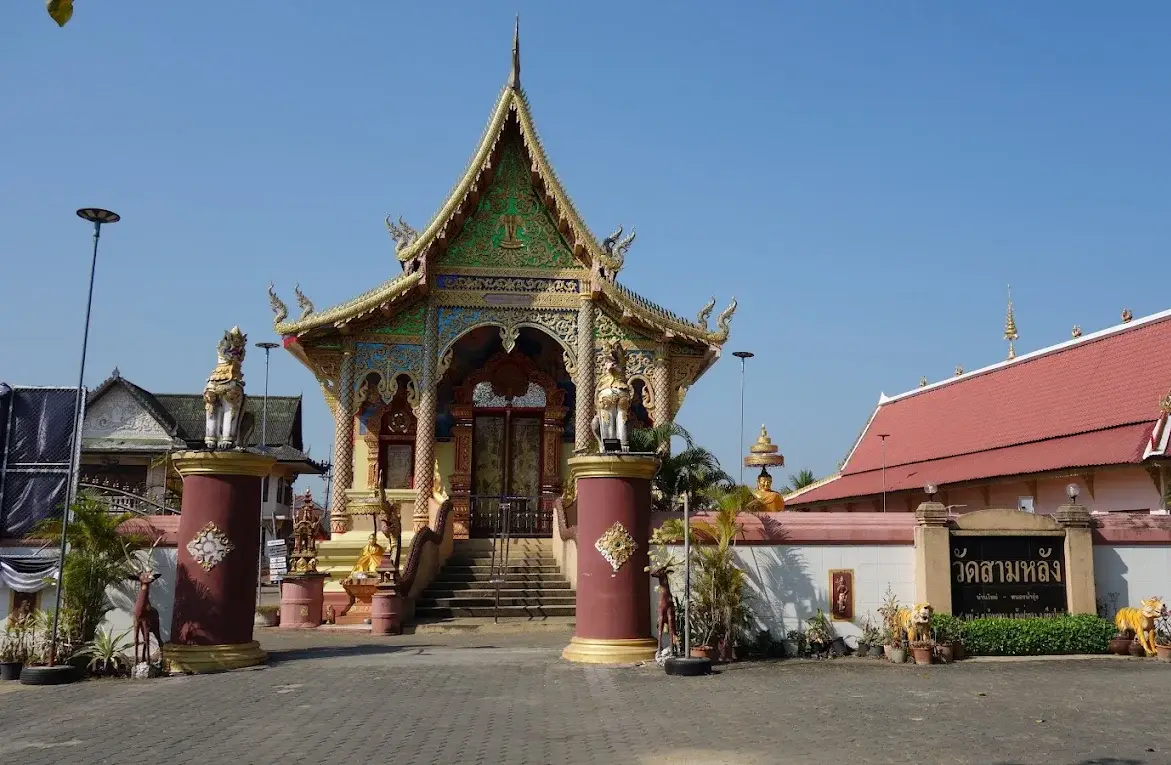
Open Days: Daily
Opening Hours: 08.00 – 17.00
Wat Sam Lang is located at 140 Moo 8, Ban Klang Subdistrict, San Pa Tong District, Chiang Mai Province. It is a local Mahanikaya Buddhist temple with a history rooted in the revival of an abandoned temple site. The temple was restored around 1776 and became an active community temple serving Ban Klang. Its importance lies in the way it reflects local faith, village cooperation, and the continuity of Buddhist practice in the cultural landscape of southern Chiang Mai.
Wat Sam Lang is a quiet village temple rather than a large commercial tourist attraction. Its value comes from its long community history, its restored religious status, and its practical role in village life. The temple contains an ordination hall, viharn, sermon hall, monks’ residences, merit-making hall, bell tower, dining hall, newspaper-reading pavilion, storage pavilion, principal Buddha image, several Buddha images, and a stupa built in 1953. These features make Wat Sam Lang a meaningful destination for travelers who want to understand Lanna village temples in a local context.
The temple originally existed as an abandoned site before being restored around 1776. In northern Thai history, an abandoned temple did not always lose its sacred meaning completely. Many old temple sites remained in community memory and were later revived when villagers rebuilt structures, invited monks, and resumed Buddhist activities. Wat Sam Lang is therefore an example of a temple that returned to active use through local faith and community effort.
The period around 1776 was a time when many communities in Lanna were recovering from long periods of political and social change. Village temples played an important role in this recovery because they were centers of worship, gathering, education, and identity. Restoring Wat Sam Lang was therefore more than repairing a religious site. It also represented the re-establishment of community life in Ban Klang.
Wat Sam Lang received its royal consecrated boundary, or Wisungkhamsima, around 1776. The consecrated boundary measures 10 meters wide and 20 meters long, and the boundary ceremony was completed around the same period. In Thai Buddhist practice, the Wisungkhamsima is essential for formal monastic ceremonies, including ordination and Sangha acts. Its presence confirms the temple’s formal religious status and its ability to serve the monastic needs of the community.
The abbot of Wat Sam Lang is Phra Athikan Phaisan Charuwanno. In a village temple, the abbot plays an important role in caring for religious buildings, maintaining monastic discipline, organizing ceremonies, guiding lay supporters, and preserving the relationship between the temple and local residents. This leadership allows Wat Sam Lang to remain an active religious center rather than only a historical location.
The temple land covers 3 rai, 1 ngan, and 76 square wah under title deed number 63680. To the north, the temple borders a public path. To the south, it borders an irrigation channel. To the east, it borders a school field. To the west, it borders a public path. The temple also has 2 plots of monastic land covering 2 rai, 3 ngan, and 92 square wah in Ban Klang Subdistrict. These boundaries show that the temple is closely connected with public routes, a school, irrigation, and everyday village life.
The eastern side of the temple borders a school field, giving Wat Sam Lang an important community and educational context. In many northern Thai villages, temples and schools have long been closely connected. Before modern schools became widespread, temples were centers of learning. Even today, a temple located near a school often remains connected with moral education, ceremonies, youth activities, and community events.
The southern boundary of the temple connects with an irrigation channel. In northern Thai communities, irrigation channels are not merely waterways; they are part of the agricultural system that supports rice fields, village cooperation, and local livelihoods. Wat Sam Lang’s location near an irrigation channel shows how the temple belongs to a wider landscape of water, farming, village paths, and community organization.
The ordination hall of Wat Sam Lang measures 6 meters wide and 12 meters long and was renovated in 1981. Its structure follows a Thai architectural form. The ordination hall is one of the most important buildings because it is directly connected with the consecrated boundary and formal monastic ceremonies. The renovation of this building shows that the community continued to maintain and renew the temple long after its initial revival.
The sermon hall measures 8 meters wide and 27 meters long and was built in 1995 in Thai style. It is used for listening to sermons, merit-making, meetings, and community activities. In a village temple, the sermon hall is both practical and symbolic. It connects monks and laypeople and provides a flexible space for religious and social functions.
The viharn measures 8 meters wide and 18 meters long and was built in 1957. It is the main devotional space where villagers come to pay respect to the principal Buddha image, make merit, listen to sermons, and join Buddhist ceremonies. In Lanna village temples, the viharn is often the building most closely connected with everyday religious life because it is regularly used by laypeople.
Wat Sam Lang has 2 monks’ residences: 1 wooden building and 1 building combining half-concrete, half-wood construction with masonry. These buildings support the residence and religious practice of monks. Their mixed materials reflect the practical development of community temples, combining traditional wood construction with stronger modern materials.
The temple has 1 concrete merit-making hall used for memorial rites, funeral ceremonies, merit-making, and family-related Buddhist activities. It also has a bell tower, dining hall, newspaper-reading pavilion, and storage pavilion. These buildings show that Wat Sam Lang is not only a place for worship but also a community space used for information, gathering, meals, ceremonies, and practical temple work.
The sacred objects of Wat Sam Lang include the principal Buddha image in the viharn, 1 Buddha image in the sermon hall, 1 Buddha image in the ordination hall, 1 metal Buddha image in the merit-making hall made in 1995, and 1 stupa built in 1953. These sacred objects are central to worship and merit-making. They also give the temple a layered religious identity across different periods of renewal.
The stupa built in 1953 is one of the important features to observe. In a northern Thai temple, a stupa is a major Buddhist symbol and a focus of devotion. For Wat Sam Lang, the stupa also represents the continuity of faith after the temple’s revival from an abandoned site. Visitors should view it as part of the temple’s historical and devotional story.
The principal Buddha image in the viharn is another important object of devotion. The viharn is where villagers gather for merit-making, sermons, and ceremonies, so the principal Buddha image acts as the spiritual center of the space. Paying respect to the principal Buddha image connects visitors with the temple’s living religious role and the faith of the Ban Klang community.
Wat Sam Lang serves the Ban Klang community on several levels. Spiritually, it is a place for worship, merit-making, and peaceful reflection. Ritually, it supports Buddhist ceremonies, ordination-related functions, memorial events, and merit-making. Socially, it is a gathering place for local residents. Culturally, it preserves the memory of an abandoned temple that was revived through community faith and continues to serve village life.
Religious events at Wat Sam Lang follow the rhythm of northern Thai Buddhist village life. These include Buddhist holy days, Buddhist Lent, the end of Buddhist Lent, Kathin, Pha Pa, merit-making ceremonies, memorial rites, and village activities. The viharn, sermon hall, merit-making hall, ordination hall, dining hall, and bell tower allow these events to take place in an organized way.
The atmosphere of Wat Sam Lang is calm and local. It is suitable for travelers interested in old temples, Lanna village culture, community temple restoration, irrigation landscapes, school-temple relationships, and cultural routes in Ban Klang. The temple is best appreciated slowly, by observing how the buildings and spaces connect with village roads, the school field, the irrigation channel, and the wider Ban Klang community.
Important things to see at Wat Sam Lang include the ordination hall renovated in 1981, the viharn built in 1957, the sermon hall built in 1995, the stupa built in 1953, the bell tower, dining hall, newspaper-reading pavilion, storage pavilion, and Buddha images in the viharn, ordination hall, sermon hall, and merit-making hall. The temple’s strength is not grandeur but its completeness as a working village temple.
Visitors should dress respectfully, speak quietly, and avoid entering monks’ private areas without permission. If a merit-making ceremony, funeral rite, or community event is taking place, visitors should give priority to local people and follow temple etiquette. This is especially important at active village temples where the temple remains part of everyday community life.
Wat Sam Lang can be included in a cultural route through Ban Klang Subdistrict. Nearby places include Wat San Hao, Wat Ton Kok, Wat Tha Kan, Wat Sri Nawarat, Wat Pa Sak, Wat Phra Chao Thong Thip, and Wiang Tha Kan Archaeological Site. This route helps visitors understand Ban Klang as an area of old temples, village communities, irrigation systems, school-temple relationships, rice fields, and ancient remains.
Wiang Tha Kan is an important archaeological site in Ban Klang Subdistrict. It contains traces of an ancient settlement, moats, earthen walls, old temple sites, stupas, viharn bases, and archaeological evidence from several periods. Combining Wat Sam Lang with Wiang Tha Kan gives travelers a broader view of San Pa Tong, from living village temples to the deeper historical landscape of the area.
Getting There is most convenient by private car, rental car, or local hired transport. From Chiang Mai city, take Highway 108, also known as the Chiang Mai–Hot Road, toward San Pa Tong District. Continue into Ban Klang Subdistrict and Moo 8, where Wat Sam Lang is located. When using a map application, search for “Wat Sam Lang Ban Klang San Pa Tong” to avoid confusion with similarly named places.
Daytime travel is recommended because the temple is located within a local village setting. A half-day route can include Wat Sam Lang, Wat San Hao, Wat Ton Kok, Wat Tha Kan, and Wiang Tha Kan. A longer route can continue to Wat Sri Nawarat, Wat Pa Sak, and Wat Phra Chao Thong Thip for a fuller understanding of Ban Klang’s temple landscape.
Overall, Wat Sam Lang is a meaningful old community temple of Ban Klang. Its key elements include its revival from an abandoned temple around 1776, its consecrated boundary, ordination hall, viharn, sermon hall, monks’ residences, merit-making hall, bell tower, dining hall, newspaper-reading pavilion, storage pavilion, Buddha images, and stupa built in 1953. It is a suitable destination for travelers who want to understand Chiang Mai through village temples and the local faith of San Pa Tong.
| Name | Wat Sam Lang |
| Location | Moo 8, Ban Klang Subdistrict, San Pa Tong District, Chiang Mai Province |
| Address | 140 Moo 8, Ban Klang Subdistrict, San Pa Tong District, Chiang Mai 50120, Thailand |
| Highlights | An old Ban Klang community temple restored from an abandoned temple site around 1776, with an ordination hall, viharn, sermon hall, bell tower, dining hall, newspaper-reading pavilion, storage pavilion, several Buddha images, and a stupa built in 1953 |
| History | Originally an abandoned temple; restored around 1776 and returned to active use as a community temple of Ban Klang |
| Consecrated Boundary | Granted around 1776; the Wisungkhamsima measures 10 meters wide and 20 meters long; boundary ceremony completed around the same period |
| Temple Land | Temple land covers 3 rai, 1 ngan, and 76 square wah under title deed number 63680; the temple also has 2 monastic land plots covering 2 rai, 3 ngan, and 92 square wah |
| Boundaries | North: public path; South: irrigation channel; East: school field; West: public path |
| Landscape | Flat temple grounds within Ban Klang community, connected with a school field, irrigation channel, public paths, and local village life |
| Main Areas / Zones | Ordination hall, viharn, sermon hall, monks’ residences, merit-making hall, bell tower, dining hall, newspaper-reading pavilion, storage pavilion, Buddha-image areas, and stupa area |
| Important Structures | Ordination hall measuring 6 by 12 meters, renovated in 1981 in Thai style; viharn measuring 8 by 18 meters, built in 1957; sermon hall measuring 8 by 27 meters, built in 1995 in Thai style |
| Other Buildings | 2 monks’ residences, including 1 wooden building and 1 mixed half-concrete, half-wood and masonry building; 1 concrete merit-making hall; bell tower; dining hall; newspaper-reading pavilion; and storage pavilion |
| Sacred Objects | Principal Buddha image in the viharn, 1 Buddha image in the sermon hall, 1 Buddha image in the ordination hall, 1 metal Buddha image in the merit-making hall made in 1995, and 1 stupa built in 1953 |
| Abbot / Caretaker | Phra Athikan Phaisan Charuwanno |
| Local Importance | A community temple of Ban Klang that reflects the revival of an abandoned temple site and the relationship between temple, school, irrigation channel, and village routes |
| Travel Information | Travel from Chiang Mai city via Highway 108, the Chiang Mai–Hot Road, toward San Pa Tong. Continue into Ban Klang Subdistrict and Moo 8. Private car, rental car, or local hired transport is recommended. |
| Current Status | A registered Mahanikaya community temple serving Moo 8, Ban Klang Subdistrict |
| Open Days | Daily |
| Opening Hours | 08.00 – 17.00 |
| Facilities | Ordination hall, viharn, sermon hall, merit-making hall, monks’ residences, bell tower, dining hall, newspaper-reading pavilion, storage pavilion, and community religious activity areas |
| Nearby Tourist Attractions | 1. Wat San Hao, about 2 km 2. Wat Ton Kok, about 3 km 3. Wat Tha Kan, about 3 km 4. Wiang Tha Kan Archaeological Site, about 3 km 5. Wat Sri Nawarat, about 5 km 6. Wat Pa Sak, about 5 km |
| Nearby Restaurants | 1. Five Star 7-Eleven Ban Thaen Thong, about 1 km, Tel. 086-306-2240 2. Cafe Vintage1980 San Pa Tong, about 3 km, Tel. 096-084-0462 3. Kuai Tiao Ton Kok, about 3 km, Tel. 092-872-6536 4. Baan Plai Suan Restaurant San Pa Tong, about 4 km, Tel. 063-847-3142, 093-321-0885, 062-541-2652 5. Nam Fai Restaurant, about 4 km, Tel. 093-231-3988, 080-124-0002 6. Thoe Na Cha Chob Tam Sang San Pa Tong, about 5 km, Tel. 096-694-7277 |
| Nearby Accommodations | 1. Kaomai Lanna Resort, about 4 km, Tel. 053-481-201, 086-428-7481 2. Huen Hom Kham Homestay, about 5 km, Tel. 086-183-1327 3. Mor-Nu Apartment, about 6 km, Tel. 091-464-7896 4. Tai Resort Sanpatong, about 7 km, Tel. 063-096-7000 5. Bannoi Himsuan, about 8 km, Tel. 090-329-6108 6. Baan Suan Kaew Huen Kham @ San Pa Tong, about 9 km, Tel. 081-366-2382 |
Frequently Asked Questions (FAQ)
Q: Where is Wat Sam Lang located?
A: Wat Sam Lang is located at 140 Moo 8, Ban Klang Subdistrict, San Pa Tong District, Chiang Mai Province.
Q: What is the main historical story of Wat Sam Lang?
A: Wat Sam Lang was originally an abandoned temple and was restored around 1776, returning to active use as a community temple of Ban Klang.
Q: When did Wat Sam Lang receive its consecrated boundary?
A: Wat Sam Lang received its Wisungkhamsima around 1776. The boundary measures 10 meters wide and 20 meters long, and the boundary ceremony was completed around the same period.
Q: What are the main things to see at Wat Sam Lang?
A: Key features include the ordination hall, viharn, sermon hall, bell tower, dining hall, newspaper-reading pavilion, storage pavilion, principal Buddha image, several Buddha images, and the stupa built in 1953.
Q: Who is the abbot of Wat Sam Lang?
A: The abbot of Wat Sam Lang is Phra Athikan Phaisan Charuwanno.
Q: Why is Wat Sam Lang important to the local community?
A: It is a spiritual center of Moo 8 in Ban Klang and is closely connected with a school field, irrigation channel, public village routes, and the cultural temple route of the Wiang Tha Kan area.
Q: How can travelers get to Wat Sam Lang?
A: Travelers can take Highway 108, the Chiang Mai–Hot Road, from Chiang Mai city toward San Pa Tong, then continue into Ban Klang Subdistrict and Moo 8.
Q: What nearby places can be visited with Wat Sam Lang?
A: Nearby places include Wat San Hao, Wat Ton Kok, Wat Tha Kan, Wiang Tha Kan Archaeological Site, Wat Sri Nawarat, and Wat Pa Sak.
 Category: ●Places of Worship
 Group: ●Temple
Last Update : 2 MonthAgo
 Last Update : 2 MonthAgo

 Click to Access the Navigation Map GPS
Wat Sam Lang Map
Recommend

 Muang Chiang Mai(121)Chom Thong(47)Mae Chaem(25)Chiang Dao(33)Doi Saket(68)Mae Taeng(85)Mae Rim(69)Samoeng(29)Fang(71)Mae Ai(59)Phrao(70)San Pa Tong(103)San Kamphaeng(66)San Sai(73)Hang Dong(73)Hot(32)Doi Tao(22)Omkoi(11)Saraphi(74)Wiang Haeng(15)Chai Prakan(28)Mae Wang(32)Mae On(22)Doi Lo(33)Galyani Vadhana(1)


