
lovethailand home >North Travel Attractions >Chiang Mai Travel Attractions >San Pa Tong >Ban Klang > Wat Sri Nawarat
TL;DR: Wat Sri Nawarat is located at Ban Thung Siao, Moo 3, Ban Klang Subdistrict, San Pa Tong District, Chiang Mai Province, open Daily, hours 08.00 – 17.00.

Wat Sri Nawarat
Open Days: Daily
Opening Hours: 08.00 – 17.00
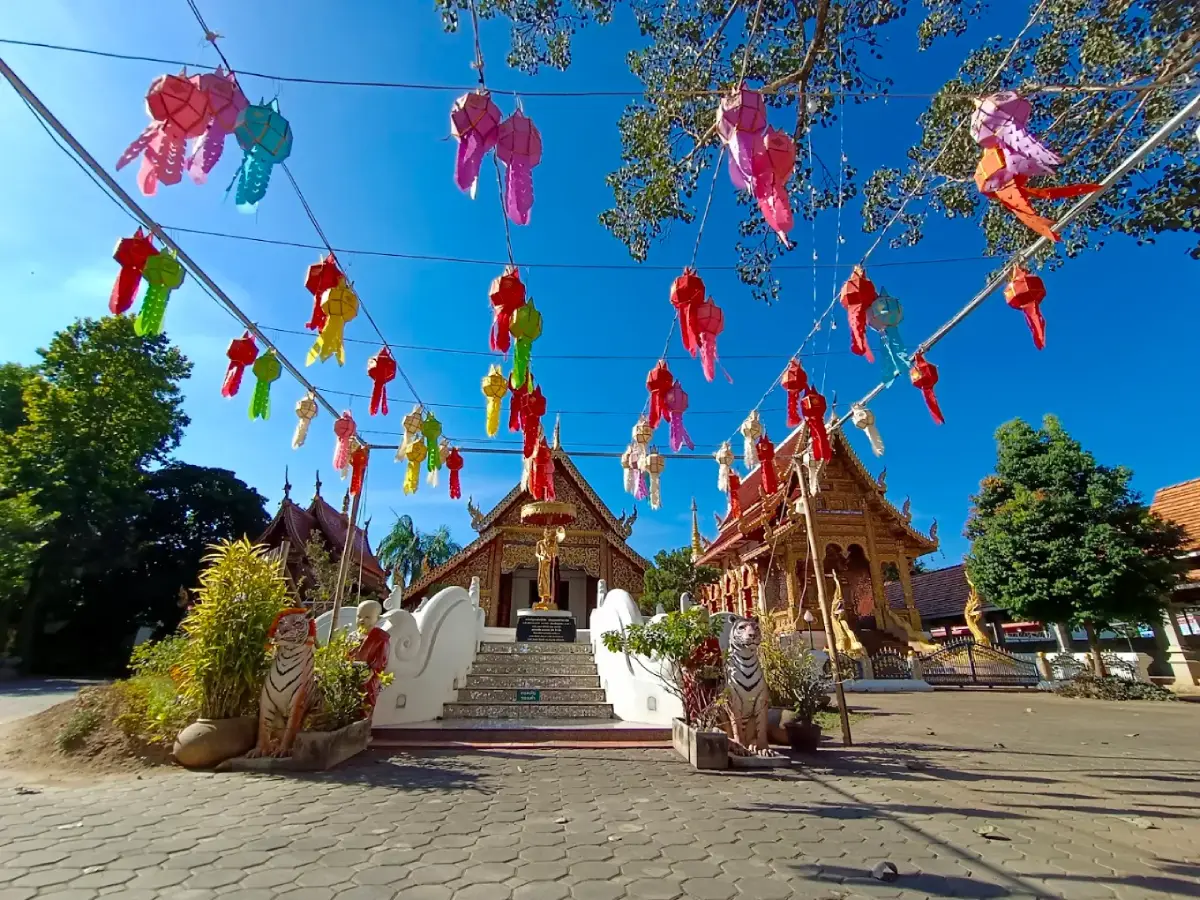
Wat Sri Nawarat, also known locally as Wat Thung Siao, is located at 266 Ban Thung Siao, Moo 3, Ban Klang Subdistrict, San Pa Tong District, Chiang Mai Province. The temple stands along the Chiang Mai–Hot Road around kilometer markers 29–30 and belongs to the Mahanikaya Buddhist order. It is one of the most important community temples in Ban Thung Siao, a village strongly connected with Tai Khuen identity, Lanna cultural memory, Prince Kaew Nawarat, Princess Dara Rasmi, and the historic cultural landscape of Ban Klang and Wiang Tha Kan.
Wat Sri Nawarat is more than a local village temple. It preserves several layers of history, including the older temple known as Wat Luang Thung Siao, the movement and settlement of Tai Khuen people in the Lanna region, the restoration of the temple under Prince Kaew Nawarat, the sacred teakwood Buddha image known as Phra Chao Aklong, and the grand temple celebration held in 1921. For visitors interested in old temples, northern Thai history, Tai Khuen culture, and Lanna Buddhist traditions, this temple is one of the most meaningful places in San Pa Tong.
The temple covers about 2 rai and 3 ngan and is supported by approximately 500 households in Ban Thung Siao. Within the temple grounds are an ordination hall, Lanna-style viharn, sermon hall, monks’ residences, merit-making halls, sacred Buddha images, an old sermon pulpit, ritual objects, old manuscript chests, a large bell, a traditional fingernail-dance drum, and cultural elements connected with the Tai Khuen community. These features make the temple both a living Buddhist site and a cultural learning place.
The older temple is recorded as having been built in 1602. It was associated with the name Wat Luang Thung Siao and later became known as Wat Sri Nawarat after Prince Kaew Nawarat restored and supported the temple. The period in which the older temple emerged overlaps with a difficult era in Lanna history, when the region was under Burmese influence. Later, during the revival of Chiang Mai, the temple and the village gained renewed significance through local faith and royal patronage.
Ban Thung Siao is closely associated with Tai Khuen people from Chiang Tung. After the campaigns and population movements in the period of Prince Kawila, people from regions such as Chiang Rung, Chiang Tung, Muang Yong, Muang Tha, Muang Tuan, Muang Hang, and Muang Sat were brought into Lanna. Many villagers in Thung Siao are linked with Tai Khuen heritage. Wat Sri Nawarat therefore functions not only as a Buddhist temple but also as a center of language, ritual, dance, music, and community identity.
The former temple stood in front of the present temple area. When Prince Kaew Nawarat renovated the temple, a new road was cut from the Chiang Mai–Hot Road directly toward the present viharn. The new road aligned with the old Buddha pedestal of the former temple, so elephants were used to remove some of the older structures. For this reason, clear remains of the old temple no longer survive in the visible landscape, but its memory continues through oral history, sacred objects, and local traditions.
The most important sacred object of Wat Sri Nawarat is Phra Chao Aklong, also known as Phra Chao Sak Khong Tan. It is a teakwood Buddha image measuring 32 inches across the lap and 56 inches high. The image had been left at the old temple site since the time of war. Prince Kaew Nawarat later invited the image from the old location, restored it, and enshrined it in the new viharn. Today, Phra Chao Aklong is regarded as a sacred Buddha image of Ban Thung Siao and a central object of community devotion.
The importance of Phra Chao Aklong lies not only in its age or teakwood material, but also in its role as a bridge between the old temple, the wartime past, the revival of local faith, and the restoration led by Prince Kaew Nawarat. Every year on the waxing 10th day of the northern ninth lunar month, the community holds the bathing ceremony for Phra Chao Aklong. This annual tradition is one of the temple’s most distinctive religious events.
One of the most significant events in the temple’s history was the grand celebration of the new viharn in 1921. Before the celebration, Prince Kaew Nawarat ordered a new road to be cut directly to the temple and invited Phra Chao Aklong to be enshrined in the new viharn. The celebration was attended by Prince Kaew Nawarat, Princess Dara Rasmi, members of the northern royal family, nobles, officials, and local villagers. The event turned Wat Sri Nawarat into a major religious and social center of the region.
During this celebration, sacred relics from Wat Phra That Si Chom Thong were invited to the ceremony. A procession of war elephants carried the relics from Wat Ton Hae Luang to Wat Sri Nawarat on the waxing 14th day of the fifth lunar month. Chao Noi Phrom organized the procession, and the leading elephant was Pu Chai Ban, a highly intelligent elephant remembered in local stories. The procession included several elephants and soldiers dressed in ancient red warrior costumes, with villagers welcoming the procession along the route.
The following day, the waxing 15th day of the fifth lunar month, marked the opening of the new viharn celebration and was also regarded in Lanna belief as the day when the relics came out of their retreat period. Princess Dara Rasmi was the first to bathe the relics, followed by Prince Kaew Nawarat. The celebration included lanterns, flags, offerings, Lanna music, drums, processions, sword dances, Tai Yai dances, boxing, and the fingernail dance of Thung Siao villagers. This event remains one of the most important cultural memories associated with the temple.
Wat Sri Nawarat is closely connected with the fingernail dance tradition of Ban Thung Siao. Prince Kaew Nawarat arranged for villagers to train in dance at the royal residence in Chiang Mai so they could perform during the grand temple celebration. The fingernail-dance drum was arranged by Khru Ba Thoem, also known as Khru Ba Sopha of Wat Saen Fang. The drum has been preserved and restored, making the temple a meaningful place for understanding Lanna performing arts as well as Buddhist tradition.
The ordination hall of Wat Sri Nawarat is a brick-and-plaster structure with mural paintings depicting the story of Phra Suthon and Nang Manora. These murals add artistic and literary value to the temple. Visitors interested in Lanna mural painting should take time to observe the narrative scenes, colors, characters, and artistic details that reflect local Buddhist storytelling and northern Thai visual culture.
The viharn of Wat Sri Nawarat is in Lanna style and is one of the temple’s most important spaces. The older viharn was remembered as a large cruciform structure with 3 entrances, a grand front staircase, naga balustrades, and a clay-tile roof. When the old viharn became severely damaged, Phra Athikan Bunma and the community decided to dismantle it. Later, Phra Duang Tip continued construction of a new viharn, making it smaller than the original because the community’s resources were limited at that time.
The sermon hall and other temple buildings support Buddhist teaching, merit-making, ceremonies, and community gatherings. Wat Sri Nawarat also preserves several important Buddhist objects, including wooden Buddha images, a Sukhothai-style meditation Buddha image, a Chiang Saen-style Mara-vijaya Buddha image, an ornate sermon pulpit, ritual candle stands, altar pieces, and old manuscript chests. These objects show the temple’s role as a keeper of Buddhist art and Lanna religious heritage.
The Tai Khuen cultural dimension is another reason Wat Sri Nawarat is important. The temple and surrounding community preserve memory through language, dance, ritual objects, local stories, and village identity. The temple is linked with a Tai Khuen museum and local learning activities, allowing visitors to understand how Buddhism and ethnic-cultural heritage are woven together in Ban Thung Siao.
The current abbot of Wat Sri Nawarat is Phra Khru Winaithon Suthep Thanawaro. In a community temple with such a long history, the abbot’s role includes caring for the temple, preserving Buddhist practice, supporting local ceremonies, maintaining the relationship between monks and villagers, and helping safeguard traditions such as the Phra Chao Aklong bathing ceremony, the fingernail dance, and local merit-making events.
The temple serves Ban Thung Siao on several levels. Spiritually, it is a place for worship, merit-making, and Buddhist practice. Socially, it is a gathering place for around 500 households. Culturally, it preserves Tai Khuen heritage, Lanna dance, Lanna music, annual ceremonies, and community festivals. Historically, it connects Prince Kaew Nawarat, Princess Dara Rasmi, Prince Kawila’s era, and the wider history of Wiang Tha Kan and Ban Klang.
Important things to see at Wat Sri Nawarat include Phra Chao Aklong, the Lanna-style viharn, the ordination hall with murals of Phra Suthon and Nang Manora, the old sermon pulpit, manuscript chests, ritual objects, the large bell, the fingernail-dance drum, and cultural elements connected with the Tai Khuen community. Visitors who take time to observe the temple carefully will see that it combines art, history, ritual, and living community faith.
The temple atmosphere is calm but deeply meaningful. Although it is located beside a main road, the temple still feels like a village religious center. It is suitable for visitors interested in old temples, Lanna history, Tai Khuen communities, royal patronage in northern Thailand, temple festivals, and cultural routes in San Pa Tong. Visitors should dress respectfully, speak quietly, and avoid disturbing monks or local ceremonies.
Key traditions at Wat Sri Nawarat include the Phra Chao Aklong bathing ceremony on the waxing 10th day of the northern ninth lunar month, flower-offering traditions, Kathin, Pha Pa, Buddhist holy days, Buddhist Lent, the end of Buddhist Lent, and community merit-making events. The temple is also connected with Kad Kom Kong Tiao, the 100-year cultural walking street of Ban Thung Siao, where visitors can experience local food, traditional dress, community crafts, and village culture.
Getting There is convenient by private car, rental car, or local hired transport. From Chiang Mai city, take Highway 108, the Chiang Mai–Hot Road, toward San Pa Tong District. Continue to Ban Thung Siao, Moo 3, Ban Klang Subdistrict, around kilometer markers 29–30. When using a map application, search for “Wat Sri Nawarat Thung Siao San Pa Tong” to avoid confusion with similarly named places.
A suitable connected route is the Ban Thung Siao–Ban Klang–Wiang Tha Kan cultural route. Visitors can begin at Wat Sri Nawarat, continue to Kad Kom Kong Tiao, then visit Wat Ton Kok, Wat Pa Sak, Wat Tha Kan, Wat Phra Chao Thong Thip, Wat Puang Sanuk, and Wiang Tha Kan Archaeological Site. This route offers a rich view of old temples, Tai Khuen culture, local food, village craftsmanship, and ancient historical remains in San Pa Tong.
Overall, Wat Sri Nawarat is one of the most important cultural temples in Ban Klang. Its value comes from the connection between Buddhist faith, Tai Khuen identity, Prince Kaew Nawarat, Princess Dara Rasmi, Phra Chao Aklong, the 1921 temple celebration, Lanna performing arts, and the living community of Ban Thung Siao. It is a strong destination for travelers who want to understand Chiang Mai through old village temples, local history, and the cultural depth of San Pa Tong.
| Name | Wat Sri Nawarat, Also Known As Wat Thung Siao |
| Location | Ban Thung Siao, Moo 3, Ban Klang Subdistrict, San Pa Tong District, Chiang Mai Province |
| Address | 266 Ban Thung Siao, Moo 3, Ban Klang Subdistrict, San Pa Tong District, Chiang Mai 50120, Thailand |
| Coordinates | Latitude 18.5632183, Longitude 98.8671766 |
| Highlights | A historic Ban Thung Siao temple connected with Prince Kaew Nawarat, Tai Khuen culture, Phra Chao Aklong, the 1921 grand viharn celebration, and Ban Klang’s cultural route |
| History | The older temple was built in 1602 and was associated with the name Wat Luang Thung Siao before being restored and renamed Wat Sri Nawarat by Prince Kaew Nawarat |
| Former Name / Local Name | Wat Luang Thung Siao / Wat Thung Siao |
| Temple Area | About 2 rai and 3 ngan, supported by around 500 local households in Ban Thung Siao |
| Consecrated Boundary | Granted on August 2, 1946 under the name Wat Sri Naowarat; the Wisungkhamsima measures 10 meters wide and 18 meters long |
| Main Areas / Zones | Ordination hall, Lanna-style viharn, sermon hall, monks’ residences, merit-making halls, Phra Chao Aklong area, large bell, fingernail-dance drum, and Tai Khuen museum area |
| Important Structures | Brick-and-plaster ordination hall with murals of Phra Suthon and Nang Manora, Lanna-style viharn, sermon hall, monks’ residences, and 2 merit-making halls |
| Sacred Objects | Phra Chao Aklong, a teakwood Buddha image measuring 32 inches across the lap and 56 inches high; wooden Buddha images, Sukhothai-style meditation Buddha image, Chiang Saen-style Mara-vijaya Buddha image, ornate sermon pulpit, ritual candle stands, altar pieces, and old manuscript chests |
| Important Traditions | Phra Chao Aklong bathing ceremony on the waxing 10th day of the northern ninth lunar month, flower-offering traditions, grand temple celebrations, Kathin, Pha Pa, Buddhist holy days, Buddhist Lent, and the end of Buddhist Lent |
| Abbot / Caretaker | Phra Khru Winaithon Suthep Thanawaro |
| Local Importance | A spiritual center of Ban Thung Siao, an important Tai Khuen cultural site, and a key temple on the Ban Klang–Wiang Tha Kan cultural route |
| Travel Information | Travel from Chiang Mai city via Highway 108, the Chiang Mai–Hot Road, toward San Pa Tong. The temple is in Ban Thung Siao, Moo 3, Ban Klang Subdistrict, around kilometer markers 29–30. |
| Current Status | A registered Mahanikaya community temple and an active religious center of Ban Thung Siao |
| Open Days | Daily |
| Opening Hours | 08.00 – 17.00 |
| Main Contact Number | 053-829-277 |
| Facilities | Ordination hall, viharn, sermon hall, merit-making halls, monks’ residences, religious activity areas, and parking space near the temple frontage |
| Nearby Tourist Attractions | 1. Kad Kom Kong Tiao Ban Thung Siao Cultural Walking Street, about 0.2 km 2. Kaomai Estate 1955, about 2 km 3. Wat Ton Kok, about 3 km 4. Wat Pa Sak, about 4 km 5. Wat Tha Kan, about 5 km 6. Wiang Tha Kan Archaeological Site, about 5 km |
| Nearby Restaurants | 1. Five Star Ban Thung Siao, about 0.5 km, Tel. 082-621-6752, 084-987-3060 2. Miracle Coffee By Coffee House Thung Siao, about 0.5 km, Tel. 094-708-0290 3. Miss Donut San Pa Tong, about 1 km, Tel. 089-553-4664 4. Cafe Vintage1980 San Pa Tong, about 2 km, Tel. 096-084-0462 5. Moo Krob Phi Bao Thung Siao, about 2 km, Tel. 093-264-9059 6. Healthy Club Kad Thung Siao, about 1 km, Tel. 081-961-4620 |
| Nearby Accommodations | 1. Kaomai Lanna Resort, about 2 km, Tel. 053-481-201, 086-428-7481 2. Huen Hom Kham Homestay, about 5 km, Tel. 086-183-1327 3. Tai Resort Sanpatong, about 7 km, Tel. 063-096-7000 4. Bannoi Himsuan, about 8 km, Tel. 090-329-6108 5. Muan Jai Hotel, about 9 km, Tel. 081-884-7545 6. Baan Suan Kaew Huen Kham @ San Pa Tong, about 9 km, Tel. 081-366-2382 |
Frequently Asked Questions (FAQ)
Q: Where is Wat Sri Nawarat located?
A: Wat Sri Nawarat is located at 266 Ban Thung Siao, Moo 3, Ban Klang Subdistrict, San Pa Tong District, Chiang Mai Province, along the Chiang Mai–Hot Road around kilometer markers 29–30.
Q: What was the former name of Wat Sri Nawarat?
A: The temple was formerly associated with the name Wat Luang Thung Siao and is still commonly known locally as Wat Thung Siao. It was later restored and renamed Wat Sri Nawarat by Prince Kaew Nawarat.
Q: How is Wat Sri Nawarat connected with Prince Kaew Nawarat?
A: Prince Kaew Nawarat restored the temple, invited Phra Chao Aklong to be enshrined in the new viharn, supported the grand temple celebration, and gave the temple the name Wat Sri Nawarat.
Q: What is Phra Chao Aklong?
A: Phra Chao Aklong is a sacred teakwood Buddha image measuring 32 inches across the lap and 56 inches high. It is regarded as a highly important Buddha image of Ban Thung Siao.
Q: What important traditions are held at Wat Sri Nawarat?
A: Important traditions include the Phra Chao Aklong bathing ceremony on the waxing 10th day of the northern ninth lunar month, flower-offering traditions, grand temple celebrations, Kathin, Pha Pa, and Buddhist holy day ceremonies.
Q: What kind of traveler is Wat Sri Nawarat suitable for?
A: It is suitable for travelers interested in old temples, Lanna culture, northern Thai history, Tai Khuen communities, royal patronage, temple festivals, and cultural routes in San Pa Tong.
Q: How can travelers get to Wat Sri Nawarat?
A: Travelers can take Highway 108, the Chiang Mai–Hot Road, from Chiang Mai city toward San Pa Tong, then continue to Ban Thung Siao, Moo 3, Ban Klang Subdistrict.
Q: What nearby places can be visited with Wat Sri Nawarat?
A: Nearby places include Kad Kom Kong Tiao, Kaomai Estate 1955, Wat Ton Kok, Wat Pa Sak, Wat Tha Kan, and Wiang Tha Kan Archaeological Site.
 Category: ●Places of Worship
 Group: ●Temple
Last Update : 2 MonthAgo
 Last Update : 2 MonthAgo
 Click to Access the Navigation Map GPS
Wat Sri Nawarat Map
Recommend

 Muang Chiang Mai(121)Chom Thong(47)Mae Chaem(25)Chiang Dao(33)Doi Saket(68)Mae Taeng(85)Mae Rim(69)Samoeng(29)Fang(71)Mae Ai(59)Phrao(70)San Pa Tong(103)San Kamphaeng(66)San Sai(73)Hang Dong(73)Hot(32)Doi Tao(22)Omkoi(11)Saraphi(74)Wiang Haeng(15)Chai Prakan(28)Mae Wang(32)Mae On(22)Doi Lo(33)Galyani Vadhana(1)


