
lovethailand home >North Travel Attractions >Chiang Mai Travel Attractions >San Pa Tong >Ban Klang > Wat Pa Sak
TL;DR: Wat Pa Sak is located at Ban Pa Sak, Moo 9, Ban Klang Subdistrict, San Pa Tong District, Chiang Mai Province, open Daily, hours 08.00 – 17.00.

Wat Pa Sak
Open Days: Daily
Opening Hours: 08.00 – 17.00
Wat Pa Sak is located at 1 Chiang Mai–Hot Road, Ban Pa Sak, Moo 9, Ban Klang Subdistrict, San Pa Tong District, Chiang Mai Province. It is a local Mahanikaya Buddhist temple founded in 1724 and remains an important community temple of Ban Pa Sak. The temple’s identity is closely tied to its original landscape, as its name comes from an area once covered with teak trees. Wat Pa Sak is therefore meaningful not only as a place of worship, but also as a record of local memory, village settlement, agricultural life, and the cultural landscape of southern Chiang Mai.
The history of Wat Pa Sak began when the temple was founded in 1724. Its name reflects the original environment of the temple grounds, which were once associated with teak forest. The temple was first established as a monastery with 2 monks and 8 novices. As the number of monks and novices increased, the community built a viharn, which took about 5 years to complete. This development shows the typical growth of a Lanna village temple, where religious buildings emerged gradually through the combined faith of monks, novices, and local villagers.
Phra Aphai appears in the recorded history of the temple as an abbot who cared for Wat Pa Sak for about 35 rains retreats before passing away at the temple. His role was important in the early development of the monastery. In a village temple, an abbot is not only a religious leader but also a caretaker of the temple grounds, a guide for lay supporters, and a central figure in sustaining Buddhist practice within the community.
Wat Pa Sak was supported by approximately 30 local households. This detail is important because it shows the temple’s character as a true village temple. Small community temples rely on the faith and participation of nearby households for merit-making, building maintenance, ceremonies, and seasonal Buddhist activities. Wat Pa Sak therefore grew together with Ban Pa Sak and reflects the long relationship between temple and village.
The temple land covers 12 rai, 1 ngan, and 11 square wah under Sor Kor 1 document number 764. To the north, the temple borders a village lane. To the south, it borders rice fields. To the east, it borders rice fields. To the west, it borders local houses. The temple also has 1 plot of monastic land covering 1 rai, 1 ngan, and 25 square wah in Ban Klang Subdistrict. These boundaries show how deeply the temple is embedded in the local landscape of lanes, fields, houses, and agricultural land.
The temple grounds are located on low flat land and are surrounded by roads on all 4 sides. The north side faces a road and village area. The east side faces a road through the fields and the main Chiang Mai–Hot Road. The south side faces a field road. The west side faces rice fields and the village. This setting makes Wat Pa Sak easily accessible while still preserving the character of a rural village temple.
The Chiang Mai–Hot Road, or Highway 108, is a major route connecting Chiang Mai city with San Pa Tong and other southern districts of Chiang Mai Province. Since Wat Pa Sak is located along this route, it is convenient for travelers who want to visit a quiet village temple while exploring Ban Klang, San Pa Tong, or the cultural route connected with Wiang Tha Kan.
Ban Pa Sak is also part of the cultural landscape associated with Tai Khuen communities in San Pa Tong. Local information connects Ban Pa Sak with groups that preserve or historically relate to Khuen language and cultural identity in the Mae Khan River basin. This gives Wat Pa Sak an additional cultural dimension. It is not only a Buddhist temple but also a community marker within a wider local cultural network.
In discussions of Tai Khuen communities in San Pa Tong, Ban Pa Sak is mentioned among the “Khuen Ko–Khuen Dae” group, together with communities such as Ban Dong Kam, Ban Thung Siao, Ban Ton Hae Noi, Ban Ton Hae Luang, Ban Pa Lan, and Ban Tha Duea. This relationship helps explain why Wat Pa Sak should be understood together with its village context, local language, memory, and community identity.
The name Wat Pa Sak preserves the memory of the old teak forest. Teak has long been important in northern Thailand for houses, temples, tools, and local construction. Naming the temple after the teak forest therefore reflects more than a natural feature. It records the way villagers remembered the original landscape before the area developed into homes, fields, roads, and a settled community.
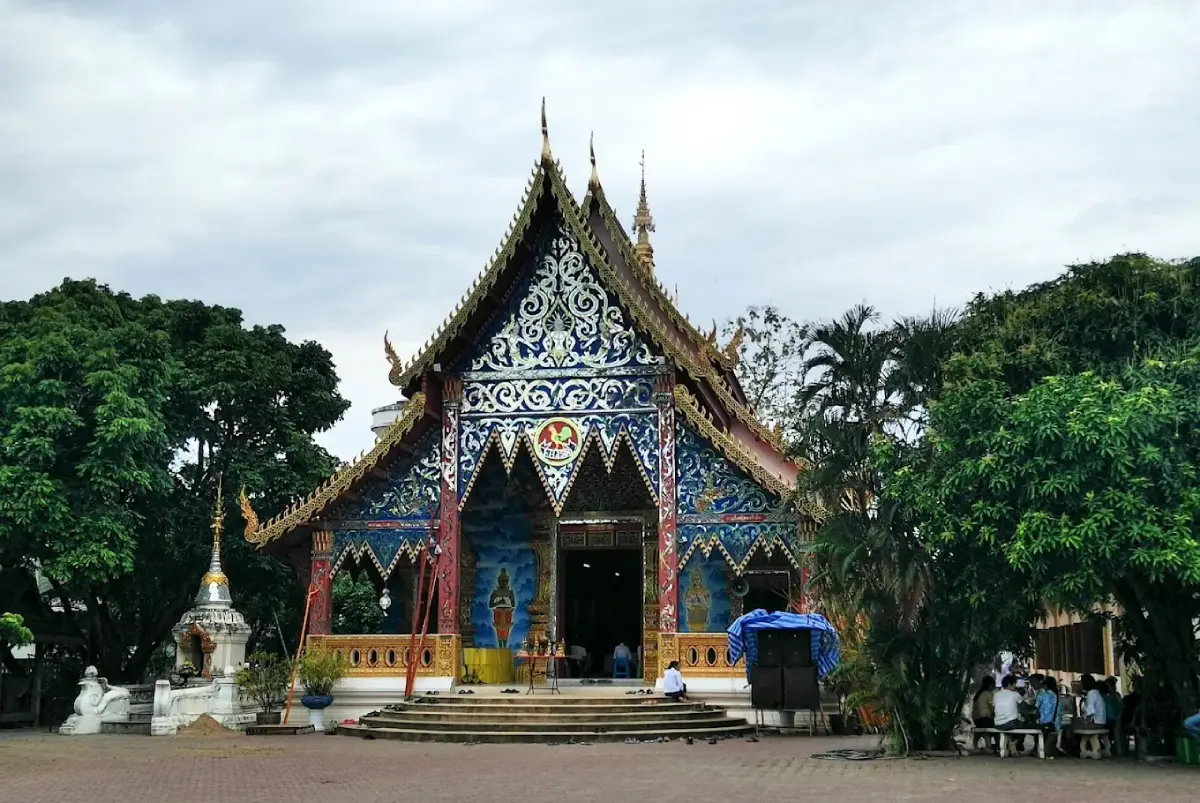
The religious buildings of Wat Pa Sak include a sermon hall, monks’ residences, a viharn, and merit-making halls. The sermon hall was built in 1992 in Lanna style and is used for religious teaching, gatherings, temple activities, and merit-making. The temple has 2 monks’ residences: one wooden building and one half-concrete, half-wood building. These structures reflect the practical building style of many northern Thai village temples.
The viharn of Wat Pa Sak measures 11 meters wide and 23 meters long and was built in 1957. The viharn is one of the most important buildings in the temple because it is where villagers come to pay respect to Buddha images, make merit, listen to sermons, and take part in Buddhist ceremonies. In a Lanna community temple, the viharn is often the building most closely connected with everyday devotional life.
Wat Pa Sak also has 2 concrete merit-making halls. These halls are used for community merit-making, memorial ceremonies, funeral rites, and gatherings that require shared space. In northern village temples, merit-making halls are essential because religious events often involve extended families, neighbors, food preparation, and collective participation by the community.
The available historical information does not clearly specify an ordination hall, stupa, principal Buddha image, or other sacred objects at Wat Pa Sak. For this reason, the temple is best presented through the elements that are directly supported: the viharn, Lanna-style sermon hall, monks’ residences, merit-making halls, temple land, community history, and the origin of its name from the old teak forest.
Wat Pa Sak is also connected with modern cultural memory through Ajarn Nen Wiset Singkham and sacred objects made around 1976, which made the temple known among people interested in northern Thai amulets and protective objects. This aspect is part of the temple’s wider cultural memory, although the main value of Wat Pa Sak as a travel and cultural site remains its identity as a village temple, community religious center, and historical marker of Ban Pa Sak.
The role of Wat Pa Sak in the Ban Pa Sak community can be seen on several levels. Spiritually, it is a place for villagers to make merit, pray, and seek peace. Ritually, it supports Buddhist ceremonies, merit-making, and memorial events. Socially, it is a gathering place for the village. Culturally, it preserves the memory of the teak landscape, local settlement, village identity, and the relationship between the temple and Tai Khuen cultural heritage in San Pa Tong.
Religious events at Wat Pa Sak follow the general pattern of northern Thai Buddhist village life. These include Buddhist holy days, Buddhist Lent, the end of Buddhist Lent, Kathin, Pha Pa, merit-making ceremonies, memorial rites, and community events. The temple’s sermon hall, merit-making halls, and viharn allow these activities to take place in an organized way and support the relationship between monks, villagers, and lay supporters.
Important things to see at Wat Pa Sak include the viharn built in 1957, the Lanna-style sermon hall built in 1992, the monks’ residences, the merit-making halls, and the quiet village atmosphere near the Chiang Mai–Hot Road, fields, and local homes. The temple’s value lies in its simplicity and authenticity rather than large-scale grandeur.
Wat Pa Sak is suitable for travelers interested in old temples, Lanna community temples, Ban Klang village life, and cultural routes in San Pa Tong. It is best visited during the daytime, either as a short temple stop or as part of a wider route including nearby temples and Wiang Tha Kan. Visitors should view the temple together with its village setting, not as an isolated tourist site.
Visitors should dress respectfully, speak quietly, and avoid entering monks’ private areas without permission. If a funeral, merit-making event, or village ceremony is taking place, visitors should give priority to local people and follow temple etiquette. This is especially important at active village temples, where the temple remains part of daily community life.
Wat Pa Sak can be included in a cultural route through Ban Klang Subdistrict. Nearby sites include Wat Phra Chao Thong Thip, Wat Ton Kok, Wat Tha Kan, Wat Puang Sanuk, Wat Rong Than, and Wiang Tha Kan Archaeological Site. This route allows visitors to see both living community temples and ancient remains connected with the Hariphunchai and Lanna historical landscape.
Wiang Tha Kan is an important archaeological site in Ban Klang Subdistrict, with remains of an ancient city, moats, earthen walls, old temple sites, stupas, and other archaeological traces. Combining Wat Pa Sak with Wiang Tha Kan gives travelers a broader understanding of San Pa Tong, from active village temples to ancient city heritage.
Getting There is most convenient by private car, rental car, or local hired transport. From Chiang Mai city, take Highway 108, also known as the Chiang Mai–Hot Road, toward San Pa Tong District. Continue to Ban Pa Sak, Moo 9, Ban Klang Subdistrict. When using a map application, search for “Wat Pa Sak Ban Klang San Pa Tong” to avoid confusion with other temples of the same name in other provinces.
Daytime travel is recommended because the temple is in a local community area with roads, fields, and homes nearby. A half-day route can include Wat Pa Sak, Wat Ton Kok, Wat Tha Kan, or Wiang Tha Kan. A longer route can add Wat Puang Sanuk, Wat Phra Chao Thong Thip, and Wat Rong Than for a fuller view of Ban Klang’s temple and cultural landscape.
Overall, Wat Pa Sak is a meaningful old temple of Ban Klang with religious, community, and cultural value. Its key elements include its founding in 1724, the origin of its name from the old teak forest, the growth of the temple through the support of monks, novices, and villagers, the viharn built in 1957, the Lanna-style sermon hall built in 1992, and its setting along the Chiang Mai–Hot Road among fields and village homes. It is a suitable destination for travelers who want to understand Chiang Mai through village temples, Lanna culture, and the quieter side of San Pa Tong.
| Name | Wat Pa Sak |
| Location | Ban Pa Sak, Moo 9, Ban Klang Subdistrict, San Pa Tong District, Chiang Mai Province |
| Address | 1 Chiang Mai–Hot Road, Ban Pa Sak, Moo 9, Ban Klang Subdistrict, San Pa Tong District, Chiang Mai 50120, Thailand |
| Highlights | An old Ban Pa Sak community temple founded in 1724; its name comes from an original teak forest landscape, with a viharn, Lanna-style sermon hall, monks’ residences, and merit-making halls |
| History | Founded in 1724; originally developed as a monastery with 2 monks and 8 novices before the community built a viharn that took about 5 years to complete |
| Name Origin | The temple was named Wat Pa Sak because the original temple area was associated with teak forest |
| Temple Land | Temple land covers 12 rai, 1 ngan, and 11 square wah under Sor Kor 1 document number 764; the temple also has 1 monastic land plot covering 1 rai, 1 ngan, and 25 square wah |
| Boundaries | North: village lane; South: rice fields; East: rice fields; West: local houses |
| Landscape | The temple is on low flat land with roads on all 4 sides, close to the Chiang Mai–Hot Road, rice fields, village roads, and local homes |
| Main Areas / Zones | Viharn, sermon hall, monks’ residences, merit-making halls, and community religious activity areas |
| Important Structures | Viharn measuring 11 by 23 meters, built in 1957; Lanna-style sermon hall built in 1992; 2 monks’ residences; and 2 concrete merit-making halls |
| Abbot In Temple History | Phra Aphai is recorded in the temple history as an abbot who cared for the temple for about 35 rains retreats |
| Local Importance | An old community temple of Ban Pa Sak, connected with local faith, agricultural life, the Chiang Mai–Hot Road, and the cultural landscape of Ban Klang |
| Travel Information | Travel from Chiang Mai city along Highway 108, the Chiang Mai–Hot Road, toward San Pa Tong. Continue to Ban Pa Sak, Moo 9, Ban Klang Subdistrict. Private car, rental car, or local hired transport is recommended. |
| Current Status | A registered Mahanikaya community temple serving Ban Pa Sak |
| Open Days | Daily |
| Opening Hours | 08.00 – 17.00 |
| Facilities | Sermon hall, monks’ residences, viharn, merit-making halls, and community religious activity spaces |
| Nearby Tourist Attractions | 1. Wat Phra Chao Thong Thip, about 3 km 2. Wat Ton Kok, about 4 km 3. Wat Tha Kan, about 4 km 4. Wiang Tha Kan Archaeological Site, about 4 km 5. Wat Puang Sanuk, about 5 km 6. Wat Rong Than, about 5 km |
| Nearby Restaurants | 1. Po Liang Bistro San Pa Tong, about 1 km, Tel. 053-481-201, 086-428-7481, 099-276-2880 2. Five Star 7-Eleven Ban Thaen Thong, about 3 km, Tel. 086-306-2240 3. Thoe Na Cha Chob Tam Sang San Pa Tong, about 5 km, Tel. 096-694-7277 4. Cafe Vintage1980 San Pa Tong, about 5 km, Tel. 096-084-0462 5. Lake View @ San Pa Tong, about 7 km, Tel. 097-079-8448 6. Saming Cha Cafe, about 7 km, Tel. 095-447-0110 |
| Nearby Accommodations | 1. Kaomai Lanna Resort, about 1 km, Tel. 053-481-201 2. Mae Khan Pool Villa, about 3 km, Tel. 086-831-9164 3. Huen Hom Kham Homestay, about 5 km, Tel. 086-183-1327 4. Bannoi Himsuan, about 8 km, Tel. 090-329-6108 5. Baan Suan Kaew Huen Kham @ San Pa Tong, about 9 km, Tel. 081-366-2382 6. Mor-Nu Apartment, about 5 km, Tel. 091-464-7896 |
Frequently Asked Questions (FAQ)
Q: Where is Wat Pa Sak located?
A: Wat Pa Sak is located at 1 Chiang Mai–Hot Road, Ban Pa Sak, Moo 9, Ban Klang Subdistrict, San Pa Tong District, Chiang Mai Province.
Q: When was Wat Pa Sak founded?
A: Wat Pa Sak was founded in 1724. It began as a monastery and later developed through the support of monks, novices, and local villagers.
Q: Why is the temple called Wat Pa Sak?
A: The name comes from the original landscape of the temple area, which was once associated with teak forest.
Q: What are the main things to see at Wat Pa Sak?
A: Key things to see include the viharn built in 1957, the Lanna-style sermon hall, monks’ residences, merit-making halls, and the quiet village-temple atmosphere near the Chiang Mai–Hot Road.
Q: Why is Wat Pa Sak important to the local community?
A: It is a spiritual center of Ban Pa Sak and supports Buddhist ceremonies, merit-making, memorial events, and the community’s relationship with local village life and agriculture.
Q: What kind of traveler is Wat Pa Sak suitable for?
A: It is suitable for travelers interested in old temples, Lanna village culture, Ban Klang community life, Tai Khuen cultural context, and routes connected with Wiang Tha Kan.
Q: How can travelers get to Wat Pa Sak?
A: Travelers can take Highway 108, the Chiang Mai–Hot Road, from Chiang Mai city toward San Pa Tong, then continue to Ban Pa Sak, Moo 9, Ban Klang Subdistrict.
Q: What nearby places can be visited with Wat Pa Sak?
A: Nearby places include Wat Phra Chao Thong Thip, Wat Ton Kok, Wat Tha Kan, Wat Puang Sanuk, Wat Rong Than, and Wiang Tha Kan Archaeological Site.
 Category: ●Places of Worship
 Group: ●Temple
Last Update : 2 MonthAgo
 Last Update : 2 MonthAgo
 Click to Access the Navigation Map GPS

 Muang Chiang Mai(121)Chom Thong(47)Mae Chaem(25)Chiang Dao(33)Doi Saket(68)Mae Taeng(85)Mae Rim(69)Samoeng(29)Fang(71)Mae Ai(59)Phrao(70)San Pa Tong(103)San Kamphaeng(66)San Sai(73)Hang Dong(73)Hot(32)Doi Tao(22)Omkoi(11)Saraphi(74)Wiang Haeng(15)Chai Prakan(28)Mae Wang(32)Mae On(22)Doi Lo(33)Galyani Vadhana(1)


