
lovethailand home >North Travel Attractions >Chiang Mai Travel Attractions >San Pa Tong >Thung Satok > Wat Rong Som Poi
TL;DR: Wat Rong Som Poi is located at Ban Rong Som Poi, Village No. 4, Thung Satok Subdistrict, San Pa Tong District, Chiang Mai Province. Highlights include Community temple of Ban Rong Som Poi with religious, educational, and village-centered roles in Thung Satok.

Wat Rong Som Poi
Operating day: Daily
Operating time: 08.00 - 17.00
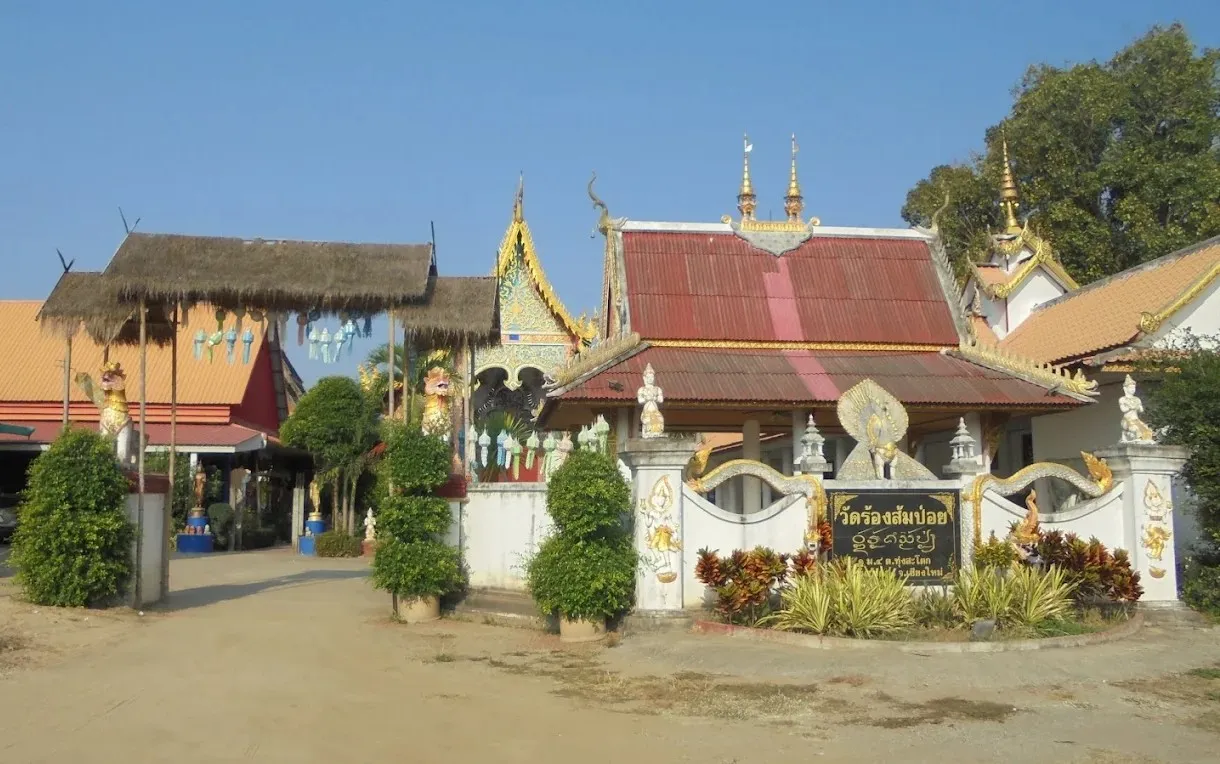
Wat Rong Som Poi is a community Buddhist temple located at No. 1, Village No. 4, Ban Rong Som Poi, Thung Satok Subdistrict, San Pa Tong District, Chiang Mai Province. It belongs to the Mahanikaya monastic order and is one of the temples that helps define the religious and social landscape of Thung Satok. The temple was first built in 1881 and was officially established as a temple on 11 October 1935. With temple land covering 2 rai, 3 ngan, and 70 square wah, plus one monastic land plot of 1 rai, 1 ngan, and 94 square wah, Wat Rong Som Poi remains a meaningful spiritual, educational, and community center for Ban Rong Som Poi.
The name Wat Rong Som Poi is closely tied to Ban Rong Som Poi, the village where the temple is located. In northern Thai place names, “rong” often evokes a channel, watercourse, or low-lying water-related area, while “som poi” refers to a locally meaningful plant used in Thai and Lanna culture. The temple’s name therefore carries a strong sense of local landscape and cultural memory. It is not just a formal temple name; it also reflects the relationship between the village, waterways, plants, and the community’s identity.
The temple boundaries are especially important for understanding its setting. To the north, the temple borders a canal for about 20 meters. To the south, it borders an irrigation channel for about 3 meters. To the east, it borders the Khan River for 10 meters, and to the west it borders a school for 5 meters. These boundaries show that Wat Rong Som Poi stands at the intersection of water, education, and village life. The presence of a school beside the temple also highlights the long-standing relationship between Buddhist temples and local learning in Thai communities.
The history of Wat Rong Som Poi began in 1881, before it was officially established as a temple on 11 October 1935. This development reflects a common pattern among community temples in northern Thailand. Many temples began as local faith-based religious spaces created by villagers, then gradually developed into formally recognized temples with monastic structures, land, and a clear role in community life. Wat Rong Som Poi represents this evolution from local devotion into a stable religious institution serving Ban Rong Som Poi and the surrounding area.
Ban Rong Som Poi is part of Thung Satok Subdistrict, a locality with many village temples. Nearby temple names in the subdistrict include Wat Don Kaeo, Wat Talat Kaeo, Wat Tha Champi, Wat Tha Sa, Wat Thung Kiang, Wat Prasat, Wat Pa Chi, Wat Pa Mai Daeng, Wat Si Bun Rueang, Wat Sawang Arom, and Wat Hua Rin. This concentration of temples shows how deeply Buddhism is woven into the settlement structure of Thung Satok. Wat Rong Som Poi is therefore part of a wider network of village temples that preserve the religious rhythm of the subdistrict.
The temple land of Wat Rong Som Poi covers 2 rai, 3 ngan, and 70 square wah under Nor Sor 3 Kor document No. 1094. The temple also has one monastic land plot covering 1 rai, 1 ngan, and 94 square wah. This land foundation gives the temple a stable base for religious ceremonies, monastic life, education-related activities, and community gatherings. In a village temple, land is not only a physical resource; it supports the continuity of Buddhist practice and the temple’s role as a shared public-religious space.
The monastic structures at Wat Rong Som Poi include a viharn, monks’ residence, salabat hall, sermon hall, chanting hall and dining hall, small surrounding pavilions, and kitchen. Together, these buildings allow the temple to support a full range of Buddhist and community functions. The viharn is the main worship hall. The monks’ residence supports monastic life. The salabat hall supports food offerings and merit-making. The sermon hall hosts Dhamma talks and larger gatherings. The chanting hall and dining hall support monastic routines, while the kitchen and pavilions help serve community events and temple festivals.
The viharn is the most important area for visitors to observe respectfully. In a Lanna community temple, the viharn is the heart of worship, where villagers pay respect to the Buddha, listen to teachings, receive precepts, and take part in ceremonies on Buddhist holy days. Although confirmed details about the principal Buddha image or interior artwork are not available, the function of the viharn as the temple’s central sacred space is clear. Visitors should approach it quietly and treat it as an active worship space.
The monks’ residence is essential because Wat Rong Som Poi functions as a living temple rather than a purely historical site. Monks’ quarters support residence, study, practice, and daily religious work. In a village setting, resident monks help local people make merit, receive blessings, listen to Dhamma teachings, and take part in Buddhist ceremonies throughout the year. The monks’ residence therefore supports the temple’s continuity as a working spiritual center.
The salabat hall and kitchen show the community side of temple life. In Lanna Buddhist culture, food offerings, shared meals, and collective preparation are central to merit-making. During Buddhist holy days, Kathin, robe-offering ceremonies, Buddhist Lent activities, or village merit-making events, villagers often work together to prepare food for monks and participants. The kitchen turns religious devotion into practical cooperation, while the salabat hall helps organize offerings and communal participation.
The sermon hall is a flexible and important community space. It can be used for Dhamma talks, meetings, ceremonies, and events with larger groups of people. In a village temple, the sermon hall is often one of the most familiar places for local residents because it brings together elders, families, lay supporters, and young people. It is both a religious space and a social space, supporting the temple’s role beyond individual worship.
The chanting hall and dining hall are closely connected with monastic life. The chanting hall supports prayer, meditation, and Buddhist practice, while the dining hall supports the daily meal routines of monks. These spaces help the temple maintain order in its daily religious life and show that Wat Rong Som Poi is structured to support both ceremony and regular monastic practice.
The small surrounding pavilions provide additional space for lay supporters during ceremonies and temple events. Such pavilions often serve as resting areas, waiting areas, or support spaces during busy merit-making days. Their presence helps the temple welcome more participants and makes religious events more comfortable for the community.
Wat Rong Som Poi has a strong educational role. The temple opened a preschool training center in 1979 and a Buddhist Sunday School in 1992. These educational functions make the temple more than a merit-making site. The preschool training center supports early childhood learning in the community, while the Buddhist Sunday School helps children and youth learn Buddhist teachings, moral conduct, temple etiquette, and cultural values. This educational dimension is one of the temple’s most important features.
The temple’s location next to a school further strengthens its connection with learning. In many Thai communities, temples and schools have long worked side by side. The school supports general education, while the temple supports ethics, culture, religious knowledge, and community identity. Wat Rong Som Poi’s educational centers show how the temple contributes to the development of younger generations in Ban Rong Som Poi and Thung Satok.
The known abbot of Wat Rong Som Poi is Phra Athikan Lum. In a community temple, an abbot’s role is broader than managing buildings. The abbot helps guide religious practice, maintain monastic order, coordinate with lay supporters, and support ceremonies and community activities. Because Wat Rong Som Poi has multiple monastic structures and educational functions, the temple depends on cooperation among monks, villagers, school-related groups, and caretakers.
Wat Rong Som Poi serves as a spiritual center for Ban Rong Som Poi. It supports daily merit-making, Buddhist observances, sermons, annual festivals, Kathin, robe-offering ceremonies, Buddhist Lent, the end of Buddhist Lent, memorial merit-making, and community gatherings. This is the essence of a Lanna village temple: it is not separate from daily life but woven into the emotional, religious, and social life of the community.
From a Lanna cultural perspective, Wat Rong Som Poi is significant because it brings together water, education, religion, and village cooperation. The surrounding waterways show the agricultural and ecological context of the community. The nearby school and temple education centers show the learning dimension. The monastic buildings show the continuation of Buddhist practice. Together, these elements make Wat Rong Som Poi a temple with strong social depth, not merely a place for a quick visit.
The atmosphere of Wat Rong Som Poi is best suited for travelers who appreciate quiet community temples and local cultural context. It is not a large commercial tourist attraction. Its value lies in its village setting, long history, educational role, and continued use by the community. Visitors can see how a temple functions as a sacred space, a learning place, and a community gathering point in rural Chiang Mai.
Important areas to observe include the viharn, sermon hall, salabat hall, monks’ residence, chanting hall and dining hall, small pavilions, kitchen, and temple courtyard. Each area represents a different function of the temple. The viharn supports worship. The sermon hall supports teaching and gatherings. The salabat hall and kitchen support merit-making. The monks’ residence and chanting hall support monastic life. The pavilions and courtyard support community participation.
Visitors should dress respectfully, speak quietly, avoid disturbing monastic areas, and refrain from entering spaces not open to the public. If a school activity, Buddhist Sunday School session, or community event is taking place, visitors should follow the guidance of monks or local caretakers. Wat Rong Som Poi remains an active sacred and community space, so it should be visited with respect.
Getting There is most convenient by private car, rental car, or local hired transport. From Chiang Mai city, travel toward San Pa Tong District, then continue into Thung Satok Subdistrict and Ban Rong Som Poi, Village No. 4. The temple can be combined with nearby temples and cultural sites in Thung Satok and San Pa Tong for a meaningful half-day or full-day local cultural route.
A good cultural route is to begin at Wat Rong Som Poi, then continue to Wat Don Kaeo, Wat Talat Kaeo, Wat Tha Champi, Wat Prasat, or Wat Pa Mai Daeng. Travelers who want a wider historical context can also continue to Wiang Tha Kan Archaeological Site in San Pa Tong. This route gives a fuller picture of village temples, irrigation systems, schools, local settlements, and the historical depth of southern Chiang Mai.
Overall, Wat Rong Som Poi is a meaningful temple for travelers interested in quiet Lanna community temples. Its importance comes from its founding in 1881, its formal establishment in 1935, its location beside waterways and a school, its complete set of monastic structures, and its educational role through the preschool training center and Buddhist Sunday School. For visitors who want to understand Chiang Mai beyond major tourist sites, Wat Rong Som Poi offers a grounded view of Buddhist community life in San Pa Tong.
| Name | Wat Rong Som Poi |
| Location | Ban Rong Som Poi, Village No. 4, Thung Satok Subdistrict, San Pa Tong District, Chiang Mai Province |
| Address | No. 1, Village No. 4, Ban Rong Som Poi, Thung Satok Subdistrict, San Pa Tong District, Chiang Mai 50120, Thailand |
| Monastic Order | Mahanikaya |
| Highlights | Community temple of Ban Rong Som Poi with religious, educational, and village-centered roles in Thung Satok |
| History | Built in 1881 and officially established as a temple on 11 October 1935 |
| Temple Land | 2 Rai, 3 Ngan, And 70 Square Wah; Nor Sor 3 Kor Document No. 1094 |
| Monastic Land | 1 Plot, 1 Rai, 1 Ngan, And 94 Square Wah |
| Boundaries | North: About 20 Meters To A Canal; South: About 3 Meters To An Irrigation Channel; East: 10 Meters To The Khan River; West: 5 Meters To A School |
| Distinctive Features | Village temple connected with waterways, school, education, and Lanna Buddhist community life |
| Important Structures | Viharn, Monks’ Residence, Salabat Hall, Sermon Hall, Chanting Hall And Dining Hall, Small Pavilions, And Kitchen |
| Main Areas / Zones | Viharn, Temple Courtyard, Monks’ Residence, Salabat Hall, Sermon Hall, Chanting Hall And Dining Hall, Small Pavilions, And Kitchen |
| Educational Role | Preschool training center opened in 1979, and Buddhist Sunday School opened in 1992 |
| Abbot / Caretaker | Phra Athikan Lum |
| Current Status | Active community temple in Ban Rong Som Poi, Village No. 4, Thung Satok Subdistrict, San Pa Tong District, Chiang Mai Province |
| Travel Information | Travel from Chiang Mai city toward San Pa Tong District, then continue into Thung Satok Subdistrict and Ban Rong Som Poi; private car, rental car, or local hired transport is recommended |
| Nearby Tourist Attractions | 1. Wat Don Kaeo, about 2 km 2. Wat Talat Kaeo, about 3 km 3. Wat Tha Champi, about 5 km 4. Wat Prasat (Thung Satok), about 5 km 5. Wiang Tha Kan Archaeological Site, about 9 km |
| Nearby Restaurants | 1. Sam Saep Ahan Tam Sang, about 2 km 2. Thung Satok@San Pa Tong, about 4 km 3. Aunt Phan’s Kitchen San Pa Tong, about 4 km 4. Nong Ple Ahan Tam Sang Behind San Pa Tong Hospital, about 8 km, Tel. 095-467-7147 5. Thoe Na Cha Chob Tam Sang San Pa Tong, about 9 km, Tel. 096-694-7277 |
| Nearby Accommodations | 1. Home At 9, about 12 km, Tel. 088-636-2679 2. P Resort & W Resort, about 12 km, Tel. 064-334-4566 3. Fortune Hotel, about 12 km, Tel. 095-129-9564 4. Bannoi Himsuan, about 13 km, Tel. 090-329-6108 5. Tai Resort, about 14 km |
Frequently Asked Questions (FAQ)
Q: Where is Wat Rong Som Poi located?
A: Wat Rong Som Poi is located at No. 1, Village No. 4, Ban Rong Som Poi, Thung Satok Subdistrict, San Pa Tong District, Chiang Mai Province.
Q: When was Wat Rong Som Poi built?
A: The temple was built in 1881 and officially established as a temple on 11 October 1935.
Q: What are the important structures at Wat Rong Som Poi?
A: Important structures include the viharn, monks’ residence, salabat hall, sermon hall, chanting hall and dining hall, small pavilions, and kitchen.
Q: What educational role does Wat Rong Som Poi have?
A: The temple opened a preschool training center in 1979 and a Buddhist Sunday School in 1992.
Q: What makes Wat Rong Som Poi distinctive?
A: It is a village temple connected with canals, an irrigation channel, the Khan River, a school, and the Buddhist community life of Thung Satok.
Q: How can travelers get to Wat Rong Som Poi?
A: Travel from Chiang Mai city toward San Pa Tong District, then continue into Thung Satok Subdistrict and Ban Rong Som Poi by private car, rental car, or local hired transport.
Q: What nearby places can be visited with Wat Rong Som Poi?
A: Nearby places include Wat Don Kaeo, Wat Talat Kaeo, Wat Tha Champi, Wat Prasat, and Wiang Tha Kan Archaeological Site.
Q: What should visitors keep in mind when visiting Wat Rong Som Poi?
A: Visitors should dress respectfully, speak quietly, avoid disturbing monastic and school-related areas, and treat the temple as an active community sacred space.
 Category: ●Places of Worship
 Group: ●Temple
Last Update : 1 MonthAgo
 Last Update : 1 MonthAgo
 Click to Access the Navigation Map GPS

 Muang Chiang Mai(121)Chom Thong(47)Mae Chaem(25)Chiang Dao(33)Doi Saket(68)Mae Taeng(85)Mae Rim(69)Samoeng(29)Fang(71)Mae Ai(59)Phrao(70)San Pa Tong(103)San Kamphaeng(66)San Sai(73)Hang Dong(73)Hot(32)Doi Tao(22)Omkoi(11)Saraphi(74)Wiang Haeng(15)Chai Prakan(28)Mae Wang(32)Mae On(22)Doi Lo(33)Galyani Vadhana(1)


