
lovethailand home >North Travel Attractions >Chiang Mai Travel Attractions >San Pa Tong >Thung Satok > Wat Prasat (Thung Satok)
TL;DR: Wat Prasat (Thung Satok) is located at Thung Satok Subdistrict, San Pa Tong District, Chiang Mai Province, open Daily, hours 08.00 – 17.00.
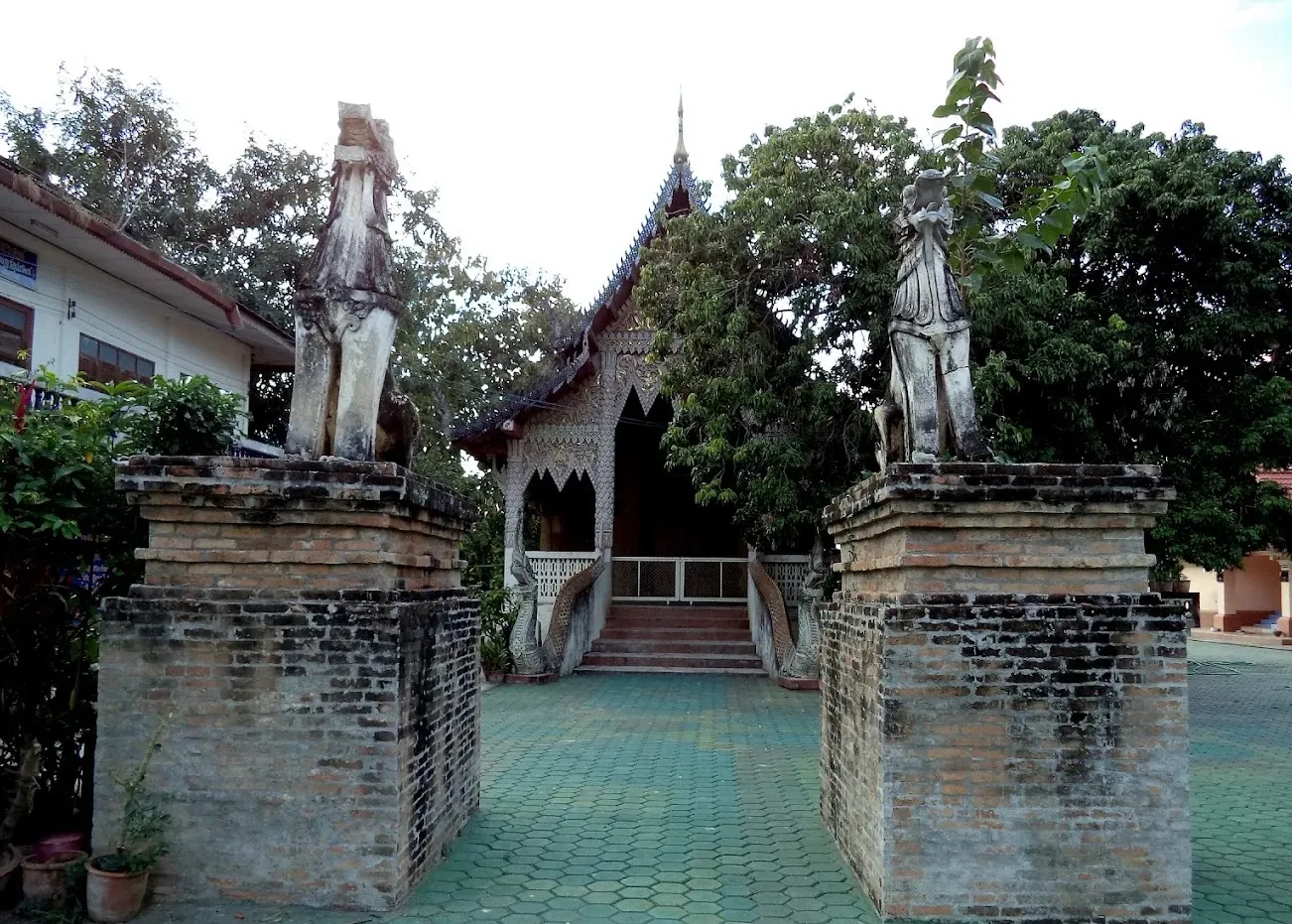
Wat Prasat (Thung Satok)
Open Days: Daily
Opening Hours: 08.00 – 17.00
Wat Prasat (Thung Satok) is a historic Buddhist temple in Thung Satok Subdistrict, San Pa Tong District, Chiang Mai Province. It is a quiet community temple with long-standing local significance, notable for its viharn, old chedi, bronze Buddha images, gilded lacquered monastic seat, and the calm atmosphere of a Lanna village temple. For travelers who want to explore Chiang Mai beyond the old city, Wat Prasat offers a slower and more local cultural experience, especially when combined with nearby temples, Wiang Tha Kan archaeological sites, and San Pa Tong’s local market route.
Wat Prasat is located in Moo 6, Thung Satok Subdistrict, San Pa Tong District, with coordinates around 18.57552, 98.85623. The temple belongs to the local religious landscape of southern Chiang Mai, where temples are not only places of worship but also social and cultural centers for village communities. The temple’s setting is modest and peaceful, making it suitable for visitors who prefer meaningful cultural stops rather than crowded tourist landmarks.
The history of Wat Prasat is believed to stretch back more than 1,000 years. The earliest phase of the temple is not clearly recorded in inscriptions, but local historical accounts state that around 460 years ago the temple existed only as a simple monastery without permanent structures and had fallen into a deteriorated condition. This long arc of decline and restoration makes Wat Prasat an important example of how rural temples in northern Thailand survived through community faith, monastic leadership, and repeated restoration across generations.
A major restoration phase took place during the time of Phra Athikan Tham, who served as abbot and encouraged local devotees to help revive the temple. The ruler of Chiang Mai, together with royal family members, also provided support for the construction of the viharn. This collaboration between the temple, villagers, and Chiang Mai’s ruling circle helped transform Wat Prasat from a deteriorated religious site into a functioning temple with important permanent structures.
Later, during the abbacy of Phra Athikan Pan, the temple’s damaged chedi was repaired and restored. The chedi remains one of the most important sacred structures at Wat Prasat. It is approximately 7 meters wide and 20 meters high from the ground to the top of the finial, and is believed to be more than 400 years old. Although no inscription confirms its exact construction date, the chedi continues to function as a visible symbol of the temple’s continuity and the Buddhist faith of the Thung Satok community.
Wat Prasat continued to develop under later abbots. During the time of Phra Khru Singkaew, the temple saw further restoration and construction, including monks’ quarters, boundary walls, a salabat hall area, and other necessary temple structures. The viharn was also completed during this period. After Phra Khru Singkaew passed away, Phra Athikan Chamroen Khemacharo took up the abbacy in 1997. This succession of monastic care shows how the temple has been preserved through continuous religious leadership and community support.
The viharn is the central architectural space of Wat Prasat. It measures approximately 8 meters wide and 20.50 meters long. The current structure combines newer construction techniques with retained older elements. Its foundation and side pillars are built with reinforced concrete, while the interior pillars are original teakwood columns. The walls are made of plastered cement blocks, and the roof is covered with cement tiles. This combination gives the viharn a layered character: restored for practical use, yet still carrying material traces of the older temple.
Inside the viharn is the principal Buddha image, a bronze Buddha in the posture of subduing Mara. The exact period of its creation is not recorded, but its placement as the main Buddha image makes it the spiritual focus of the temple. Wat Prasat also preserves another bronze Buddha image measuring 29.5 inches across the lap and 41 inches in height. These sacred objects are central to the temple’s religious identity and are among the key reasons cultural travelers should take time to visit the viharn carefully and respectfully.
Another important antique object at Wat Prasat is a beautifully gilded lacquered monastic seat. Such an object reflects both religious function and traditional craftsmanship. Gilded lacquer work requires patience and skill, and it indicates the devotion of the people who commissioned or preserved it. Together with the bronze Buddha images and the old chedi, this object gives Wat Prasat cultural value beyond its role as a local temple.
The monks’ residence at Wat Prasat measures approximately 6 meters wide and 29 meters long. It was completed in 1968 and is a two-storey building combining masonry and timber. Its lower structure uses concrete pillars and plastered brick walls, while the upper level is made of hardwood. Although it is not the main focus for visitors, the monks’ residence is important because it supports the temple’s living religious function. Wat Prasat is not merely a historical site; it remains a working temple connected to monastic life and village practice.
The role of Wat Prasat in the community is as important as its architecture. The temple functions as a spiritual center for merit-making, Buddhist observances, community gatherings, and annual religious activities such as Buddhist holy days, Buddhist Lent, the end of Buddhist Lent, Kathin, and robe-offering ceremonies when organized by the temple and villagers. This kind of temple life is central to Lanna culture, where the temple is closely tied to local identity, family merit-making, and village continuity.
For visitors, the most rewarding way to experience Wat Prasat is to move slowly through the temple grounds. The viharn, chedi, principal Buddha image, bronze Buddha image, gilded lacquered seat, and original teak pillars inside the viharn are the key points of interest. The temple is suitable for travelers who appreciate quiet religious sites, local history, and modest but meaningful cultural details. It is not a highly commercial attraction, which is precisely what makes it valuable for those seeking a deeper view of Chiang Mai’s local temple culture.
Visitors should dress respectfully, keep their voices low, avoid disturbing worshippers, and refrain from touching sacred objects or antiques unless permission is clearly given. Photography should be done discreetly, especially inside the viharn. Wat Prasat is still a sacred and active community temple, so the best approach is to visit with the attitude of a respectful guest rather than a casual sightseer.
Getting There is most convenient by private car, rental car, or local hired transport. From Chiang Mai city, travel south toward San Pa Tong District, then continue into Thung Satok Subdistrict and use the coordinates 18.57552, 98.85623 for navigation. Wat Prasat can be included in a one-day cultural route with Wat Tha Champi, Wat Tha Sa, Wat Thung Kiang, Wiang Tha Kan archaeological sites, and Kad Ngua Thung Fa Bot Market. Travelers should allow extra time for local roads and temple-side parking.
Overall, Wat Prasat (Thung Satok) is a meaningful stop for travelers interested in old temples, Lanna culture, and the quieter side of Chiang Mai. Its value lies in its long history, restored viharn, old chedi, bronze Buddha images, preserved sacred objects, and its continuing role as a spiritual center of the Thung Satok community. It is best visited as part of a wider San Pa Tong cultural route rather than as a quick standalone stop.
| Name | Wat Prasat (Thung Satok) |
| Location | Thung Satok Subdistrict, San Pa Tong District, Chiang Mai Province |
| Address | Moo 6, Thung Satok Subdistrict, San Pa Tong District, Chiang Mai 50120, Thailand |
| Coordinates | 18.57552, 98.85623 |
| Highlights | Historic community temple with a viharn, old chedi, bronze Buddha images, and preserved religious objects |
| History | Believed to have been founded more than 1,000 years ago, with major restoration phases over the past several centuries |
| Distinctive Features | A Lanna community temple with a restored viharn, original teak interior pillars, and an old chedi as the main sacred landmark |
| Sacred Objects And Antiques | One chedi, a bronze principal Buddha image in the Mara-subduing posture, another bronze Buddha image, and a gilded lacquered monastic seat |
| Important Structures | Viharn, monks’ residence, chedi, boundary walls, salabat hall area, and temple courtyard |
| Chedi | Approximately 7 meters wide and 20 meters high from the ground to the top of the finial; believed to be more than 400 years old |
| Viharn | Approximately 8 meters wide and 20.50 meters long, with reinforced concrete side pillars and original teak interior pillars |
| Monks’ Residence | Approximately 6 meters wide and 29 meters long; completed in 1968 as a two-storey masonry-and-timber building |
| Travel Information | Travel from Chiang Mai city toward San Pa Tong District, then continue into Thung Satok Subdistrict; private car, rental car, or local hired transport is recommended |
| Current Status | Open to visitors and active as a community temple in Thung Satok |
| Open Days | Daily |
| Opening Hours | 08.00 – 17.00 |
| Abbot / Caretaker | Phra Athikan Chamroen Khemacharo took up the abbacy in 1997 |
| Main Areas / Zones | Viharn, chedi, monks’ residence, salabat hall area, and temple courtyard |
| Nearby Tourist Attractions | 1. Wat Tha Champi, about 3 km 2. Wat Tha Sa, about 5 km 3. Wat Thung Kiang, about 6 km 4. Wiang Tha Kan Archaeological Site, about 9 km 5. Kad Ngua Thung Fa Bot Market, about 11 km |
| Nearby Restaurants | 1. Aunt Phan’s Kitchen San Pa Tong, about 2 km, Tel. 084-609-6109 2. Lung Ta Coffee, about 2 km, Tel. 086-672-5722 3. Sam Saep Ahan Tam Sang, about 4 km 4. Thoe Na Cha Chob Tam Sang San Pa Tong, about 8 km, Tel. 096-694-7277 5. Khuadam Tum Zap San Pa Tong, about 10 km, Tel. 097-971-6422 |
| Nearby Accommodations | 1. P Resort & W Resort, about 9 km, Tel. 064-334-4566 2. Sompoinn Hotel, about 11 km, Tel. 053-025-112 3. Fortune Hotel, about 11 km, Tel. 095-129-9564 4. Home At 9, about 12 km, Tel. 088-636-2679 5. Bannoi Himsuan, about 13 km, Tel. 090-329-6108 |
Frequently Asked Questions (FAQ)
Q: Where is Wat Prasat (Thung Satok) located?
A: Wat Prasat is located in Moo 6, Thung Satok Subdistrict, San Pa Tong District, Chiang Mai Province.
Q: Why is Wat Prasat historically important?
A: The temple is believed to be more than 1,000 years old and has a long restoration history connected to the Thung Satok community.
Q: What should visitors see at Wat Prasat?
A: Key points of interest include the viharn, old chedi, bronze principal Buddha image, another bronze Buddha image, gilded lacquered monastic seat, and original teak pillars inside the viharn.
Q: What is special about the chedi at Wat Prasat?
A: The chedi is approximately 7 meters wide and 20 meters high, and is believed to be more than 400 years old.
Q: When is Wat Prasat open to visitors?
A: The temple is open daily from 08.00 to 17.00.
Q: How can travelers get to Wat Prasat?
A: The most convenient way is by private car, rental car, or local hired transport from Chiang Mai city toward San Pa Tong and Thung Satok.
Q: What nearby attractions can be combined with Wat Prasat?
A: Travelers can combine the visit with Wat Tha Champi, Wat Tha Sa, Wat Thung Kiang, Wiang Tha Kan Archaeological Site, and Kad Ngua Thung Fa Bot Market.
Q: What should visitors keep in mind when visiting the temple?
A: Visitors should dress respectfully, speak quietly, avoid disturbing worshippers, and refrain from touching sacred objects or antiques.
 Category: ●Places of Worship
 Group: ●Temple
Last Update : 1 WeekAgo
 Last Update : 1 WeekAgo
 Click to Access the Navigation Map GPS
Wat Prasat (Thung Satok) Map
Recommend

 Muang Chiang Mai(121)Chom Thong(47)Mae Chaem(25)Chiang Dao(33)Doi Saket(68)Mae Taeng(85)Mae Rim(69)Samoeng(29)Fang(71)Mae Ai(59)Phrao(70)San Pa Tong(103)San Kamphaeng(66)San Sai(73)Hang Dong(73)Hot(32)Doi Tao(22)Omkoi(11)Saraphi(74)Wiang Haeng(15)Chai Prakan(28)Mae Wang(32)Mae On(22)Doi Lo(33)Galyani Vadhana(1)


