
lovethailand home >North Travel Attractions >Chiang Mai Travel Attractions >San Pa Tong >San Klang > Wat Ubosot (San Klang)
TL;DR: Wat Ubosot (San Klang) is located at Ban Klang Nuea, Moo 3, San Klang Subdistrict, San Pa Tong District, Chiang Mai Province, open Daily, hours 08.00 – 17.00.

Wat Ubosot (San Klang)
Open Days: Daily
Opening Hours: 08.00 – 17.00
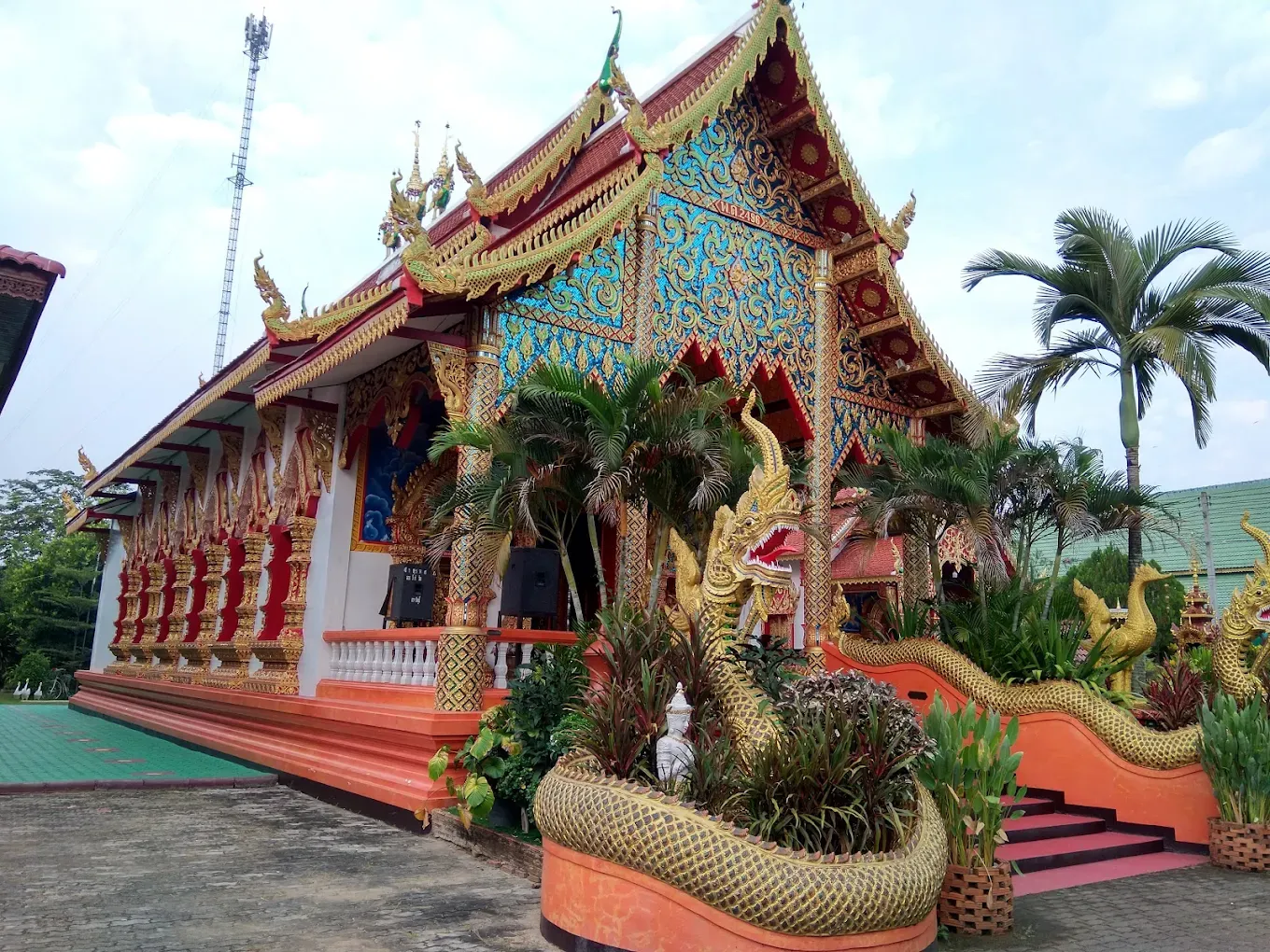
Wat Ubosot (San Klang) is a local Mahanikaya temple located at 88 Ban Klang Nuea, Moo 3, San Klang Subdistrict, San Pa Tong District, Chiang Mai Province. The temple land covers 7 rai and 71 square wah under Nor Sor 3 document number 51. It was built in 932 CE, corresponding to Buddhist Era 1475. The temple was formerly abandoned before Khruba Mahin led its reconstruction, and it received its Wisungkhamsima in 937 CE, corresponding to Buddhist Era 1480. Important structures include the ordination hall, sermon hall, viharn, and monks’ residences. The main sacred object is the chedi. Wat Ubosot remains an important community temple of Ban Klang Nuea and is associated with local merit-making, the relic-bathing tradition, Loy Krathong activities, and Lanna Buddhist community life.
Wat Ubosot (San Klang) is located at 88 Ban Klang Nuea, Moo 3, San Klang Subdistrict, San Pa Tong District, Chiang Mai Province 50120. It is a local Buddhist temple under the Mahanikaya order. The temple land covers 7 rai and 71 square wah under Nor Sor 3 document number 51. Its name, “Ubosot,” directly reflects one of the most important functions of Buddhist temple space: the ordination hall and the consecrated area used for formal monastic acts.
The temple was built in Buddhist Era 1475, corresponding to 932 CE. It was originally an abandoned temple before being reconstructed under the leadership of Khruba Mahin. This history gives Wat Ubosot a distinctive identity. It is not merely a temple that continued uninterrupted from its founding. It is a sacred place that passed through abandonment and revival, showing the power of monastic leadership and community faith in restoring a Buddhist site.
Khruba Mahin is the key figure in the temple’s revival. In Lanna Buddhist culture, a Khruba is often more than a religious teacher. Such figures may lead temple restoration, gather lay supporters, preserve local faith, and re-establish Buddhist practice in a community. Wat Ubosot therefore preserves a memory of restoration, not only construction.
Wat Ubosot received its Wisungkhamsima in Buddhist Era 1480, corresponding to 937 CE. A Wisungkhamsima is the consecrated boundary used for formal monastic acts such as ordination. This gives the temple strong religious significance. Visitors should treat the ordination hall and consecrated areas with particular respect, keeping voices low and behaving appropriately around monastic spaces.
Ban Klang Nuea, Moo 3, is part of San Klang Subdistrict in San Pa Tong District. The temple stands within a village landscape shaped by fields, irrigation channels, roads, and local settlement. Wat Ubosot is therefore deeply connected with the everyday life of the community. It functions as a place for worship, Dhamma listening, village ceremonies, merit-making, and annual traditions.
The temple boundaries show its relationship with the village landscape. The northern side extends about 5 sen, 7 wah, and 1 sok to private rice fields. The southern side extends about 5 sen, 15 wah, and 2 sok to an irrigation channel. The eastern side extends about 1 sen, 8 wah, and 3 sok to a road. The western side extends about 1 sen, 18 wah, and 1 sok to private rice fields. These boundaries place the temple within the living geography of fields, water channels, and village roads.
The irrigation channel along the southern boundary is especially meaningful. In northern Thai communities, irrigation channels are central to farming, water management, and village life. A temple located beside such a landscape is not isolated from daily life. It belongs to the same cultural system that supports rice fields, households, and community cooperation.
The important structures of Wat Ubosot include the ordination hall, sermon hall, viharn, and monks’ residences. These structures allow the temple to serve both monks and lay supporters. The ordination hall is connected with formal monastic acts. The viharn is the main devotional space. The sermon hall supports Dhamma listening and merit-making activities. The monks’ residences support monastic life, study, and daily religious duties.
The ordination hall is the core of the temple’s name and religious identity. Visitors should approach it with restraint, remove shoes before entering sacred buildings, avoid loud conversations, and not treat the space as a casual photo area. The ordination hall represents the temple’s formal Buddhist function and the revival of a once-abandoned sacred site.
The viharn is the space where villagers and visitors pay respect to Buddha images, listen to Dhamma, make merit, and take part in ceremonies. In a Lanna community temple, the viharn is often the most accessible devotional space for laypeople. Even when detailed information about individual images is limited, the viharn remains central to the living practice of the temple community.
The sermon hall serves as a community religious space. It can support Dhamma talks, Kathin robe offerings, forest robe offerings, ordination events, funerals, dedication ceremonies, and village gatherings. In a community temple, the sermon hall is often where monks, elders, families, and children meet through repeated acts of faith and cooperation.
The monks’ residences represent the living side of the temple. They support monastic residence, study, rest, and daily religious duties. Visitors should avoid entering monastic areas without permission and should not disturb monks or private temple spaces. Wat Ubosot remains an active religious site, not merely a historical location.
The main sacred object of Wat Ubosot is the chedi. In Lanna Buddhist culture, a chedi is a major devotional focus and a symbol of Buddhist continuity. It links the temple community with the memory of the Buddha, the Triple Gem, and local faith. Visitors should walk around the chedi respectfully and avoid touching or climbing sacred structures.
The temple is associated with the relic-bathing tradition of Wat Ubosot. Such traditions are important in Lanna Buddhist communities because they bring together monks, villagers, local leaders, and devotees for merit-making and ritual respect toward sacred objects. The annual or periodic bathing of a relic or chedi is not only a religious act but also a way for the community to renew its shared identity.
Wat Ubosot has also served as a community activity space for Loy Krathong in San Klang Subdistrict. Loy Krathong connects local residents through cultural performance, krathong-making, community contests, and the preservation of Thai and Lanna traditions. The use of Wat Ubosot as an event space shows that the temple functions as a cultural center as well as a religious one.
Other traditions associated with the temple follow the normal rhythm of Lanna community Buddhism. These include Buddhist holy days, Buddhist Lent, the end of Buddhist Lent, Kathin robe offerings, forest robe offerings, meal offerings, ordinations, funerals, and dedication ceremonies. These activities keep the relationship between monks and lay supporters active throughout the year.
The historical depth of Wat Ubosot makes it especially interesting. Its early founding date, abandoned status, and later restoration under Khruba Mahin give the temple a layered identity. Even though publicly available details about its older art and archaeology are limited, the temple clearly stands as one of the old religious markers of Ban Klang Nuea and San Klang Subdistrict.
The main appeal of Wat Ubosot is its quiet authenticity as a village temple. It is not defined by a large number of modern visitor zones. Instead, it is defined by its old temple history, its revival from abandonment, its ordination-hall identity, its chedi, and its role in village rituals. Visitors interested in local Lanna temples will find its value in this simplicity.
Visitors should dress modestly, remove shoes before entering religious buildings, keep voices low, avoid touching the chedi or sacred objects, and give priority to monks and local residents during ceremonies. Since the temple is still used by the community, it should be visited with respect rather than treated as an ordinary sightseeing stop.
Getting There is most convenient by private car or rental car. From Chiang Mai city, travel south via the Chiang Mai – Hot Road or Highway 108 toward San Pa Tong District, then continue into San Klang Subdistrict and Ban Klang Nuea, Moo 3. The temple can be included in a San Klang temple route together with Wat Buppharam, Wat Huai Som, Wat Kantharam, and Wat Phra Bat Thung O.
A practical connected route can begin at Wat Ubosot, then continue to Wat Buppharam, Wat Huai Som, Wat Kantharam, Wat Phra Bat Thung O, Wat San Pa Tong, Wat Si Nawarat, Kaomai Lanna, and Wiang Tha Kan. Travelers who want to extend the route toward Thung Tom Subdistrict can continue to Wat Si Arun, Wat Sop Han, Wat Pa Lan, Wat Rattanaram, and Wat Suphan Rangsri.
The best time to visit is in the morning or late afternoon during opening hours. These periods are suitable for quiet worship and observation of the temple setting. During relic-bathing traditions, Loy Krathong, Kathin, or other community activities, visitors should allow extra time and give priority to local participants.
Overall, Wat Ubosot (San Klang) is an old Mahanikaya community temple of Ban Klang Nuea, Moo 3, San Klang Subdistrict, San Pa Tong District, Chiang Mai Province. It was built in Buddhist Era 1475, was once abandoned, and was later restored under Khruba Mahin. With its ordination hall, sermon hall, viharn, monks’ residences, chedi, relic-bathing tradition, Loy Krathong role, and connection to the agricultural village landscape, Wat Ubosot is a meaningful stop for visitors interested in old Lanna community temples and cultural routes in San Pa Tong.
| Name | Wat Ubosot (San Klang) |
| Location | Ban Klang Nuea, Moo 3, San Klang Subdistrict, San Pa Tong District, Chiang Mai Province |
| Address | 88 Ban Klang Nuea, Moo 3, San Klang Subdistrict, San Pa Tong District, Chiang Mai 50120, Thailand |
| Temple Type | Local Buddhist Temple Under The Mahanikaya Order |
| Temple Land | 7 Rai And 71 Square Wah under Nor Sor 3 document number 51 |
| Boundaries | North: about 5 Sen, 7 Wah, and 1 Sok to private rice fields South: about 5 Sen, 15 Wah, and 2 Sok to an irrigation channel East: about 1 Sen, 8 Wah, and 3 Sok to a road West: about 1 Sen, 18 Wah, and 1 Sok to private rice fields |
| History | Built in Buddhist Era 1475, corresponding to 932 CE; formerly an abandoned temple before Khruba Mahin led its reconstruction |
| Wisungkhamsima | Received Wisungkhamsima in Buddhist Era 1480, corresponding to 937 CE |
| Abbot / Caretaker | Phra Athikan Kasem Katasaro |
| Important Structures | Ordination Hall Sermon Hall Viharn Monks’ Residences |
| Important Sacred Object | Chedi |
| Important Temple Tradition | Relic-Bathing Tradition Of Wat Ubosot And Seasonal Merit-Making In The Lanna Community Temple Context |
| Highlights | An old Ban Klang Nuea community temple revived from abandonment by Khruba Mahin, with an ordination hall, viharn, sermon hall, monks’ residences, and chedi as the main sacred focus |
| Community Role | A spiritual center for Ban Klang Nuea, used for merit-making, Dhamma listening, Buddhist ceremonies, ordinations, funerals, dedication ceremonies, relic-bathing, Loy Krathong activities, and local community events |
| Related Traditions | Buddhist Holy Days, Buddhist Lent, The End Of Buddhist Lent, Kathin Robe Offerings, Forest Robe Offerings, Meal Offerings, Ordination Ceremonies, Funerals, Dedication Ceremonies, Relic-Bathing Tradition, And Loy Krathong Community Activities |
| Open Days | Daily |
| Opening Hours | 08.00 – 17.00 |
| Travel Information | Private car or rental car is the most convenient option. From Chiang Mai city, travel via the Chiang Mai – Hot Road or Highway 108 toward San Pa Tong District, then continue into San Klang Subdistrict and Ban Klang Nuea, Moo 3. |
| Current Status | Active local Mahanikaya temple in Moo 3, San Klang Subdistrict, San Pa Tong District, Chiang Mai Province, with continuing religious, merit-making, and community functions |
| Nearby Tourist Attractions | 1. Wat Buppharam (San Klang), about 3 km 2. Wat Kantharam (Thung O), about 5 km 3. Wat Phra Bat Thung O, about 6 km 4. Wat San Pa Tong, about 6 km 5. Kaomai Lanna, about 9 km 6. Wiang Tha Kan, about 14 km |
| Nearby Restaurants | 1. Khao Soi Pa Daet, Chiang Mai – Hot Road, about 4 km, Tel. 083-566-8813 2. Khrua Na Ban, about 5 km, Tel. 098-376-4358 3. Fang-Fang Cafe, about 5 km, Tel. 089-950-3966 4. Lake View @ San Pa Tong, about 6 km, Tel. 097-079-8448 5. Ton Khao Shop, about 10 km, Tel. 098-792-6440 6. Pla Salawin Restaurant, about 12 km, Tel. 086-919-3851 |
| Nearby Accommodations | 1. Home At 9, about 5 km, Tel. 088-636-2679 2. Kaomai Lanna Resort, about 9 km, Tel. 053-481-201 3. Thai Resort, about 10 km 4. Wanwan Lanna By Pat, about 12 km, Tel. 080-892-7724 5. P Resort & W Resort, about 13 km, Tel. 064-334-4566 |
Frequently Asked Questions (FAQ)
Q: Where Is Wat Ubosot (San Klang) Located?
A: Wat Ubosot (San Klang) is located at 88 Ban Klang Nuea, Moo 3, San Klang Subdistrict, San Pa Tong District, Chiang Mai Province 50120.
Q: What Are The Open Days And Opening Hours?
A: Wat Ubosot is open daily from 08.00 to 17.00.
Q: When Was Wat Ubosot Built?
A: Wat Ubosot was built in Buddhist Era 1475, corresponding to 932 CE. It was formerly abandoned before Khruba Mahin led its reconstruction.
Q: When Did Wat Ubosot Receive Its Wisungkhamsima?
A: Wat Ubosot received its Wisungkhamsima in Buddhist Era 1480, corresponding to 937 CE.
Q: What Important Structures Are Found At Wat Ubosot?
A: Important structures include the ordination hall, sermon hall, viharn, and monks’ residences.
Q: What Is The Main Sacred Object At Wat Ubosot?
A: The main sacred object of Wat Ubosot is the chedi.
Q: What Important Traditions Are Associated With Wat Ubosot?
A: Wat Ubosot is associated with its relic-bathing tradition, seasonal merit-making, Kathin and forest robe offerings, and Loy Krathong community activities.
Q: What Nearby Places Can Be Visited With Wat Ubosot?
A: Nearby places include Wat Buppharam, Wat Kantharam, Wat Phra Bat Thung O, Wat San Pa Tong, Kaomai Lanna, and Wiang Tha Kan.
 Category: ●Places of Worship
 Group: ●Temple
Last Update : 2 MonthAgo
 Last Update : 2 MonthAgo
 Click to Access the Navigation Map GPS
Wat Ubosot (San Klang) Map
Recommend

 Muang Chiang Mai(121)Chom Thong(47)Mae Chaem(25)Chiang Dao(33)Doi Saket(68)Mae Taeng(85)Mae Rim(69)Samoeng(29)Fang(71)Mae Ai(59)Phrao(70)San Pa Tong(103)San Kamphaeng(66)San Sai(73)Hang Dong(73)Hot(32)Doi Tao(22)Omkoi(11)Saraphi(74)Wiang Haeng(15)Chai Prakan(28)Mae Wang(32)Mae On(22)Doi Lo(33)Galyani Vadhana(1)


