
lovethailand home >North Travel Attractions >Chiang Mai Travel Attractions >San Pa Tong >Thung Tom > Wat Sop Han
TL;DR: Wat Sop Han is located at Ban Sop Han, Moo 3, Thung Tom Subdistrict, San Pa Tong District, Chiang Mai Province, open Daily, hours 08.00 – 17.00.

Wat Sop Han
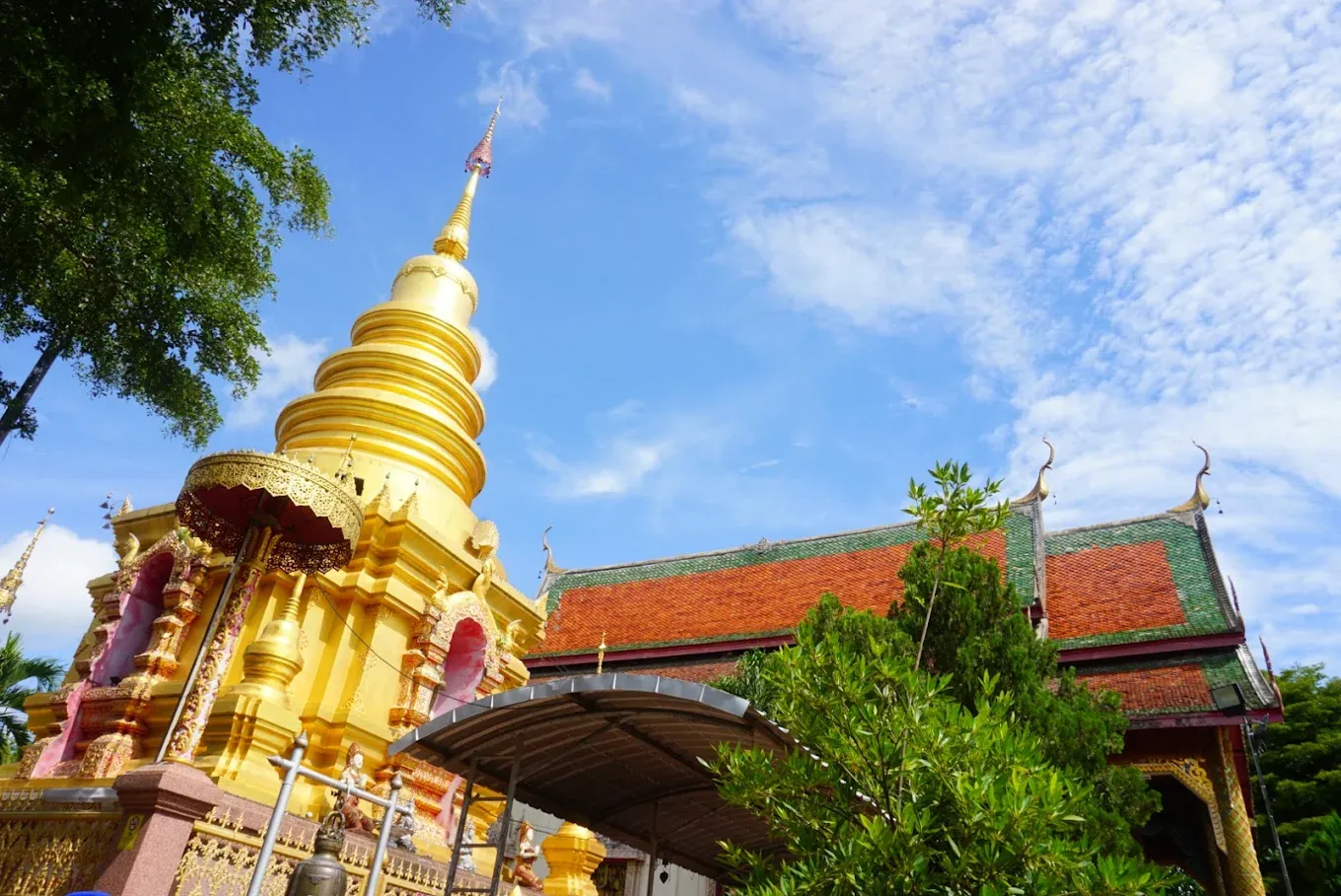
Open Days: Daily
Opening Hours: 08.00 – 17.00
Wat Sop Han is a local Mahanikaya temple located at 96 Ban Sop Han, Moo 3, Thung Tom Subdistrict, San Pa Tong District, Chiang Mai Province. Built in 1838, the temple occupies 5 rai, 2 ngan, and 11 square wah under Nor Sor 3 document number 170, with two parcels of monastic land covering 1 rai and 32 square wah. Its important features include the viharn with teakwood doors and windows, chanting hall, monks’ residences, principal Buddha image in Subduing Mara posture, brass Buddha image, Phra Buddha Sihing, an old sermon seat, scripture chest, and an old Naga-protected Buddha-style pedestal. The temple is also associated with the annual Song Nam Phra That Si Ming Mongkhon tradition, making it an important community temple of Ban Sop Han.
Wat Sop Han is located at 96 Ban Sop Han, Moo 3, Thung Tom Subdistrict, San Pa Tong District, Chiang Mai Province 50120. It is a local Buddhist temple under the Mahanikaya order. The temple land covers 5 rai, 2 ngan, and 11 square wah under Nor Sor 3 document number 170. It also has two parcels of monastic land covering 1 rai and 32 square wah. Wat Sop Han is one of the old community temples of Thung Tom Subdistrict and serves as a religious, social, and cultural center for Ban Sop Han.
Wat Sop Han was built in 1838, placing it among the older temples in the San Pa Tong area. Its long history reflects the continuity of Buddhist faith in Ban Sop Han and the surrounding agricultural communities of Thung Tom. In rural Lanna society, a temple was never only a place for worship. It was also a place for listening to Dhamma, holding family rites, organizing ordinations and funerals, preserving sacred objects, and maintaining the bond between monks and lay supporters.
The name Wat Sop Han should be understood together with Ban Sop Han, the village in which the temple stands. Many village names in Thung Tom Subdistrict are connected with the local landscape, irrigation systems, fields, and community memories. Wat Sop Han is therefore not an isolated religious site. It is a village temple rooted in the daily life of the community, where local people continue to make merit, listen to Dhamma teachings, and participate in annual Buddhist traditions.
The temple boundaries reveal its relationship with the village landscape. The northern boundary extends about 1 sen and 12 wah to an irrigation channel. The southern boundary extends about 1 sen, 8 wah, and 2 sok to a public road. The eastern boundary extends about 2 sen and 17 wah to an irrigation channel and private garden land. The western boundary extends about 2 sen and 12 wah to villagers’ houses. These boundaries show that the temple is surrounded by water channels, roads, gardens, and village residences.
Irrigation channels are more than boundary markers in Lanna communities. They are part of the water-management system that supports rice fields, gardens, and everyday life. Thung Tom Subdistrict is a lowland area shaped by irrigation canals, the Mae Kung water system, agricultural fields, and village roads. A temple located within this landscape becomes the spiritual center of the same community system that sustains local life. Visitors should understand Wat Sop Han together with its surrounding village, roads, fields, and water channels.
The important structures of Wat Sop Han include the viharn, chanting hall, and monks’ residences. The viharn is the main worship space of the temple. The chanting hall supports prayer, Dhamma listening, and Buddhist ceremonies. The monks’ residences support monastic life, study, rest, and daily religious duties. These structures allow the temple to function as an active community temple for both monks and laypeople.
The viharn is especially important because its doors and windows are made of teakwood. Teak has long been valued in northern Thailand for its durability and suitability for temple woodworking. The use of teakwood in the viharn reflects local craftsmanship and the devotion of the community. Visitors should take time to notice such details, as they reveal the material culture and artistic care that local supporters dedicated to the temple.
The principal Buddha image in the viharn is in the Subduing Mara posture. This posture represents the Buddha’s victory over Mara through spiritual firmness and accumulated merit. The right hand reaching toward the earth symbolizes calling the Earth Goddess to witness enlightenment. For worshippers, this image expresses perseverance, clarity, and inner strength. Visitors should approach the principal image quietly, dress modestly, and pay respect with restraint.
Wat Sop Han also preserves several other important sacred objects, including a brass Buddha image, Phra Buddha Sihing, and Phra Sihing Sam. Phra Buddha Sihing has deep significance in northern Thai Buddhist devotion. Its presence in a village temple adds spiritual depth to the worship space and connects Wat Sop Han with wider Lanna Buddhist culture. These images should be treated as sacred objects, not as ordinary display items.
The old sermon seat is another important object because it reflects the temple’s role as a place of Dhamma teaching. In Lanna temples, a sermon seat is often more than functional furniture. It is a symbol of the transmission of Buddhist teachings from monks to laypeople. The care placed into creating such objects reflects the community’s respect for the Dhamma and for the act of listening to teachings.
The scripture chest is also significant. It was used to preserve Buddhist texts or temple manuscripts. Such a chest shows that Wat Sop Han functioned not only as a place for ritual but also as a place that protected religious knowledge. Visitors should not touch old religious objects without permission, as they are part of the temple’s sacred and cultural heritage.
The old Naga-protected Buddha-style pedestal adds another layer of symbolic meaning. In Buddhist and Lanna art, the Naga often represents protection, sacred power, and a connection with water. This symbolism is especially meaningful in a temple landscape shaped by irrigation channels and village water systems. The object should be viewed with respect as both a sacred feature and a local artistic expression.
The chanting hall supports the regular religious life of Wat Sop Han. It is used for chanting, prayer, Dhamma listening, and Buddhist ceremonies. In community temples, such a hall is where monks and villagers meet repeatedly through religious practice. It helps keep the temple active throughout the year, especially during Buddhist holy days, Lent-related ceremonies, and community merit-making events.
The monks’ residences represent the living side of the temple. They support residence, study, and daily religious duties for monks. Visitors should avoid entering monastic residential areas without permission, avoid loud noise nearby, and avoid photographing monks or private areas in a disruptive way. Wat Sop Han is not only a place to visit; it is also a working religious residence.
Wat Sop Han plays an important role in Ban Sop Han. It serves as a place for Buddhist holy days, Dhamma listening, ordination ceremonies, funerals, dedication ceremonies, and annual merit-making. It also takes part in local community activities, including cooperation with local authorities and residents in improving the village environment. This shows that the temple continues to serve both spiritual and social functions.
One of the temple’s important traditions is the annual Song Nam Phra That Si Ming Mongkhon ceremony held at Wat Sop Han, Ban Sop Han, Moo 3, Thung Tom Subdistrict. This event brings together monks, local leaders, and villagers through merit-making, ritual bathing, offerings, and Buddhist ceremonies. The tradition gives Wat Sop Han a continuing cultural role beyond ordinary daily worship and strengthens the temple’s identity within the community.
Religious traditions connected with Wat Sop Han should also be understood within the wider context of Lanna community temples. These include Buddhist holy days, Buddhist Lent, the end of Buddhist Lent, Kathin robe offerings, forest robe offerings, ordinations, funerals, dedication ceremonies, and seasonal merit-making. These events are not only religious rituals; they are repeated forms of cooperation that maintain village relationships and Buddhist culture.
The current abbot of Wat Sop Han is Phra Baidika Thanthep Sophonpanyo. In a village temple, the abbot plays an important role in maintaining religious activities, temple order, sacred objects, and the relationship between monks and lay supporters. The life of a community temple depends on cooperation among monks, temple committees, village leaders, local authorities, and residents.
The main highlights of Wat Sop Han are its long history from 1838, its teakwood viharn details, principal Buddha image in Subduing Mara posture, Phra Buddha Sihing, old sermon seat, scripture chest, Naga-protected Buddha-style pedestal, and the Song Nam Phra That Si Ming Mongkhon tradition. The temple is suitable for visitors interested in quiet merit-making, old village temples, Lanna sacred objects, and cultural routes in San Pa Tong.
Visitors should approach Wat Sop Han respectfully. Dress modestly, remove shoes before entering religious buildings, keep voices low, avoid entering monks’ private areas without permission, and do not touch Buddha images, old sermon seats, scripture chests, or antique objects. If a ceremony or merit-making event is taking place, visitors should give priority to local participants. The temple remains a living community religious place, so respectful conduct is essential.
Getting There is most convenient by private car or rental car. From Chiang Mai city, travel south via the Chiang Mai – Hang Dong – San Pa Tong route or Highway 108, then continue into Thung Tom Subdistrict and Ban Sop Han, Moo 3. The temple is located within the village area and can be combined with nearby temples, restaurants, and accommodations in San Pa Tong.
A practical connected route can begin at Wat Sop Han, then continue to Wat Si Arun, Wat Pa Lan, Wat Klang Thung, Wat Ko Kao, Wat Chang Kradat, Wat Boon Nak, Wat Rattanaram, Wat Thung Tom, and Wiang Tha Kan. Travelers who want a broader cultural route can continue toward Tha Wang Phrao Subdistrict, where old temples such as Wat Ton Naen Luang, Wat Tha Wang Phrao, Wat Mongkhon, Wat Si Rattanaram, and Wat Don Chai add further depth to the San Pa Tong temple route.
Overall, Wat Sop Han is an old Mahanikaya community temple of Ban Sop Han, Moo 3, Thung Tom Subdistrict, San Pa Tong District, Chiang Mai Province. Built in 1838, it preserves important sacred objects such as the principal Buddha image in Subduing Mara posture, Phra Buddha Sihing, an old sermon seat, scripture chest, and Naga-protected Buddha-style pedestal. With its teakwood viharn details, chanting hall, monks’ residences, and annual Song Nam Phra That Si Ming Mongkhon tradition, Wat Sop Han is a meaningful stop for travelers interested in Lanna community temples and cultural routes in San Pa Tong.
| Name | Wat Sop Han |
| Location | Ban Sop Han, Moo 3, Thung Tom Subdistrict, San Pa Tong District, Chiang Mai Province |
| Address | 96 Ban Sop Han, Moo 3, Thung Tom Subdistrict, San Pa Tong District, Chiang Mai 50120, Thailand |
| Coordinates | 18.62902, 98.92057 |
| Temple Type | Local Buddhist Temple Under The Mahanikaya Order |
| Temple Land | 5 Rai, 2 Ngan, 11 Square Wah under Nor Sor 3 document number 170 |
| Monastic Land | Two parcels covering 1 Rai and 32 Square Wah under Nor Sor 3 document number 170 |
| Boundaries | North: about 1 Sen and 12 Wah to an irrigation channel South: about 1 Sen, 8 Wah, and 2 Sok to a public road East: about 2 Sen and 17 Wah to an irrigation channel and private garden land West: about 2 Sen and 12 Wah to villagers’ houses |
| History | Built in 1838 as an old community temple of Ban Sop Han in Thung Tom Subdistrict |
| Abbot / Caretaker | Phra Baidika Thanthep Sophonpanyo |
| Important Structures | Viharn With Teakwood Doors And Windows Chanting Hall Monks’ Residences |
| Important Sacred Objects | Principal Buddha Image In Subduing Mara Posture Brass Buddha Image Phra Buddha Sihing Phra Sihing Sam Old Sermon Seat Scripture Chest Old Naga-Protected Buddha-Style Pedestal |
| Important Temple Tradition | Annual Song Nam Phra That Si Ming Mongkhon Ceremony At Wat Sop Han, Ban Sop Han, Moo 3, Thung Tom Subdistrict |
| Highlights | An old Ban Sop Han community temple with teakwood viharn details, principal Buddha image in Subduing Mara posture, Phra Buddha Sihing, old sermon seat, scripture chest, and an annual relic-bathing tradition |
| Community Role | A spiritual center for Ban Sop Han, used for merit-making, Dhamma listening, Buddhist ceremonies, ordinations, funerals, dedication ceremonies, annual temple traditions, and local community activities |
| Related Traditions | Buddhist Holy Days, Buddhist Lent, The End Of Buddhist Lent, Kathin Robe Offerings, Forest Robe Offerings, Ordination Ceremonies, Funerals, Dedication Ceremonies, And The Song Nam Phra That Si Ming Mongkhon Tradition |
| Open Days | Daily |
| Opening Hours | 08.00 – 17.00 |
| Travel Information | Private car or rental car is the most convenient option. From Chiang Mai city, travel via the Chiang Mai – Hang Dong – San Pa Tong route or Highway 108, then continue into Thung Tom Subdistrict and Ban Sop Han, Moo 3. |
| Current Status | Active local Mahanikaya temple in Moo 3, Ban Sop Han, Thung Tom Subdistrict, San Pa Tong District, Chiang Mai Province, with continuing religious and community activities |
| Nearby Tourist Attractions | 1. Wat Si Arun, about 3 km 2. Wat Pa Lan (Thung Tom), about 5 km 3. Wat Klang Thung (Thung Tom), about 5 km 4. Wat Ko Kao, about 6 km 5. Wat Rattanaram (Thung Tom), about 6 km 6. Wiang Tha Kan, about 12 km |
| Nearby Restaurants | 1. Pla Salawin Restaurant, about 8 km, Tel. 086-919-3851 2. Ton Khao Shop, about 8 km, Tel. 098-792-6440 3. Lake View @ San Pa Tong, about 9 km, Tel. 097-079-8448 4. Klin Kaphrao Khao Ho Mok San Pa Tong, about 10 km, Tel. 093-243-8923 5. Charcoal Pork Leg Rice San Pa Tong, about 10 km, Tel. 081-881-5112 6. Khrua Pa Phan San Pa Tong, about 12 km, Tel. 084-609-6109 |
| Nearby Accommodations | 1. Khuang Chan Resort, about 7 km, Tel. 089-835-3057 2. P Resort & W Resort, about 8 km, Tel. 064-334-4566 3. Ban Muan Jai Hotel (Ton Naen), about 9 km, Tel. 089-261-1426 4. Sompor Inn Hotel, about 9 km, Tel. 053-025-112 5. The Elephant House And Pool Villa, about 10 km |
Frequently Asked Questions (FAQ)
Q: Where is Wat Sop Han located?
A: Wat Sop Han is located at 96 Ban Sop Han, Moo 3, Thung Tom Subdistrict, San Pa Tong District, Chiang Mai Province 50120.
Q: What are the open days and opening hours?
A: Wat Sop Han is open daily from 08.00 to 17.00.
Q: When was Wat Sop Han built?
A: Wat Sop Han was built in 1838 and is an old community temple of Ban Sop Han in Thung Tom Subdistrict, San Pa Tong District.
Q: What important structures are found at Wat Sop Han?
A: Important structures include the viharn with teakwood doors and windows, the chanting hall, and monks’ residences.
Q: What important sacred objects are found at Wat Sop Han?
A: Important sacred objects include the principal Buddha image in Subduing Mara posture, a brass Buddha image, Phra Buddha Sihing, Phra Sihing Sam, an old sermon seat, a scripture chest, and an old Naga-protected Buddha-style pedestal.
Q: What important tradition is associated with Wat Sop Han?
A: Wat Sop Han is associated with the annual Song Nam Phra That Si Ming Mongkhon ceremony held at the temple in Ban Sop Han.
Q: Who is the abbot of Wat Sop Han?
A: The abbot of Wat Sop Han is Phra Baidika Thanthep Sophonpanyo.
Q: What nearby places can be visited with Wat Sop Han?
A: Nearby places include Wat Si Arun, Wat Pa Lan, Wat Klang Thung, Wat Ko Kao, Wat Rattanaram, and Wiang Tha Kan.
 Category: ●Places of Worship
 Group: ●Temple
Last Update : 2 MonthAgo
 Last Update : 2 MonthAgo
 Click to Access the Navigation Map GPS

 Muang Chiang Mai(121)Chom Thong(47)Mae Chaem(25)Chiang Dao(33)Doi Saket(68)Mae Taeng(85)Mae Rim(69)Samoeng(29)Fang(71)Mae Ai(59)Phrao(70)San Pa Tong(103)San Kamphaeng(66)San Sai(73)Hang Dong(73)Hot(32)Doi Tao(22)Omkoi(11)Saraphi(74)Wiang Haeng(15)Chai Prakan(28)Mae Wang(32)Mae On(22)Doi Lo(33)Galyani Vadhana(1)


