
lovethailand home >North Travel Attractions >Chiang Mai Travel Attractions >San Pa Tong >Thung Tom > Wat Klang Thung (Thung Tom)
TL;DR: Wat Klang Thung (Thung Tom) is located at Ban Pa Lan, Moo 2, Thung Tom Subdistrict, San Pa Tong District, Chiang Mai Province, open Daily, hours 08.00 – 17.00.
Wat Klang Thung (Thung Tom)
Open Days: Daily
Opening Hours: 08.00 – 17.00
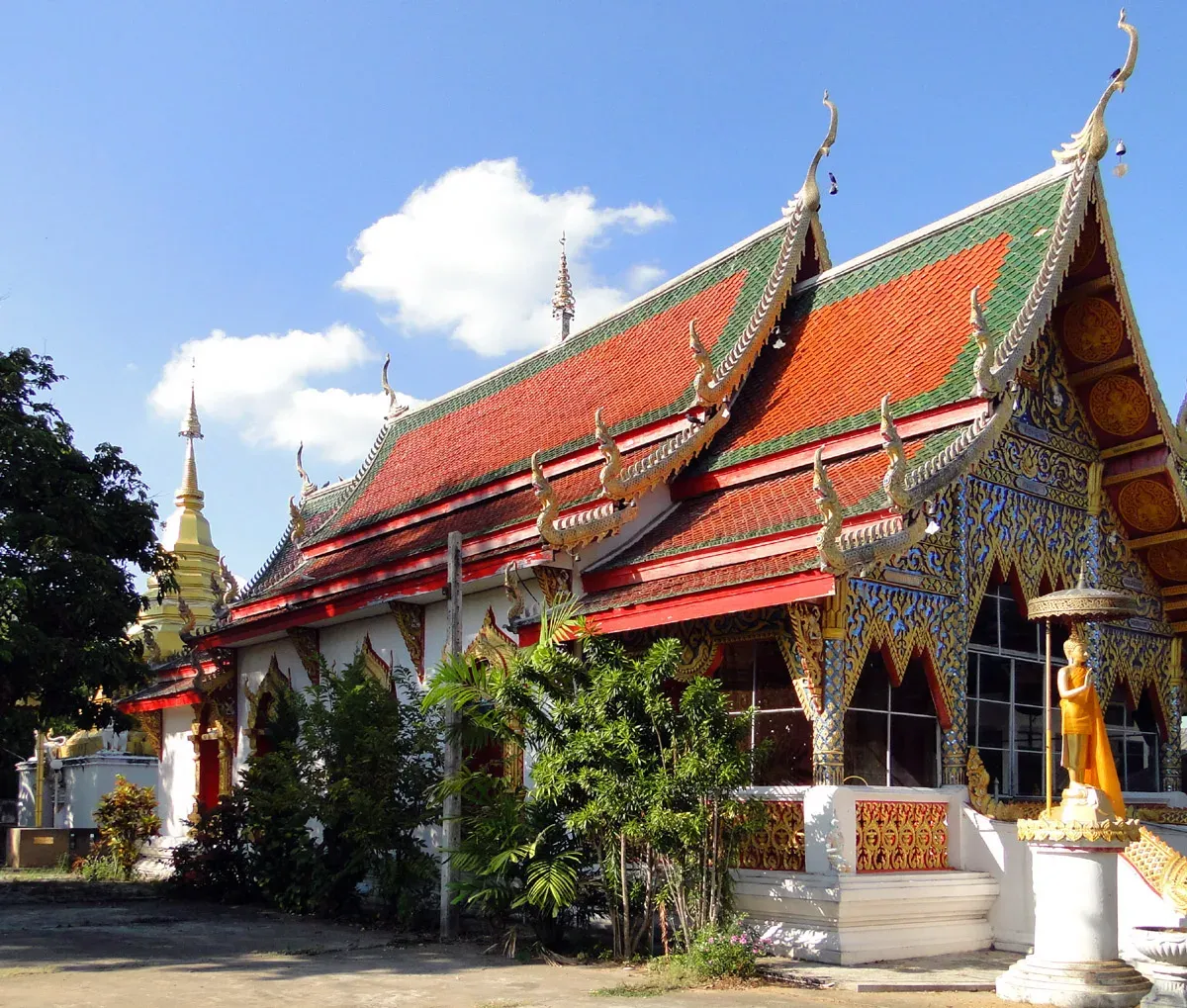
Wat Klang Thung (Thung Tom) is a local Mahanikaya temple located at 169 Moo 2, Ban Pa Lan, Thung Tom Subdistrict, San Pa Tong District, Chiang Mai Province. Officially permitted as a temple in 1885, it covers 1 rai, 2 ngan, and 64 square wah. The abbot is Phra Athikan Weerachai Kalyano. The temple reflects the rural landscape of Thung Tom, a lowland agricultural subdistrict with irrigation canals, the Mae Kung irrigation stream, fields, gardens, and village roads. It is suitable for merit-making, quiet temple visits, and a connected route through local temples in Thung Tom and San Pa Tong.
Wat Klang Thung (Thung Tom) is located at 169 Moo 2, Ban Pa Lan, Thung Tom Subdistrict, San Pa Tong District, Chiang Mai Province 50120. It is a local Buddhist temple under the Mahanikaya order. The temple was officially permitted as a temple in 1885 and covers 1 rai, 2 ngan, and 64 square wah. Phra Athikan Weerachai Kalyano is the abbot. Although public information about the temple’s detailed architectural history is limited, its establishment year, address, and status show that it has long served as a Buddhist temple for the Ban Pa Lan community.
The name Wat Klang Thung carries a strong connection with the landscape of Thung Tom. “Klang Thung” means “in the middle of the fields” or “among the fields,” suggesting a temple rooted in an agricultural environment. Many rural temples in northern Thailand developed within farming communities because villagers needed a nearby religious center for merit-making, Dhamma listening, family rites, ordinations, funerals, and seasonal Buddhist activities. Wat Klang Thung should therefore be understood as a community temple tied to the land and village life around it.
Thung Tom Subdistrict is a lowland area on the eastern side of San Pa Tong District. The area has irrigation canals and the Mae Kung irrigation stream, and it is connected with the Chiang Mai – Hot route. The local economy and everyday life have long been associated with farming, gardening, small trade, and community networks. In such a landscape, temples remain central because they support religious practice and provide shared space for villagers across generations.
Ban Pa Lan, Moo 2, is one of the communities in Thung Tom Subdistrict. The presence of Wat Klang Thung and other nearby temples shows how closely local settlement is connected with Buddhism. A village temple allows residents to join Buddhist activities without traveling far from home. It also strengthens social ties because temple ceremonies require cooperation among monks, lay supporters, village leaders, families, and local residents.
The year 1885 is important because it marks the official permission for the establishment of Wat Klang Thung. This period shows that the Ban Pa Lan community had developed enough to support a permanent Buddhist temple. In rural northern Thailand, a temple was not only a sacred place. It was also a place for learning, preserving traditions, strengthening moral life, and bringing the community together through repeated acts of merit-making.
Public sources do not provide a complete list of confirmed structures within Wat Klang Thung, such as a viharn, ordination hall, bell tower, or chedi. For this reason, those details should not be added without confirmation. Still, as an active local Mahanikaya temple recorded in temple and local directories, Wat Klang Thung should be approached as a functioning community religious site. Visitors should respect the temple grounds, monastic areas, and any ceremonies taking place during their visit.
Phra Athikan Weerachai Kalyano, the abbot of Wat Klang Thung, has an important role in maintaining the religious life of the temple and the relationship between monks and the local community. A village temple remains active through cooperation among the abbot, monks, lay supporters, temple committees, and residents. The abbot’s responsibilities include overseeing religious activities, maintaining temple order, supporting merit-making, and preserving the temple as a peaceful place for Buddhist practice.
Wat Klang Thung plays an important community role for Ban Pa Lan. It is a place for Buddhist holy days, merit-making, Dhamma listening, ordination ceremonies, funerals, dedication ceremonies, and seasonal Buddhist events. These activities allow villagers to meet, cooperate, support monks, and maintain the connection between Buddhism and local daily life. The temple is therefore both a spiritual center and a social space for the community.
Religious traditions connected with Wat Klang Thung should be understood within the context of Lanna community temples. These include Buddhist holy days, Buddhist Lent, the end of Buddhist Lent, Kathin robe offerings, forest robe offerings, ordinations, funerals, and dedication ceremonies. Such events are not only religious rituals. They are also shared community efforts involving food preparation, cleaning, welcoming guests, arranging ceremonies, and supporting the temple according to local faith.
The landscape of Thung Tom gives the temple additional meaning. Lowland fields, irrigation canals, the Mae Kung stream, gardens, and village roads form the setting around local temples in the subdistrict. For farming communities, water and land are essential to life. A temple located in this setting becomes the spiritual center within the same landscape that sustains the community economically and socially.
The main value of Wat Klang Thung lies in its identity as an old community temple connected with Ban Pa Lan. It may not be a large tourist temple with extensive public architectural records, but its importance lies in continuity. It remains part of the community’s Buddhist life, local memory, and rural cultural landscape. This makes it meaningful for visitors who want to understand San Pa Tong beyond major tourist attractions.
For visitors interested in local history, Wat Klang Thung can be understood as part of a wider temple network in Thung Tom Subdistrict. Nearby temples such as Wat Pa Lan, Wat Rattanaram, and Wat Thung Tom each preserve different layers of community history. Wat Pa Lan is associated with the local Tai Khun community and irrigation landscape. Wat Rattanaram has its own historical record and consecrated boundary. Wat Thung Tom is connected with stories of migration and traditional pottery. Visiting these temples together gives a fuller picture of the subdistrict.
The atmosphere of Wat Klang Thung is suitable for quiet merit-making and a respectful local temple visit. Visitors should dress modestly, keep voices low, avoid entering monks’ private areas without permission, remove shoes before entering religious buildings, and avoid interrupting ceremonies. Because the temple remains a real community religious place, visitors should treat it with restraint rather than as only a sightseeing stop.
Getting There is most convenient by private car or rental car. From Chiang Mai city, travel south via the Chiang Mai – Hang Dong – San Pa Tong route or Highway 108, then continue into Thung Tom Subdistrict and Ban Pa Lan, Moo 2. The temple is located within the community and can be combined with nearby temples, restaurants, and accommodations in San Pa Tong.
A practical connected route can begin at Wat Klang Thung, then continue to Wat Pa Lan, Wat Rattanaram, Wat Thung Tom, Wat Suphan Rangsri, Wat Chang Kradat, and Wiang Tha Kan. Travelers who want to focus on Thung Tom Subdistrict should begin with temples around Ban Pa Lan and nearby villages. Travelers who want a broader cultural route can continue toward Tha Wang Phrao Subdistrict, where old temples such as Wat Ton Naen Luang, Wat Tha Wang Phrao, Wat Mongkhon, and Wat Don Chai add further local history.
The best time to visit is in the morning or late afternoon during opening hours. These periods are more comfortable for walking calmly through temple grounds. During the rainy season, visitors should consider local road and lowland conditions because Thung Tom is a landscape of irrigation canals and streams. During Buddhist holy days or temple events, visitors should give priority to local residents and observe temple etiquette carefully.
Overall, Wat Klang Thung (Thung Tom) is an old Mahanikaya community temple of Ban Pa Lan, Moo 2, Thung Tom Subdistrict, San Pa Tong District, Chiang Mai Province. Officially permitted as a temple in 1885, it covers 1 rai, 2 ngan, and 64 square wah, with Phra Athikan Weerachai Kalyano serving as abbot. For visitors interested in quiet local temples, rural Lanna community life, and the temple network of Thung Tom, Wat Klang Thung is a meaningful stop in San Pa Tong.
| Name | Wat Klang Thung (Thung Tom) |
| Location | Ban Pa Lan, Moo 2, Thung Tom Subdistrict, San Pa Tong District, Chiang Mai Province |
| Address | 169 Moo 2, Ban Pa Lan, Thung Tom Subdistrict, San Pa Tong District, Chiang Mai 50120, Thailand |
| Temple Type | Local Buddhist Temple Under The Mahanikaya Order |
| Temple Land | 1 Rai, 2 Ngan, 64 Square Wah |
| History | Officially permitted as a temple in 1885 and long associated with Ban Pa Lan in Thung Tom Subdistrict |
| Abbot / Caretaker | Phra Athikan Weerachai Kalyano |
| Contact Number | 053-823-814 |
| Community Context | Located in Thung Tom, a lowland subdistrict with irrigation canals, the Mae Kung irrigation stream, agricultural communities, gardens, and village roads |
| Highlights | An old Ban Pa Lan community temple whose name reflects the rural field landscape of Thung Tom and the continuing role of Buddhism in village life |
| Community Role | A spiritual center for Ban Pa Lan, used for merit-making, Dhamma listening, ordination ceremonies, funerals, dedication ceremonies, and local Lanna community activities |
| Related Traditions | Buddhist holy days, Buddhist Lent, the end of Buddhist Lent, Kathin robe offerings, forest robe offerings, ordination ceremonies, funerals, dedication ceremonies, and local merit-making |
| Open Days | Daily |
| Opening Hours | 08.00 – 17.00 |
| Travel Information | Private car or rental car is the most convenient option. From Chiang Mai city, travel via the Chiang Mai – Hang Dong – San Pa Tong route or Highway 108, then continue into Thung Tom Subdistrict and Ban Pa Lan, Moo 2. |
| Current Status | Active local Mahanikaya temple in Moo 2, Ban Pa Lan, Thung Tom Subdistrict, San Pa Tong District, Chiang Mai Province |
| Nearby Tourist Attractions | 1. Wat Pa Lan (Thung Tom), about 1 km 2. Wat Rattanaram (Thung Tom), about 3 km 3. Wat Thung Tom, about 5 km 4. Wat Suphan Rangsri, about 6 km 5. Wat Chang Kradat, about 7 km 6. Wiang Tha Kan, about 12 km |
| Nearby Restaurants | 1. Pla Salawin Restaurant, about 8 km, Tel. 086-919-3851 2. Ton Khao Shop, about 8 km, Tel. 098-792-6440 3. Lake View @ San Pa Tong, about 9 km, Tel. 097-079-8448 4. Klin Kaphrao Khao Ho Mok San Pa Tong, about 10 km, Tel. 093-243-8923 5. Charcoal Pork Leg Rice San Pa Tong, about 10 km, Tel. 081-881-5112 6. Khrua Pa Phan San Pa Tong, about 12 km, Tel. 084-609-6109 |
| Nearby Accommodations | 1. Khuang Chan Resort, about 7 km, Tel. 089-835-3057 2. P Resort & W Resort, about 8 km, Tel. 064-334-4566 3. Ban Muan Jai Hotel (Ton Naen), about 9 km, Tel. 089-261-1426 4. Sompor Inn Hotel, about 9 km, Tel. 053-025-112 5. The Elephant House And Pool Villa, about 10 km, Tel. 098-963-2274 6. Fortune Hotel, about 11 km, Tel. 095-129-9564 |
Frequently Asked Questions (FAQ)
Q: Where is Wat Klang Thung (Thung Tom) located?
A: Wat Klang Thung (Thung Tom) is located at 169 Moo 2, Ban Pa Lan, Thung Tom Subdistrict, San Pa Tong District, Chiang Mai Province 50120.
Q: What are the open days and opening hours?
A: Wat Klang Thung is open daily from 08.00 to 17.00.
Q: Why is Wat Klang Thung historically important?
A: The temple was officially permitted as a temple in 1885 and has long served as a local Buddhist temple for Ban Pa Lan in Thung Tom Subdistrict.
Q: Who is the abbot of Wat Klang Thung?
A: The abbot is Phra Athikan Weerachai Kalyano.
Q: Does Wat Klang Thung have a contact number?
A: The contact number listed for Wat Klang Thung is 053-823-814.
Q: What kind of visitors is Wat Klang Thung suitable for?
A: It is suitable for visitors interested in merit-making, quiet local temples, rural Lanna community life, and temple routes in San Pa Tong.
Q: What nearby places can be visited with Wat Klang Thung?
A: Nearby places include Wat Pa Lan, Wat Rattanaram, Wat Thung Tom, Wat Suphan Rangsri, Wat Chang Kradat, and Wiang Tha Kan.
Q: Is there an entrance fee at Wat Klang Thung?
A: No publicly confirmed entrance-fee information was found. Visitors can prepare a voluntary merit-making donation instead.
 Category: ●Places of Worship
 Group: ●Temple
Last Update : 2 HourAgo
 Last Update : 2 HourAgo
 Click to Access the Navigation Map GPS
Wat Klang Thung (Thung Tom) Map
Recommend

 Muang Chiang Mai(121)Chom Thong(47)Mae Chaem(25)Chiang Dao(33)Doi Saket(68)Mae Taeng(85)Mae Rim(69)Samoeng(29)Fang(71)Mae Ai(59)Phrao(70)San Pa Tong(105)San Kamphaeng(66)San Sai(73)Hang Dong(74)Hot(32)Doi Tao(22)Omkoi(11)Saraphi(74)Wiang Haeng(15)Chai Prakan(28)Mae Wang(32)Mae On(22)Doi Lo(34)Galyani Vadhana(1)


