
lovethailand home >North Travel Attractions >Chiang Mai Travel Attractions >San Sai >Nong Han > Wat Thung Muen Noi
TL;DR: Wat Thung Muen Noi is located at Ban Thung Muen Noi, Moo 9, Nong Han Subdistrict, San Sai District, Chiang Mai Province, open Daily, hours 08.00 – 17.00.
Wat Thung Muen Noi
Open Days: Daily
Opening Hours: 08.00 – 17.00
Wat Thung Muen Noi is a local Buddhist temple under the Maha Nikaya order, located at 289 Moo 9, Ban Thung Muen Noi, Nong Han Subdistrict, San Sai District, Chiang Mai Province 50290. The temple stands along the Chiang Mai–Phrao road within Mae Jo Municipality. It is one of the old community temples of San Sai District and covers 4 rai, 3 ngan, and 49 square wah. Wat Thung Muen Noi was once a deserted temple where monks stayed only from time to time, and there was a period when no monk was in residence. The temple later developed significantly during the time of Luang Pho Chai Chayawuttho, who initiated the construction of permanent temple structures.
Wat Thung Muen Noi is located in Nong Han Subdistrict, an important area of San Sai District and Mae Jo Municipality. This area includes old communities, agricultural land, main roads, Maejo University, village temples, and residential zones that have expanded with the growth of Chiang Mai. The temple is therefore not only a religious site but also a community temple connected with local residents, students, workers, and families in the Mae Jo area.
The name Thung Muen Noi is linked with local oral traditions. One version says that an elderly couple named Pho Ui Muen and Mae Ui Noi donated the land for the temple. Another version suggests that the name may refer to a person with the official rank of muen who gave land for the temple. These explanations remain part of local memory rather than firmly documented history, but they show the connection between the temple, land donation, and the identity of Ban Thung Muen Noi.
The old settlement pattern of Ban Thung Muen Noi was closely related to water and landform. In earlier times, villagers lived behind the temple while the temple stood at the head of the village. Later, flooding in the lower area caused villagers to move their houses to higher ground. As a result, the temple’s position in relation to the village changed. What was once the head of the village is now remembered differently within the present community landscape.
The temple was registered as having been founded in 1897, but local history also remembers it as an older deserted temple known through the words of elders. Its importance therefore lies not only in a registration year but in the continuity of a sacred site that passed through decline, periods without resident monks, and later revival through local faith and monastic leadership.
The period when the temple became deserted is a key part of its story. Without monks in regular residence, the temple lacked consistent care, and villagers once brought cattle and buffalo to graze within the temple grounds. This image shows how a sacred site can weaken when monastic presence and community support decline. At the same time, it also shows that the temple remained in village memory and was ready to be revived when local faith returned.
The temple’s revival became clear during the time of Luang Pho Chai Chayawuttho, who initiated the construction of permanent religious structures inside the temple. In a village temple, building permanent structures is not only a matter of architecture. It also creates religious stability, allowing monks to reside, villagers to make merit, and the community to gather for funerals, ordinations, annual traditions, and Buddhist ceremonies.
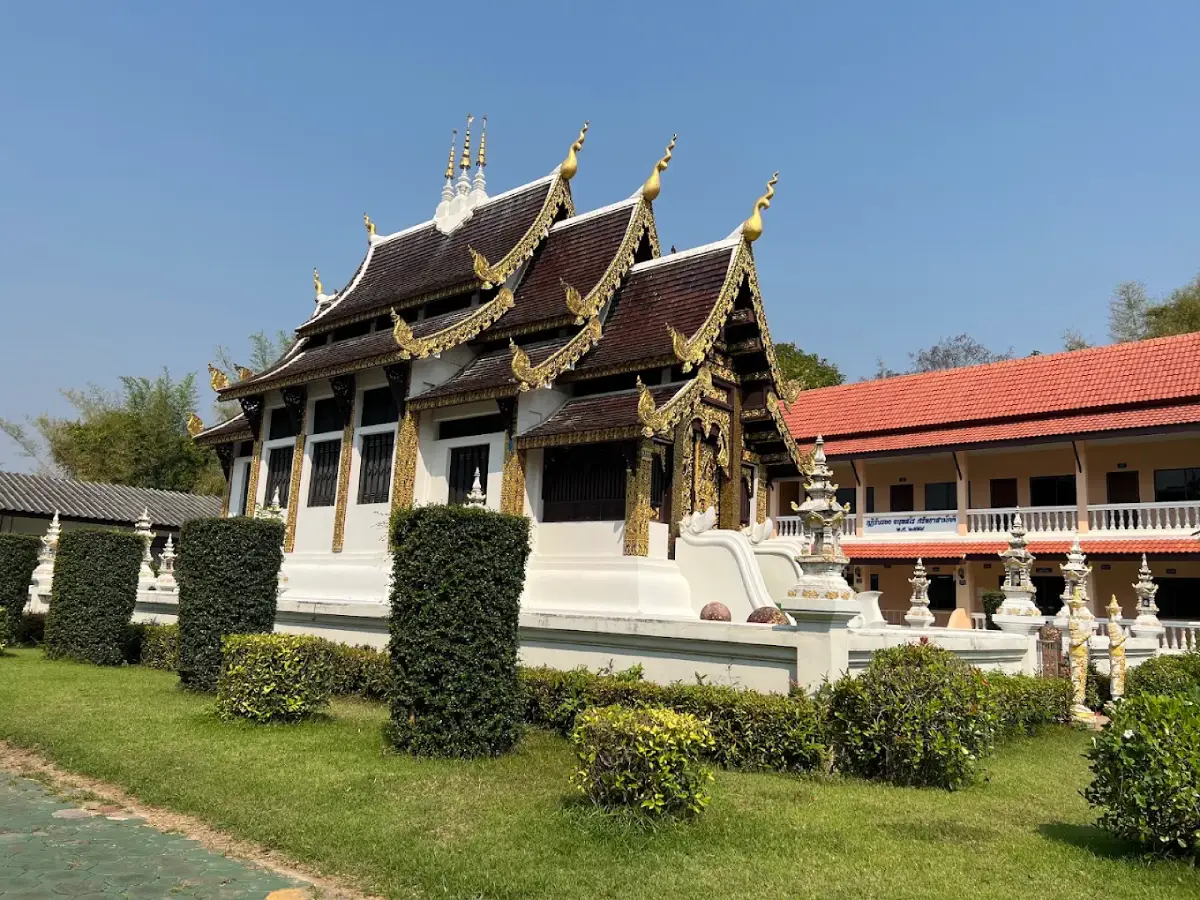
The main temple structures include a viharn, a Lanna-style ubosot, a multipurpose pavilion, an alms pavilion, and monks’ residences. The main sacred object is the chedi. These elements make Wat Thung Muen Noi a complete community temple. The viharn is used for worship and ceremonies, the ubosot is used for formal monastic rites, the pavilions support village merit-making, and the chedi functions as a major devotional focus.
The Lanna-style ubosot is one of the important points to observe. Lanna religious architecture often emphasizes calm proportions, rooflines, and harmony with the temple grounds. The ubosot is a sacred space for monastic acts, while the viharn is more accessible to devotees who come to pay respect, make merit, and join ceremonies on Buddhist holy days.
The chedi is a key sacred focus of Wat Thung Muen Noi, especially in the northern fifth lunar month water-pouring ceremony. In Lanna Buddhist culture, pouring water over a relic shrine or chedi expresses reverence for Buddhism and the sacred temple space. Villagers gather to make merit, pray, and renew their connection with the temple. This annual tradition keeps the temple active and visible to younger generations.
Wat Thung Muen Noi is also known for Tang Tham Luang and Mahachat sermon activities held around the end of the year together with year-end chanting. Tang Tham Luang is a demanding community ceremony that requires strong cooperation, preparation, space, and participation. At Wat Thung Muen Noi, it includes the chanting and preaching of all 13 chapters of the Vessantara Jataka and is connected with age-renewing or life-prolonging beliefs based on the zodiac cycle.
The event also includes a simulated Khao Wongkot, inspired by an episode from the Vessantara Jataka. This allows children and younger participants to experience Buddhist stories through an activity that is easier to understand and remember. The temple therefore becomes both a place of worship and a place of cultural learning.
Year-end chanting gives the temple a role in contemporary community life. Beginning the new year with chanting, listening to sermons, and calming the mind allows local devotees to enter the new year with mindfulness. When combined with Tang Tham Luang, Wat Thung Muen Noi connects old Lanna religious practice with the needs of modern community life.
Kathin is another important annual event at the temple after Buddhist Lent. Kathin brings local devotees together to offer robes and requisites to the monastic community. For a community temple like Wat Thung Muen Noi, Kathin is both a religious ceremony and a social act of unity. It supports the temple, strengthens local faith, and keeps the cycle of Buddhist generosity alive.
The current abbot appearing in recent public records is Phra Khru Chanthasarakarn. In earlier temple history, the name Phra Baidika Channarong Chantasaro appears in the line of abbots. The recorded succession of abbots includes Phra Inta Sumetho, Phra Boonpeng Thanathammo, Phra Pan Chakkathammo, Phra Boonpan Chantawangso, Phra Boonma Aphaso, Phra Chai Chayawuttho, Phra Duangchan Dhammapanyo, Phra Wichai Aggawanno, Phra Pathom Panyatharo, Phra Amnuay Aggadhammo, Phra Thotsaphon Dhammarato, Phra Athikan Amorn Chinawaro, and Phra Baidika Channarong Chantasaro.
This succession shows the continuity of care at Wat Thung Muen Noi across many generations. It also highlights the importance of Luang Pho Chai Chayawuttho in the temple’s revival and the continuing role of later abbots in sustaining ceremonies, community activities, and temple maintenance. In a village temple, the abbot’s role includes ritual leadership, care for monks, stewardship of buildings, and coordination with local devotees.
Wat Thung Muen Noi serves the community on several levels. Religiously, it is a place for worship, merit-making, sermons, and ceremonies. Socially, it is a gathering place where villagers return for important occasions. Culturally, it preserves Lanna traditions such as the Phra That water-pouring ceremony, Tang Tham Luang, Mahachat sermons, and year-end chanting. Educationally, these practices help children and younger generations understand Buddhist stories and local heritage.
Important points to see inside the temple include the viharn, Lanna-style ubosot, chedi, multipurpose pavilion, alms pavilion, and the overall temple atmosphere. Visitors should treat the chedi as a major devotional focus and observe the viharn and ubosot as spaces that support the religious life of the community. The temple is best visited quietly and respectfully rather than as a quick photo stop.
Wat Thung Muen Noi is suitable for visitors who want to understand community temples in the Mae Jo and San Sai area. Its story includes a deserted-temple period, revival through monastic leadership, living annual ceremonies, and a location close to the Chiang Mai–Phrao road. Visitors interested in old temples, Lanna culture, village history, and local merit-making traditions will find the temple meaningful beyond its physical appearance.
Wat Thung Muen Noi can be combined with nearby temples such as Wat Thung Pa Ket, Wat Mae Jo, Wat Mae Tao Hai, Wat Pa Bong, and Wat Huai Kiang. These temples form part of the village-temple network of Nong Han and Mae Jo. For a more relaxed itinerary, Tweechol Botanic Garden can be added as a green stop. This route is suitable for a half-day or full-day cultural trip focused on local temples and community life.
Getting There is easiest by private car, rental car, or ride-hailing service. Set the destination as Wat Thung Muen Noi, 289 Moo 9, Ban Thung Muen Noi, Nong Han Subdistrict, San Sai District, Chiang Mai Province. From Chiang Mai city, travel along the Chiang Mai–Phrao road toward Mae Jo and continue into the Ban Thung Muen Noi area. Allow extra time during morning and evening traffic because Mae Jo has schools, university traffic, shops, and local commuting routes.
Because Wat Thung Muen Noi is an active religious place, visitors should dress modestly, keep voices low, remove shoes where required, avoid touching Buddha images, the chedi, or sacred objects without permission, and give space to monks and local residents during ceremonies. If visiting during the Phra That water-pouring ceremony, Tang Tham Luang, year-end chanting, or Kathin, visitors should respect the community ritual before taking photographs.
| Name | Wat Thung Muen Noi |
| Location | Ban Thung Muen Noi, Moo 9, Nong Han Subdistrict, San Sai District, Chiang Mai Province |
| Address | 289 Moo 9, Ban Thung Muen Noi, Nong Han Subdistrict, San Sai District, Chiang Mai 50290, Thailand |
| Temple Type | Local Buddhist Temple |
| Buddhist Order | Maha Nikaya |
| Land Area | 4 Rai, 3 Ngan, 49 Square Wah |
| Highlights | Old community temple of San Sai that was once deserted and later revived; notable for its Lanna-style ubosot, viharn, chedi, Phra That water-pouring ceremony, Tang Tham Luang, Mahachat sermon, and year-end chanting |
| History | Registered as founded in 1897; previously a deserted temple with intermittent monastic residence before being revived during the time of Luang Pho Chai Chayawuttho |
| Name Origin | Associated with local oral traditions about land donation by Pho Ui Muen and Mae Ui Noi, or a donor connected with the rank of Muen |
| Sacred Object | Chedi of Wat Thung Muen Noi |
| Main Areas / Zones | Viharn, Lanna-style ubosot, multipurpose pavilion, alms pavilion, monks’ residences, and chedi |
| Abbot / Caretaker | Phra Khru Chanthasarakarn |
| Local Traditions / Activities | Northern fifth lunar month Phra That water-pouring ceremony, Tang Tham Luang, Mahachat sermon, year-end chanting, and Kathin ceremony |
| Travel Information | Accessible by private car, rental car, or ride-hailing service; set the destination as Wat Thung Muen Noi, 289 Moo 9, Nong Han Subdistrict, San Sai District, Chiang Mai Province |
| Current Status | Open as an active community temple with monks in residence |
| Open Days | Daily |
| Opening Hours | 08.00 – 17.00 |
| Main Contact Number | Wat Thung Muen Noi Tel. 053-869-516 |
| Nearby Tourist Attractions | 1. Wat Thung Pa Ket, about 4 km 2. Wat Mae Jo, about 4 km 3. Wat Mae Tao Hai, about 5 km 4. Wat Pa Bong, about 6 km 5. Tweechol Botanic Garden, about 12 km |
| Nearby Restaurants | 1. Baan Coffee Maison De Cafe, about 1 km, Tel. 089-755-1630 2. Khao Soi Prince Mae Jo, about 1 km, Tel. 089-435-3991 3. Café Amazon Mae Jo Front Branch, about 2 km, Tel. 082-679-5479 4. Laughter Coffee, about 3 km, Tel. 094-614-0088, 095-540-8132 5. Soul Café MJU Chiang Mai, about 4 km, Tel. 061-856-8988 |
| Nearby Accommodations | 1. Sky&Sea Apartment Soi Thung Muen Noi, about 1 km, Tel. 081-724-2333 2. MY Apartment Ban Thung Muen Noi Soi 1, about 1 km, Tel. 085-868-2525 3. Surachai Dormitory Mae Jo, about 3 km, Tel. 093-269-3869 4. The Slipper Resort Maejo, about 5 km, Tel. 063-336-9641 5. The Loft House Sansai, about 8 km, Tel. 089-759-8666 |
Frequently Asked Questions (FAQ)
Q: Where is Wat Thung Muen Noi located?
A: Wat Thung Muen Noi is located at 289 Moo 9, Ban Thung Muen Noi, Nong Han Subdistrict, San Sai District, Chiang Mai 50290, Thailand.
Q: What is historically important about Wat Thung Muen Noi?
A: Wat Thung Muen Noi is an old temple of San Sai District. It was once a deserted temple with intermittent monastic residence and later developed significantly during the time of Luang Pho Chai Chayawuttho.
Q: What are the main highlights of Wat Thung Muen Noi?
A: Highlights include the Lanna-style ubosot, viharn, chedi, Phra That water-pouring ceremony, Tang Tham Luang, Mahachat sermon, year-end chanting, and its role as a community temple.
Q: Who is the abbot of Wat Thung Muen Noi?
A: The current abbot appearing in recent public records is Phra Khru Chanthasarakarn.
Q: What are the opening hours of Wat Thung Muen Noi?
A: Wat Thung Muen Noi is open daily from 08.00 to 17.00. Visitors should dress modestly and respect the quiet atmosphere of the active temple.
Q: What annual ceremonies are associated with Wat Thung Muen Noi?
A: Important activities include the northern fifth lunar month Phra That water-pouring ceremony, Tang Tham Luang, Mahachat sermon, year-end chanting, and Kathin ceremony.
Q: What nearby places can be combined with a visit to Wat Thung Muen Noi?
A: Nearby places include Wat Thung Pa Ket, Wat Mae Jo, Wat Mae Tao Hai, Wat Pa Bong, and Tweechol Botanic Garden.
Q: What is the easiest way to reach Wat Thung Muen Noi?
A: The easiest way is by private car, rental car, or ride-hailing service. Set the destination as Wat Thung Muen Noi, 289 Moo 9, Nong Han Subdistrict, San Sai District, Chiang Mai Province.
 Category: ●Places of Worship
 Group: ●Temple
Last Update : 6 DayAgo
 Last Update : 6 DayAgo
 Click to Access the Navigation Map GPS
Wat Thung Muen Noi Map
Recommend

 Muang Chiang Mai(121)Chom Thong(47)Mae Chaem(25)Chiang Dao(33)Doi Saket(68)Mae Taeng(85)Mae Rim(69)Samoeng(29)Fang(71)Mae Ai(59)Phrao(70)San Pa Tong(103)San Kamphaeng(66)San Sai(73)Hang Dong(73)Hot(32)Doi Tao(22)Omkoi(11)Saraphi(74)Wiang Haeng(15)Chai Prakan(28)Mae Wang(32)Mae On(22)Doi Lo(33)Galyani Vadhana(1)


