
lovethailand home >North Travel Attractions >Chiang Mai Travel Attractions >San Sai >San Phra Net > Wat Mae Khao
TL;DR: Wat Mae Khao is located at Ban Mae Khao, Mu 2, San Phra Net Subdistrict, San Sai District, Chiang Mai Province, open Daily, hours 08.00 – 17.00.

Wat Mae Khao
Open Days: Daily
Opening Hours: 08.00 – 17.00
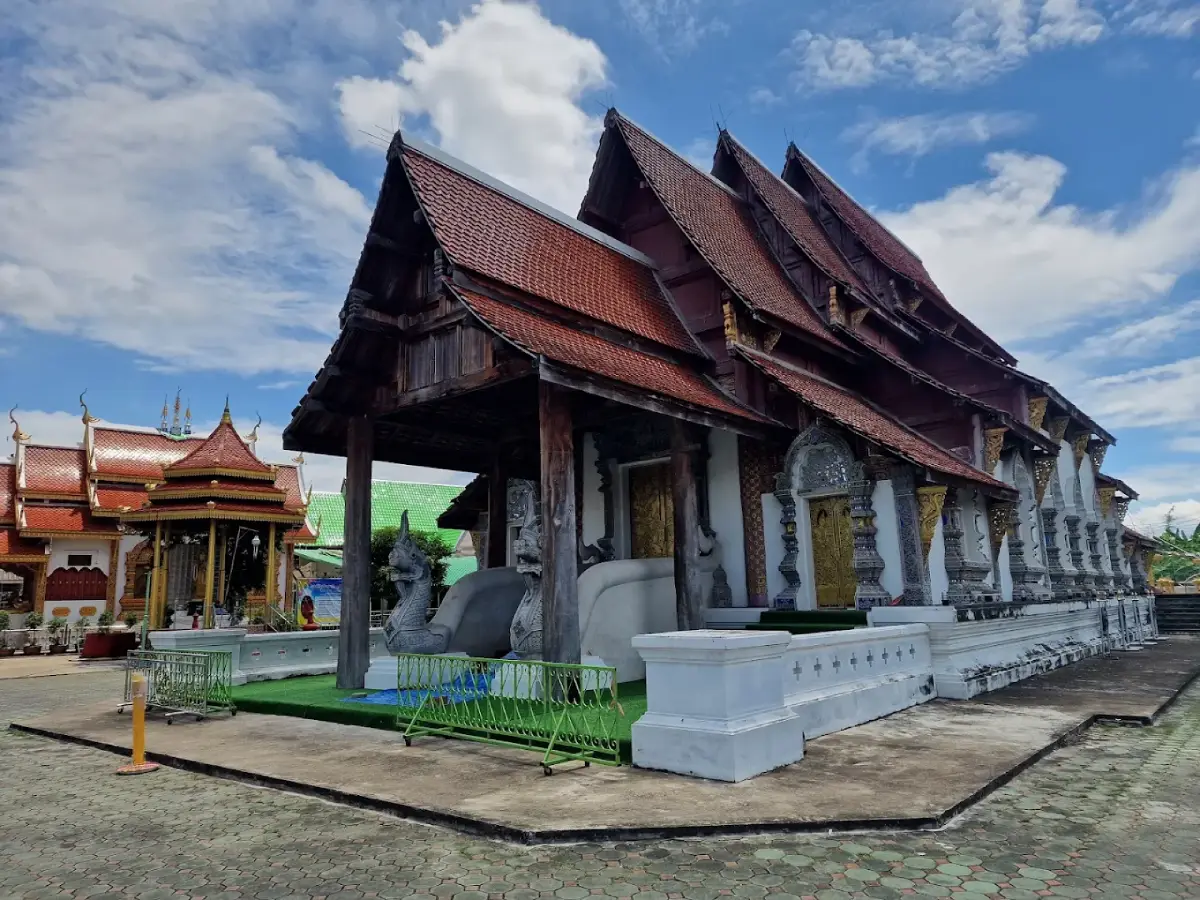
Wat Mae Khao is a local Buddhist temple under the Mahanikaya monastic order, located at 73 Ban Mae Khao, Mu 2, San Phra Net Subdistrict, San Sai District, Chiang Mai Province 50210. The temple was established in 1816 and received its royal consecrated boundary on 23 June 1971. It is one of the old community temples of San Phra Net and remains closely connected with village life, local waterways, rice fields, and Buddhist traditions.
Wat Mae Khao is suitable for visitors who want to experience a quiet local temple near Chiang Mai rather than a crowded tourist attraction. Its value lies in its long history, complete temple structures, chedi, Buddha image, manuscript-related religious space, and continuing role as a community Buddhist center for Ban Mae Khao.
The temple land covers 4 rai, 2 ngan, and 24 square wah under Nor Sor 3 document No. 32. It also has one monastic land plot covering 5 rai and 33 square wah. These land records show that the temple has long been embedded in the village landscape and has supported Buddhist activities for the surrounding community over many generations.
The temple boundaries show a close relationship with irrigation waterways, rice fields, and village homes. The north borders an irrigation channel, the south borders villagers’ rice fields, the east borders another irrigation channel, and the west borders local houses. This setting places Wat Mae Khao within a living Lanna village landscape shaped by water, agriculture, roads, and homes.
San Phra Net Subdistrict is part of San Sai District, northeast of Chiang Mai city. The area includes several local temples such as Wat Tha Thum, Wat Mae Khao, Wat San Phra Net, and Wat San Si. This pattern reflects the traditional northern Thai village structure in which each community has its own temple as a center for worship, merit-making, Dharma listening, and community ceremonies.
Wat Mae Khao was established in 1816, during a period when local temples around Chiang Mai developed from community faith and the need for nearby Buddhist centers. A village temple was not only a place for worship. It also served as a meeting place, moral center, ritual space, and shared point of identity for local residents.
The temple received its royal consecrated boundary on 23 June 1971. In Thai Buddhist practice, a consecrated boundary is important because it marks the formal area for monastic acts, especially ordination and other Sangha ceremonies. At Wat Mae Khao, this consecrated boundary measures 16 meters wide and 25 meters long.
Important temple structures include the ordination hall, viharn, Ho Phra Trai, ritual pavilion, monks’ residences, and kitchen. The temple’s sacred objects include a chedi and Buddha image. Together, these elements allow the temple to support formal monastic acts, worship, Dharma listening, manuscript preservation, food offerings, monk residence, community merit-making, and annual ceremonies.
The ordination hall is one of the most important sacred areas of the temple because it is connected with the consecrated boundary and formal monastic ceremonies. Visitors should dress modestly, speak quietly, remove shoes before entering religious buildings, and avoid entering restricted areas. Respectful behavior is especially important in a living community temple.
The viharn is the main worship space where local residents and visitors can pay respect, chant, listen to Dharma, and join ceremonies on important Buddhist occasions. In a Lanna community temple, the viharn is closely tied to village religious life and is often the most familiar sacred space for local residents.
The Ho Phra Trai gives Wat Mae Khao an additional dimension of religious learning. In Lanna Buddhist culture, such a structure is associated with the preservation of scriptures or Buddhist texts. Its presence reflects the temple’s role not only as a ritual space but also as a place connected with Buddhist knowledge and transmission.
The chedi is one of the temple’s important sacred objects. In Lanna Buddhist practice, a chedi is a devotional landmark where people pay respect, make merit, and reflect on Buddhist teachings. The Buddha image inside the temple provides a central point for prayer, chanting, merit-making, and quiet reflection.
The ritual pavilion and kitchen show the community function of the temple. These spaces support merit-making, food offerings, preparation for ceremonies, and lay participation in temple life. The monks’ residences allow resident monks and novices to maintain daily religious routines, making the temple an active Buddhist site rather than only a historic place.
The known succession of abbots includes Phra Athikan Kavil Kovito from 1816 to 1851, Phra Athikan Ano Aphiwatthano from 1852 to 1876, Phra Athikan Phimphisan Phutthasilo from 1877 to 1904, Phra Khru Un Ruean Sukhontho from 1905 to 1946, Phra Khru Winit Khunakorn Kinthachakko from 1947 to 1984, Phra Khun Chanthip Inthachoto, and Phra Khru Pairoj Phuripanyo. This succession reflects the temple’s long continuity of monastic leadership.
Local Sangha information identifies Phra Athikan Sermsuk Buddhasilo as the abbot associated with Wat Mae Khao, with resident monks and novices in the temple. In a community temple, the abbot plays an important role in maintaining religious activities, caring for temple structures, supporting merit-making events, and preserving the relationship between monks and local residents.
Wat Mae Khao remains important to Ban Mae Khao as a place for Buddhist holy day merit-making, Dharma listening, family ceremonies, and annual religious events. During major merit-making occasions, villagers often help prepare the temple, cook food, offer meals to monks, and support shared religious activities. These actions keep the temple active as a spiritual and social center.
Religious activities associated with Wat Mae Khao include Buddhist holy day merit-making, Dharma listening, Buddhist Lent, end-of-Lent activities, Kathin, Pha Pa offerings, Lanna New Year, Songkran, and ceremonies on important Buddhist dates. Kathin and Pha Pa are especially important because they bring villagers and supporters together to maintain the temple and support the monastic community.
During Lanna New Year or Songkran, local temples in Chiang Mai often become centers for merit-making, water-pouring ceremonies, offerings for ancestors, and community gatherings. Wat Mae Khao, as the village temple of Ban Mae Khao, helps connect families, local residents, and Buddhist customs through these annual traditions.
The atmosphere of Wat Mae Khao is calm, modest, and local. It is best suited to visitors who appreciate quiet community temples, old village temples, and Buddhist sites still connected with everyday village life. Its value lies not in large-scale tourism but in its long history, community role, temple structures, and relationship with local waterways and rice fields.
Visitors can respectfully observe the ordination hall, viharn, Ho Phra Trai, chedi, Buddha image, ritual pavilion, monks’ residences, kitchen, and temple courtyard. A visit should be slow and respectful, allowing time to understand how the temple relates to the surrounding irrigation channels, rice fields, houses, and community roads.
Visitors should dress modestly, speak quietly, remove shoes before entering religious buildings, avoid disturbing monks, novices, or worshippers, and refrain from entering private monastic areas without permission. If visiting during a ceremony or merit-making event, visitors should give priority to local residents participating in the ritual.
Getting There is most convenient by private car, rental car, or local transport. From Chiang Mai city, travel toward San Sai District and continue into San Phra Net Subdistrict and Ban Mae Khao, Mu 2. The temple can be combined with other nearby community temples in San Phra Net.
A meaningful route can begin at Wat Mae Khao to pay respect and learn about the old Ban Mae Khao community temple. Visitors can then continue to Wat Tha Thum, Wat San Phra Net, and Wat San Si. For a broader cultural route, Bo Sang Umbrella Village and Tweechol Botanic Garden can also be added depending on travel time and direction.
In summary, Wat Mae Khao is a local Mahanikaya temple in Ban Mae Khao, San Phra Net Subdistrict, San Sai District, Chiang Mai. Established in 1816 and granted its royal consecrated boundary in 1971, the temple has an ordination hall, viharn, Ho Phra Trai, ritual pavilion, monks’ residences, kitchen, chedi, and Buddha image. It is a meaningful stop for travelers who want to understand Chiang Mai’s quiet community temple culture beyond the main tourist routes.
| Name | Wat Mae Khao |
| Type | Local Buddhist Temple Under The Mahanikaya Order |
| Location | Ban Mae Khao, Mu 2, San Phra Net Subdistrict, San Sai District, Chiang Mai Province |
| Address | 73 Ban Mae Khao, Mu 2, San Phra Net Subdistrict, San Sai District, Chiang Mai 50210, Thailand |
| Main Contact Number | 053-492-083 |
| Highlights | Historic community temple established in 1816, with an ordination hall, viharn, Ho Phra Trai, chedi, Buddha image, and strong connection with Ban Mae Khao village life |
| History | Established in 1816 and received its royal consecrated boundary on 23 June 1971 |
| Consecrated Boundary | 16 meters wide and 25 meters long |
| Distinctive Features | Lanna community temple connected with irrigation channels, villagers’ rice fields, local houses, and the temple network of San Phra Net Subdistrict |
| Temple Area | 4 rai, 2 ngan, and 24 square wah under Nor Sor 3 document No. 32 |
| Monastic Land | One plot covering 5 rai and 33 square wah |
| Boundaries | North: irrigation channel; South: villagers’ rice fields; East: irrigation channel; West: local houses |
| Important Structures | Ordination hall, viharn, Ho Phra Trai, ritual pavilion, monks’ residences, and kitchen |
| Sacred Objects | Chedi and Buddha image |
| Main Areas / Zones | Ordination hall area, viharn, Ho Phra Trai, chedi, Buddha image worship area, ritual pavilion, monks’ residences, kitchen, and temple courtyard for community activities |
| Abbot | Phra Athikan Sermsuk Buddhasilo |
| Former Abbots | Phra Athikan Kavil Kovito, Phra Athikan Ano Aphiwatthano, Phra Athikan Phimphisan Phutthasilo, Phra Khru Un Ruean Sukhontho, Phra Khru Winit Khunakorn Kinthachakko, Phra Khun Chanthip Inthachoto, and Phra Khru Pairoj Phuripanyo |
| Traditions / Merit-Making Events | Buddhist holy day merit-making, Dharma listening, Buddhist Lent, end-of-Lent activities, Kathin, Pha Pa offerings, Lanna New Year, Songkran, and ceremonies on important Buddhist dates |
| Current Status | Listed as a Mahanikaya temple in San Phra Net Subdistrict, San Sai District, Chiang Mai, with local Sangha information showing resident monks and novices |
| Open Days | Daily |
| Opening Hours | 08.00 – 17.00 |
| Travel Information | Best reached by private car, rental car, or local transport from Chiang Mai city toward San Sai District, San Phra Net Subdistrict, and Ban Mae Khao, Mu 2 |
| Nearby Tourist Attractions | 1. Wat Tha Thum, about 2 km 2. Wat San Phra Net, about 3 km 3. Wat San Si, about 4 km 4. Bo Sang Umbrella Village, about 6 km 5. Tweechol Botanic Garden, about 9 km |
| Nearby Restaurants | 1. Jin Hu Chinese Herbal Stew Chiang Mai, about 2 km, Tel. 063-432-2104 2. Mala Mai Kha, San Sai Hospital Branch, about 3 km, Tel. 094-957-4658 3. Kuai Tiao Rot Chan PTT San Phra Net, about 3 km, Tel. 080-821-7475 4. Pi La Noodle Shop San Phra Net, about 3 km, Tel. 064-042-4186 5. Rak Ahlong Chicken Rice, about 4 km, Tel. 094-724-6109 |
| Nearby Accommodations | 1. Baan San Sai, about 2 km, Tel. 089-851-8343 2. The NicheHome Waterside Living, about 3 km, Tel. 081-847-5759 3. The Greenery Central Suites Apartment & Hotel, about 4 km, Tel. 090-606-0609 4. moon 11 boutique home, about 4 km, Tel. 085-863-6448 5. Horizon Village & Resort, about 9 km, Tel. 053-292-381 |
Frequently Asked Questions (FAQ)
Q: Where is Wat Mae Khao located?
A: Wat Mae Khao is located at 73 Ban Mae Khao, Mu 2, San Phra Net Subdistrict, San Sai District, Chiang Mai 50210, Thailand.
Q: Is Wat Mae Khao open daily?
A: Yes. It is listed as open daily from 08.00 to 17.00.
Q: Why is Wat Mae Khao historically important?
A: Wat Mae Khao was established in 1816 and received its royal consecrated boundary on 23 June 1971, with a consecrated area measuring 16 meters by 25 meters.
Q: What important structures can visitors see at Wat Mae Khao?
A: Visitors can see the ordination hall, viharn, Ho Phra Trai, ritual pavilion, monks’ residences, kitchen, chedi, Buddha image, and temple courtyard.
Q: Who is the abbot of Wat Mae Khao?
A: Local Sangha information identifies Phra Athikan Sermsuk Buddhasilo as the abbot associated with Wat Mae Khao.
Q: What type of traveler is Wat Mae Khao suitable for?
A: It is suitable for travelers who enjoy quiet community temples, old village temples, and local Buddhist culture in San Sai District.
Q: What religious events are associated with Wat Mae Khao?
A: The temple is associated with Buddhist holy day merit-making, Dharma listening, Buddhist Lent, end-of-Lent activities, Kathin, Pha Pa offerings, Lanna New Year, Songkran, and ceremonies on important Buddhist dates.
Q: What nearby places can be visited with Wat Mae Khao?
A: Nearby places include Wat Tha Thum, Wat San Phra Net, Wat San Si, Bo Sang Umbrella Village, and Tweechol Botanic Garden.
 Category: ●Places of Worship
 Group: ●Temple
Last Update : 1 MonthAgo
 Last Update : 1 MonthAgo
 Click to Access the Navigation Map GPS

 Muang Chiang Mai(121)Chom Thong(47)Mae Chaem(25)Chiang Dao(33)Doi Saket(68)Mae Taeng(85)Mae Rim(69)Samoeng(29)Fang(71)Mae Ai(59)Phrao(70)San Pa Tong(103)San Kamphaeng(66)San Sai(73)Hang Dong(73)Hot(32)Doi Tao(22)Omkoi(11)Saraphi(74)Wiang Haeng(15)Chai Prakan(28)Mae Wang(32)Mae On(22)Doi Lo(33)Galyani Vadhana(1)


