
lovethailand home >North Travel Attractions >Chiang Mai Travel Attractions >San Sai >San Phra Net > Wat Tha Thum
TL;DR: Wat Tha Thum is located at Ban Tha Thum, Mu 4, San Phra Net Subdistrict, San Sai District, Chiang Mai Province, open Daily, hours 08.00 – 17.00.

Wat Tha Thum
Open Days: Daily
Opening Hours: 08.00 – 17.00
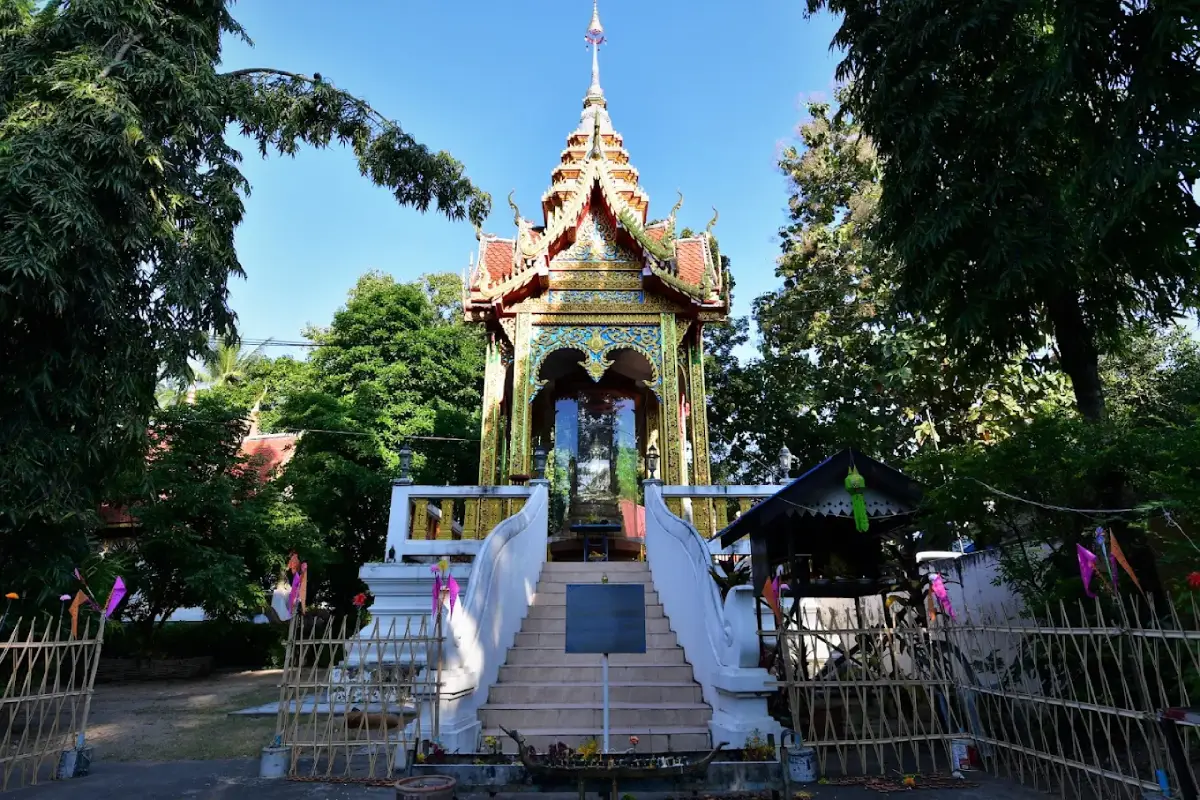
Wat Tha Thum is a local Buddhist temple under the Mahanikaya monastic order, located at 136 Ban Tha Thum, Mu 4, San Phra Net Subdistrict, San Sai District, Chiang Mai Province 50210. The temple was established in 1841 and received its royal consecrated boundary on 23 June 1971. It remains an important community temple for Ban Tha Thum and San Phra Net, serving both religious and cultural roles.
Wat Tha Thum is suitable for visitors who want to experience a quiet local temple in San Sai rather than a crowded tourist site. Its value lies in its long history, its name connected with a riverside tree, its functioning temple structures, and its role in preserving Lanna performing arts through youth activities involving sword dance and Jaiya Mongkhon drum practice.
The name Wat Tha Thum comes from a local landscape memory. In the past, there was a tree called mai thum near a riverside landing. The word tha refers to a landing or waterside access point, while thum refers to the tree associated with the site. The temple name therefore preserves the relationship between the temple, water, local trees, and the memory of Ban Tha Thum.
The temple land covers 3 rai under a Nor Sor 3 document. Its boundaries show a strong relationship with the village landscape: the north borders a public irrigation channel, the south borders rice fields, the east borders a road, and the west borders rice fields. This setting places Wat Tha Thum within a living Lanna village landscape shaped by water, agriculture, and local movement.
San Phra Net Subdistrict includes several community temples, including Wat Tha Thum, Wat Mae Khao, Wat San Phra Net, and Wat San Si. This pattern reflects the traditional northern Thai village structure in which each community has its own temple as a center for worship, merit-making, Dharma listening, ceremonies, and community identity.
Wat Tha Thum was established in 1841. At that time, many village temples around Chiang Mai developed from local faith and the community’s need for a nearby Buddhist center. A village temple served not only as a place of worship but also as a space for listening to Dharma, gathering as a community, and organizing social and religious activities.
The temple received its royal consecrated boundary on 23 June 1971. In Thai Buddhist practice, a consecrated boundary is important because it marks the formal area for monastic acts, especially ordination and other Sangha ceremonies. This status confirms the temple’s full religious function within the local Buddhist community.
Important temple structures include the ordination hall, viharn, ritual pavilion, monks’ residences, and kitchen. The temple’s sacred object is a Buddha image. Each structure supports a specific function. The ordination hall is connected with formal monastic acts, the viharn is the main worship space, the ritual pavilion supports merit-making activities, the monks’ residences support daily monastic life, and the kitchen is important during community merit-making events.
The ordination hall should be treated with special respect because it is connected with the temple’s consecrated boundary and formal monastic ceremonies. Visitors should dress modestly, speak quietly, remove shoes before entering religious buildings, and avoid entering restricted areas. Respectful behavior is especially important in a living village temple.
The viharn is the main space for worship, chanting, Dharma listening, and religious ceremonies. In a Lanna community temple, the viharn is often the most familiar sacred space for local residents. It is used on Buddhist holy days, during Buddhist Lent, after Lent, during Kathin, Pha Pa offerings, and at family ceremonies.
The ritual pavilion and kitchen show the community function of the temple. They support merit-making, food offerings, preparation for ceremonies, and lay participation in temple life. The monks’ residences allow resident monks and novices to maintain daily religious routines, making the temple an active religious site rather than only a historic place.
Local Sangha information identifies Phra Khru Praphat Sarakhun, Sayan Attasaro Chaisuk, as the abbot associated with Wat Tha Thum. The temple also has resident monks and novices, reflecting its continuing role as an active Buddhist temple in San Phra Net. The abbot’s role in a community temple includes maintaining religious activities, caring for temple structures, and preserving the relationship between monks and local residents.
The known line of former abbots includes Phra Athikan Ut Uttamachitto from 1841 to 1871, Phra Athikan Panya Panyatharo from 1871 to 1896, Phra Athikan Not Nathasilo from 1896 to 1916, Phra Athikan Bunpan Dhammakamo from 1949 to 1964, Phra Athikan Thon Thitadhammo from 1964 to 1974, Phra Si Thon Thitasilo from 1974 to 1979, and Phra Thongsuk Silasaro from 1979 to 1984. This succession reflects long-term monastic care for the temple and community.
Wat Tha Thum is also significant for its role in Lanna performing arts. The temple has supported youth interested in traditional Lanna performance, including sword dance and Jaiya Mongkhon drum practice, through the group known as the Buddhist Youth Group of Wat Tha Thum. This makes the temple a cultural learning space as well as a religious site.
Sword dance is a northern Thai performing art that combines movement, discipline, strength, and martial aesthetics. Jaiya Mongkhon or Chai Mongkhon drumming is associated with Lanna musical heritage, ceremonies, auspicious occasions, and community identity. The use of Wat Tha Thum as a training space helps keep these traditions connected with younger generations.
The Buddhist Youth Group of Wat Tha Thum reflects the role of temples as cultural institutions. Learning traditional arts requires discipline, teachers, practice space, and community support. Through such activities, young people learn not only dance and rhythm but also respect for teachers, teamwork, and pride in local heritage.
Wat Tha Thum remains important to Ban Tha Thum and San Phra Net as a place for Buddhist holy day merit-making, Dharma listening, family ceremonies, and annual merit-making events. It connects elders, families, children, young people, and local supporters through religious and cultural activities.
Religious activities associated with Wat Tha Thum include Buddhist holy day merit-making, Dharma listening, Buddhist Lent, end-of-Lent activities, Kathin, Pha Pa offerings, Lanna New Year, Songkran, and ceremonies on important Buddhist dates. These events help keep the temple active as a spiritual and social center for the community.
During Lanna New Year or Songkran, local temples in Chiang Mai often become centers for merit-making, water-pouring ceremonies, offerings for ancestors, and community gatherings. Wat Tha Thum, as the village temple of Ban Tha Thum, helps connect families, local residents, and Buddhist customs through these annual traditions.
The atmosphere of Wat Tha Thum is calm, local, and culturally meaningful. It is best suited to visitors who appreciate quiet community temples, local Buddhist history, and Lanna cultural heritage. The temple is not defined by large-scale tourism but by its relationship with the village, its religious function, and its role in transmitting local performing arts.
Visitors can respectfully observe the ordination hall, viharn, Buddha image, ritual pavilion, monks’ residences, kitchen, and temple courtyard. A visit should be slow and respectful, allowing time to understand how the temple relates to the surrounding irrigation channel, rice fields, road, and village community.
Visitors should dress modestly, speak quietly, remove shoes before entering religious buildings, avoid disturbing monks or worshippers, and refrain from entering private monastic areas without permission. If visiting during a ceremony or cultural practice session, visitors should give priority to the activity of the temple community.
Getting There is most convenient by private car, rental car, or local transport. From Chiang Mai city, travel toward San Sai District and continue into San Phra Net Subdistrict and Ban Tha Thum, Mu 4. The temple can be combined with other nearby community temples in San Phra Net.
A meaningful route can begin at Wat Tha Thum to pay respect and learn about the temple’s riverside-name origin. Visitors can then continue to Wat Mae Khao, Wat San Phra Net, and Wat San Si. For a broader cultural route, Bo Sang Umbrella Village and Tweechol Botanic Garden can also be added, depending on travel time and direction.
In summary, Wat Tha Thum is a local Mahanikaya temple in Ban Tha Thum, San Phra Net Subdistrict, San Sai District, Chiang Mai. Established in 1841, granted its royal consecrated boundary in 1971, and associated with Lanna youth performing arts, the temple is a meaningful stop for travelers who want to understand Chiang Mai’s quiet community temple culture beyond the main tourist routes.
| Name | Wat Tha Thum |
| Type | Local Buddhist Temple Under The Mahanikaya Order |
| Location | Ban Tha Thum, Mu 4, San Phra Net Subdistrict, San Sai District, Chiang Mai Province |
| Address | 136 Ban Tha Thum, Mu 4, San Phra Net Subdistrict, San Sai District, Chiang Mai 50210, Thailand |
| Main Contact Number | 053-384-157 |
| Highlights | Historic village temple established in 1841, named after a thum tree near a riverside landing, and associated with Lanna sword dance and Jaiya Mongkhon drum practice |
| History | Established in 1841 and received its royal consecrated boundary on 23 June 1971 |
| Name Origin | The name comes from a thum tree that stood near a riverside landing in the original local landscape |
| Distinctive Features | Lanna community temple connected with public irrigation waterways, rice fields, village roads, and local performing arts transmission |
| Temple Area | 3 rai under a Nor Sor 3 document |
| Boundaries | North: public irrigation channel; South: rice fields; East: road; West: rice fields |
| Important Structures | Ordination hall, viharn, ritual pavilion, monks’ residences, and kitchen |
| Sacred Object | Buddha image |
| Main Areas / Zones | Ordination hall area, viharn, Buddha image worship area, ritual pavilion, monks’ residences, kitchen, and temple courtyard for community activities |
| Abbot | Phra Khru Praphat Sarakhun, Sayan Attasaro Chaisuk |
| Former Abbots | Phra Athikan Ut Uttamachitto, Phra Athikan Panya Panyatharo, Phra Athikan Not Nathasilo, Phra Athikan Bunpan Dhammakamo, Phra Athikan Thon Thitadhammo, Phra Si Thon Thitasilo, and Phra Thongsuk Silasaro |
| Cultural Role | Training space for Lanna sword dance and Jaiya Mongkhon drum practice through the Buddhist Youth Group of Wat Tha Thum |
| Traditions / Merit-Making Events | Buddhist holy day merit-making, Dharma listening, Buddhist Lent, end-of-Lent activities, Kathin, Pha Pa offerings, Lanna New Year, Songkran, and ceremonies on important Buddhist dates |
| Current Status | Registered as a local Mahanikaya temple in San Phra Net Subdistrict, San Sai District, Chiang Mai, and active in local religious and cultural activities |
| Open Days | Daily |
| Opening Hours | 08.00 – 17.00 |
| Travel Information | Best reached by private car, rental car, or local transport from Chiang Mai city toward San Sai District, San Phra Net Subdistrict, and Ban Tha Thum, Mu 4 |
| Nearby Tourist Attractions | 1. Wat Mae Khao, about 2 km 2. Wat San Phra Net, about 3 km 3. Wat San Si, about 4 km 4. Bo Sang Umbrella Village, about 6 km 5. Tweechol Botanic Garden, about 9 km |
| Nearby Restaurants | 1. Jin Hu Chinese Herbal Stew Chiang Mai, about 2 km, Tel. 063-432-2104 2. Kuai Tiao Rot Chan PTT San Phra Net, about 3 km, Tel. 080-821-7475 3. Pi La Noodle Shop San Phra Net, about 3 km, Tel. 064-042-4186 4. Rak Ahlong Chicken Rice, about 4 km, Tel. 094-724-6109 5. Krit Ocha Chicken Rice San Sai Branch, about 5 km, Tel. 086-659-6620, 053-217-913 |
| Nearby Accommodations | 1. Baan San Sai, about 2 km, Tel. 089-851-8343 2. The NicheHome Waterside Living, about 3 km, Tel. 081-847-5759 3. The Greenery Central Suites Apartment & Hotel, about 4 km, Tel. 090-606-0609 4. IM Residence Chiang Mai, about 4 km, Tel. 081-681-2840 5. Horizon Village & Resort, about 9 km, Tel. 053-292-381 |
Frequently Asked Questions (FAQ)
Q: Where is Wat Tha Thum located?
A: Wat Tha Thum is located at 136 Ban Tha Thum, Mu 4, San Phra Net Subdistrict, San Sai District, Chiang Mai 50210, Thailand.
Q: Is Wat Tha Thum open daily?
A: Yes. It is listed in this article as open daily from 08.00 to 17.00.
Q: Why is Wat Tha Thum historically important?
A: Wat Tha Thum was established in 1841 and received its royal consecrated boundary on 23 June 1971.
Q: What is the origin of the name Wat Tha Thum?
A: The name comes from a thum tree that stood near a riverside landing in the original local landscape.
Q: What important structures can visitors see at Wat Tha Thum?
A: Visitors can see the ordination hall, viharn, ritual pavilion, monks’ residences, kitchen, and Buddha image worship area.
Q: Who is the abbot of Wat Tha Thum?
A: The abbot associated with Wat Tha Thum in local Sangha information is Phra Khru Praphat Sarakhun, Sayan Attasaro Chaisuk.
Q: What cultural role is Wat Tha Thum known for?
A: Wat Tha Thum is associated with youth training in Lanna sword dance and Jaiya Mongkhon drum practice through the Buddhist Youth Group of Wat Tha Thum.
Q: What nearby places can be visited with Wat Tha Thum?
A: Nearby places include Wat Mae Khao, Wat San Phra Net, Wat San Si, Bo Sang Umbrella Village, and Tweechol Botanic Garden.
 Category: ●Places of Worship
 Group: ●Temple
Last Update : 2 MonthAgo
 Last Update : 2 MonthAgo
 Click to Access the Navigation Map GPS

 Muang Chiang Mai(121)Chom Thong(47)Mae Chaem(25)Chiang Dao(33)Doi Saket(68)Mae Taeng(85)Mae Rim(69)Samoeng(29)Fang(71)Mae Ai(59)Phrao(70)San Pa Tong(103)San Kamphaeng(66)San Sai(73)Hang Dong(73)Hot(32)Doi Tao(22)Omkoi(11)Saraphi(74)Wiang Haeng(15)Chai Prakan(28)Mae Wang(32)Mae On(22)Doi Lo(33)Galyani Vadhana(1)


