
lovethailand home >North Travel Attractions >Chiang Mai Travel Attractions >San Sai >San Pa Pao > Wat San Pa Khang
TL;DR: Wat San Pa Khang is located at Ban Pa Kang, Mu 2, San Pa Pao Subdistrict, San Sai District, Chiang Mai Province, open Daily, hours 08.00 – 17.00.

Wat San Pa Khang
Open Days: Daily
Opening Hours: 08.00 – 17.00
Wat San Pa Khang is a local Buddhist temple under the Mahanikaya monastic order, located in Ban Pa Kang, Mu 2, San Pa Pao Subdistrict, San Sai District, Chiang Mai Province 50210. The temple is an old community temple of Ban Pa Kang, established in 1752, and it continues to serve as a place for worship, merit-making, Dharma listening, and community Buddhist activities.
Wat San Pa Khang is suitable for visitors who want to experience a quiet local temple rather than a crowded tourist attraction. Its value lies in its long history, its connection with Ban Pa Kang, its functioning temple structures, and its continuing role in community merit-making. The temple is a meaningful stop for travelers who want to understand Chiang Mai’s local Lanna Buddhist culture beyond the main tourist routes.
San Pa Pao Subdistrict is a suburban area of Chiang Mai that still preserves agricultural roots, waterways, public irrigation channels, and village-based relationships. Wat San Pa Khang should therefore be understood as a village temple shaped by roads, irrigation systems, rice fields, and community life. It is part of the living landscape of Ban Pa Kang rather than an isolated religious site.
The name San Pa Khang reflects the local identity of Ban Pa Kang in Mu 2 of San Pa Pao Subdistrict. In northern Thai usage, san often relates to a raised ridge or local topographic feature, while Pa Kang refers to the village name and surrounding community. The temple name therefore preserves the relationship between place, landscape, and village memory.
The temple was established in 1752, during a period when many Lanna village temples emerged from the faith and cooperation of local residents. A village temple served not only as a place of worship, but also as a center for Dharma learning, community gathering, ceremonies, and shared identity. The continued presence of Wat San Pa Khang reflects the long continuity of Buddhist faith in Ban Pa Kang.
The temple land covers 1 rai, 2 ngan, and 90 square wah under a Nor Sor 3 document. The known boundaries include the north, which borders a public road and irrigation channel, and the west, which borders villagers’ rice fields. These boundaries show how closely the temple is connected with local movement, water management, and agriculture.
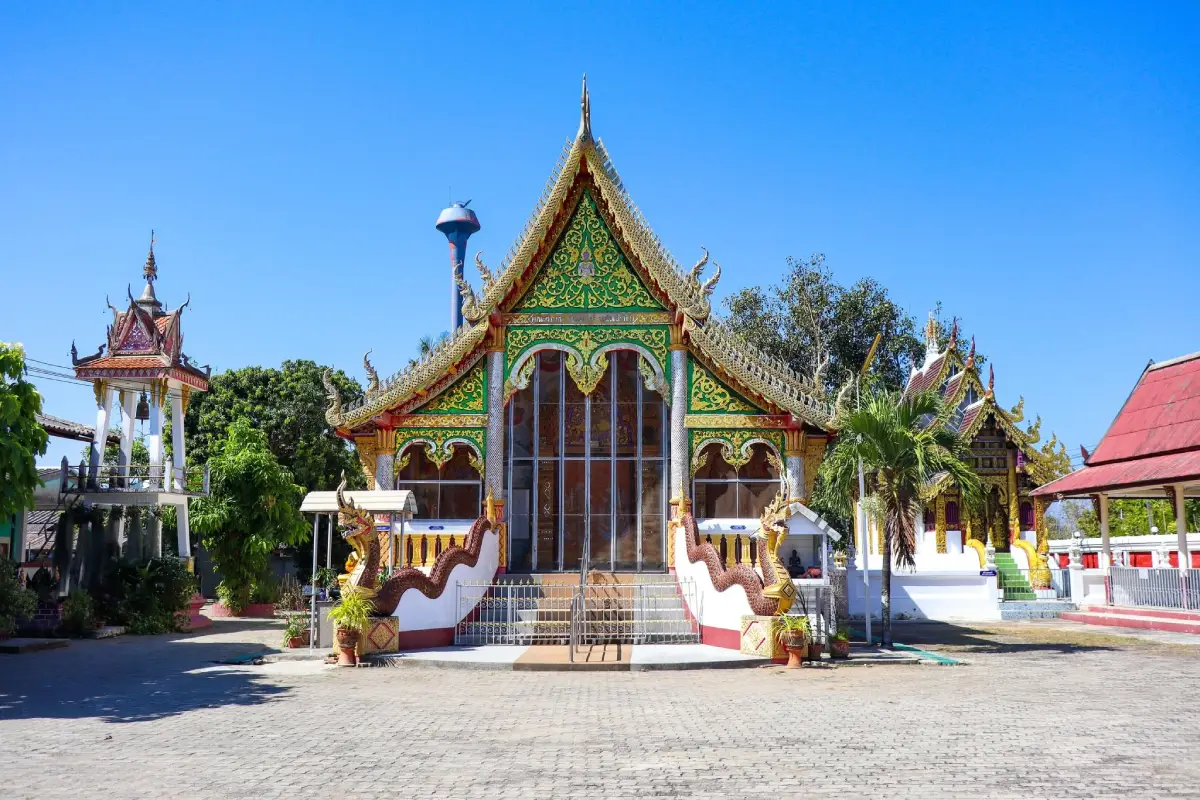
Important temple structures include the viharn, ritual pavilion, monks’ residences, and bell tower. The viharn is the main worship and ceremony space. The ritual pavilion supports merit-making and food offering activities. The monks’ residences allow monastic life to continue, while the bell tower is a symbolic and functional part of the village temple environment.
The viharn is the main sacred space that visitors should treat with respect. In a Lanna community temple, the viharn is closely connected with everyday religious life. Local residents gather there for worship, chanting, Dharma listening, Buddhist holy days, Buddhist Lent, end-of-Lent activities, and annual merit-making events.
The ritual pavilion reflects the lay community’s participation in temple life. It is connected with alms offerings, food preparation, and merit-making gatherings. The monks’ residences support daily monastic routines, while the bell tower links temple activities with village rhythm and local religious awareness.
The known succession of abbots includes Phra Suk Pajoto from 1871 to 1892, Phra Nuan Rin Chiao from 1893 to 1907, Phra Athikan Kham Ai Intachakko from 1909 to 1961, Phra Chamnong from 1977 to 1979, Phra Pan from 1983 to 1984, and Phra Athikan Sonthaya Siriwatthano as the current abbot associated with the temple. This succession reflects long-term monastic care and the continuity of temple leadership.
Phra Athikan Sonthaya Siriwatthano plays an important role in the temple’s present community life. In a village temple, the abbot is responsible not only for religious ceremonies but also for coordinating community merit-making, maintaining temple structures, and preserving the relationship between monks and local residents.
Wat San Pa Khang remains active as a place for community merit-making. Recent community events show villagers, local leaders, and supporters coming together to support temple maintenance, improve monastic facilities, and prepare temple spaces for ceremonies, funerals, and important community activities. This reflects the living role of the temple in Ban Pa Kang.
The temple remains important to the local community as a place for Buddhist holy day merit-making, Dharma listening, family ceremonies, and annual religious events. During major merit-making occasions, villagers often help prepare the temple, cook food, offer meals to monks, and support shared religious activities. These acts keep the temple active as a spiritual and social center.
Religious activities associated with Wat San Pa Khang include Buddhist holy day merit-making, Dharma listening, Buddhist Lent, end-of-Lent activities, Kathin, Pha Pa offerings, Lanna New Year, and ceremonies on important Buddhist dates. Kathin and Pha Pa are especially important because they bring villagers and supporters together to maintain the temple and support the monastic community.
During Lanna New Year or Songkran, local temples in Chiang Mai often become centers for merit-making, water-pouring ceremonies, offerings for ancestors, and community gatherings. Wat San Pa Khang, as the village temple of Ban Pa Kang, helps connect families, local residents, and Buddhist traditions through these annual customs.
The atmosphere of Wat San Pa Khang is calm, modest, and local. It is best suited to visitors who appreciate quiet community temples, historic village temples, and Buddhist sites still connected with everyday village life. The temple is not defined by large-scale tourism but by its long history, community support, and active role in local religious practice.
Visitors can respectfully observe the viharn, ritual pavilion, monks’ residences, bell tower, and temple courtyard. A visit should be slow and quiet, allowing time to understand how the temple relates to the nearby road, irrigation channel, rice fields, and Ban Pa Kang community.
Visitors should dress modestly, speak quietly, remove shoes before entering religious buildings, avoid disturbing monks or worshippers, and refrain from entering private monastic areas without permission. If visiting during a ceremony or merit-making event, visitors should give priority to local residents participating in the ritual and observe respectfully before taking photographs.
Getting There is most convenient by private car, rental car, or local transport. From Chiang Mai city, travel toward San Sai District and San Pa Pao Subdistrict, then continue to Ban Pa Kang, Mu 2. The temple can be combined with other nearby temples and community attractions in San Pa Pao.
A meaningful route can begin at Wat San Pa Khang to pay respect and learn about the Ban Pa Kang community temple. Visitors can then continue to Wat Phayak Noi, Wat Ton Sarn, Wat San Ton Pao, and Tweechol Botanic Garden. This route combines village religion, local history, community culture, and a nature-based stop in the San Sai and Doi Saket area.
In summary, Wat San Pa Khang is a local Mahanikaya temple in Ban Pa Kang, San Pa Pao Subdistrict, San Sai District, Chiang Mai. Established in 1752, with a viharn, ritual pavilion, monks’ residences, and bell tower, and led by Phra Athikan Sonthaya Siriwatthano, the temple is a meaningful stop for travelers who want to understand Chiang Mai’s quiet local Lanna Buddhist culture beyond the main tourist routes.
| Name | Wat San Pa Khang |
| Type | Local Buddhist Temple Under The Mahanikaya Order |
| Location | Ban Pa Kang, Mu 2, San Pa Pao Subdistrict, San Sai District, Chiang Mai Province |
| Address | 113 Mu 2, San Pa Pao Subdistrict, San Sai District, Chiang Mai 50210, Thailand |
| Main Contact Number | 053-868-444 |
| Highlights | Historic village temple of Ban Pa Kang, established in 1752, with a viharn, ritual pavilion, monks’ residences, and bell tower |
| History | Established in 1752 as a local Mahanikaya temple in San Pa Pao Subdistrict, San Sai District |
| Distinctive Features | Lanna community temple connected with Ban Pa Kang, public roads, irrigation waterways, villagers’ rice fields, and local merit-making traditions |
| Temple Area | 1 rai, 2 ngan, and 90 square wah, Nor Sor 3 document |
| Boundaries | North: public road and irrigation channel; West: villagers’ rice fields |
| Important Structures | Viharn, ritual pavilion, monks’ residences, and bell tower |
| Main Areas / Zones | Viharn area, ritual pavilion, monks’ residential area, bell tower, and temple courtyard for community activities |
| Abbot | Phra Athikan Sonthaya Siriwatthano |
| Former Abbots | Phra Suk Pajoto, Phra Nuan Rin Chiao, Phra Athikan Kham Ai Intachakko, Phra Chamnong, and Phra Pan |
| Traditions / Merit-Making Events | Buddhist holy day merit-making, Dharma listening, Buddhist Lent, end-of-Lent activities, Kathin, Pha Pa offerings, Lanna New Year, and ceremonies on important Buddhist dates |
| Current Status | Registered as a local Mahanikaya temple in San Pa Pao Subdistrict, San Sai District, Chiang Mai, and still active as a community merit-making site of Ban Pa Kang |
| Open Days | Daily |
| Opening Hours | 08.00 – 17.00 |
| Travel Information | Best reached by private car, rental car, or local transport from Chiang Mai city toward San Sai District, San Pa Pao Subdistrict, and Ban Pa Kang, Mu 2 |
| Nearby Tourist Attractions | 1. Wat Phayak Noi, about 3 km 2. Wat Ton Sarn, about 4 km 3. Wat San Ton Pao, about 4 km 4. Tweechol Botanic Garden, about 6 km 5. Ban San Ton Pao Community Route, about 4 km |
| Nearby Restaurants | 1. PunThai Coffee San Sai 3, about 3 km, Tel. 061-030-3470 2. Nueng Phleng Sushi Home, about 3 km, Tel. 090-320-0325, 095-048-5819 3. JinnyLlama Coffee and Matcha San Pa Pao, about 4 km 4. Bingsu Mobile Branch 1 San Ton Pao, about 4 km, Tel. 063-850-4105 5. Baan Coffee Horizon, about 6 km, Tel. 098-983-5896 |
| Nearby Accommodations | 1. Is Am O Chiangmai Resort, about 4 km, Tel. 053-867-284, 083-885-4747, 083-885-5757 2. Horizon Village & Resort, about 6 km, Tel. 053-292-381-5 3. Suwanna Tara Resort & Spa, about 8 km, Tel. 053-291-937 4. Palm Villa - Modern Luxury & Exclusive Villa Resort, about 8 km, Tel. 064-597-6494 5. Fern Paradise Hotel, about 9 km, Tel. 084-687-2474 |
Frequently Asked Questions (FAQ)
Q: Where is Wat San Pa Khang located?
A: Wat San Pa Khang is located in Ban Pa Kang, Mu 2, San Pa Pao Subdistrict, San Sai District, Chiang Mai 50210, Thailand.
Q: Is Wat San Pa Khang open daily?
A: Yes. It is listed as open daily from 08.00 to 17.00.
Q: Why is Wat San Pa Khang historically important?
A: Wat San Pa Khang was established in 1752, making it an old community temple of Ban Pa Kang in San Pa Pao Subdistrict.
Q: What important structures can visitors see at Wat San Pa Khang?
A: Visitors can see the viharn, ritual pavilion, monks’ residences, bell tower, and temple courtyard.
Q: Who is the abbot of Wat San Pa Khang?
A: The abbot is Phra Athikan Sonthaya Siriwatthano.
Q: What type of traveler is Wat San Pa Khang suitable for?
A: It is suitable for travelers who enjoy quiet community temples, old village temples, and local Buddhist culture in San Sai District.
Q: What religious events are associated with Wat San Pa Khang?
A: The temple is associated with Buddhist holy day merit-making, Dharma listening, Buddhist Lent, end-of-Lent activities, Kathin, Pha Pa offerings, Lanna New Year, and ceremonies on important Buddhist dates.
Q: What nearby places can be visited with Wat San Pa Khang?
A: Nearby places include Wat Phayak Noi, Wat Ton Sarn, Wat San Ton Pao, Tweechol Botanic Garden, and the Ban San Ton Pao community route.
 Category: ●Places of Worship
 Group: ●Temple
Last Update : 2 MonthAgo
 Last Update : 2 MonthAgo
 Click to Access the Navigation Map GPS

 Muang Chiang Mai(121)Chom Thong(47)Mae Chaem(25)Chiang Dao(33)Doi Saket(68)Mae Taeng(85)Mae Rim(69)Samoeng(29)Fang(71)Mae Ai(59)Phrao(70)San Pa Tong(103)San Kamphaeng(66)San Sai(73)Hang Dong(73)Hot(32)Doi Tao(22)Omkoi(11)Saraphi(74)Wiang Haeng(15)Chai Prakan(28)Mae Wang(32)Mae On(22)Doi Lo(33)Galyani Vadhana(1)


