
lovethailand home >North Travel Attractions >Chiang Mai Travel Attractions >San Sai >Muang Len > Wat Khua Sung
TL;DR: Wat Khua Sung is located at Ban Khua Sung, Moo 1, Mueang Len Subdistrict, San Sai District, Chiang Mai Province.

Wat Khua Sung
Operating day: Daily
Operating time: 08.00 - 17.00
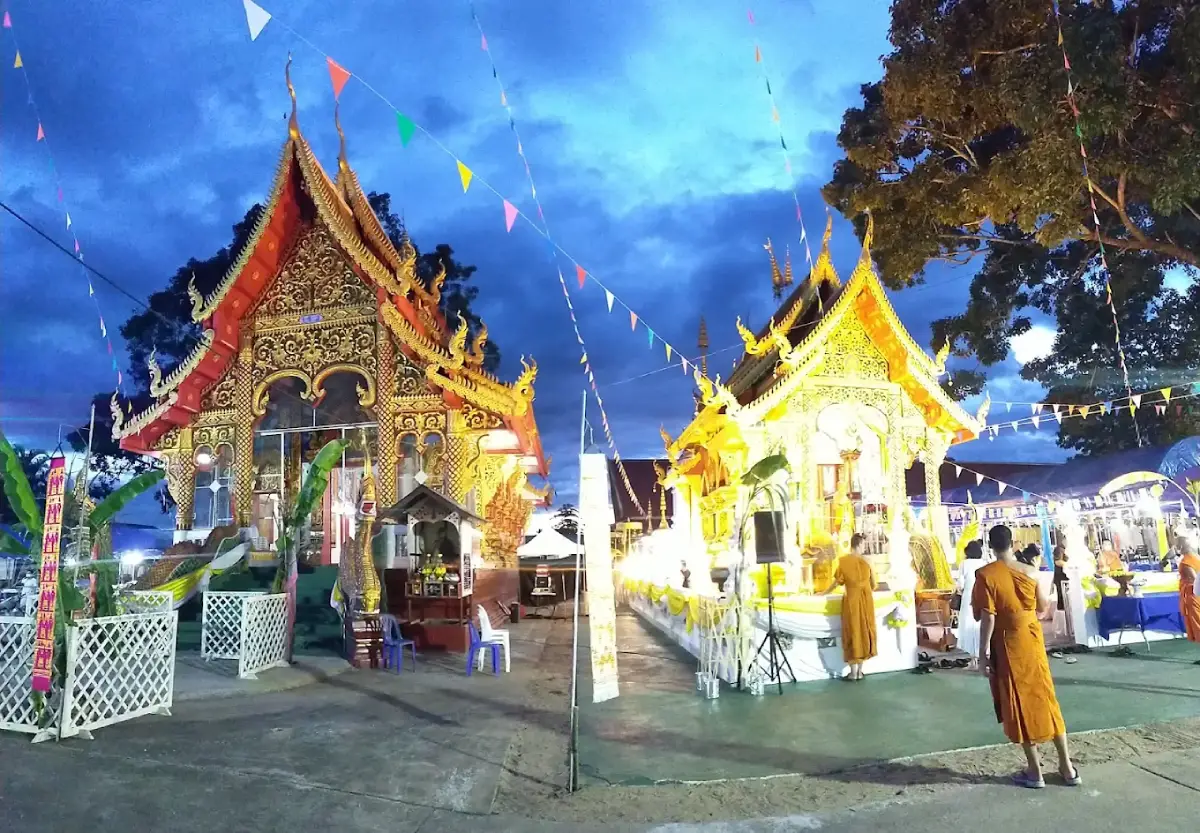
Wat Khua Sung is a local Buddhist temple under the Mahanikaya order, located at No. 83, Ban Khua Sung, Moo 1, Mueang Len Subdistrict, San Sai District, Chiang Mai Province. The temple was officially permitted to be established in 1840 according to the temple history used as the main source for this article. It is an important community temple of Ban Khua Sung, notable for its old Thai-style vihara, teakwood craftsmanship, hip-roofed sala bat, teak monks’ residences, and a Chiang Saen-period Phra Phuttha Sihing Buddha image brought from Kengtung.
Ban Khua Sung is part of Mueang Len Subdistrict in San Sai District, a community area northwest of central San Sai. Mueang Len is shaped by foothill plains, the Mae Kuang water system, irrigation canals, agricultural land, village roads, and Buddhist temples. Wat Khua Sung therefore stands within a living cultural landscape where temples, houses, fields, water systems, and local travel routes remain closely connected.
The name Khua Sung carries a strong local sense of place. In northern Thai usage, khua often refers to a bridge or crossing, while sung means high or elevated. The name suggests a place connected with movement, passage, and local geography. As both the village name and the temple name, Khua Sung preserves the memory of the community and the physical landscape around it.
The temple land covers 4 rai, 2 ngan, and 66 square wah under document No. 279. The temple boundary connects with private orchards, villagers’ land, pathways, and agricultural fields. This setting shows that Wat Khua Sung is deeply embedded in the everyday life of the village. It is not isolated from the community; it stands among homes, fields, and local movement routes.
The temple’s historical abbots include Phra Athikan Kham Saen, Phra Athikan In Laeng, Phra Athikan Bunma, Phra Athikan Si Mun Phromupamo, Phra Athikan Prathip Chitwiriyo, Phra Udom Panyawachiro, Phra Bunmek Mahawiro, Phra Thawi Kantasaro, and Phra Charoen Siridhammo. This succession indicates the temple’s continuity across generations of monastic leadership and community faith.
Contemporary records show more than one abbot-related reference. A local temple directory lists Phra Khru Sutjai Katakijjo, while a 2022 Chiang Mai Provincial Office of Buddhism report identifies Phra Athikan Annop Dhammaratano as the abbot who joined a land-boundary inspection for Wat Khua Sung. This article uses the more recent official government record for the current caretaker field, while preserving the earlier directory reference in the source notes after the article.
The most distinctive structure at Wat Khua Sung is its old Thai-style vihara. Its chofa and bai raka are made of carved teakwood with lacquer and gilding. This detail reveals the value of local craftsmanship and Lanna Buddhist architecture. The vihara is not only a worship hall but also a cultural object that preserves the skill, faith, and aesthetic tradition of the community.
Other important structures include a hip-roofed sala bat and monks’ residences built of teakwood. The sala bat supports food offerings, merit-making, and community gatherings, while the teak monks’ residences support monastic life. Together, these structures reflect the temple’s role as both a sacred site and a community space where monks and villagers maintain a close relationship.
The temple’s most important sacred object is a Chiang Saen-period Phra Phuttha Sihing Buddha image brought from Kengtung. Phra Phuttha Sihing is a name of deep religious significance in Lanna Buddhist culture, and the Kengtung connection gives the image wider cultural meaning. It links Wat Khua Sung with the broader movement of Buddhist art, devotion, and monastic culture across the Lanna and Kengtung cultural sphere.
Kengtung has long been connected with many Lanna temple histories, especially through migration, monastic networks, devotional objects, and shared Buddhist artistic styles. The presence of a Chiang Saen-period Phra Phuttha Sihing image from Kengtung gives Wat Khua Sung a stronger historical and cultural identity than its small village scale might suggest.
The main highlights for visitors are the old Thai-style vihara, teakwood decorative elements, the sala bat, teak monks’ residences, and the Phra Phuttha Sihing image. Wat Khua Sung is not a large tourist temple. Its value lies in its quiet community atmosphere, its local architecture, its sacred image, and its continuing role as the spiritual center of Ban Khua Sung.
Wat Khua Sung serves as the spiritual center of Ban Khua Sung. Villagers use the temple for paying respect, making merit, listening to sermons, and joining Buddhist ceremonies throughout the year. In a village temple, religious activities also strengthen social relationships among elders, families, children, youth, and former residents who return during festivals.
Religious activities at Wat Khua Sung follow the Buddhist calendar and local Lanna practice. Important occasions include Buddhist holy days, Makha Bucha, Visakha Bucha, Asalha Bucha, Buddhist Lent, the end of Buddhist Lent, Kathin, robe-offering activities, and Ban Khua Sung community merit-making events. These activities keep the temple active and maintain the relationship between temple and village.
Kathin and robe-offering activities are especially important for a local temple. They allow villagers and supporters to help maintain the monastic community, temple structures, religious ceremonies, and the temple grounds. Kathin is not only a Buddhist rite; it is also an annual gathering that renews the bond between the village and the temple.
Mueang Len Subdistrict has several nearby temples that can be connected into a local cultural route, including Wat Mueang Len, Wat Mueang Wa, Wat Hua Fai, and Wat Nong Kon Khru. Wat Mueang Len is known for its reclining Buddha image, Wat Hua Fai has a history connected with a monk from Kengtung, and Wat Khua Sung is distinctive for its teakwood vihara elements and Phra Phuttha Sihing image.
Visitors interested in local history should pay special attention to the vihara and the Phra Phuttha Sihing image. The vihara preserves local craftsmanship, while the Buddha image preserves the broader devotional connection between Chiang Saen, Kengtung, and Lanna Buddhist culture. A slow and respectful visit will reveal more than a quick stop for photographs.
Getting There is convenient by private car or motorcycle. From Chiang Mai city, travel toward San Sai and Mae Jo, then continue into Mueang Len Subdistrict and proceed to Ban Khua Sung, Moo 1. The temple can be combined with Wat Mueang Len, Wat Mueang Wa, Wat Hua Fai, Wat Nong Kon Khru, the Mae Kuang water landscape, and local restaurants or accommodations in the Mueang Len area.
A meaningful route can begin at Wat Khua Sung to pay respect and see the old vihara, then continue to Wat Mueang Len for the reclining Buddha, Wat Hua Fai for its community history, Wat Mueang Wa, and Wat Nong Kon Khru. This route gives visitors a quieter and more local view of San Sai beyond the better-known tourist areas of Chiang Mai.
Visitors should dress modestly, keep their voices low, avoid entering monks’ private areas without permission, and photograph sacred areas respectfully. Wat Khua Sung remains an active community temple, so it should be treated first as a place of worship and village faith rather than a purely touristic site.
Overall, Wat Khua Sung is an old and meaningful local temple of Ban Khua Sung, Moo 1, Mueang Len Subdistrict, San Sai District, Chiang Mai. Its strongest value lies in its establishment in 1840, its 4 rai 2 ngan 66 square wah temple land, its old Thai-style vihara with carved and gilded teakwood elements, its hip-roofed sala bat, teak monks’ residences, and its Chiang Saen-period Phra Phuttha Sihing image brought from Kengtung. It is a worthwhile stop for travelers who want to understand a quieter and more authentic side of Chiang Mai’s Lanna village temple culture.
| Name | Wat Khua Sung |
| Location | Ban Khua Sung, Moo 1, Mueang Len Subdistrict, San Sai District, Chiang Mai Province |
| Address | No. 83, Ban Khua Sung, Moo 1, Mueang Len Subdistrict, San Sai District, Chiang Mai 50210, Thailand |
| Type | Local Buddhist temple under the Mahanikaya order |
| Abbot / Contemporary Caretaker | Phra Athikan Annop Dhammaratano |
| Coordinates | 18.88186, 99.08445 |
| Highlights | Old Thai-style vihara, carved and gilded teakwood decorative elements, hip-roofed sala bat, teak monks’ residences, and a Chiang Saen-period Phra Phuttha Sihing Buddha image brought from Kengtung |
| History | Officially permitted to be established as a temple in 1840, serving as an old community temple of Ban Khua Sung in Mueang Len Subdistrict |
| Temple Land Area | 4 rai, 2 ngan, and 66 square wah under document No. 279 |
| Name Origin | The name Khua Sung is connected with Ban Khua Sung and the local landscape; in northern Thai, khua often refers to a bridge or crossing |
| Main Areas / Zones | Old Thai-style vihara, hip-roofed sala bat, teak monks’ residences, temple courtyard, worship area, and Ban Khua Sung community merit-making space |
| Important Structures | Old Thai-style vihara with carved and gilded teakwood chofa and bai raka, hip-roofed sala bat, and teak monks’ residences |
| Important Sacred Object | Chiang Saen-period Phra Phuttha Sihing Buddha image brought from Kengtung |
| Area Context | Mueang Len Subdistrict is a foothill-plain community area with the Mae Kuang water system, irrigation canals, agricultural land, and village temples |
| Community Role | Spiritual center of Ban Khua Sung, used for merit-making, sermons, Kathin, robe-offering activities, Buddhist holy days, and community ceremonies |
| Traditions / Merit-Making | Buddhist holy days, major Buddhist festivals, Buddhist Lent, the end of Buddhist Lent, Kathin, robe-offering activities, and Ban Khua Sung community merit-making events |
| Travel Information | From Chiang Mai city, travel toward San Sai and Mae Jo, continue into Mueang Len Subdistrict, and proceed to Ban Khua Sung, Moo 1. The route is suitable for private cars or motorcycles. |
| Current Status | Open as a local Buddhist temple and community sacred site of Ban Khua Sung, Mueang Len Subdistrict, San Sai District, Chiang Mai |
| Facilities | Worship area, temple courtyard, sala bat, and community religious activity area |
| Nearby Tourist Attractions | 1. Wat Mueang Len, Mueang Len Subdistrict, about 2–3 km 2. Wat Mueang Wa, Mueang Len Subdistrict, about 3–4 km 3. Wat Hua Fai, Mueang Len Subdistrict, about 4–5 km 4. Wat Nong Kon Khru, Mueang Len Subdistrict, about 5–6 km 5. Mae Kuang water landscape and Mueang Len farming communities, about 5–7 km 6. Mae Kuang Udom Thara Dam, Doi Saket District, about 12–15 km |
| Nearby Restaurants | 1. Kap Khao Ban Mae, Mueang Len, about 2–3 km, Tel. 088-576-1511 2. Pizza Na Ban, Mueang Len, about 2–3 km, Tel. 090-328-6104, 081-946-6542 3. Sai Jai Restaurant, Mueang Len, about 3–4 km, Tel. 080-672-9539 4. Chaliang Coffee, Mueang Len, about 4–5 km, Tel. 090-979-5009 5. Kinlum Kindee Sansai, about 5–7 km, Tel. 082-656-3941 6. Phu Cafe, Mueang Len, about 3–4 km |
| Nearby Accommodations | 1. Ban Nong Resort, Mueang Len, about 3–5 km, Tel. 089-266-1687 2. Rabiang Dao Resort 95, Mueang Len, about 4–6 km, Tel. 089-428-9945 3. B3 Home Resort & Restaurant, Mueang Len, about 5–7 km, Tel. 090-946-0400 4. Lanna Saithong Resort, Mueang Len, about 5–7 km, Tel. 053-255-371 5. Nok Resort & Hotel, Mueang Len–Nong Yaeng area, about 6–8 km, Tel. 080-679-9270 |
Frequently Asked Questions (FAQ)
Q: Where is Wat Khua Sung located?
A: Wat Khua Sung is located at No. 83, Ban Khua Sung, Moo 1, Mueang Len Subdistrict, San Sai District, Chiang Mai 50210, Thailand.
Q: What type of temple is Wat Khua Sung?
A: Wat Khua Sung is a local Buddhist temple under the Mahanikaya order and serves as a sacred community site for Ban Khua Sung.
Q: When was Wat Khua Sung established?
A: Wat Khua Sung was officially permitted to be established as a temple in 1840 according to the temple history used as the main source for this article.
Q: What is Wat Khua Sung known for?
A: The temple is known for its old Thai-style vihara with carved and gilded teakwood decorative elements, hip-roofed sala bat, teak monks’ residences, and a Chiang Saen-period Phra Phuttha Sihing Buddha image brought from Kengtung.
Q: What is the most important sacred object at Wat Khua Sung?
A: The most important sacred object is a Chiang Saen-period Phra Phuttha Sihing Buddha image brought from Kengtung.
Q: Who is the current caretaker or abbot of Wat Khua Sung?
A: A contemporary record from the Chiang Mai Provincial Office of Buddhism identifies Phra Athikan Annop Dhammaratano as the abbot involved in the temple’s monastic land-boundary work.
Q: How do visitors get to Wat Khua Sung?
A: From Chiang Mai city, travel toward San Sai and Mae Jo, continue into Mueang Len Subdistrict, and proceed to Ban Khua Sung, Moo 1. Private car or motorcycle is convenient.
Q: What nearby places can be visited on the same trip?
A: Nearby places include Wat Mueang Len, Wat Mueang Wa, Wat Hua Fai, Wat Nong Kon Khru, the Mae Kuang water landscape, and Mae Kuang Udom Thara Dam.
 Category: ●Places of Worship
 Group: ●Temple
Last Update : 5 DayAgo
 Last Update : 5 DayAgo
 Click to Access the Navigation Map GPS
 Muang Chiang Mai(121)Chom Thong(47)Mae Chaem(25)Chiang Dao(33)Doi Saket(68)Mae Taeng(85)Mae Rim(69)Samoeng(29)Fang(71)Mae Ai(59)Phrao(70)San Pa Tong(103)San Kamphaeng(66)San Sai(73)Hang Dong(73)Hot(32)Doi Tao(22)Omkoi(11)Saraphi(74)Wiang Haeng(15)Chai Prakan(28)Mae Wang(32)Mae On(22)Doi Lo(34)Galyani Vadhana(1)


