
lovethailand home >North Travel Attractions >Chiang Mai Travel Attractions >San Sai >Mae Faek Mai > Wat Sop Faek
TL;DR: Wat Sop Faek is located at Ban Sop Faek, Moo 2, Mae Faek Mai Subdistrict, San Sai District, Chiang Mai Province.

Wat Sop Faek
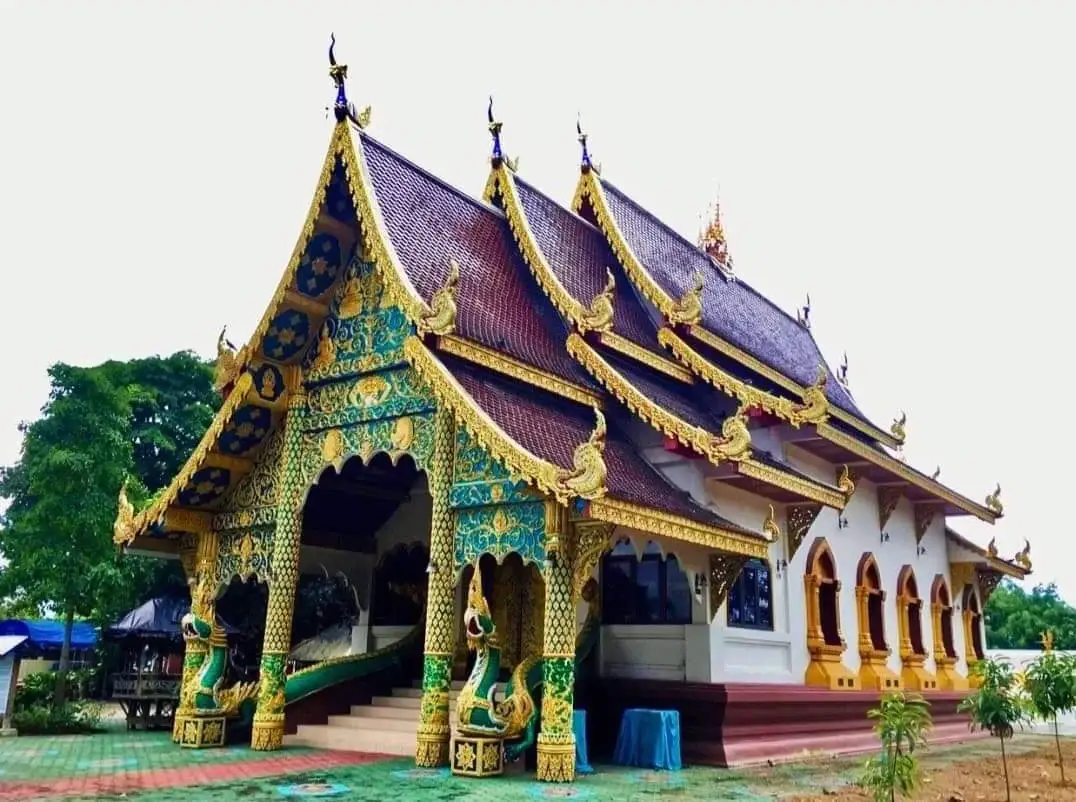
Operating day: Daily
Operating time: 08.00 - 17.00
Wat Sop Faek in Ban Sop Faek, Moo 2, Mae Faek Mai Subdistrict, San Sai District, Chiang Mai Province, is an old local Buddhist temple under the Mahanikaya order. Officially permitted to be established in 1860, the temple is one of the older community temples in Mae Faek Mai. Its history is closely connected with the Ping River, Mae Faek stream, Ban Sop Faek, and a Burmese-style chedi that existed before villagers moved into the area and established the community temple.
The temple is located in Moo 2, Mae Faek Mai Subdistrict, San Sai District, Chiang Mai 50290, Thailand. It lies within the wider cultural landscape of northern San Sai, connected with the Chiang Mai–Phrao route, also known as Highway 1001. This route links Chiang Mai city, Mae Jo, San Sai, Mae Faek, Mae Faek Mai, and northern Chiang Mai, making Wat Sop Faek suitable for a connected community-temple itinerary through Mae Faek Mai.
The most distinctive feature of Wat Sop Faek is its Burmese-style chedi. Temple history records that this chedi existed before villagers moved into the area and built their village temple. This gives Wat Sop Faek deeper historical meaning than a newly established village temple, because the sacred site appears to have been present before the later growth of Ban Sop Faek.
The temple was formerly known as Wat Ping, named after the Ping River flowing behind the temple. Later, because the site is close to the place where Mae Faek water flows into the Ping River, the temple became known as Wat Sop Faek, following the name of Ban Sop Faek. In northern Thai usage, sop often refers to a confluence or a place where waterways meet. The temple name therefore preserves both local geography and community memory.
Wat Sop Faek must be understood together with its water landscape. The Ping River flows behind the temple, while Mae Faek water meets the Ping River nearby. In Lanna communities, rivers and irrigation systems were not only water sources; they shaped settlement, agriculture, transportation, and community identity. Wat Sop Faek therefore stands within a cultural landscape where temple, village, river, and agricultural life are closely connected.
The temple’s establishment in 1860 is also associated with the restoration of the chedi. Temple history records that the chedi had collapsed after a later earthquake and was restored. This restoration reflects the faith of the local community, which did not allow an important sacred monument to disappear. Repairing the chedi was both an act of religious devotion and an act of preserving local memory.
The Burmese-style chedi is therefore the temple’s most important sacred structure. Visitors should pay respect to the chedi and take time to observe its context. It is the historical core of the temple and a visible sign that Ban Sop Faek has been connected with Buddhism for a long time.
Wat Sop Faek serves as the spiritual center of Ban Sop Faek. Villagers come to the temple to pay respect, make merit, listen to sermons, and join Buddhist ceremonies. The temple supports family merit-making, community rituals, Kathin, robe-offering activities, Buddhist holy days, and other religious events that bring villagers together throughout the year.
Phra Athikan Sarayut Chantarongsi is listed as the abbot of Wat Sop Faek in the temple information used for this article. In a community temple, the abbot helps maintain temple activities, care for the monastic community, coordinate merit-making events, and preserve the relationship between monks and villagers. This role is essential for keeping a village temple active and meaningful.
Historically, Wat Sop Faek tells a layered story. The first layer is the Burmese-style chedi that existed before the later village settlement. The second layer is the settlement of villagers near the Ping River and Mae Faek stream. The third layer is the change from the name Wat Ping to Wat Sop Faek, reflecting the temple’s relationship with the river confluence and the village name.
The temple’s relationship with the Ping River gives it a distinct identity among the community temples of Mae Faek Mai. While some nearby temples are known for settlement history, education, or irrigation-canal legends, Wat Sop Faek is especially linked with the river landscape. The Ping River is one of northern Thailand’s major rivers and has long shaped settlement, agriculture, movement, and local memory in Chiang Mai.
The main site to observe and pay respect to is the Burmese-style chedi. Publicly available details about other specific monastic buildings at Wat Sop Faek are limited, so the temple should be appreciated through its chedi, its history, its riverside context, and its community role. This slower and more contextual way of visiting helps reveal the temple’s true significance.
Wat Sop Faek is suitable for visitors interested in old riverside temples, community Buddhism, Lanna local history, and temple routes outside Chiang Mai city. It is not a large city landmark, but a quiet village temple whose value lies in history, faith, water landscape, and the relationship between temple and community.
The temple is also a meaningful stop on a Mae Faek Mai temple route. Wat Mae Faek dates back to 1557, Wat Chedi Mae Krua is known for its old chedi and irrigation-canal story, Wat Khua Mung has educational and welfare roles, Wat Wang Khum Ngern represents a more recent village temple, and Wat Sop Faek is distinctive for its Burmese-style chedi and riverside setting.
A connected itinerary can begin at Wat Sop Faek to understand the Ping River and Mae Faek water context, then continue to Wat Mae Faek, Wat Chedi Mae Krua, Wat Khua Mung, Wat Wang Khum Ngern, and Wat Huai Bong Watthanaram. This route helps visitors understand how temples in Mae Faek Mai preserve settlement history, water systems, village identity, and Buddhist faith.
Religious activities at Wat Sop Faek follow the Buddhist calendar and local Lanna practice. Important occasions include Buddhist holy days, Makha Bucha, Visakha Bucha, Asalha Bucha, Buddhist Lent, the end of Buddhist Lent, Kathin, robe-offering activities, and Ban Sop Faek community merit-making events. These activities keep the relationship between the temple and village active throughout the year.
Kathin is especially important for a local temple. During Kathin, villagers and devotees offer robes and support the maintenance of the temple and monastic life. It is not only a religious ceremony but also an annual gathering that brings together villagers, former residents, and supporters who remain connected to the temple.
Robe-offering activities and other merit-making events also help sustain the temple. Maintaining an old temple such as Wat Sop Faek requires the faith of many generations, especially in caring for the chedi, preserving the temple grounds, organizing ceremonies, and passing down the story of the temple to younger generations.
Visitors interested in Lanna culture should approach Wat Sop Faek quietly and respectfully. The temple is best appreciated by paying respect to the chedi, observing the surrounding village and river context, and understanding how the temple name preserves the meeting of Mae Faek water and the Ping River. Its value is found in the relationship between sacred architecture, water, and community life.
Getting There is convenient by private car or motorcycle. From Chiang Mai city, take Highway 1001 or the Chiang Mai–Phrao road toward San Sai and Mae Jo, then continue into Mae Faek Mai Subdistrict and proceed to Ban Sop Faek, Moo 2. The temple is located within the local community near the Ping River and the Mae Faek water context.
Visitors should allow around 30–60 minutes to pay respect, observe the chedi, and understand the temple’s riverside context. For a deeper cultural trip, Wat Sop Faek can be combined with Wat Mae Faek, Wat Chedi Mae Krua, Wat Khua Mung, Wat Wang Khum Ngern, Wat Huai Bong Watthanaram, Wat Nong Ma Chap, and Wat Phra That Chom Kitti.
Visitors should dress modestly, keep their voices low, avoid entering monks’ private areas without permission, and photograph sacred areas respectfully. Wat Sop Faek remains an active community temple, so it should be treated first as a place of worship and village faith rather than a purely touristic site.
Overall, Wat Sop Faek is an old and meaningful community temple of Ban Sop Faek, Moo 2, Mae Faek Mai Subdistrict. Its strongest value lies in its establishment in 1860, the Burmese-style chedi that existed before the later village settlement, the former name Wat Ping, its relationship with the Ping River and Mae Faek water, and its role as the spiritual center of Ban Sop Faek. It is a worthwhile stop for travelers who want to understand a quieter, deeper, and more authentic side of Chiang Mai’s Lanna riverside temple culture.
| Name | Wat Sop Faek |
| Location | Ban Sop Faek, Moo 2, Mae Faek Mai Subdistrict, San Sai District, Chiang Mai Province |
| Address | Moo 2, Mae Faek Mai Subdistrict, San Sai District, Chiang Mai 50290, Thailand |
| Type | Local Buddhist temple under the Mahanikaya order |
| Abbot / Caretaker | Phra Athikan Sarayut Chantarongsi |
| Highlights | Burmese-style chedi, old temple near the Ping River, connection with Mae Faek water, former name Wat Ping, and quiet Lanna community temple atmosphere |
| History | Officially permitted to be established as a temple in 1860. The Burmese-style chedi existed before villagers moved into the area and built the village temple. |
| Former Name | Wat Ping, named after the Ping River flowing behind the temple, before the name was changed to Wat Sop Faek after Ban Sop Faek |
| Name Origin | The name Sop Faek is connected with the area near Mae Faek water flowing into the Ping River, preserving the local river-confluence identity |
| Main Areas / Zones | Burmese-style chedi, worship area, temple courtyard, Buddhist activity area, and Ban Sop Faek community merit-making space |
| Important Sacred Object | Burmese-style chedi, which collapsed after an earthquake and was later restored according to temple history |
| Landscape Context | The Ping River flows behind the temple, and the temple is close to the area where Mae Faek water flows into the Ping River |
| Community Role | Spiritual center of Ban Sop Faek, used for merit-making, sermons, Kathin, robe-offering activities, and local Buddhist ceremonies |
| Traditions / Merit-Making | Buddhist holy days, major Buddhist festivals, Buddhist Lent, the end of Buddhist Lent, Kathin, robe-offering activities, and Ban Sop Faek community merit-making events |
| Travel Information | From Chiang Mai city, take Highway 1001 or the Chiang Mai–Phrao road toward San Sai and Mae Jo, continue to Mae Faek Mai Subdistrict, and proceed to Ban Sop Faek, Moo 2. |
| Current Status | Open as a local Buddhist temple and community sacred site of Ban Sop Faek, Mae Faek Mai Subdistrict, San Sai District, Chiang Mai |
| Facilities | Worship area, temple courtyard, religious activity space, and parking area within the temple community |
| Nearby Tourist Attractions | 1. Wat Mae Faek, Mae Faek Mai Subdistrict, about 4 km 2. Wat Wang Khum Ngern, Mae Faek Mai Subdistrict, about 4 km 3. Wat Chedi Mae Krua, Mae Faek Mai Subdistrict, about 5 km 4. Wat Khua Mung, Mae Faek Mai Subdistrict, about 5 km 5. Wat Huai Bong Watthanaram, Mae Faek Mai Subdistrict, about 6 km 6. Wat Nong Ma Chap and Ban Nong Ma Chap Community Tourism Area, about 8 km |
| Nearby Restaurants | 1. Khwan Bakery & Coffee Chedi Mae Krua, about 5 km, Tel. 095-674-9863 2. Terdto Coffee Chedi Mae Krua, about 5 km, Tel. 098-910-8017 3. Ploy Thip Chedi Mae Krua Market Branch, about 5 km, Tel. 081-884-6075 4. Moo VP Chedi Mae Krua Branch, about 5 km, Tel. 093-140-8666 5. CHA 168 Mae Faek Mai, about 7 km, Tel. 081-749-1549, 080-052-9538 6. Enjoy Healthy Food Mae Faek Mai, about 8 km, Tel. 085-082-3953, 099-218-9339 |
| Nearby Accommodations | 1. Mae Faek Villas, about 5 km 2. The Royal Chiang Mai Golf Resort, about 10 km 3. Dream Villa Resort @ Chiang Mai, about 13 km 4. Yoo Sabai Home, about 13 km 5. Tao Garden Health Spa & Resort, about 23 km |
Frequently Asked Questions (FAQ)
Q: Where is Wat Sop Faek located?
A: Wat Sop Faek is located in Ban Sop Faek, Moo 2, Mae Faek Mai Subdistrict, San Sai District, Chiang Mai 50290, Thailand.
Q: What type of temple is Wat Sop Faek?
A: Wat Sop Faek is a local Buddhist temple under the Mahanikaya order and serves as a sacred community site for Ban Sop Faek.
Q: When was Wat Sop Faek established?
A: Wat Sop Faek was officially permitted to be established as a temple in 1860.
Q: What was Wat Sop Faek formerly called?
A: The temple was formerly called Wat Ping, named after the Ping River flowing behind the temple, before becoming Wat Sop Faek.
Q: What is Wat Sop Faek known for?
A: The temple is known for its Burmese-style chedi, riverside setting near the Ping River, connection with Mae Faek water, and old community-temple history.
Q: Who is the abbot of Wat Sop Faek?
A: The abbot of Wat Sop Faek is Phra Athikan Sarayut Chantarongsi.
Q: How do visitors get to Wat Sop Faek?
A: From Chiang Mai city, take Highway 1001 or the Chiang Mai–Phrao road toward San Sai and Mae Jo, continue to Mae Faek Mai Subdistrict, and proceed to Ban Sop Faek, Moo 2.
Q: What nearby places can be visited on the same trip?
A: Nearby places include Wat Mae Faek, Wat Wang Khum Ngern, Wat Chedi Mae Krua, Wat Khua Mung, Wat Huai Bong Watthanaram, Wat Nong Ma Chap, and Ban Nong Ma Chap community tourism area.
 Category: ●Places of Worship
 Group: ●Temple
Last Update : 2 MonthAgo
 Last Update : 2 MonthAgo
 Click to Access the Navigation Map GPS

 Muang Chiang Mai(121)Chom Thong(47)Mae Chaem(25)Chiang Dao(33)Doi Saket(68)Mae Taeng(85)Mae Rim(69)Samoeng(29)Fang(71)Mae Ai(59)Phrao(70)San Pa Tong(103)San Kamphaeng(66)San Sai(73)Hang Dong(73)Hot(32)Doi Tao(22)Omkoi(11)Saraphi(74)Wiang Haeng(15)Chai Prakan(28)Mae Wang(32)Mae On(22)Doi Lo(33)Galyani Vadhana(1)


