
lovethailand home >North Travel Attractions >Chiang Mai Travel Attractions >San Sai >Mae Faek > Wat Si Ngam
TL;DR: Wat Si Ngam is located at Ban Si Ngam, Moo 5, Mae Faek Subdistrict, San Sai District, Chiang Mai Province, open Daily, hours 08.00 – 17.00.

Wat Si Ngam
Open Days: Daily
Opening Hours: 08.00 – 17.00
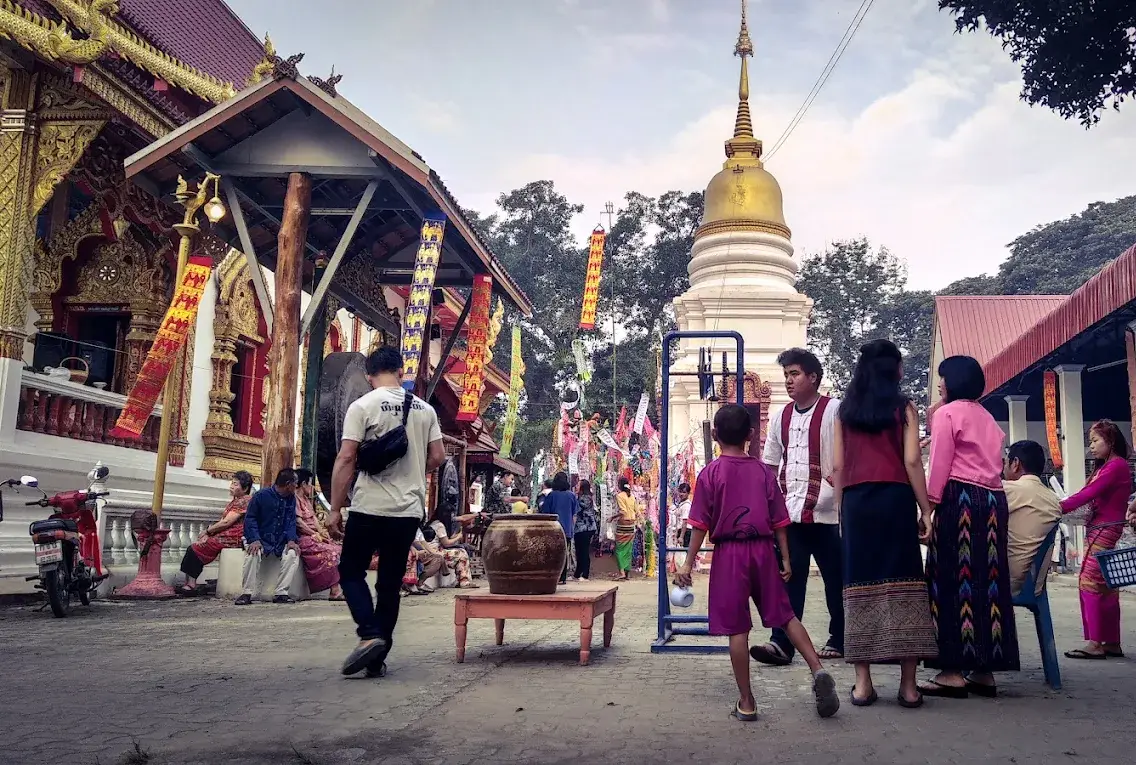
Wat Si Ngam in Ban Si Ngam, Moo 5, Mae Faek Subdistrict, San Sai District, Chiang Mai Province, is an old local Buddhist temple under the Mahanikaya order. Established in 1863, the temple has served Ban Si Ngam and the Mae Faek community for more than 160 years. It is located along the Chiang Mai–Phrao route, one of the important northern corridors of San Sai District, connecting Chiang Mai city, Mae Jo, Mae Faek, Mae Faek Mai, and Phrao. Wat Si Ngam is not a large tourist temple, but it is meaningful as a living community temple with religious, social, educational, and cultural value.
The temple is located at No. 62 (242), Ban Si Ngam, Moo 5, Mae Faek Subdistrict, San Sai District, Chiang Mai 50290, Thailand. Its temple land covers 2 rai, 3 ngan, and 28 square wah under N.S.3 land document No. 207. The northern boundary adjoins a pathway and village area, the southern boundary adjoins another pathway and village area, the eastern boundary adjoins a school, and the western boundary adjoins a pathway and the Ping River watercourse. These boundaries show how closely the temple is embedded in the local village landscape.
The history of Wat Si Ngam began with the faith and cooperation of local people. Pho Liang Thamthi and Mae Liang Suan led the villagers in establishing the temple, while Phra Wong Chao from Wat Mongkhon Prasit served as the leading monk in the construction. The temple was originally called Wat Tao Pun. Villagers later called it Wat Sa Ri Ngam, and over time the name shifted into Wat Si Ngam. The current name therefore preserves the spoken memory of the local community, not only an official temple title.
Wat Si Ngam received its Wisungkham Sima on May 2, 1932. The consecrated boundary measures 11 meters wide and 20 meters long. This boundary is important because it allows the temple to perform key monastic rites correctly according to Buddhist discipline. The granting of Wisungkham Sima confirms the temple’s role as an active Buddhist institution in the Mae Faek area.
The context of Ban Si Ngam and Mae Faek is essential for understanding the temple. Mae Faek is an old agricultural area of San Sai District where temples, schools, houses, roads, waterways, and farming communities developed together. Wat Si Ngam functions as both a sacred place and a shared community space. Local people use the temple for merit-making, Buddhist holy days, sermons, funerals, Kathin, robe-offering activities, and community gatherings.
The main monastic structures at Wat Si Ngam include an ubosot, a sermon hall, and 2-storey monks’ residences. The ubosot is used for important monastic rites, the sermon hall supports merit-making and community activities, and the monks’ residences allow the temple to remain active as a living monastery. Together, these structures form the essential layout of a local Buddhist temple in a northern Thai village.
One of the most interesting points for visitors is the vihara and its Lanna-style details. Photographic records of Wat Si Ngam show the vihara, its gable, entrance, doors, lintel, and decorative makara-and-naga elements. These features reveal the temple’s connection with local Lanna temple art and craftsmanship. The value of Wat Si Ngam lies not in grandeur, but in the refined details that reflect community devotion and northern Thai religious aesthetics.
Makara and naga motifs are important in Lanna temple architecture. The naga often symbolizes the protection of Buddhism and guides devotees from ordinary space into sacred space. The makara, a mythical creature, frequently appears with naga figures in Thai and Lanna decorative art. These elements make the entrance to the vihara more than a practical stairway; they transform it into a symbolic passage into a place of merit, calmness, and devotion.
Buddha images inside the temple are the main sacred objects for villagers and visitors. They are worshipped on Buddhist holy days, during merit-making ceremonies, and in community events. In a village temple, Buddha images are not merely works of art. They are the spiritual focus of the community and represent the Buddhist teachings in everyday life.
Wat Si Ngam also once had a formal educational role. A Buddhist scripture school, or Phra Pariyattidhamma school in the Dhamma division, opened at the temple in 1960. Although the school is no longer active, its existence shows that the temple once served as a center for Buddhist learning. Monks, novices, and local youth used the temple as a place for religious education and moral training.
The temple also houses an office of a funeral welfare association. This role shows how closely the temple is connected with the real lives of villagers. A temple is not only used during joyful merit-making occasions; it is also a place where the community faces grief, loss, mutual assistance, and funeral rites together. Wat Si Ngam therefore functions as a center of compassion and social support, not only religious devotion.
The temple has had 7 known abbots from the past to the present. Even though the main published sources do not list every name in full, this succession reflects continuity in temple administration and monastic care. In a local temple, an abbot does more than manage temple affairs. He guides religious activities, maintains temple structures, coordinates with villagers, and keeps the temple active as the spiritual center of the community.
Current Kathin activity records list Wat Si Ngam as a local temple in Mae Faek Subdistrict, San Sai District, Chiang Mai Province. The temple has 5 resident monks and Phra Athikan Ekkaphon Thirapunyo is listed as the abbot. This confirms that the temple remains active in present-day Buddhist life and continues to participate in the cycle of annual merit-making.
Religious activities at Wat Si Ngam follow the Buddhist calendar and local Lanna community rhythms. Important occasions include Buddhist holy days, Buddhist Lent, the end of Buddhist Lent, Kathin, robe-offering activities, and community merit-making events. Kathin is especially important because it brings villagers, devotees, and supporters together to maintain the temple and support the monastic community.
Wat Si Ngam is suitable for travelers who appreciate quiet local temples and want to understand village Buddhism in northern Thailand. Its value lies in its long history, its relationship with Ban Si Ngam, its former role in Buddhist education, its social welfare role, and its Lanna architectural details. The temple offers a calm and grounded experience rather than a crowded sightseeing atmosphere.
Visitors should begin by observing the temple entrance and courtyard, then pay respect to the Buddha images in the main sacred area. The vihara, ubosot, sermon hall, monks’ residences, and courtyard can be viewed respectfully from appropriate areas. The makara-and-naga details, gable, doorway, and vihara elements are worth observing carefully because they reveal the craftsmanship and symbolic language of Lanna temple art.
Getting There is convenient by private car or motorcycle. From Chiang Mai city, take Highway 1001 or the Chiang Mai–Phrao road toward San Sai and Mae Jo, then continue into Mae Faek Subdistrict. Wat Si Ngam is located in Ban Si Ngam, Moo 5, along the northern San Sai–Mae Faek route. It can be included in a cultural route through Mae Faek and northern San Sai.
Wat Si Ngam can be combined with nearby temples and attractions such as Wat Rom Luang, Wat Phra That Chom Kitti, Wat Ban Pong, Wat Nong Ma Chap, Ban Nong Ma Chap community tourism area, Wat Mae Faek, and The Royal Chiang Mai Golf Resort. This route helps visitors understand the religious and community landscape of Mae Faek through several connected local temples.
Visitors should dress modestly, keep their voices low, avoid entering monks’ residences without permission, and photograph sacred areas respectfully. Wat Si Ngam remains an active community temple, so visitors should treat the space primarily as a living Buddhist site rather than a purely touristic attraction.
Overall, Wat Si Ngam is an old and meaningful community temple in Mae Faek Subdistrict. Its strongest features are its foundation in 1863, its former names Wat Tao Pun and Wat Sa Ri Ngam, its Wisungkham Sima granted in 1932, its former Buddhist education role, its social welfare function, and its continued presence as an active local temple. It is a worthwhile stop for travelers who want to see a quieter, deeper, and more authentic side of Chiang Mai’s village temple culture.
| Name | Wat Si Ngam |
| Location | Ban Si Ngam, Moo 5, Mae Faek Subdistrict, San Sai District, Chiang Mai Province |
| Address | No. 62 (242), Ban Si Ngam, Moo 5, Mae Faek Subdistrict, San Sai District, Chiang Mai 50290, Thailand |
| Type | Local Buddhist temple under the Mahanikaya order |
| Abbot / Caretaker | Phra Athikan Ekkaphon Thirapunyo |
| Highlights | Old community temple of Ban Si Ngam with a vihara, main sacred areas, Buddha images, a former Buddhist scripture school, and a community funeral welfare association office |
| History | Built in 1863. Pho Liang Thamthi and Mae Liang Suan led the villagers in constructing the temple, with Phra Wong Chao from Wat Mongkhon Prasit as the leading monk. |
| Wisungkham Sima | Granted on May 2, 1932. The consecrated boundary measures 11 meters wide and 20 meters long. |
| Temple Land Area | 2 rai, 3 ngan, and 28 square wah under N.S.3 land document No. 207 |
| Boundaries | North: pathway and village; South: pathway and village; East: school; West: pathway and Ping River watercourse |
| Name Origin | Originally called Wat Tao Pun, later locally known as Wat Sa Ri Ngam, which evolved into Wat Si Ngam |
| Main Areas / Zones | Ubosot, sermon hall, 2-storey monks’ residences, vihara, temple courtyard, worship areas, and funeral welfare association office |
| Important Sacred Objects | Buddha images and the main sacred areas used for Buddhist activities by the local community |
| Educational Role | A Buddhist scripture school in the Dhamma division opened in 1960. It is no longer active. |
| Traditions / Merit-Making | Buddhist holy days, Buddhist Lent, the end of Buddhist Lent, Kathin, robe-offering activities, and community merit-making events |
| Travel Information | From Chiang Mai city, take Highway 1001 or the Chiang Mai–Phrao road toward San Sai and Mae Jo, then continue into Mae Faek Subdistrict and Ban Si Ngam, Moo 5. |
| Current Status | Open as a local Buddhist temple and community sacred site of Ban Si Ngam, Mae Faek Subdistrict, San Sai District, Chiang Mai |
| Main Contact Number | 053-849-314 |
| Facilities | Worship area, temple courtyard, sermon hall, community religious activity space, and parking area within the temple community |
| Nearby Tourist Attractions | 1. Ban Si Ngam School and Ban Si Ngam Community, about 0.2 km 2. Wat Rom Luang, Mae Faek Subdistrict, about 1 km 3. The Royal Chiang Mai Golf Resort, about 3 km 4. Wat Phra That Chom Kitti, about 5 km 5. Wat Ban Pong, Mae Faek Subdistrict, about 6 km 6. Wat Nong Ma Chap and Ban Nong Ma Chap Community Tourism Area, about 8 km |
| Nearby Restaurants | 1. CHA 168 Mae Faek Mai, about 5 km, Tel. 081-749-1549, 080-052-9538 2. Enjoy Healthy Food Mae Faek Mai, about 6 km, Tel. 085-082-3953, 099-218-9339 3. Moonshine Cafe, about 7 km, Tel. 092-365-1178 4. M&M Cha, about 8 km, Tel. 093-032-2321 5. SHONG CHA Chedi Mae Khrua Branch, about 8 km, Tel. 062-610-0324 6. Mum Aroi Food Court, about 8 km, Tel. 052-014-190 |
| Nearby Accommodations | 1. The Royal Chiang Mai Golf Resort, about 3 km, Tel. 083-568-9797, 083-578-2727, 083-576-4747 2. Innbox Chiangmai Hotel, about 4 km, Tel. 081-171-0247 3. Mae Faek Villas, about 6 km 4. Dream Villa Resort @ Chiang Mai, about 8 km, Tel. 099-291-6447 5. Yoo Sabai Home, about 10 km 6. Tao Garden Health Spa & Resort, about 18 km, Tel. 084-028-0230 |
Frequently Asked Questions (FAQ)
Q: Where is Wat Si Ngam located?
A: Wat Si Ngam is located in Ban Si Ngam, Moo 5, Mae Faek Subdistrict, San Sai District, Chiang Mai Province 50290, Thailand, along the Chiang Mai–Phrao route.
Q: When was Wat Si Ngam built?
A: Wat Si Ngam was built in 1863 by local villagers led by Pho Liang Thamthi and Mae Liang Suan, with Phra Wong Chao from Wat Mongkhon Prasit as the leading monk.
Q: What was Wat Si Ngam originally called?
A: The temple was originally called Wat Tao Pun. Villagers later called it Wat Sa Ri Ngam, which eventually became Wat Si Ngam.
Q: What is Wat Si Ngam known for?
A: The temple is known as an old community temple of Ban Si Ngam, with a vihara, ubosot, sermon hall, monks’ residences, Buddha images, a former Buddhist scripture school, and a strong role in village life.
Q: When did Wat Si Ngam receive Wisungkham Sima?
A: Wat Si Ngam received its Wisungkham Sima on May 2, 1932. The consecrated boundary measures 11 meters wide and 20 meters long.
Q: How does Wat Si Ngam serve the local community?
A: The temple serves as a center for merit-making, Buddhist holy days, Kathin, robe-offering activities, community ceremonies, and funeral welfare activities in Ban Si Ngam.
Q: How do visitors get to Wat Si Ngam?
A: From Chiang Mai city, take Highway 1001 or the Chiang Mai–Phrao road toward San Sai and Mae Jo, then continue to Mae Faek Subdistrict and Ban Si Ngam, Moo 5.
Q: What nearby places can be visited on the same trip?
A: Nearby places include Wat Rom Luang, Wat Phra That Chom Kitti, Wat Ban Pong, Wat Nong Ma Chap, Ban Nong Ma Chap community tourism area, and The Royal Chiang Mai Golf Resort.
 Category: ●Places of Worship
 Group: ●Temple
Last Update : 2 MonthAgo
 Last Update : 2 MonthAgo
 Click to Access the Navigation Map GPS

 Muang Chiang Mai(121)Chom Thong(47)Mae Chaem(25)Chiang Dao(33)Doi Saket(68)Mae Taeng(85)Mae Rim(69)Samoeng(29)Fang(71)Mae Ai(59)Phrao(70)San Pa Tong(103)San Kamphaeng(66)San Sai(73)Hang Dong(73)Hot(32)Doi Tao(22)Omkoi(11)Saraphi(74)Wiang Haeng(15)Chai Prakan(28)Mae Wang(32)Mae On(22)Doi Lo(33)Galyani Vadhana(1)


