
lovethailand home >North Travel Attractions >Chiang Mai Travel Attractions >San Sai >Mae Faek > Wat Rom Luang
TL;DR: Wat Rom Luang is located at Ban Rom Luang, Moo 4, Mae Faek Subdistrict, San Sai District, Chiang Mai Province, open Daily, hours 08.00 – 17.00.

Wat Rom Luang
Open Days: Daily
Opening Hours: 08.00 – 17.00
Wat Rom Luang in Ban Rom Luang, Moo 4, Mae Faek Subdistrict, San Sai District, Chiang Mai Province, is an old community temple with strong local, religious, and artistic value. The temple is located at No. 146, Ban Rom Luang, on the San Sai–Phrao road, and belongs to the Mahanikaya order. It is one of the meaningful local temples in the Mae Faek area, especially for travelers who want to see Lanna temple architecture, mural painting, village Buddhism, and a quieter side of Chiang Mai outside the old city.
Wat Rom Luang was built in 1862, making it more than 160 years old. Its long history makes the temple more than a place of worship. It is part of the local memory of Ban Rom Luang and Mae Faek Subdistrict, where temple, school, road, farmland, and village life are closely connected. The temple stands along the San Sai–Phrao route, an important road linking Chiang Mai city, Mae Jo, Mae Faek, and the northern part of San Sai District.
The temple has long functioned as the spiritual center of Ban Rom Luang. Mae Faek is an old agricultural area where local communities developed around temples, schools, roads, and irrigation routes. Wat Rom Luang therefore serves not only as a Buddhist site but also as a shared community space for merit-making, Buddhist holy days, Kathin, robe-offering activities, funerals, community gatherings, and village ceremonies.
The temple land covers 4 rai, 3 ngan, and 3 square wah. Its northern boundary adjoins a school, the southern boundary adjoins a pathway, the eastern boundary adjoins the road, and the western boundary adjoins another pathway. These boundaries show how deeply the temple is embedded in the everyday geography of the village. The connection between temple and school also reflects a common pattern in Lanna communities, where temples historically played a role in both religious and moral education.
The main monastic structures at Wat Rom Luang include a vihara, an ubosot, a sermon hall, monks’ residences, and religious activity areas. Important sacred objects include Buddha images and a brick-and-mortar chedi. Together, these elements form the essential structure of a functioning local Buddhist temple: a worship space, a monastic ritual space, a merit-making hall, a residential area for monks, and an open courtyard for community activities.
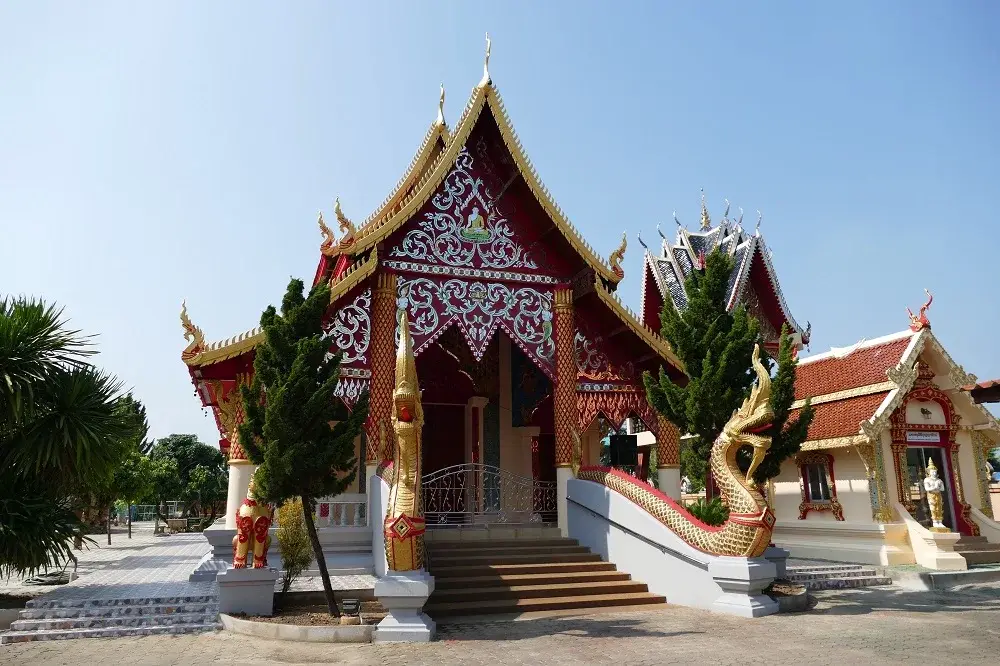
The vihara is the first highlight visitors should observe. It is a fine example of local Lanna-style temple architecture. The roof is built in 2 overlapping tiers that descend in rhythm, giving the building a graceful and balanced appearance. The red pediment is decorated with glass mosaic in scrolling floral patterns, adding brightness and sacred beauty to the façade. The eyebrow-like arches include decorative honeycomb-style elements in 3 sections, giving the building a soft and refined Lanna character.
The entrance to the vihara has 3 doors, creating symmetry and allowing movement during ceremonies. The stair railings are shaped as nagas and decorated with colored glass. In Lanna belief, the naga is a guardian of sacred space and a symbolic guide from the ordinary world into the Buddhist sanctuary. The glass decoration gives the stairway a lively visual effect, especially when it catches sunlight.
Inside the vihara, the murals depict the Vessantara Jataka, one of the most important Buddhist birth stories in Theravada tradition. The story tells of Prince Vessantara, the Buddha-to-be, who perfected the virtue of generosity. In northern Thai Buddhist culture, the Vessantara Jataka is closely associated with Mahachat sermons and communal merit-making. At Wat Rom Luang, the murals serve as both religious art and visual teaching.
The murals are especially meaningful for travelers interested in local art. Temple murals in village monasteries are not only decorative. They are teaching tools that allow people of all ages to understand Buddhist values through images. The Vessantara Jataka emphasizes generosity, patience, sacrifice, and moral strength. These themes remain central to community Buddhism in northern Thailand.
The chedi at Wat Rom Luang is built with brick and mortar on a square plan. The lowest level consists of a base structure supporting a square platform. Above this are niches containing Buddha images on all 4 sides. Higher levels include decorative bands, the bell-shaped body, a faceted throne-like section, the ringed spire, the finial, and the umbrella element at the top. This vertical sequence represents the symbolic movement from the earthly base toward the sacred summit.
The 4 directional Buddha-image niches make the chedi an important devotional focus within the temple compound. Visitors can pay respect from different directions, while the presence of Buddha images around the chedi suggests the spreading of Buddhist teaching in all directions. This is a common sacred idea in Buddhist architectural symbolism and is especially meaningful in a community temple setting.
The Buddha images inside the temple are the main objects of devotion for villagers and visitors. They are worshipped on Buddhist holy days, during merit-making ceremonies, and during important annual events. Visitors should approach the vihara and chedi respectfully, as Wat Rom Luang remains an active community temple rather than a purely touristic site.
The ubosot is important for monastic rites, while the sermon hall supports merit-making, listening to sermons, meetings, and community activities. The monks’ residences allow the monastic community to remain present at the temple. The temple courtyard functions as a shared space for festivals, ceremonies, and village gatherings. These elements make Wat Rom Luang a living temple rather than an isolated historical monument.
The known abbots associated with Wat Rom Luang include Khru Ba Panya, Khru Ba Mano, Phra Sao Tisaviro, Phra Poeng Yannasamvaro, Phra Ma Paphakaro, Phra Tum Thirapanno, Phra Athikan Bunrat Dhammavaro, Phra Athikan Bunsi Chittadhammo, Phra Athikan Sanga Panyavaro, and Phra Athikan Bunma Siripunno. This succession shows the continuity of monastic care and the long-term preservation of the temple by monks and the local community.
The role of an abbot in a community temple such as Wat Rom Luang goes beyond administration. Abbots help preserve temple buildings, guide merit-making activities, support local ceremonies, and maintain the relationship between monks and villagers. The temple’s survival from 1862 to the present reflects both monastic leadership and the continuing faith of the Ban Rom Luang community.
Religious activities at Wat Rom Luang follow the Buddhist calendar and local Lanna traditions. Important occasions include Buddhist holy days, Makha Bucha, Visakha Bucha, Asalha Bucha, Buddhist Lent, the end of Buddhist Lent, Kathin, robe-offering activities, and local merit-making events. In northern Thai villages, temple events also strengthen family and community relationships through shared work, food offerings, listening to sermons, and temple decoration.
The presence of Vessantara Jataka murals connects the temple with the tradition of great Buddhist sermons, especially the Mahachat or Vessantara sermon. While the exact annual schedule depends on the temple and community, the mural subject itself gives Wat Rom Luang a strong link to Lanna merit-making culture and Buddhist storytelling.
The atmosphere of Wat Rom Luang is suitable for travelers who appreciate quiet local temples rather than crowded landmark sites. Visitors should take time to notice the vihara roof, red pediment, glass mosaic patterns, naga stairways, murals, chedi, Buddha images, and the relationship between the temple and surrounding village. The value of Wat Rom Luang lies in these details, which reveal the craftsmanship and faith of a local Lanna community.
The best way to explore the temple is to begin at the vihara, pay respect to the Buddha image, look carefully at the Vessantara Jataka murals, then walk around the chedi and observe its 4 directional Buddha niches. Visitors can also see the ubosot, sermon hall, monks’ residences, and temple courtyard. Morning and late afternoon are especially pleasant times to visit because the atmosphere is cooler and quieter.
Wat Rom Luang can be included in a wider cultural route through Mae Faek and northern San Sai. Nearby places include Wat Si Ngam, Wat Phra That Chom Kitti, Wat Ban Pong, Wat Nong Ma Chap, Ban Nong Ma Chap community tourism area, Mae Faek temples, and The Royal Chiang Mai Golf Resort. This route is suitable for travelers interested in Lanna temples, community history, agricultural landscapes, and quiet countryside travel.
Getting There is convenient by private car or motorcycle. From Chiang Mai city, take Highway 1001 or the Chiang Mai–Phrao road toward San Sai and Mae Jo, then continue to Mae Faek Subdistrict. Wat Rom Luang is located along the San Sai–Phrao road in Ban Rom Luang, Moo 4. The route also has local public transport stops near Wat Rom Luang and Ban Rom Luang, making the temple accessible along the main local corridor.
Visitors should allow at least 45–90 minutes to pay respect, see the vihara, observe the murals, walk around the chedi, and absorb the temple atmosphere. For a half-day or full-day route, Wat Rom Luang can be combined with Wat Phra That Chom Kitti, Wat Ban Pong, Wat Nong Ma Chap, and Ban Nong Ma Chap community tourism area.
Visitors should dress modestly, keep their voices low, avoid touching murals or architectural details, and refrain from entering monks’ residences without permission. Photography should be done respectfully, especially inside the vihara. Flash photography should be avoided near murals, and visitors should not disturb people praying, chanting, or making merit.
Overall, Wat Rom Luang is an old and meaningful temple in Mae Faek Subdistrict. Its strongest features are the Lanna-style vihara, red glass-decorated pediment, naga stairway, Vessantara Jataka murals, brick-and-mortar chedi, Buddha images, and calm community atmosphere. It is a worthwhile destination for travelers who want to understand Chiang Mai’s village temples beyond the better-known temples in the city center.
| Name | Wat Rom Luang |
| Location | Ban Rom Luang, Moo 4, Mae Faek Subdistrict, San Sai District, Chiang Mai Province |
| Address | 146 Ban Rom Luang, San Sai–Phrao Road, Moo 4, Mae Faek Subdistrict, San Sai District, Chiang Mai 50290, Thailand |
| Type | Local Buddhist temple under the Mahanikaya order |
| Highlights | Lanna-style vihara, Vessantara Jataka murals, Buddha images, brick-and-mortar chedi, and the atmosphere of an old Ban Rom Luang community temple |
| History | Built in 1862 as an old community temple of Ban Rom Luang, Mae Faek Subdistrict, San Sai District, Chiang Mai Province |
| Temple Land Area | 4 rai, 3 ngan, and 3 square wah |
| Boundaries | North: school; South: pathway; East: road; West: pathway |
| Distinctive Features | Two-tier Lanna vihara roof, red glass-decorated pediment, 3 entrance doors, naga stair railings with colored glass, and mural paintings inside the vihara |
| Main Areas / Zones | Vihara, ubosot, sermon hall, monks’ residences, chedi, temple courtyard, and community religious activity areas |
| Important Sacred Objects | Buddha images inside the vihara and a brick-and-mortar chedi with Buddha-image niches on all 4 sides |
| Important Murals | Vessantara Jataka murals inside the vihara |
| Known Former Abbots | Khru Ba Panya, Khru Ba Mano, Phra Sao Tisaviro, Phra Poeng Yannasamvaro, Phra Ma Paphakaro, Phra Tum Thirapanno, Phra Athikan Bunrat Dhammavaro, Phra Athikan Bunsi Chittadhammo, Phra Athikan Sanga Panyavaro, and Phra Athikan Bunma Siripunno |
| Traditions / Merit-Making | Buddhist holy days, major Buddhist festivals, Buddhist Lent, the end of Buddhist Lent, Kathin, robe-offering activities, and community merit-making events |
| Travel Information | From Chiang Mai city, take Highway 1001 or the Chiang Mai–Phrao road toward San Sai and Mae Jo, then continue to Mae Faek Subdistrict. The temple is located along the San Sai–Phrao road in Ban Rom Luang, Moo 4. |
| Current Status | Open as a Buddhist temple and community sacred site of Ban Rom Luang, Mae Faek Subdistrict, San Sai District, Chiang Mai |
| Open Days | Daily |
| Opening Hours | 08.00 – 17.00 |
| Facilities | Worship area, temple courtyard, sermon hall, parking area, and community religious activity space |
| Nearby Tourist Attractions | 1. Ban Rom Luang School and Ban Rom Luang Community, about 0.2 km 2. Wat Si Ngam, Mae Faek Subdistrict, about 1 km 3. The Royal Chiang Mai Golf Resort, about 2.5 km 4. Wat Phra That Chom Kitti, about 4 km 5. Wat Ban Pong, Mae Faek Subdistrict, about 6 km 6. Wat Nong Ma Chap and Ban Nong Ma Chap Community Tourism Area, about 8 km |
| Nearby Restaurants | 1. Café de Pu, about 1 km 2. CHA 168 Mae Faek Mai, about 5 km, Tel. 081-749-1549, 080-052-9538 3. Enjoy Healthy Food Mae Faek Mai, about 6 km, Tel. 085-082-3953, 099-218-9339 4. Cha & Som Tam Na Ban, about 7 km, Tel. 064-695-7899 5. Moonshine Cafe, about 8 km, Tel. 092-365-1178 6. Thai Taste Cafe, about 8 km, Tel. 098-762-0888 |
| Nearby Accommodations | 1. The Royal Chiang Mai Golf Resort, about 2.5 km, Tel. 083-568-9797, 083-578-2727, 083-576-4747 2. Innbox Chiangmai Hotel, about 2 km, Tel. 081-171-0247 3. Mae Faek Villas, about 6 km, Tel. 081-287-9011 4. Dream Villa Resort @ Chiang Mai, about 8 km, Tel. 099-291-6447 5. Holiday Resort Rimping, about 8 km, Tel. 062-945-3242 6. Yoo Sabai Home, about 10 km |
Frequently Asked Questions (FAQ)
Q: Where is Wat Rom Luang located?
A: Wat Rom Luang is located at 146 Ban Rom Luang, San Sai–Phrao Road, Moo 4, Mae Faek Subdistrict, San Sai District, Chiang Mai Province 50290, Thailand.
Q: What is Wat Rom Luang known for?
A: The temple is known for its Lanna-style vihara, red glass-decorated pediment, naga stairways, Vessantara Jataka murals, Buddha images, and brick-and-mortar chedi.
Q: When was Wat Rom Luang built?
A: Wat Rom Luang was built in 1862, making it one of the older community temples in Mae Faek Subdistrict, San Sai District, Chiang Mai.
Q: What is important inside the vihara?
A: Inside the vihara are Buddha images and murals depicting the Vessantara Jataka, an important Buddhist story connected with generosity, moral strength, and the Mahachat sermon tradition.
Q: What is the chedi like?
A: The chedi is built with brick and mortar on a square plan. It has Buddha-image niches on all 4 sides, decorative bands, a bell-shaped body, a ringed spire, a finial, and an umbrella element at the top.
Q: How do visitors get to Wat Rom Luang?
A: From Chiang Mai city, take Highway 1001 or the Chiang Mai–Phrao road toward San Sai and Mae Jo, then continue to Mae Faek Subdistrict. The temple is located along the San Sai–Phrao road in Ban Rom Luang, Moo 4.
Q: Who should visit Wat Rom Luang?
A: The temple is suitable for travelers interested in Lanna architecture, local community temples, Buddhist murals, Vessantara Jataka art, chedis, and quiet cultural routes in San Sai District.
Q: What nearby places can be visited on the same trip?
A: Nearby places include Wat Si Ngam, Wat Phra That Chom Kitti, Wat Ban Pong, Wat Nong Ma Chap, Ban Nong Ma Chap community tourism area, and The Royal Chiang Mai Golf Resort.
 Category: ●Places of Worship
 Group: ●Temple
Last Update : 2 MonthAgo
 Last Update : 2 MonthAgo
 Click to Access the Navigation Map GPS

 Muang Chiang Mai(121)Chom Thong(47)Mae Chaem(25)Chiang Dao(33)Doi Saket(68)Mae Taeng(85)Mae Rim(69)Samoeng(29)Fang(71)Mae Ai(59)Phrao(70)San Pa Tong(103)San Kamphaeng(66)San Sai(73)Hang Dong(73)Hot(32)Doi Tao(22)Omkoi(11)Saraphi(74)Wiang Haeng(15)Chai Prakan(28)Mae Wang(32)Mae On(22)Doi Lo(33)Galyani Vadhana(1)


