
lovethailand home >North Travel Attractions >Chiang Mai Travel Attractions >San Kamphaeng >San Kamphaeng > Wat Rong Tham Samakkhi
TL;DR: Wat Rong Tham Samakkhi is located at Moo 7, Ban Talat, San Kamphaeng Subdistrict, San Kamphaeng District, Chiang Mai Province, open Contact the temple before visiting, hours Contact the temple before visiting.

Wat Rong Tham Samakkhi
Open Days: Contact the temple before visiting
Opening Hours: Contact the temple before visiting
Wat Rong Tham Samakkhi is located at 56 Moo 7, Ban Talat, Khotchasan Road, San Kamphaeng Subdistrict, San Kamphaeng District, Chiang Mai 50130, Thailand. It is a private Buddhist temple under the Dhammayut order. The temple land recorded in temple-history sources covers approximately 10 rai, 3 ngan, and 70 square wah. Wat Rong Tham Samakkhi was officially established as a temple in 1938 and received its royal Wisungkhamsima in 1963. It is one of the most significant Dhammayut temples in San Kamphaeng, known for its connection with forest-meditation teachers, Luang Pu Mun Bhuridatto, Luang Pu Thong Bua Tantikaro, and the distinctive Bodhipakkhiya Dhamma Chedi.
The temple began as a community place for merit-making, Dhamma listening, and meditation practice. Before it became a formal temple, local devotees purchased the land and built a wooden merit-making hall. In northern Thai usage, such a Dhamma hall was known as a “hong tham” or “rong tham,” which became the root of the temple name. The word “samakkhi” means unity, reflecting the shared effort of local devotees who built this place as a center of faith and Buddhist practice for San Kamphaeng.
The importance of Wat Rong Tham Samakkhi lies in its origin as a temple created through community devotion. The early hall was built with local materials, including teak boards and traditional northern roofing tiles, and was used for Dhamma talks, food offerings, and meditation. In Lanna society, a Buddhist place of practice often began with local faith rather than official structure alone. Wat Rong Tham Samakkhi therefore represents the connection between village devotion, forest meditation practice, and the development of a formal temple.
Wat Rong Tham Samakkhi is especially important because it belongs to the Dhammayut order. The Dhammayut tradition is often associated with discipline, monastic order, Buddhist study, and meditation practice. This gives the temple a calm and contemplative atmosphere. Visitors should understand the temple not only as an architectural site, but also as a place shaped by meditation, monastic discipline, and the memory of respected forest teachers.
Before the temple was formally established, the site had already become connected with important forest-meditation monks. Luang Pu Mun Bhuridatto, one of the most influential teachers in the Thai forest tradition, stayed in the area and taught local devotees in San Kamphaeng. This connection gives Wat Rong Tham Samakkhi deep meaning for followers of the forest tradition, because the temple landscape is connected with meditation practice, Dhamma training, and the spread of Buddhist faith in the local community.
From 1938 onward, several respected meditation teachers stayed or spent periods at the site, including Phra Achan Ku Dhammadinno, Phra Achan Kwa Sumano, Luang Pu Sim Buddhacaro, Luang Pu Rien Varalabho, and Luang Pu Cham Mahapunno. In 1950, local devotees invited Luang Pu Thong Bua Tantikaro to reside there. He later developed the place into a stable and well-known temple, making Wat Rong Tham Samakkhi an important center of faith in northern Thailand.
Luang Pu Thong Bua Tantikaro, later known as Phra Ratcha Phutthimongkhon, is one of the most important figures connected with Wat Rong Tham Samakkhi. He helped develop the temple, continued the meditation lineage, and became deeply respected by disciples and lay devotees. His memory remains central to the temple. For visitors interested in Thai forest Buddhism, Wat Rong Tham Samakkhi offers a meaningful connection with his life and work.
Phra Khru Chittaphatraphon is the current abbot of Wat Rong Tham Samakkhi. The temple remains active in contemporary Buddhist life, including Buddhist Lent activities and community merit-making ceremonies. This shows that the temple is not only historically important; it continues to function as an active Dhammayut temple, religious center, and community space in San Kamphaeng.
The Bodhipakkhiya Dhamma Chedi is the temple’s most distinctive landmark. Its layered form gives it an unusual and memorable appearance. The chedi is connected with the 37 qualities that support awakening: the Four Foundations of Mindfulness, the Four Right Efforts, the Four Bases of Spiritual Power, the Five Faculties, the Five Powers, the Seven Factors of Awakening, and the Noble Eightfold Path. It is therefore both a sacred monument and a symbolic structure expressing the Buddhist path to awakening.
Inside the Bodhipakkhiya Dhamma Chedi are several functional and devotional spaces. The lower level is used as a library. Other levels contain displays of art objects and ancient items, Buddha images in various postures, and devotional spaces. The uppermost level enshrines relics of the Buddha. This makes the chedi both a sacred monument and a learning space for visitors who want to understand Buddhism more deeply.
The location of the Bodhipakkhiya Dhamma Chedi is historically meaningful. It was built in the area associated with the former hut where Luang Pu Mun once stayed. The old hut was later damaged by fire, and the chedi was built as a memorial and sacred point in that location. The original merit-making hall is also connected with the present ubosot area. These spatial links allow visitors to see how the old Dhamma hall gradually became the present temple landscape.
The temple also preserves ashes and hair relics associated with Luang Pu Mun Bhuridatto. These relics are deeply meaningful to devotees of the Thai forest tradition. They connect Wat Rong Tham Samakkhi with the memory of Luang Pu Mun’s stay in San Kamphaeng and make the temple a significant pilgrimage site for those who follow the path of forest meditation teachers.
The ubosot is another important structure. It is connected with the temple’s royal Wisungkhamsima and the performance of important monastic acts. The royal grant of Wisungkhamsima in 1963 strengthened the temple’s formal status within the Sangha system. Visitors should treat the ubosot with particular respect because it is a sacred monastic area rather than a general sightseeing space.
Other important structures at Wat Rong Tham Samakkhi include the Lanna-style Ho Kham viharn, sermon hall, merit-making hall, bell tower, monks’ residences, Pathumanusorn Library, Phra Pariyattidhamma study building, and a residence associated with Somdet Phra Sangharaja Chuan Utthayi Mahathera. These structures show that the temple has religious, educational, devotional, and community functions.
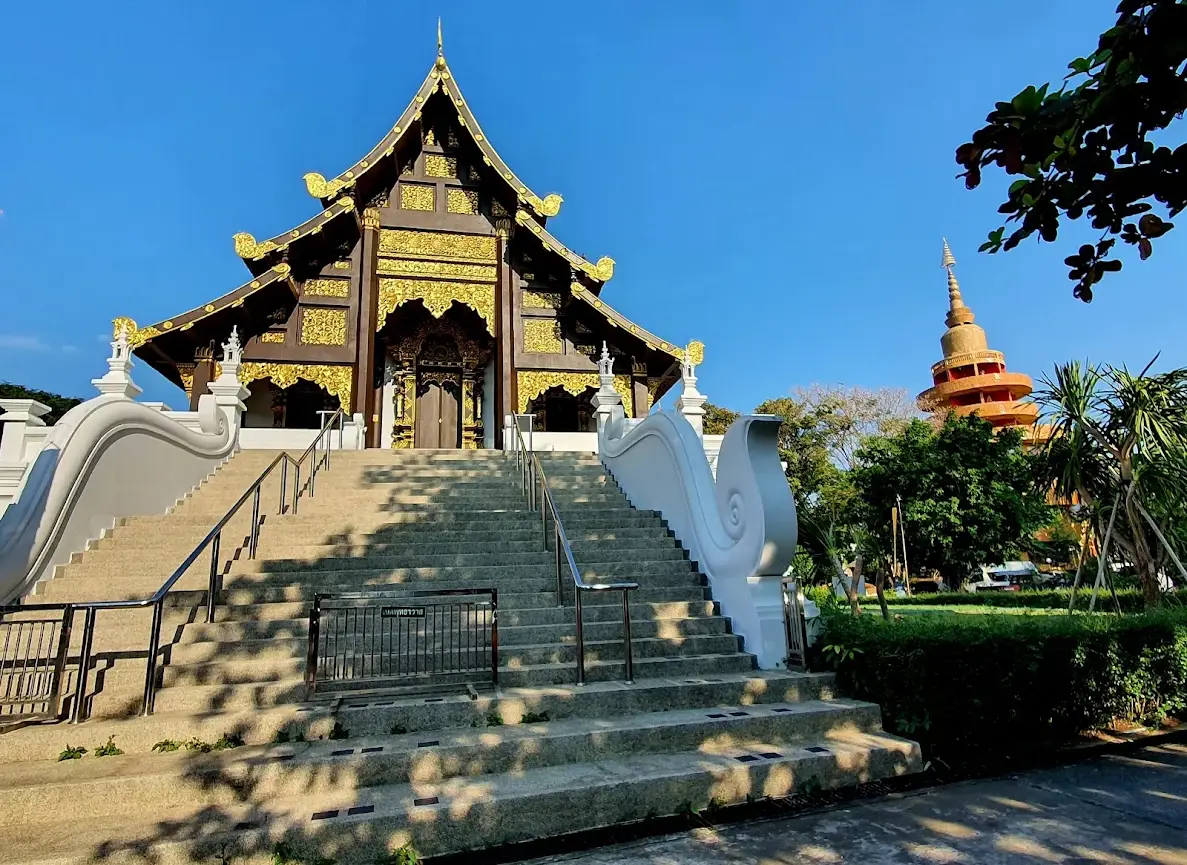
The Lanna-style Ho Kham viharn adds an architectural dimension to the temple. It shows how local northern Thai design can exist within a Dhammayut temple shaped by forest-meditation history. Visitors interested in architecture can observe how Lanna forms, meditation history, and modern temple development come together in the same temple compound.
The residence associated with Somdet Phra Sangharaja Chuan Utthayi Mahathera reflects the temple’s connection with senior monastic figures in the Dhammayut order. It also shows that Wat Rong Tham Samakkhi is not merely a small village temple, but a temple with broader importance in the religious landscape of northern Thailand.
The temple’s educational role is visible through its library, Phra Pariyattidhamma study building, and learning spaces inside the chedi. Visitors who are interested in Buddhist history, forest meditation, sacred objects, and the lives of respected teachers can spend meaningful time here beyond a short worship visit. The temple combines pilgrimage, study, and meditation memory in one place.
Wat Rong Tham Samakkhi has also served community functions beyond religious ceremonies. Areas within the temple have been used for Thai massage and physical rehabilitation services for local people, patients, people with disabilities, and the wider public. This reflects the broader role of a Thai temple as a community space that supports well-being, not only ritual life.
Regular Buddhist activities at the temple include Kathin, robe offerings, Buddhist Lent, End of Buddhist Lent, candle offerings for Buddhist Lent, Magha Puja, Visakha Bucha, Buddhist holy days, Dhamma listening, and meditation-related activities. These events bring together monks, lay devotees, local officials, and residents, keeping the temple active as a living Buddhist center.
The temple’s role can be understood on several levels. Religiously, it is a place for worship, Dhamma listening, meditation, and merit-making. Historically, it is connected with Luang Pu Mun, Luang Pu Thong Bua, and the Thai forest tradition. Educationally, it includes library and learning spaces. Socially, it remains a community center for Ban Talat and San Kamphaeng.
The atmosphere of Wat Rong Tham Samakkhi is calm and contemplative. Its value does not come only from architecture, but from the memory of Buddhist practice and respected teachers. Visitors who are interested in meditation temples, Dhammayut history, forest tradition, and meaningful Buddhist travel should allow enough time to explore the temple carefully and respectfully.
Key points to see at Wat Rong Tham Samakkhi include the Bodhipakkhiya Dhamma Chedi, ubosot, Lanna-style Ho Kham viharn, bronze Buddha image, Buddha relics, ashes and hair relics associated with Luang Pu Mun, Pathumanusorn Library, Phra Pariyattidhamma study building, and memorial elements connected with Luang Pu Thong Bua. These features make the temple especially meaningful for visitors who want to understand the forest-meditation tradition in Chiang Mai.
Wat Rong Tham Samakkhi can be included in a San Kamphaeng cultural route. Nearby places include San Kamphaeng Market, Wat San Kamphaeng, Wat Pa Daeng, Bo Sang Umbrella Village, MAIIAM Contemporary Art Museum, and the route toward Mae On and San Kamphaeng Hot Springs. A half-day trip can combine the temple with San Kamphaeng Market and Bo Sang, while a full-day trip can continue toward Mae On and the hot springs.
San Kamphaeng is known for temples, markets, crafts, and local culture. Wat Rong Tham Samakkhi is a strong starting point for understanding the religious dimension of the district before continuing to local food, craft villages, and nearby accommodation. This makes the area suitable for travelers who want a route combining Buddhist faith, history, crafts, food, and community life.
Visitors should dress modestly, speak quietly, respect the ubosot, viharn, chedi, monks’ residences, library, and sacred objects, and avoid disturbing monks or people practicing meditation. Do not touch sacred objects without permission. During Buddhist holy days, Kathin, robe offerings, Buddhist Lent activities, or candle-offering ceremonies, visitors should follow the guidance of monks, temple committee members, and local staff.
Getting There is convenient by private car, rental car, or hired local transport from Chiang Mai city. Take the Chiang Mai–San Kamphaeng route toward San Kamphaeng Market, then use Khotchasan Road to reach Ban Talat in Moo 7. The temple can be combined with San Kamphaeng Market, Wat San Kamphaeng, Wat Pa Daeng, Bo Sang Umbrella Village, MAIIAM Contemporary Art Museum, and the route toward Mae On. Travelers using navigation apps should search for “Wat Rong Tham Samakkhi San Kamphaeng” to reach the correct Dhammayut temple in Chiang Mai.
Wat Rong Tham Samakkhi is suitable for visitors interested in Dhammayut temples, Thai forest meditation, Luang Pu Mun, Luang Pu Thong Bua, sacred relics, Buddhist learning spaces, and quiet temple travel. Its value lies in its establishment in 1938, its royal Wisungkhamsima in 1963, its Bodhipakkhiya Dhamma Chedi, its connection with respected meditation teachers, and its continuing role as a Buddhist center of San Kamphaeng. For travelers who want to understand Chiang Mai beyond major tourist landmarks, this temple offers a grounded and meaningful view of Buddhist practice, local faith, and northern Thai religious history.
| Name | Wat Rong Tham Samakkhi |
| Location | Moo 7, Ban Talat, San Kamphaeng Subdistrict, San Kamphaeng District, Chiang Mai Province |
| Address | 56 Moo 7, Ban Talat, Khotchasan Road, San Kamphaeng Subdistrict, San Kamphaeng District, Chiang Mai 50130, Thailand |
| Contact Number | 053-332-060, 085-999-3058 |
| Highlights | An important Dhammayut temple in San Kamphaeng with the Bodhipakkhiya Dhamma Chedi, ubosot, Lanna-style Ho Kham viharn, relics associated with Luang Pu Mun, and history connected with Luang Pu Thong Bua Tantikaro |
| History | Officially established as a temple in 1938 and granted royal Wisungkhamsima in 1963 |
| Name Origin | The name comes from the original Dhamma hall, locally called “hong tham” or “rong tham,” built by local devotees for Dhamma listening, merit-making, and meditation; “samakkhi” reflects community unity |
| Distinctive Features | A private Dhammayut temple connected with the Thai forest tradition, Luang Pu Mun, Luang Pu Thong Bua, Buddhist learning spaces, and San Kamphaeng community faith |
| Travel Information | Travel from Chiang Mai city via the Chiang Mai–San Kamphaeng route toward San Kamphaeng Market, then use Khotchasan Road to Ban Talat in Moo 7. Search for “Wat Rong Tham Samakkhi San Kamphaeng” in navigation apps. |
| Current Status | Active Dhammayut temple, Buddhist learning space, and religious activity center of San Kamphaeng |
| Temple Type | Private Buddhist temple under the Dhammayut order |
| Temple Code | 650130101 |
| Temple Area | Approximately 10 rai, 3 ngan, and 70 square wah |
| Abbot / Caretaker | Phra Khru Chittaphatraphon |
| Important Monks Connected With The Temple | Luang Pu Mun Bhuridatto, Phra Ratcha Phutthimongkhon or Luang Pu Thong Bua Tantikaro, Luang Pu Sim Buddhacaro, Luang Pu Rien Varalabho, Luang Pu Cham Mahapunno, and several respected forest-meditation teachers |
| Open Days | Contact the temple before visiting |
| Opening Hours | Contact the temple before visiting |
| Main Areas / Structures | Ubosot, Bodhipakkhiya Dhamma Chedi, Lanna-style Ho Kham viharn, sermon hall, merit-making hall, bell tower, monks’ residences, Pathumanusorn Library, Phra Pariyattidhamma study building, Somdet Phra Sangharaja residence, and meditation spaces |
| Important Devotional Points | Bodhipakkhiya Dhamma Chedi, Buddha relics, ashes and hair relics associated with Luang Pu Mun, bronze Buddha image, and memorial elements connected with Luang Pu Thong Bua |
| Related Traditions / Activities | Kathin, robe offerings, Buddhist Lent, End of Buddhist Lent, candle offerings for Buddhist Lent, Magha Puja, Visakha Bucha, Buddhist holy days, Dhamma listening, and meditation-related activities |
| Nearby Tourist Attractions | 1. San Kamphaeng Market, about 1 km 2. Wat San Kamphaeng, about 2 km 3. Wat Pa Daeng, San Kamphaeng, about 3 km 4. Bo Sang Umbrella Village, about 7 km 5. MAIIAM Contemporary Art Museum, about 9 km |
| Nearby Restaurants | 1. San Kamphaeng Restaurant, about 2 km, Tel. 053-332-935, 053-395-389 2. San Kamphaeng Beef Noodle, about 3 km, Tel. 082-685-2863 3. Mala Thai Soi, about 5 km, Tel. 094-759-7087 4. Huen Jai Yong, about 8 km, Tel. 086-671-8710 5. Satesinlp Restaurant, about 10 km, Tel. 053-338-388, 081-881-4121, 089-992-3434 |
| Nearby Accommodations | 1. 102 Residence, about 2 km 2. The Vet Boutique Hotel, about 8 km, Tel. 052-011-179, 091-852-5507 3. LaMoon Cottage SanKampang, about 9 km, Tel. 094-723-5395 4. San Kamphaeng Lake View Resort, about 10 km, Tel. 053-381-039 5. Baanpong Lodge, about 12 km, Tel. 083-969-6555 |
Frequently Asked Questions (FAQ)
Q: Where is Wat Rong Tham Samakkhi located?
A: Wat Rong Tham Samakkhi is located at 56 Moo 7, Ban Talat, Khotchasan Road, San Kamphaeng Subdistrict, San Kamphaeng District, Chiang Mai 50130, Thailand.
Q: What Buddhist order does Wat Rong Tham Samakkhi belong to?
A: Wat Rong Tham Samakkhi is a private Buddhist temple under the Dhammayut order.
Q: What is the history of Wat Rong Tham Samakkhi?
A: The temple was officially established in 1938 and received royal Wisungkhamsima in 1963. It developed from a local Dhamma hall into an important Dhammayut temple connected with the Thai forest tradition.
Q: Who is the abbot of Wat Rong Tham Samakkhi?
A: The abbot is Phra Khru Chittaphatraphon.
Q: Why is the Bodhipakkhiya Dhamma Chedi important?
A: The Bodhipakkhiya Dhamma Chedi is a 7-tiered chedi symbolically connected with the 37 qualities that support awakening. It contains a library, display areas, Buddha images, and Buddha relics.
Q: How is Wat Rong Tham Samakkhi connected with Luang Pu Mun?
A: Luang Pu Mun Bhuridatto once stayed and taught local devotees in this area. The temple also preserves ashes and hair relics associated with him.
Q: Is Wat Rong Tham Samakkhi suitable for cultural travelers?
A: Yes. It is suitable for visitors interested in Dhammayut temples, Thai forest meditation, Luang Pu Mun, Luang Pu Thong Bua, sacred relics, and quiet Buddhist travel in San Kamphaeng.
Q: What nearby places can visitors combine with Wat Rong Tham Samakkhi?
A: Visitors can combine the trip with San Kamphaeng Market, Wat San Kamphaeng, Wat Pa Daeng, Bo Sang Umbrella Village, and MAIIAM Contemporary Art Museum.
 Category: ●Places of Worship
 Group: ●Temple
Last Update : 2 MonthAgo
 Last Update : 2 MonthAgo
 Click to Access the Navigation Map GPS
Wat Rong Tham Samakkhi Map
Recommend

 Muang Chiang Mai(121)Chom Thong(47)Mae Chaem(25)Chiang Dao(33)Doi Saket(68)Mae Taeng(85)Mae Rim(69)Samoeng(29)Fang(71)Mae Ai(59)Phrao(70)San Pa Tong(103)San Kamphaeng(66)San Sai(73)Hang Dong(73)Hot(32)Doi Tao(22)Omkoi(11)Saraphi(74)Wiang Haeng(15)Chai Prakan(28)Mae Wang(32)Mae On(22)Doi Lo(33)Galyani Vadhana(1)


