
lovethailand home >North Travel Attractions >Chiang Mai Travel Attractions >San Kamphaeng >Buak Khang > Wat Ban Pong (Buak Khang)
TL;DR: Wat Ban Pong (Buak Khang) is located at Ban Pong, Village No. 11, Buak Khang Subdistrict, San Kamphaeng District, Chiang Mai Province.

Wat Ban Pong (Buak Khang)
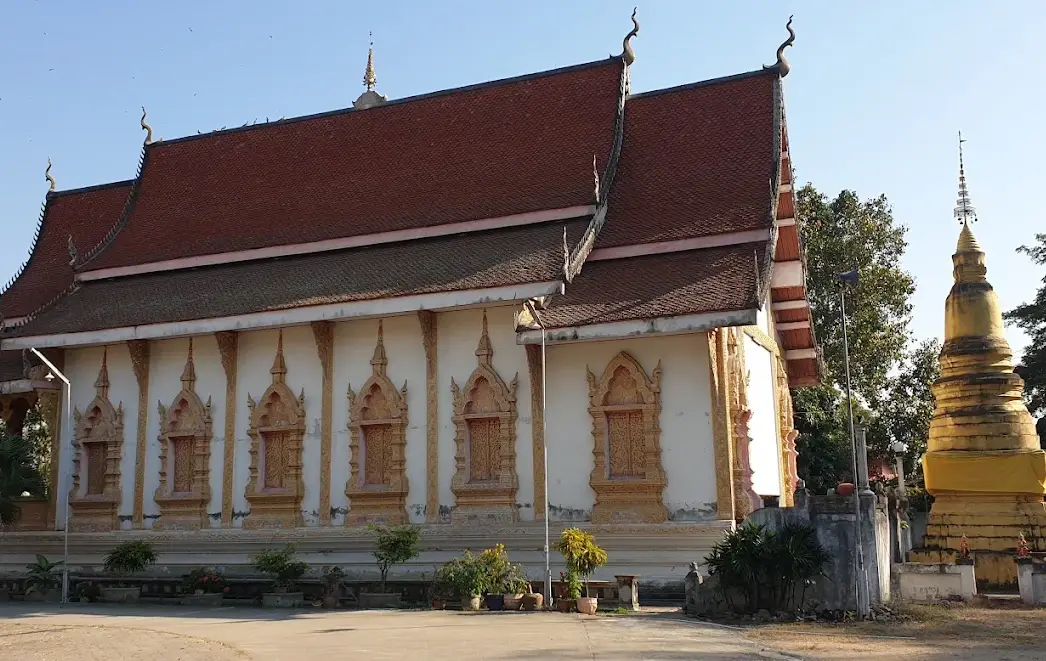
Operating day: Daily
Operating time: 08.00 - 17.00
Wat Ban Pong (Buak Khang) is a local Buddhist temple under the Mahanikaya sect, located at 74 Ban Pong, Village No. 11, Buak Khang Subdistrict, San Kamphaeng District, Chiang Mai Province 50130. The temple covers 10 rai and 2 ngan of land and was officially established in 1732. Its abbot is Phra Aphichat Aphichato. Wat Ban Pong is an important community temple of Ban Pong, serving as a place for Buddhist ceremonies, merit-making, Dhamma listening, Kathin, forest robe offerings, and annual village religious activities.
Ban Pong, Village No. 11, is part of Buak Khang Subdistrict in San Kamphaeng District. Buak Khang is a culturally significant area where village temples, homes, agricultural land, local roads, and community traditions remain closely connected. Wat Ban Pong therefore functions not only as a place of worship, but also as a central space where villagers gather, preserve Buddhist traditions, and maintain community relationships throughout the year.
The name “Wat Ban Pong” is directly connected with Ban Pong, the village in which the temple is located. Naming a temple after its village is common in Lanna communities, where temples were often created and maintained by local residents. The name reflects the close relationship between the temple and the village, showing that the temple belongs to the spiritual and social life of the local community.
Being officially established in 1732 gives Wat Ban Pong a long history of nearly 300 years. Over this long period, the temple has witnessed the development of Buak Khang and San Kamphaeng through many changes, from agricultural village life to the present cultural landscape connected with Chiang Mai. Wat Ban Pong remains a living witness to local Buddhist faith and village continuity.
Buak Khang Subdistrict is known for its Yong cultural background. Local history connects the area with Yong communities that settled in Chiang Mai during the revival of the city under Phaya Kawila. Yong identity remains visible through language, customs, food, religious practice, merit-making, and temple patronage. Wat Ban Pong stands within this cultural setting and forms part of the wider network of community temples that help preserve Buak Khang’s local identity.
The importance of Wat Ban Pong lies in its role in everyday community life. Villagers use the temple for Buddhist holy days, food offerings, Dhamma listening, Kathin, forest robe offerings, Buddhist Lent, the end of Buddhist Lent, and annual merit-making events. During religious activities, villagers help prepare the temple grounds, arrange food, support ceremonies, and maintain the temple as a shared sacred space.
Phra Aphichat Aphichato is the abbot of Wat Ban Pong. In a local community temple, the abbot plays an important role in caring for monks, maintaining temple buildings, leading ceremonies, supporting annual merit-making, and preserving the relationship between the temple and local villagers. Wat Ban Pong continues through cooperation between the monastic community and lay devotees.
The temple land covers 10 rai and 2 ngan, providing space for religious activities and community events. The main point of interest is the temple’s viharn, which serves as a worship and ceremonial space for lay devotees. In a Lanna village temple, the viharn is often the heart of community religious life, used for worship, Dhamma listening, annual ceremonies, and merit-making.
Wat Ban Pong is suitable for visitors interested in old community temples, village history, Yong cultural routes, and quiet Buddhist sites in San Kamphaeng. The temple’s value is not in large-scale tourism, but in its calm atmosphere, long history, and continuing function as the spiritual center of Ban Pong. Visitors can pay respect, walk quietly through the grounds, and appreciate the temple’s village-based character.
Within Buak Khang Subdistrict, Wat Ban Pong can be connected with several nearby temples and cultural sites, including Wat Buak Khang, Wat Ko Saliam, Wat Chang Phian, Wat Pa Tan, Wat Long Ko Kham, and Wat Rong Kong Khao. These places help visitors understand Buak Khang as a cultural community shaped by temples, village history, Yong identity, and local Buddhist traditions.
Wat Buak Khang, located not far from Wat Ban Pong, is known for Phra Non La, Ku Dam, and a rare twin-roofed viharn. Wat Ko Saliam is connected with village history and the saliam or neem trees that once grew in the area. Wat Chang Phian preserves a distinctive local naming legend, while Wat Pa Tan is closely associated with Yong community culture. Visiting Wat Ban Pong together with these nearby temples gives a deeper understanding of Buak Khang’s cultural landscape.
In cultural terms, Wat Ban Pong reflects an important feature of Lanna village temples: religion and everyday life are not separate. Villagers come to the temple not only for major ceremonies, but also for merit-making, community gatherings, family occasions, and the continuation of local customs. The temple functions as a religious institution, a shared community space, and a center of village relationships.
Religious activities at Wat Ban Pong follow the Buddhist calendar and local Lanna practice. These include Buddhist holy days, Kathin, forest robe offerings, Makha Bucha, Visakha Bucha, Asalha Bucha, Buddhist Lent, the end of Buddhist Lent, and annual community merit-making. These events keep the temple active throughout the year and strengthen cooperation among villagers.
For visitors interested in community history, Wat Ban Pong is a useful starting point for understanding Buak Khang. After visiting the temple, travelers can continue to Wat Buak Khang, Wat Pa Tan, or other Yong cultural learning points nearby to see how local language, food, customs, Buddhist practice, and temple life continue to shape the subdistrict.
Getting There from Chiang Mai city is convenient by private car, rental car, or local hired transport. Take the Chiang Mai–San Kamphaeng route toward San Kamphaeng District, then continue to Buak Khang Subdistrict and Ban Pong, Village No. 11. The temple is located at 74 Ban Pong and can be included in the same route as Wat Buak Khang, Wat Ko Saliam, Wat Chang Phian, and Wat Pa Tan.
A half-day itinerary can begin at Wat Ban Pong for worship and a quiet walk through the temple grounds, then continue to Wat Buak Khang to see Phra Non La, Ku Dam, and the twin-roofed viharn. Visitors can stop for local northern food in Buak Khang and then add Wat Pa Tan, Wat Ko Saliam, or Bo Sang Umbrella Village if time allows. This route adds depth to a San Kamphaeng trip by combining temples, community history, Yong culture, and local crafts.
Visitors should dress modestly, keep noise low, avoid disturbing monks or local devotees, and behave respectfully inside the temple grounds. If a ceremony, merit-making event, or community activity is taking place, visitors should give space to participants. Photography should be discreet and should not disturb rituals or private monastic areas.
Wat Ban Pong (Buak Khang) deserves a place in San Kamphaeng’s cultural travel routes because it combines a temple history dating to 1732, a 10-rai-and-2-ngan temple area, a community viharn, and a strong connection with Buak Khang’s Yong cultural landscape. For travelers who want to understand San Kamphaeng through faith, village life, and local Buddhist culture, Wat Ban Pong offers a calm and meaningful community-temple experience.
| Name | Wat Ban Pong (Buak Khang) |
| Location | Ban Pong, Village No. 11, Buak Khang Subdistrict, San Kamphaeng District, Chiang Mai Province |
| Address | 74 Ban Pong, Village No. 11, Buak Khang Subdistrict, San Kamphaeng District, Chiang Mai 50130, Thailand |
| Type | Local Buddhist temple under the Mahanikaya sect |
| Highlights | Old community temple of Ban Pong, official establishment in 1732, temple viharn, quiet village-temple atmosphere, and connection with Buak Khang’s Yong cultural route |
| History | Officially established as a temple in 1732 and maintained as a community temple of Ban Pong, Village No. 11 |
| Name Origin | Named after Ban Pong, Village No. 11, the community where the temple is located |
| Abbot / Caretaker | Phra Aphichat Aphichato |
| What To See / Worship | Viharn, worship area, temple courtyard, and the village-temple atmosphere of Ban Pong |
| Main Areas / Structures | Viharn, worship area, temple courtyard, and community merit-making area |
| Temple Land | 10 rai and 2 ngan |
| Community Context | Located in Buak Khang Subdistrict, a Yong cultural area of San Kamphaeng where temples remain central to language, customs, merit-making, and community identity |
| Religious Activities | Kathin, forest robe offerings, Buddhist holy days, Buddhist Lent, the end of Buddhist Lent, Makha Bucha, Visakha Bucha, Asalha Bucha, and annual community merit-making |
| Community Importance | Spiritual center of Ban Pong, used for Buddhist ceremonies, Dhamma listening, merit-making, Kathin, forest robe offerings, and village activities throughout the year |
| Travel Information | From Chiang Mai city, take the Chiang Mai–San Kamphaeng route toward San Kamphaeng District, then continue to Buak Khang Subdistrict and Ban Pong, Village No. 11; best accessed by private car, rental car, or local hired transport |
| Current Status | Active community Buddhist temple used for local religious ceremonies |
| Main Areas / Zones | 1. Viharn and worship area 2. Temple courtyard 3. Community merit-making area 4. Connected area with Ban Pong community 5. Route connection with cultural temples in Buak Khang |
| Nearby Tourist Attractions | 1. Wat Buak Khang, about 3 km 2. Wat Ko Saliam, about 3 km 3. Wat Chang Phian, about 5 km 4. Wat Pa Tan, about 5 km 5. Bo Sang Umbrella Village, about 10 km |
| Nearby Restaurants | 1. Bar Buak Khang @ San Kamphaeng, about 3 km 2. Huen Jai Yong, about 4 km, Tel. 086-671-8710, 086-730-2673 3. Aroi Ploen Phung, about 5 km, Tel. 085-151-5409 4. Huen Chao Khun, about 6 km, Tel. 090-317-3521 5. Tam Zaap San Kamphaeng, about 9 km, Tel. 089-559-0298 |
| Nearby Accommodations | 1. Boon Homestay, about 4 km, Tel. 093-494-8000 2. Huanmaisakngam Resort, about 5 km, Tel. 065-495-5365 3. 749 Baan Suan Resort, about 7 km 4. LaMoon Cottage SanKampang, about 11 km, Tel. 094-723-5395 5. The Vet Boutique Hotel, about 13 km, Tel. 052-011-179 |
Frequently Asked Questions (FAQ)
Q: Where is Wat Ban Pong (Buak Khang) located?
A: Wat Ban Pong (Buak Khang) is located at 74 Ban Pong, Village No. 11, Buak Khang Subdistrict, San Kamphaeng District, Chiang Mai Province 50130.
Q: What type of temple is Wat Ban Pong?
A: Wat Ban Pong is a local Buddhist temple under the Mahanikaya sect and serves as the community temple of Ban Pong in Buak Khang Subdistrict.
Q: When was Wat Ban Pong established?
A: Wat Ban Pong was officially established as a temple in 1732, making it one of the long-established community temples in Buak Khang.
Q: Who is the abbot of Wat Ban Pong?
A: The abbot of Wat Ban Pong is Phra Aphichat Aphichato.
Q: What are the highlights of Wat Ban Pong?
A: Highlights include its long history since 1732, temple viharn, calm village-temple atmosphere, and role as the spiritual center of Ban Pong.
Q: What type of travelers is Wat Ban Pong suitable for?
A: It is suitable for visitors interested in Lanna community temples, village history, Buak Khang’s Yong cultural routes, and quiet Buddhist sites in San Kamphaeng.
Q: What nearby places can be visited with Wat Ban Pong?
A: Nearby places include Wat Buak Khang, Wat Ko Saliam, Wat Chang Phian, Wat Pa Tan, and Bo Sang Umbrella Village.
 Category: ●Places of Worship
 Group: ●Temple
Last Update : 1 MonthAgo
 Last Update : 1 MonthAgo
 Click to Access the Navigation Map GPS
Wat Ban Pong (Buak Khang) Map
Recommend

 Muang Chiang Mai(121)Chom Thong(47)Mae Chaem(25)Chiang Dao(33)Doi Saket(68)Mae Taeng(85)Mae Rim(69)Samoeng(29)Fang(71)Mae Ai(59)Phrao(70)San Pa Tong(103)San Kamphaeng(66)San Sai(73)Hang Dong(73)Hot(32)Doi Tao(22)Omkoi(11)Saraphi(74)Wiang Haeng(15)Chai Prakan(28)Mae Wang(32)Mae On(22)Doi Lo(33)Galyani Vadhana(1)


