
lovethailand home >North Travel Attractions >Chiang Mai Travel Attractions >San Kamphaeng >Buak Khang > Wat Ko Saliam
TL;DR: Wat Ko Saliam is located at Ban Ko Saliam, Village No. 8, Buak Khang Subdistrict, San Kamphaeng District, Chiang Mai Province.

Wat Ko Saliam
Operating day: Daily
Operating time: 08.00 - 17.00
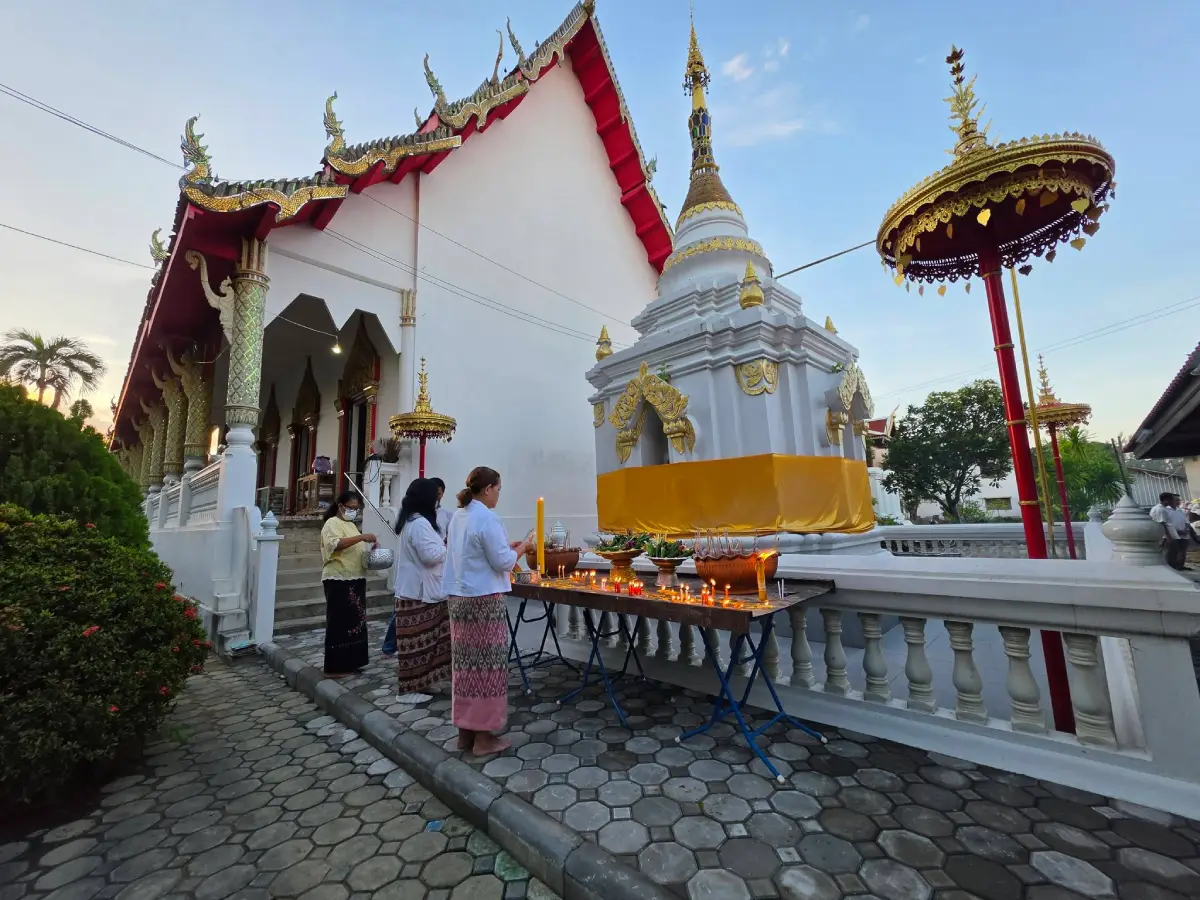
Wat Ko Saliam is a local Buddhist temple under the Mahanikaya sect, located at 70 Ban Ko Saliam, Village No. 8, Buak Khang Subdistrict, San Kamphaeng District, Chiang Mai Province 50130. The temple was officially established in 1895 and received Wisungkhamasima in 1916. Its abbot is Phra Athikan Boonchuay Chotipunyo. Wat Ko Saliam is an important community temple of Ban Ko Saliam and Buak Khang Subdistrict, serving as a spiritual center for Buddhist ceremonies, merit-making, Kathin, forest robe offerings, and the religious life of the local Lanna and Yong community.
Buak Khang Subdistrict is one of the culturally significant areas of San Kamphaeng District. The area consists of several villages where temples, houses, agricultural land, and community traditions are closely connected. Ban Ko Saliam, Village No. 8, is a village whose name is linked with the natural vegetation once found in the area. Wat Ko Saliam therefore preserves not only Buddhist faith, but also the memory of the village name, local landscape, and community settlement.
The name “Ko Saliam” comes from saliam trees, also known as neem trees, which once grew in large numbers around the temple and village area. When local villagers built the temple in a place known for these trees, they named the temple after the village. The name is simple but meaningful because it connects the temple with trees, land, settlement, and local memory.
The history of Wat Ko Saliam began around 1895, when local people joined together to build a place for Buddhist practice and religious activities. In the early period, villagers built one viharn using wood, with a roof made of banana leaves. This reflects the village-based way of building temples in the past, when local materials, faith, labor, and cooperation were the main foundations of a new Buddhist temple.
After the temple was built, villagers invited Phra Nuan Yanawichayo to reside there as the first abbot. His presence gave the temple a stable monastic role and allowed the community to use the temple continuously for merit-making, Dhamma listening, Buddhist observances, and religious practice. This marked the beginning of Wat Ko Saliam as a true spiritual center for Ban Ko Saliam.
Wat Ko Saliam was officially established as a temple in 1895 and received Wisungkhamasima in 1916. In Thai Buddhist tradition, Wisungkhamasima is the consecrated boundary granted for formal monastic acts. This confirmed the temple’s recognized status within the Buddhist monastic system and made it a complete religious institution for the local community.
With more than 130 years of history, Wat Ko Saliam has witnessed many changes in Buak Khang and San Kamphaeng. The temple grew from a simple wooden viharn built by villagers into a community temple with important structures and a continuing role in Buddhist life. It remains a living temple rather than only an old name in local history.
Buak Khang Subdistrict has a strong Yong cultural background. Local history connects the area with the resettlement of Yong people during the revival of Chiang Mai under Phaya Kawila. Yong identity remains visible through language, customs, rituals, craft knowledge, and temple patronage. Wat Ko Saliam stands within this cultural setting, where Lanna Buddhism and Yong community identity continue to support each other.
In a Yong community context, the temple is especially important. Villagers come to the temple for Buddhist holy days, Kathin, forest robe offerings, Buddhist Lent, the end of Buddhist Lent, and major Buddhist observances. The temple also serves as a place where elders, families, and younger generations meet during merit-making events. This gives Wat Ko Saliam an important social role as well as a religious one.
The temple area covers 8 rai, 1 ngan, and 64 square wah. Important structures and areas include a Thai-style ubosot, viharn, monks’ quarters, hall, chedi, temple courtyard, and community merit-making areas. These elements support monastic life, Buddhist ceremonies, lay worship, and village activities, making Wat Ko Saliam a complete and active community temple.
The Thai-style ubosot is one of the most important areas of the temple because it is connected with formal monastic acts. Together with the granting of Wisungkhamasima, the ubosot shows the temple’s full religious status. It also reflects the development of the temple from its early wooden viharn with a banana-leaf roof into a more established Buddhist site.
The viharn is another central space at Wat Ko Saliam. From the beginning, villagers built a viharn first because they needed a shared place for worship, Dhamma listening, and religious gatherings. The viharn therefore represents the original faith of the local community and the practical role of the temple as a gathering place for Buddhist life.
The chedi adds an important sacred dimension to the temple. In Lanna temple culture, a chedi often functions as a devotional focus, a visual center of the temple grounds, and a symbol of stability in Buddhism. Visitors should approach the chedi and worship areas respectfully and take time to appreciate the quiet community-temple atmosphere.
Phra Athikan Boonchuay Chotipunyo is the abbot of Wat Ko Saliam. In a community temple, the abbot plays an important role in caring for monks, maintaining temple buildings, leading ceremonies, supporting annual merit-making, and preserving the relationship between the temple and local villagers. Wat Ko Saliam continues through cooperation between monks and devotees.
Key things to see and respect at Wat Ko Saliam include the Thai-style ubosot, viharn, chedi, worship area, hall, monks’ quarters, temple courtyard, and the surrounding atmosphere of Ban Ko Saliam. The temple’s appeal is not large-scale tourism, but its calm setting, village-based history, and close relationship with local Buddhist life.
Wat Ko Saliam is suitable for visitors interested in Lanna community temples, village history, Yong cultural background, and cultural travel routes in San Kamphaeng. The temple is best experienced slowly, with attention to the story of local people who built the temple through collective faith and maintained it through generations.
Religious activities at Wat Ko Saliam follow the Buddhist calendar and local Lanna practice. These include Buddhist holy days, Kathin, forest robe offerings, Makha Bucha, Visakha Bucha, Asalha Bucha, Buddhist Lent, the end of Buddhist Lent, and annual community merit-making. Through these events, villagers gather to make merit, listen to Dhamma, support temple work, and maintain community ties.
Wat Ko Saliam serves as the spiritual center of Ban Ko Saliam. During temple events, villagers help prepare the grounds, support food offerings, make merit, listen to sermons, and assist with community activities. This shows that the temple is still a real public religious space used by the community, not simply a place to visit briefly.
Within Buak Khang Subdistrict, Wat Ko Saliam can be linked with several cultural sites, including Wat Buak Khang, Wat Long Ko Kham, Wat Rong Kong Khao, Wat Pong Chang Khot, and other local temples. These places help visitors understand Buak Khang as a cultural community with strong Yong heritage rather than just a rural area of San Kamphaeng.
Getting There from Chiang Mai city is convenient by private car, rental car, or local hired transport. Take the Chiang Mai–San Kamphaeng route toward San Kamphaeng District, then continue to Buak Khang Subdistrict and Ban Ko Saliam, Village No. 8. The temple is located at 70 Ban Ko Saliam and can be included in a cultural route with Wat Buak Khang and other temples in Buak Khang.
A half-day itinerary can begin at Wat Ko Saliam for worship and a quiet walk around the temple grounds, then continue to Wat Buak Khang to see Phra Non La, Phra That Ku Dam, and the twin-roofed viharn. A longer route can include Buak Khang cultural learning points, local Yong food, weaving or handicraft activities, Bo Sang Umbrella Village, or contemporary art sites in nearby Ton Pao.
Visitors should dress modestly, keep noise low, avoid disturbing monks or local devotees, and behave respectfully in the temple grounds. If a ceremony, merit-making event, or community gathering is taking place, visitors should give space to participants. Photography should be discreet and should not disturb rituals or private monastic areas.
Wat Ko Saliam deserves a place in San Kamphaeng’s cultural travel routes because it combines a temple history beginning in 1895, Wisungkhamasima granted in 1916, a name connected with saliam trees and local landscape, important structures such as a Thai-style ubosot, viharn, monks’ quarters, hall, and chedi, and its location within Buak Khang, a subdistrict known for Yong cultural identity. For travelers who want to understand San Kamphaeng through faith, community, and living Lanna culture, Wat Ko Saliam offers a calm and meaningful village-temple experience.
| Name | Wat Ko Saliam |
| Location | Ban Ko Saliam, Village No. 8, Buak Khang Subdistrict, San Kamphaeng District, Chiang Mai Province |
| Address | 70 Ban Ko Saliam, Village No. 8, Buak Khang Subdistrict, San Kamphaeng District, Chiang Mai 50130, Thailand |
| Type | Local Buddhist temple under the Mahanikaya sect |
| Highlights | Community temple of Ban Ko Saliam, history since 1895, Thai-style ubosot, viharn, monks’ quarters, hall, chedi, and a temple name linked with saliam or neem trees |
| History | Built around 1895 by local villagers as a place for Buddhist practice, officially established as a temple in 1895, and received Wisungkhamasima in 1916 |
| Name Origin | Named after Ban Ko Saliam, an area where saliam or neem trees once grew in large numbers around the temple and village |
| Abbot / Caretaker | Phra Athikan Boonchuay Chotipunyo |
| First Abbot | Phra Nuan Yanawichayo |
| What To See / Worship | Thai-style ubosot, viharn, chedi, worship area, hall, monks’ quarters, temple courtyard, and the village atmosphere of Ban Ko Saliam |
| Main Areas / Structures | Thai-style ubosot, viharn, monks’ quarters, hall, chedi, temple courtyard, and community merit-making area |
| Temple Land | 8 rai, 1 ngan, and 64 square wah |
| Community Context | Located in Buak Khang Subdistrict, a Yong cultural community of San Kamphaeng with strong local traditions, language, Buddhist practice, and temple patronage |
| Religious Activities | Kathin, forest robe offerings, Buddhist holy days, Buddhist Lent, the end of Buddhist Lent, Makha Bucha, Visakha Bucha, Asalha Bucha, and annual community merit-making |
| Community Importance | Spiritual center of Ban Ko Saliam, used for Buddhist ceremonies, Dhamma listening, merit-making, religious practice, and village gatherings throughout the year |
| Travel Information | From Chiang Mai city, take the Chiang Mai–San Kamphaeng route toward San Kamphaeng District, then continue to Buak Khang Subdistrict and Ban Ko Saliam, Village No. 8; best accessed by private car, rental car, or local hired transport |
| Current Status | Active community Buddhist temple used for local religious ceremonies |
| Main Contact Number | 095-450-9444 |
| Main Areas / Zones | 1. Thai-style ubosot 2. Viharn and worship area 3. Chedi 4. Hall and merit-making area 5. Monks’ quarters, temple courtyard, and community activity space |
| Nearby Tourist Attractions | 1. Wat Buak Khang, about 3 km 2. Wat Long Ko Kham, about 2 km 3. Wat Rong Kong Khao, about 3 km 4. Wat Pong Chang Khot, about 4 km 5. Bo Sang Umbrella Village, about 9 km |
| Nearby Restaurants | 1. Aroi Ploen Phung, about 2 km, Tel. 085-151-5409 2. Bar Buak Khang @ San Kamphaeng, about 3 km, Tel. 062-309-4252 3. Huen Jai Yong, about 5 km 4. Huen Chao Khun, about 5 km, Tel. 090-317-3521 5. Tam Zaap San Kamphaeng, about 8 km, Tel. 089-559-0298 |
| Nearby Accommodations | 1. Boon Homestay, about 3 km, Tel. 093-494-8000 2. Huanmaisakngam Resort, about 5 km 3. 749 Baan Suan Resort, about 6 km 4. LaMoon Cottage SanKampang, about 10 km, Tel. 094-723-5395 5. The Vet Boutique Hotel, about 12 km, Tel. 052-011-179 |
Frequently Asked Questions (FAQ)
Q: Where is Wat Ko Saliam located?
A: Wat Ko Saliam is located at 70 Ban Ko Saliam, Village No. 8, Buak Khang Subdistrict, San Kamphaeng District, Chiang Mai Province 50130.
Q: What type of temple is Wat Ko Saliam?
A: Wat Ko Saliam is a local Buddhist temple under the Mahanikaya sect and an important community temple of Ban Ko Saliam.
Q: When was Wat Ko Saliam established?
A: Wat Ko Saliam was built and officially established around 1895 and received Wisungkhamasima in 1916.
Q: What is the origin of the name Wat Ko Saliam?
A: The name comes from the saliam or neem trees that once grew in large numbers around the temple and village area.
Q: Who is the abbot of Wat Ko Saliam?
A: The abbot of Wat Ko Saliam is Phra Athikan Boonchuay Chotipunyo. The first abbot invited by villagers was Phra Nuan Yanawichayo.
Q: What are the highlights of Wat Ko Saliam?
A: Highlights include the temple’s village-based history since 1895, Thai-style ubosot, viharn, monks’ quarters, hall, chedi, and its connection with the Yong cultural community of Buak Khang.
Q: What nearby places can be visited with Wat Ko Saliam?
A: Nearby places include Wat Buak Khang, Wat Long Ko Kham, Wat Rong Kong Khao, Wat Pong Chang Khot, and Bo Sang Umbrella Village.
 Category: ●Places of Worship
 Group: ●Temple
Last Update : 2 MonthAgo
 Last Update : 2 MonthAgo
 Click to Access the Navigation Map GPS
Wat Ko Saliam Map
Recommend

 Muang Chiang Mai(121)Chom Thong(47)Mae Chaem(25)Chiang Dao(33)Doi Saket(68)Mae Taeng(85)Mae Rim(69)Samoeng(29)Fang(71)Mae Ai(59)Phrao(70)San Pa Tong(103)San Kamphaeng(66)San Sai(73)Hang Dong(73)Hot(32)Doi Tao(22)Omkoi(11)Saraphi(74)Wiang Haeng(15)Chai Prakan(28)Mae Wang(32)Mae On(22)Doi Lo(33)Galyani Vadhana(1)


