
lovethailand home >North Travel Attractions >Chiang Mai Travel Attractions >San Kamphaeng >Ton Pao > Wat San Mahok Fa
TL;DR: Wat San Mahok Fa is located at Ban San Mahok Fa, Village No. 7, Ton Pao Subdistrict, San Kamphaeng District, Chiang Mai Province, open Daily, hours 08.00 – 17.00.
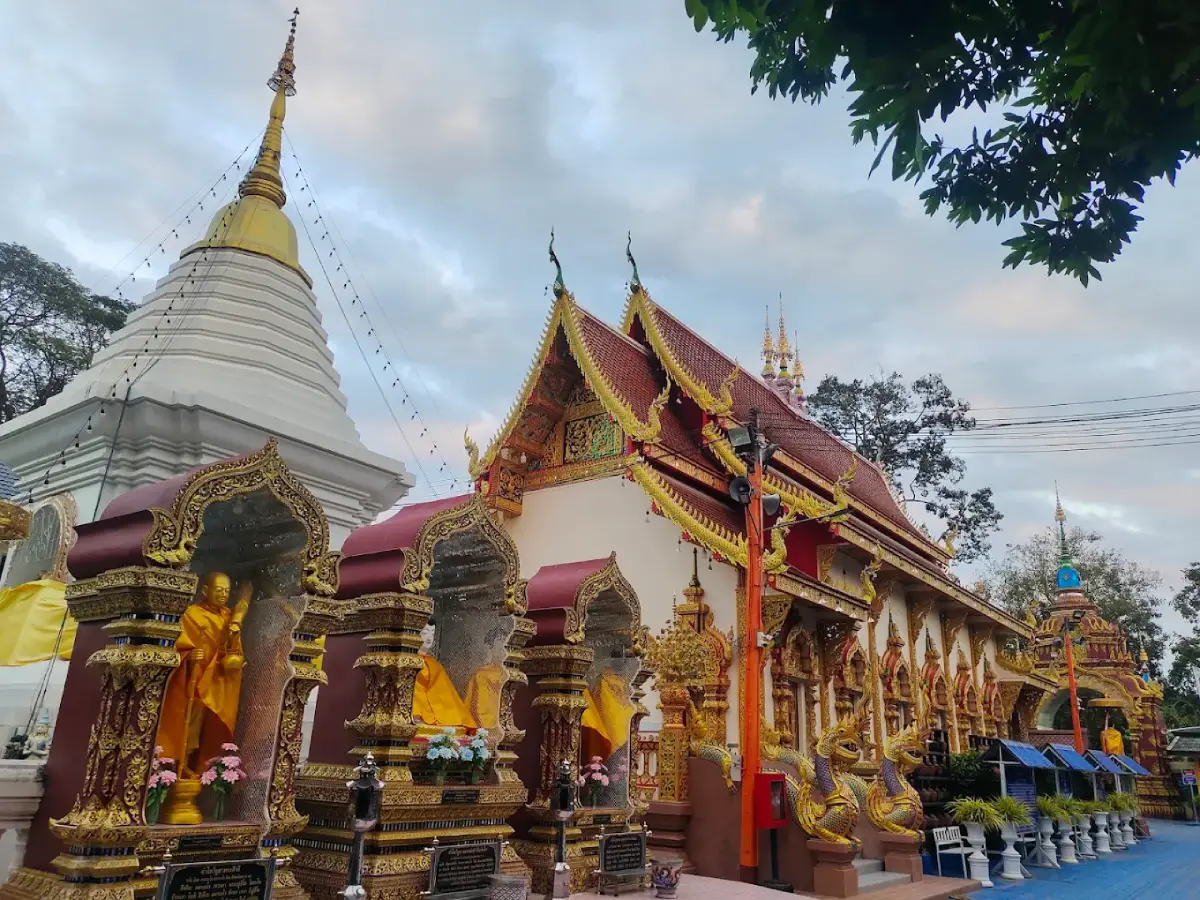
Wat San Mahok Fa
Open Days: Daily
Opening Hours: 08.00 – 17.00
Wat San Mahok Fa is a local Buddhist temple under the Mahanikaya sect, located in Ban San Mahok Fa, Village No. 7, Ton Pao Subdistrict, San Kamphaeng District, Chiang Mai Province 50130. The temple was officially established in 1782 and received Wisungkhamasima in 1832. It was recognized as an outstanding developed temple in 2004 and as a model developed temple in 2005. Its abbot is Phra Khru Sutapanyawithit Aggapanyo. Wat San Mahok Fa is an old community temple that continues to serve as the spiritual center of Ban San Mahok Fa, supporting Buddhist ceremonies, merit-making, Kathin, forest robe offerings, and Lanna Buddhist community traditions.
Ban San Mahok Fa is Village No. 7 of Ton Pao Subdistrict in San Kamphaeng District. Ton Pao is known for handicrafts, mulberry paper, Bo Sang umbrellas, basketry, local craft knowledge, and a network of old community temples. Wat San Mahok Fa therefore stands within a cultural landscape where Buddhism, village life, craft heritage, agriculture, and community roads connecting Chiang Mai with San Kamphaeng meet.
The name “San Mahok Fa” is connected with the landform and trees remembered by the community. In the Lanna context, “san” can refer to a ridge or raised ground, while “mahog fa” refers to trees once found on the raised land where the community settled. Local history says a group of people migrated from Sipsong Panna and settled in this area. Because the settlement site had a raised earthen ridge and mahog fa trees, the village became known as Ban San Mahok Fa. The temple name therefore preserves the memory of migration, landscape, vegetation, and village formation.
The temple’s establishment in 1782 gives Wat San Mahok Fa more than 240 years of history. Over that period, Ton Pao and San Kamphaeng changed from agricultural and local craft communities into a cultural travel route close to Chiang Mai city. Wat San Mahok Fa has remained a living community temple rather than a large commercial tourist attraction. Its value lies in continuity: worship, Buddhist observances, ceremonies, local merit-making, and the relationship between monks and villagers.
Receiving Wisungkhamasima in 1832 was an important religious milestone. In Thai Buddhist tradition, Wisungkhamasima is the consecrated boundary granted for formal monastic acts. It is associated with the proper use of an ordination hall and confirms the temple’s status within the Buddhist monastic system. For Wat San Mahok Fa, this reflects its long-standing role as a stable Buddhist temple in the community.
The temple’s recognition as an outstanding developed temple in 2004 and a model developed temple in 2005 shows that Wat San Mahok Fa is not only historically old, but also has a record of temple development and community involvement. A developed temple is valued for its organization, maintenance, religious usefulness, and role in supporting both Buddhism and local people.
Phra Khru Sutapanyawithit Aggapanyo is the abbot of Wat San Mahok Fa. In a community temple, the abbot plays an important role in caring for monastic life, leading ceremonies, guiding devotees, maintaining temple buildings, and keeping the connection between temple and village strong. Wat San Mahok Fa continues through cooperation between monks and local residents, and the abbot helps preserve that relationship.
Historical temple records place Wat San Mahok Fa at No. 19, Ban San Mahok Fa, Ton Pao Subdistrict, San Kamphaeng District, Chiang Mai. The temple land covers about 5 rai and 90 square wah, with two plots of monastic land totaling about 3 rai, 1 ngan, and 44 square wah. This gives the temple space for monastic life, worship, merit-making, and community activities.
Important temple structures recorded for Wat San Mahok Fa include an old Thai-style ubosot, a sala bat, a viharn, and monks’ quarters. The ubosot is important for formal monastic acts. The viharn serves as a worship and religious activity space. The sala bat is connected with offerings and community merit-making, while the monks’ quarters support monks who reside at the temple. These structures show that Wat San Mahok Fa functions as a complete and active village temple.
Key things to see and respect include the old Thai-style ubosot, viharn, worship area, sala bat, monks’ quarters, temple courtyard, and the surrounding atmosphere of Ban San Mahok Fa. The temple is not defined by large-scale tourism, but by its continuity as a quiet and meaningful Lanna community temple. Visitors should appreciate its calm setting, long history, and living relationship with local people.
Wat San Mahok Fa is suitable for visitors who want to experience a quiet local temple rather than a crowded tourist site. It is especially suitable for cultural travelers, local-history enthusiasts, visitors interested in Lanna temples, and those planning a route that connects temples, villages, handicrafts, and local life in San Kamphaeng.
The temple’s role in the community is clear. It serves as a spiritual center of Ban San Mahok Fa and supports Buddhist holy days, Kathin, forest robe offerings, Buddhist Lent, the end of Buddhist Lent, major Buddhist observances, and local Lanna merit-making. The temple area and its frontage are also used as important reference points in local municipal and community activities, showing that the temple remains part of the village’s public life.
Ban San Mahok Fa is also connected with several forms of local wisdom. Local records mention community wisdom from Ban San Mahok Fa in woodcarving, local games, food, rattan craft, and other craft traditions. This means the temple is surrounded by a community with strong cultural capital. Wat San Mahok Fa is therefore connected not only with religion, but also with the wider craft and knowledge network of Ton Pao.
As a cultural travel stop, Wat San Mahok Fa can be combined with several important places in Ton Pao and San Kamphaeng. A temple-and-community route can include Wat San Pa Kha, Wat Bo Sang, Wat Phra Pan, Wat Ton Phueng, and Wat Buak Pet. A craft-focused route can continue to Ban Ton Pao, Bo Sang Umbrella Village, and mulberry paper craft areas. A wider cultural route can also include MAIIAM Contemporary Art Museum. This combination gives visitors a broad view of San Kamphaeng through temples, villages, handicrafts, art, and Lanna community life.
Getting There from Chiang Mai city is convenient by private car, rental car, or local hired transport. Take the Chiang Mai–San Kamphaeng road toward Ton Pao and Bo Sang, then continue to Ban San Mahok Fa, Village No. 7. The temple is located within Ban San Mahok Fa, Ton Pao Subdistrict, San Kamphaeng District, Chiang Mai 50130. Travelers already visiting Bo Sang Umbrella Village, Ban Ton Pao, or Wat Bo Sang can add Wat San Mahok Fa without a long detour.
A half-day itinerary can begin at Wat San Mahok Fa, then continue to Wat San Pa Kha, Ban Ton Pao, and Bo Sang Umbrella Village. A longer route can add Wat Phra Pan, Wat Bo Sang, MAIIAM Contemporary Art Museum, and Baan Jang Nak. This route helps visitors experience San Kamphaeng beyond souvenirs, showing old temples, local communities, craft traditions, contemporary art, and everyday Lanna culture.
Visitors should dress modestly, keep noise low, avoid disturbing monks or local devotees, and use the temple respectfully. If a ceremony, funeral, or merit-making event is taking place, visitors should give space to participants. Photography should be discreet, especially near monks’ quarters and private monastic areas. Wat San Mahok Fa is still an active community temple, so respectful behavior is essential.
Wat San Mahok Fa deserves a place in San Kamphaeng’s cultural travel routes because it combines a long history since 1782, Wisungkhamasima since 1832, recognition as an outstanding developed and model developed temple, the role of Phra Khru Sutapanyawithit Aggapanyo as abbot, the story of Ban San Mahok Fa’s settlement by people from Sipsong Panna, and the craft identity of Ton Pao. For travelers who want to understand San Kamphaeng beyond Bo Sang umbrellas alone, this temple offers a calm and grounded view of Lanna Buddhist community culture.
| Name | Wat San Mahok Fa |
| Location | Ban San Mahok Fa, Village No. 7, Ton Pao Subdistrict, San Kamphaeng District, Chiang Mai Province |
| Address | No. 19, Ban San Mahok Fa, Village No. 7, Ton Pao Subdistrict, San Kamphaeng District, Chiang Mai 50130, Thailand |
| Type | Local Buddhist temple under the Mahanikaya sect |
| Highlights | Old community temple of Ban San Mahok Fa, history since 1782, old Thai-style ubosot, viharn, sala bat, monks’ quarters, and recognition as an outstanding developed temple |
| History | Officially established as a temple in 1782, received Wisungkhamasima in 1832, recognized as an outstanding developed temple in 2004, and as a model developed temple in 2005 |
| Name Origin | Linked with Ban San Mahok Fa, a village whose name comes from raised ground with mahog fa trees and the settlement story of people who migrated from Sipsong Panna |
| Abbot / Caretaker | Phra Khru Sutapanyawithit Aggapanyo |
| What To See / Worship | Old Thai-style ubosot, viharn, worship area, sala bat, monks’ quarters, temple courtyard, and the local atmosphere of Ban San Mahok Fa |
| Main Areas / Structures | Old Thai-style ubosot, sala bat, viharn, monks’ quarters, worship area, temple courtyard, and community merit-making area |
| Temple Land | Main temple land covers about 5 rai and 90 square wah, with two plots of monastic land totaling about 3 rai, 1 ngan, and 44 square wah |
| Community Context | Ban San Mahok Fa, Village No. 7, is a Ton Pao community with a settlement story connected with Sipsong Panna migration and local wisdom in crafts, food, rattan work, and local traditions |
| Religious Activities | Kathin, forest robe offerings, Buddhist holy days, Buddhist Lent, the end of Buddhist Lent, major Buddhist observances, and Lanna community merit-making |
| Community Importance | Spiritual center of Ban San Mahok Fa, used for Buddhist ceremonies, merit-making, community activities, and as an important local reference point of Village No. 7 |
| Travel Information | From Chiang Mai city, take the Chiang Mai–San Kamphaeng road toward Ton Pao and Bo Sang, then continue to Ban San Mahok Fa, Village No. 7; best accessed by private car, rental car, or local hired transport |
| Current Status | Active community Buddhist temple used for local religious ceremonies |
| Open Days | Daily |
| Opening Hours | 08.00 – 17.00 |
| Main Contact Number | 053-390-446 |
| Main Areas / Zones | 1. Old Thai-style ubosot 2. Viharn and worship area 3. Sala bat 4. Monks’ quarters 5. Temple courtyard and community activity area |
| Nearby Tourist Attractions | 1. Ban Ton Pao / Mulberry Paper Craft Area, about 2 km 2. Wat San Pa Kha, about 2 km 3. Bo Sang Umbrella Village, about 4 km 4. Wat Bo Sang, about 4 km 5. MAIIAM Contemporary Art Museum, about 6 km |
| Nearby Restaurants | 1. Chai Si Bamee Kiao San Pa Kha, about 2 km, Tel. 086-912-2258 2. Ryota Shabu Bo Sang Branch, about 3 km 3. Solao Baan Je Ton Pao Branch, about 3 km, Tel. 099-397-9946 4. Bo Sang Cafe, about 4 km, Tel. 087-710-5232 5. Saphai Mae Nuan Pla Phao Bo Sang, about 4 km, Tel. 096-083-2539 |
| Nearby Accommodations | 1. The Vet Boutique Hotel, about 4 km, Tel. 052-011-179, 091-852-5507 2. Chiangmai Lanna Modern Loft Hotel, about 5 km 3. Doltara Chiang Mai Boutique Resort, about 6 km 4. LaMoon Cottage SanKampang, about 7 km, Tel. 094-723-5395 5. Viewdoi Art and Resort, about 10 km, Tel. 088-866-2562 |
Frequently Asked Questions (FAQ)
Q: Where is Wat San Mahok Fa located?
A: Wat San Mahok Fa is located in Ban San Mahok Fa, Village No. 7, Ton Pao Subdistrict, San Kamphaeng District, Chiang Mai Province 50130.
Q: What type of temple is Wat San Mahok Fa?
A: Wat San Mahok Fa is a local Buddhist temple under the Mahanikaya sect and serves as the community temple of Ban San Mahok Fa.
Q: When was Wat San Mahok Fa established?
A: Wat San Mahok Fa was officially established as a temple in 1782 and received Wisungkhamasima in 1832.
Q: Who is the abbot of Wat San Mahok Fa?
A: The abbot of Wat San Mahok Fa is Phra Khru Sutapanyawithit Aggapanyo.
Q: What are the highlights of Wat San Mahok Fa?
A: Highlights include its old community-temple history, old Thai-style ubosot, viharn, sala bat, monks’ quarters, and recognition as an outstanding developed temple of Ton Pao.
Q: What is the origin of the name San Mahok Fa?
A: The name is linked with raised village land, mahog fa trees, and the settlement story of people who migrated from Sipsong Panna.
Q: What nearby places can be visited with Wat San Mahok Fa?
A: Nearby places include Ban Ton Pao, Wat San Pa Kha, Bo Sang Umbrella Village, Wat Bo Sang, and MAIIAM Contemporary Art Museum.
 Category: ●Places of Worship
 Group: ●Temple
Last Update : 23 HourAgo
 Last Update : 23 HourAgo
 Click to Access the Navigation Map GPS
 Muang Chiang Mai(121)Chom Thong(47)Mae Chaem(25)Chiang Dao(33)Doi Saket(68)Mae Taeng(85)Mae Rim(69)Samoeng(29)Fang(71)Mae Ai(59)Phrao(70)San Pa Tong(103)San Kamphaeng(66)San Sai(73)Hang Dong(74)Hot(32)Doi Tao(22)Omkoi(11)Saraphi(74)Wiang Haeng(15)Chai Prakan(28)Mae Wang(32)Mae On(22)Doi Lo(34)Galyani Vadhana(1)


