
lovethailand home >North Travel Attractions >Chiang Mai Travel Attractions >Samoeng >Samoeng Nuea > Wat Sala Pong Kwao
TL;DR: Wat Sala Pong Kwao is located at 94 Moo 3, Ban Pong Kwao, Samoeng Nuea Subdistrict, Samoeng District, Chiang Mai Province 50250.

Wat Sala Pong Kwao
Operating day: Daily
Operating time: 08.00 - 17.00
Wat Sala Pong Kwao is a local Buddhist temple under the Maha Nikaya order, located at 94 Moo 3, Ban Pong Kwao, Samoeng Nuea Subdistrict, Samoeng District, Chiang Mai Province. The temple was founded in B.E. 2350 and received its royal consecrated boundary on July 20, B.E. 2550. The boundary measures 20 meters wide and 40 meters long. Wat Sala Pong Kwao is an important old community temple of Ban Pong Kwao, closely connected with local faith, Lanna village life, the mountain landscape of Samoeng Nuea, Phra Kaeo and the founding devotees of Ban Pong Kwao, the long memory of Luang Pu Khru Ba Som Opaso, and a continuous lineage of abbots from the early Rattanakosin period to the present.
Wat Sala Pong Kwao is one of the important community temples in Samoeng Nuea. Its value comes not only from its establishment in B.E. 2350, but also from its deep connection with Ban Pong Kwao. The village is located in a mountainous area of Samoeng, surrounded by local roads, farming areas, community land, and hills. The temple functions as a place for worship, merit-making, Dhamma listening, Buddhist ceremonies, and community memory.
In provincial temple records, the temple appears under the name “Wat Sala,” while local residents commonly call it “Wat Pong Kwao” or “Wat Sala Pong Kwao.” These names reflect the relationship between formal registration and the name used by villagers in everyday life. Understanding the temple’s names helps visitors see how official records, local memory, and community identity overlap in a living village temple.
The history of Wat Sala Pong Kwao began in B.E. 2350, when Phra Kaeo and the devotees of Ban Pong Kwao jointly established the temple. The founding of a village temple in a mountain community reflects strong local faith and cooperation. The temple was not created simply as a physical structure; it was created as a shared religious center where villagers could make merit, listen to Dhamma teachings, hold ceremonies, and preserve Buddhism within their own community.
Ban Pong Kwao is Moo 3 of Samoeng Nuea Subdistrict, Samoeng District, Chiang Mai. The temple land covers 3 rai, 2 ngan, and 40 square wah, with the land title deed number 3303. The temple’s southern boundary adjoins a road, the eastern boundary adjoins a road and rice fields, the northern boundary adjoins local residents’ land, and the western boundary adjoins a mountain. This setting gives Wat Sala Pong Kwao the clear character of a village temple surrounded by roads, farmland, local households, and natural landscape.
The temple received its royal consecrated boundary on July 20, B.E. 2550. This is an important religious milestone because a consecrated boundary provides an officially recognized area for formal Sangha ceremonies according to Buddhist discipline. The boundary confirms the temple’s role as a complete Buddhist institution serving both monks and laypeople in Ban Pong Kwao.
The principal Buddha image in the viharn was created in B.E. 2542. It has a lap width of 1 meter and a height of 1.5 meters, and was built from brick and plaster. This principal image is the main devotional focus of the temple, where villagers and visitors pay respect, make merit, and recollect the qualities of the Buddha. Its presence makes the viharn one of the most important religious spaces of the temple.
Wat Sala Pong Kwao is also important because it enshrines the relic remains of Luang Pu Khru Ba Som Opaso, who spent more than 60 Buddhist Lents at the temple. His long residence gives the temple a deeper spiritual dimension. The relic memorial connects the temple with the memory of a monk who served Ban Pong Kwao for decades and remains respected by local devotees.
The lineage of abbots reflects the long continuity of Wat Sala Pong Kwao. The first recorded abbot was Phra Kaeo from B.E. 2350 to 2382, followed by Phra Dee from B.E. 2382 to 2405, Phra Ka Khantitharo from B.E. 2406 to 2428, Phra Panya Khunawaro from B.E. 2429 to 2440, Phra Duangkaeo from B.E. 2440 to 2472, Phra Techa Techathammo from B.E. 2472 to 2476, Phra Panya Khunathawaro from B.E. 2476 to 2480, Phra Khru Ba Som Opaso from B.E. 2480 to 2536, Phra Samu Chamlong Sanyamo from B.E. 2536 to 2547, and Phra Athikan Somchai Natathammo from B.E. 2547 onward. This succession shows the continuous monastic care of the temple across many generations.
The sermon hall measures 15 meters wide and 20 meters long. Built in B.E. 2537, it is a single-storey building roofed with corrugated tiles. It is used for Dhamma listening, merit-making, community gatherings, and annual Buddhist activities. In a village temple, the sermon hall is a shared space where laypeople come together for religious and community purposes.
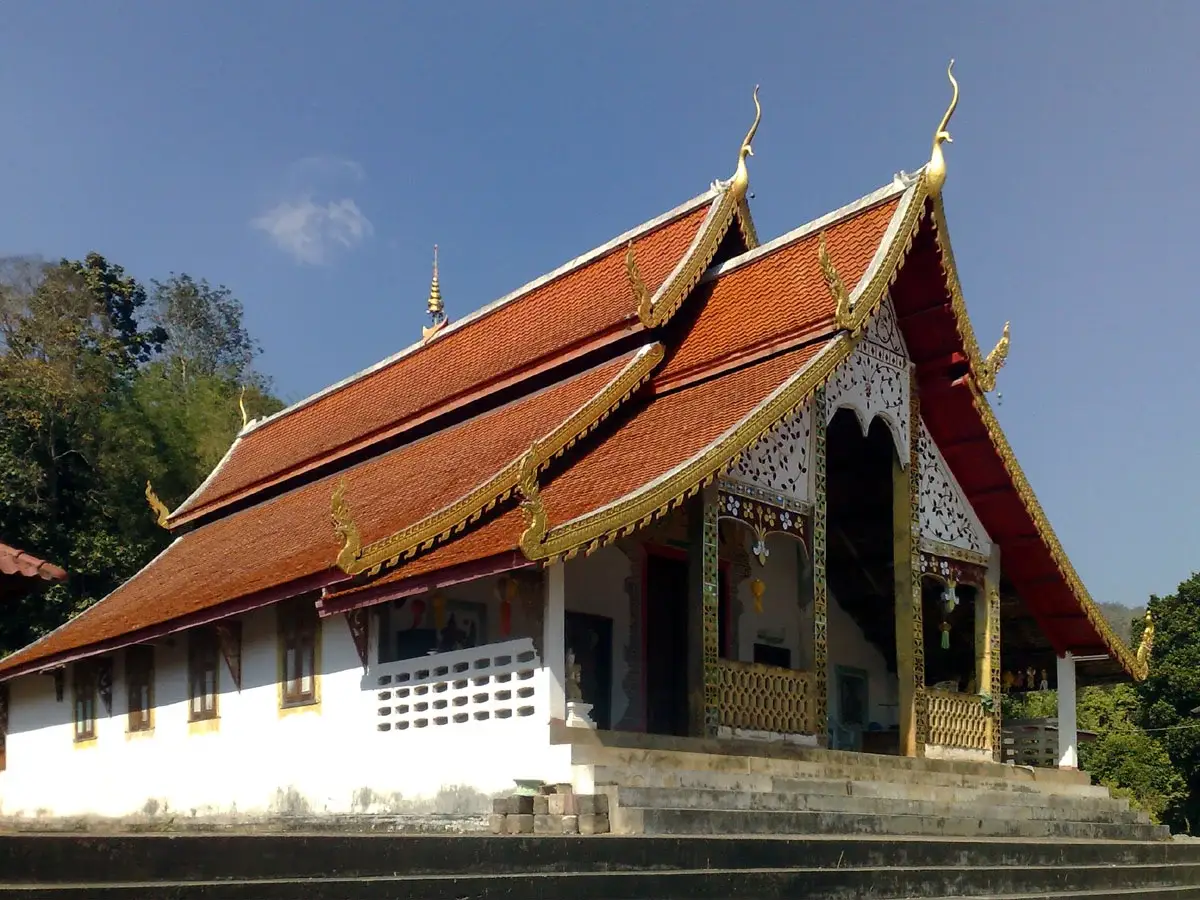
The viharn measures 10 meters wide and 25 meters long. It is a single-storey building roofed with clay tiles and houses the principal Buddha image. The viharn is the temple’s main devotional space, where villagers come to worship, chant, make merit, and take part in Buddhist ceremonies. Its clay-tile roof also reflects the atmosphere of a northern Thai community temple.
The temple has two monk’s residences: one wooden building and one half-masonry, half-wooden building. These provide living space for monks and support the daily religious life of the temple. The multi-purpose pavilion measures 5 meters wide and 20 meters long, was built in B.E. 2554, and is a two-storey building roofed with metal sheets. The temple also has one kitchen used for merit-making events and community activities.
The temple’s structures together show how Wat Sala Pong Kwao supports both religious and community life. The viharn is the worship space, the sermon hall supports Dhamma listening and gatherings, the monk’s residences support monastic life, the multi-purpose pavilion supports activities, and the kitchen supports communal merit-making. These components allow the temple to function as a living center of Ban Pong Kwao.
The role of Wat Sala Pong Kwao can be seen in several dimensions. Religiously, it is a place for worship, merit-making, Dhamma listening, and Buddhist ceremonies. Socially, it is a gathering place for villagers during annual merit-making activities. Culturally, it preserves the Lanna relationship between village, temple, community, and natural landscape. Historically, it preserves the story of its founding, the lineage of abbots, and the memory of Luang Pu Khru Ba Som Opaso.
Religious activities at Wat Sala Pong Kwao follow the rhythm of northern Thai community temples. These include Buddhist holy day observances, Kathin ceremonies, forest robe offerings, Buddhist Lent activities, end-of-Lent merit-making, major Buddhist holy days, and Northern Thai New Year traditions. These occasions bring villagers together to make offerings, listen to Dhamma teachings, prepare the temple grounds, and maintain local Buddhist culture.
For visitors, the key points of interest are the principal Buddha image in the viharn, the clay-tile-roofed viharn, the sermon hall, the relic memorial of Luang Pu Khru Ba Som Opaso, and the calm atmosphere of a Ban Pong Kwao community temple. Visitors should take time to pay respect and understand that each part of the temple reflects local faith, community cooperation, and long-term monastic care.
The atmosphere of Wat Sala Pong Kwao is calm and rural, suitable for travelers interested in old temples, Lanna village culture, monastic history, and cultural routes in Samoeng Nuea. The temple should not be seen only as a stop near Pong Kwao Hot Spring. It is a long-standing spiritual center of Ban Pong Kwao with documented history from B.E. 2350.
Visitors should dress modestly, speak quietly, and respect the viharn, sermon hall, monk’s residences, and ceremony areas. During Buddhist holy days, merit-making events, or community activities, travelers should avoid disturbing monks and villagers. A respectful visit allows travelers to experience the temple’s calm atmosphere while supporting the community’s continued use of the space.
Getting There is most convenient by private car or rental car. From Chiang Mai city, travelers can drive toward Samoeng District via the Mae Rim–Samoeng route or the Hang Dong–Samoeng route, then continue to Samoeng Nuea Subdistrict and Ban Pong Kwao, Moo 3. The route includes mountain roads and rural village roads, so careful driving is recommended, especially during the rainy season or late afternoon.
A visit to Wat Sala Pong Kwao can be combined with nearby places in Samoeng Nuea, including Pong Kwao Hot Spring, Wat Mae Loei, Wat Mae Phae, Wat Pong Pa, Wat Ban Pok, Wat Ton Lan, and Wat Thung Lom. This route is suitable for travelers who want to experience community temples, monastic history, nature, hot springs, cafés, restaurants, and mountain accommodation in western Chiang Mai.
| Name | Wat Sala Pong Kwao |
| Related Names | Wat Sala / Wat Pong Kwao / Wat Sala Pong Kwao |
| Type | Local Buddhist Temple Under The Maha Nikaya Order |
| Location | 94 Moo 3, Ban Pong Kwao, Samoeng Nuea Subdistrict, Samoeng District, Chiang Mai Province 50250 |
| Highlights | An old community temple of Ban Pong Kwao, founded in B.E. 2350 by Phra Kaeo and the devotees of Ban Pong Kwao, with a principal Buddha image, the relic memorial of Luang Pu Khru Ba Som Opaso, and a long lineage of abbots |
| History / Religious Status | Founded in B.E. 2350 and granted a royal consecrated boundary on July 20, B.E. 2550 as a Maha Nikaya community temple of Ban Pong Kwao |
| Consecrated Boundary | 20 meters wide and 40 meters long |
| Temple Land | 3 rai, 2 ngan, and 40 square wah; land title deed number 3303 |
| Surrounding Boundaries | South: road; east: road and rice fields; north: local residents’ land; west: mountain |
| Name Origin | In provincial temple records the temple appears as Wat Sala, while villagers call it Wat Pong Kwao after Ban Pong Kwao, the Moo 3 village where the temple is located |
| Sacred Objects / Important Features | Principal Buddha image in the viharn, built in B.E. 2542, with a lap width of 1 meter and a height of 1.5 meters, made of brick and plaster; relic memorial of Luang Pu Khru Ba Som Opaso |
| Important Structures | Sermon hall: 15 by 20 meters, built in B.E. 2537, single-storey building roofed with corrugated tiles Viharn: 10 by 25 meters, single-storey building roofed with clay tiles Two monk’s residences: one wooden building and one half-masonry, half-wooden building Multi-purpose pavilion: 5 by 20 meters, built in B.E. 2554, two-storey building roofed with metal sheets One kitchen |
| Abbot Lineage | 1. Phra Kaeo, B.E. 2350-2382 2. Phra Dee, B.E. 2382-2405 3. Phra Ka Khantitharo, B.E. 2406-2428 4. Phra Panya Khunawaro, B.E. 2429-2440 5. Phra Duangkaeo, B.E. 2440-2472 6. Phra Techa Techathammo, B.E. 2472-2476 7. Phra Panya Khunathawaro, B.E. 2476-2480 8. Phra Khru Ba Som Opaso, B.E. 2480-2536 9. Phra Samu Chamlong Sanyamo, B.E. 2536-2547 10. Phra Athikan Somchai Natathammo, from B.E. 2547 onward |
| Traditions / Religious Activities | Buddhist holy day observances, Kathin ceremonies, forest robe offerings, Buddhist Lent activities, end-of-Lent merit-making, major Buddhist holy days, and Northern Thai New Year traditions |
| Community Role | A spiritual center for Ban Pong Kwao, supporting worship, merit-making, Dhamma listening, Buddhist activities, and the continuity of Lanna village life in Samoeng Nuea |
| Travel Information | Best reached by private car or rental car from Chiang Mai city to Samoeng District, then onward to Samoeng Nuea Subdistrict and Ban Pong Kwao, Moo 3. The route includes mountain and rural roads. |
| Current Status | A Maha Nikaya community temple of Ban Pong Kwao, used for worship, merit-making, sermons, and Buddhist community activities |
| Facilities | Viharn, sermon hall, multi-purpose pavilion, monk’s residences, kitchen, temple grounds, worship area, and community Buddhist activity space |
| Nearby Tourist Attractions | 1. Pong Kwao Hot Spring, about 2 km 2. Wat Mae Loei, about 12 km 3. Wat Mae Phae, about 10 km 4. Wat Pong Pa, about 13 km 5. Wat Ban Pok, about 13 km 6. Wat Ton Lan, about 15 km 7. Wat Thung Lom, about 17 km |
| Nearby Restaurants | 1. Food Service Area At Pong Kwao Hot Spring, about 2 km 2. Ice Cream Café At Samoeng, about 24 km, Tel. 081-751-2191 3. Baan Coffee Samoeng, about 25 km, Tel. 082-763-3400 4. Cafe De Mountain, about 26 km, Tel. 098-506-5306 5. Coffee By Aitsara, about 28 km |
| Nearby Accommodations | 1. Baan Amphor Hotel, Pong Kwao Hot Spring, about 2 km, Tel. 086-012-3771, 097-429-1453 2. Accommodation Inside Pong Kwao Hot Spring, about 2 km, Tel. 097-429-1453 3. Ban Pong Kwao Homestay, about 3 km 4. Forest Guesthouse, about 26 km, Tel. 084-371-5055 5. Rai Nap-Phupha, about 30 km, Tel. 088-404-2553, 081-603-9800, 053-378-414 |
Frequently Asked Questions (FAQ)
Q: Where Is Wat Sala Pong Kwao Located?
A: Wat Sala Pong Kwao is located at 94 Moo 3, Ban Pong Kwao, Samoeng Nuea Subdistrict, Samoeng District, Chiang Mai Province 50250.
Q: Does Wat Sala Pong Kwao Have Other Names?
A: Yes. In provincial temple records, the temple appears as Wat Sala, while villagers commonly call it Wat Pong Kwao or Wat Sala Pong Kwao after Ban Pong Kwao.
Q: What Is The History Of Wat Sala Pong Kwao?
A: Wat Sala Pong Kwao was founded in B.E. 2350 by Phra Kaeo and the devotees of Ban Pong Kwao. It received its royal consecrated boundary on July 20, B.E. 2550.
Q: What Is The Principal Buddha Image At Wat Sala Pong Kwao Like?
A: The principal Buddha image in the viharn was built in B.E. 2542. It has a lap width of 1 meter and a height of 1.5 meters and was made of brick and plaster.
Q: How Is Luang Pu Khru Ba Som Opaso Connected With Wat Sala Pong Kwao?
A: Luang Pu Khru Ba Som Opaso spent more than 60 Buddhist Lents at Wat Sala Pong Kwao, and the temple enshrines his relic memorial as a sign of remembrance and respect.
Q: What Important Structures Are Inside Wat Sala Pong Kwao?
A: The temple has a viharn, sermon hall, monk’s residences, multi-purpose pavilion, kitchen, temple grounds, worship area, and community Buddhist activity space.
Q: Why Is Wat Sala Pong Kwao Important To The Local Community?
A: Wat Sala Pong Kwao is a spiritual center for Ban Pong Kwao, supporting worship, merit-making, Dhamma listening, Buddhist activities, and the continuity of Lanna village life in Samoeng Nuea.
Q: What Nearby Places Can Travelers Visit With Wat Sala Pong Kwao?
A: Travelers can combine the visit with Pong Kwao Hot Spring, Wat Mae Loei, Wat Mae Phae, Wat Pong Pa, Wat Ban Pok, Wat Ton Lan, and Wat Thung Lom.
 Category: ●Places of Worship
 Group: ●Temple
Last Update : 2 MonthAgo
 Last Update : 2 MonthAgo
 Click to Access the Navigation Map GPS

 Muang Chiang Mai(121)Chom Thong(47)Mae Chaem(25)Chiang Dao(33)Doi Saket(68)Mae Taeng(85)Mae Rim(69)Samoeng(29)Fang(71)Mae Ai(59)Phrao(70)San Pa Tong(103)San Kamphaeng(66)San Sai(73)Hang Dong(73)Hot(32)Doi Tao(22)Omkoi(11)Saraphi(74)Wiang Haeng(15)Chai Prakan(28)Mae Wang(32)Mae On(22)Doi Lo(33)Galyani Vadhana(1)


