
lovethailand home >North Travel Attractions >Chiang Mai Travel Attractions >Samoeng >Samoeng Tai > Wat Sai Mun
TL;DR: Wat Sai Mun is located at 31 Moo 5, Ban Sai Mun, Samoeng Tai Subdistrict, Samoeng District, Chiang Mai Province, open Daily, hours 08.00 - 17.00.

Wat Sai Mun
Open Days: Daily
Opening Hours: 08.00 - 17.00
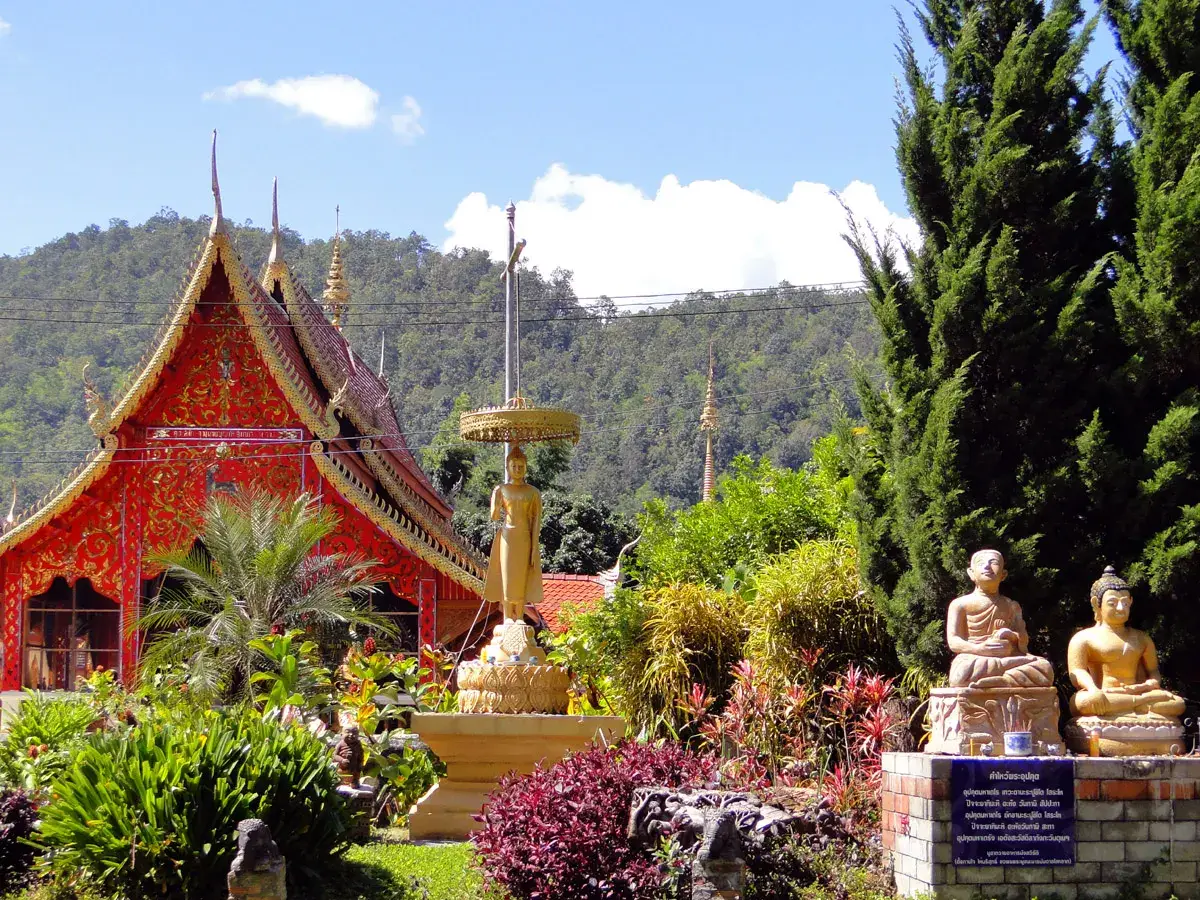
Wat Sai Mun is a local Buddhist temple under the Maha Nikaya order, located at 31 Moo 5, Ban Sai Mun, Samoeng Tai Subdistrict, Samoeng District, Chiang Mai Province. The temple was established in B.E. 2365 and received its royal consecrated boundary on April 28, B.E. 2523. The consecrated boundary measures 20 meters wide and 30 meters long. The abbot is Phra Khru Sorat Phatthanakhun, monastic name Chirawatthano, who also serves as the Ecclesiastical Chief of Samoeng Tai Subdistrict Area 1. Wat Sai Mun is an important spiritual center for Ban Sai Mun and a place for moral and ethical development in Samoeng Tai.
Wat Sai Mun is a village temple with strong historical, religious, and cultural value. It is not a large commercial tourist attraction, but a functioning community temple where local residents make merit, worship, listen to Dhamma teachings, join Kathin and forest robe offerings, and participate in Buddhist activities throughout the year. Visitors can experience a quiet local temple that reflects the Buddhist way of life in rural Samoeng.
The temple’s history began with its establishment in B.E. 2365, making Wat Sai Mun one of the older temples in Samoeng Tai Subdistrict. With more than two centuries of history, the temple predates modern tourism development in Samoeng by many generations. Its existence reflects the long-standing settlement, faith, and community structure of Ban Sai Mun, where a temple was needed as a religious center, a gathering place, and a moral foundation for villagers.
The name “Sai Mun” comes from the local geography. The temple land is located beside Lam Huai Nang Liap, near the end of the stream where sand accumulated in a mound. Because of this natural feature, the area became known as “Sai Mun,” and the temple was named after the village. This origin links the temple’s name with water, sand, and the landscape of Samoeng Tai, showing how local place names often emerge from natural features and community memory.
Wat Sai Mun received its royal consecrated boundary on April 28, B.E. 2523. This is an important religious status because it gives the temple an officially recognized area for formal Sangha ceremonies according to Buddhist discipline. The consecrated boundary measures 20 meters by 30 meters. This status strengthened the temple’s role as a complete Buddhist institution serving both monks and laypeople in the local community.
The temple land covers 4 rai and 59.5 square wah, with additional Sangha land totaling 1 rai, 36 ngan, and 63.7 square wah. The temple compound contains important religious structures that support Buddhist practice and community life, including an ordination hall, sermon hall, viharn, multi-purpose pavilion, monk’s residences, a stupa, and a bell tower. This makes Wat Sai Mun a fully functioning village temple with the facilities needed for worship, ceremonies, sermons, and community gatherings.
The ordination hall measures 6 meters wide and 12 meters long and was built in B.E. 2523. It is one of the most important religious buildings in the temple because it is used for formal monastic ceremonies. The construction of the ordination hall in the same year that the temple received its royal consecrated boundary gives the building strong historical importance within the development of Wat Sai Mun.
The sermon hall measures 12 meters wide and 22 meters long and was built in B.E. 2539. It functions as a gathering space for Dhamma listening, merit-making, community Buddhist activities, and religious events. In a village temple, the sermon hall is highly important because it allows local residents to gather comfortably during Buddhist holy days, annual merit-making ceremonies, and community activities.
The viharn measures 12 meters wide and 22 meters long and was built in B.E. 2519. It is the main place for worship, chanting, and paying respect to the principal Buddha image. The viharn is central to the devotional life of the temple because villagers come here to make merit, pray, and participate in ceremonies. Together with the ordination hall and sermon hall, it forms the spiritual core of Wat Sai Mun.
The multi-purpose pavilion measures 14 meters wide and 30 meters long and was built in B.E. 2551. This building expands the temple’s ability to support community activities, including religious events, public gatherings, and local merit-making preparations. Wat Sai Mun also has two monk’s residences built as half-masonry and half-wooden structures, supporting the daily life of resident monks.
The temple’s stupa measures 4.5 meters wide, 4.5 meters long, and 15 meters high. It is an important sacred structure within the temple compound. The bell tower measures 5 meters wide, 5 meters long, and 19 meters high. The bell tower is both a visual landmark and a functional element of temple life, associated with the rhythm of Buddhist practice and community awareness.
Phra Khru Sorat Phatthanakhun, Chirawatthano, serves as the abbot of Wat Sai Mun and Ecclesiastical Chief of Samoeng Tai Subdistrict Area 1. His role is important not only for the temple but also for the wider Sangha administration in the area. As abbot, he leads religious activities, guides laypeople, supports moral development, and helps maintain the continuity of Buddhist practice in Samoeng Tai.
The main importance of Wat Sai Mun is its role as a center for moral and ethical development in Samoeng Tai. The temple is where villagers learn, practice, and maintain Buddhist values through merit-making, precept observance, sermons, and community religious activities. It is both a spiritual space and a social space where people of different generations gather and maintain local Buddhist traditions.
Ban Sai Mun is Moo 5 of Samoeng Tai Subdistrict, which is part of Samoeng District in Chiang Mai. Samoeng Tai Municipality covers 11 villages, including Ban Sai Mun. The area has a rural mountain landscape, local temples, agricultural communities, and nature-based travel routes. Wat Sai Mun serves as the Buddhist center of Ban Sai Mun and is part of the wider network of community temples in Samoeng.
Religious activities at Wat Sai Mun follow the rhythm of northern Thai village temples. These include Buddhist holy day observances, Kathin ceremonies, forest robe offerings, Buddhist Lent activities, end-of-Lent merit-making, major Buddhist holy days, and Northern Thai New Year traditions. These occasions bring villagers together to make offerings, listen to Dhamma teachings, prepare the temple grounds, and strengthen community relationships.
For visitors, the highlight of Wat Sai Mun is the combination of long history, meaningful name origin, and complete temple structures. The temple has an ordination hall, viharn, sermon hall, multi-purpose pavilion, monk’s residences, stupa, and bell tower. Its name is connected to Lam Huai Nang Liap and the accumulated sand near the stream, giving the temple a distinctive local identity rooted in the landscape.
The atmosphere of Wat Sai Mun is calm and local. It is suitable for travelers who want to visit an old community temple, make merit, and experience the quieter side of Samoeng. Visitors should dress modestly, speak quietly, and respect the ordination hall, viharn, stupa, monk’s residences, and temple grounds. During merit-making events, the temple’s role as a community center becomes especially clear.
Getting There is most convenient by private car or rental car. From Chiang Mai city, travelers can drive toward Samoeng District via the Mae Rim–Samoeng route or the Hang Dong–Samoeng route, then continue to Samoeng Tai Subdistrict and Ban Sai Mun. The route includes mountain roads and rural village roads, so careful driving is recommended, especially during the rainy season or late afternoon.
A visit to Wat Sai Mun can be combined with nearby places in Samoeng Tai, including Wat Nam Rin, Wat Kong Khak Luang, Wat Kong Khak Noi, Sop Samoeng, Samoeng Forest Viewpoint in Khun Khan National Park, and Phra That Doi Nok. This route is suitable for travelers who want to connect old temples, village life, mountain scenery, local cafés, and nature-based travel in western Chiang Mai.
| Name | Wat Sai Mun |
| Type | Local Buddhist temple under the Maha Nikaya order |
| Location | 31 Moo 5, Ban Sai Mun, Samoeng Tai Subdistrict, Samoeng District, Chiang Mai Province |
| Coordinates | 18.83367, 98.73239 |
| Contact Number | 053-487-046 |
| Highlights | An old village temple of Ban Sai Mun, established in B.E. 2365, with an ordination hall, viharn, sermon hall, stupa, and bell tower |
| History | Established in B.E. 2365 and granted a royal consecrated boundary on April 28, B.E. 2523 |
| Temple Area | Temple land: 4 rai and 59.5 square wah; Sangha land: 1 rai, 36 ngan, and 63.7 square wah |
| Consecrated Boundary | 20 meters wide and 30 meters long |
| Name Origin | The temple land is beside Lam Huai Nang Liap, where sand accumulated near the end of the stream; the village and temple were therefore called “Sai Mun.” |
| Distinctive Features | A historic Lanna community temple connected with Lam Huai Nang Liap, Ban Sai Mun, and the moral development role of Samoeng Tai |
| Main Areas / Zones | Ordination hall, viharn, sermon hall, multi-purpose pavilion, monk’s residences, stupa, bell tower, temple grounds, and community Buddhist activity space |
| Important Structures | Ordination hall: 6 by 12 meters, built in B.E. 2523; sermon hall: 12 by 22 meters, built in B.E. 2539; viharn: 12 by 22 meters, built in B.E. 2519; multi-purpose pavilion: 14 by 30 meters, built in B.E. 2551; two half-masonry and half-wooden monk’s residences; stupa: 4.5 by 4.5 meters and 15 meters high; bell tower: 5 by 5 meters and 19 meters high |
| Abbot / Caretaker | Phra Khru Sorat Phatthanakhun, Chirawatthano, Ecclesiastical Chief of Samoeng Tai Subdistrict Area 1 |
| Traditions / Religious Activities | Kathin ceremonies, forest robe offerings, Buddhist holy day observances, Buddhist Lent activities, end-of-Lent merit-making, major Buddhist holy days, and Northern Thai New Year traditions |
| Community Role | A center for moral and ethical development in Samoeng Tai, and a spiritual center for Ban Sai Mun |
| Travel Information | Best reached by private car or rental car from Chiang Mai city to Samoeng District, then onward to Samoeng Tai Subdistrict and Ban Sai Mun. The route includes mountain and rural roads. |
| Current Status | Open as a local community temple for worship, merit-making, and Buddhist activities |
| Open Days | Daily |
| Opening Hours | 08.00 - 17.00 |
| Facilities | Ordination hall, viharn, sermon hall, multi-purpose pavilion, monk’s residences, stupa, bell tower, and temple grounds for community activities |
| Nearby Tourist Attractions | 1. Wat Nam Rin, about 3 km 2. Wat Kong Khak Luang, about 5 km 3. Wat Kong Khak Noi, about 6 km 4. Sop Samoeng, about 7 km 5. Samoeng Forest Viewpoint, Khun Khan National Park, about 18 km 6. Phra That Doi Nok, about 20 km |
| Nearby Restaurants | 1. Cafe De Mountain, about 4 km, Tel. 098-506-5306 2. Ice Cream Café At Samoeng, about 6 km, Tel. 081-751-2191 3. Baan Coffee Samoeng, about 7 km, Tel. 082-763-3400 4. Khwamsukh Cafe, about 9 km, Tel. 064-339-2582 5. Coffee By Aitsara, about 11 km, Tel. 084-378-0821 |
| Nearby Accommodations | 1. Forest Guesthouse, about 4 km, Tel. 084-371-5055 2. Lhongkhao Samoeng, about 6 km, Tel. 062-789-9444 3. Khum Samoeng - Samoeng Center, about 7 km 4. Wongwan Strawberry Farm, about 8 km 5. Rai Nap-Phupha, about 10 km |
Frequently Asked Questions (FAQ)
Q: Where is Wat Sai Mun located?
A: Wat Sai Mun is located at 31 Moo 5, Ban Sai Mun, Samoeng Tai Subdistrict, Samoeng District, Chiang Mai Province.
Q: What are the open days and opening hours of Wat Sai Mun?
A: Wat Sai Mun is open daily from 08.00 to 17.00.
Q: What is the history of Wat Sai Mun?
A: Wat Sai Mun was established in B.E. 2365 and received its royal consecrated boundary on April 28, B.E. 2523. It is an old Maha Nikaya temple of Ban Sai Mun in Samoeng Tai.
Q: What is the origin of the name Wat Sai Mun?
A: The name comes from the temple’s location beside Lam Huai Nang Liap, where sand accumulated near the end of the stream. The village and temple were therefore called “Sai Mun.”
Q: What important structures are inside Wat Sai Mun?
A: The temple has an ordination hall, sermon hall, viharn, multi-purpose pavilion, monk’s residences, stupa, and bell tower.
Q: Who is the abbot of Wat Sai Mun?
A: The abbot is Phra Khru Sorat Phatthanakhun, Chirawatthano, who also serves as the Ecclesiastical Chief of Samoeng Tai Subdistrict Area 1.
Q: Why is Wat Sai Mun important to the local community?
A: Wat Sai Mun is a center for moral and ethical development in Samoeng Tai, and a spiritual center for Ban Sai Mun where villagers make merit, listen to sermons, and join Buddhist activities.
Q: What nearby places can travelers visit with Wat Sai Mun?
A: Travelers can combine the visit with Wat Nam Rin, Wat Kong Khak Luang, Wat Kong Khak Noi, Sop Samoeng, Samoeng Forest Viewpoint, and Phra That Doi Nok.
 Category: ●Places of Worship
 Group: ●Temple
Last Update : 2 MonthAgo
 Last Update : 2 MonthAgo
 Click to Access the Navigation Map GPS

 Muang Chiang Mai(121)Chom Thong(47)Mae Chaem(25)Chiang Dao(33)Doi Saket(68)Mae Taeng(85)Mae Rim(69)Samoeng(29)Fang(71)Mae Ai(59)Phrao(70)San Pa Tong(103)San Kamphaeng(66)San Sai(73)Hang Dong(73)Hot(32)Doi Tao(22)Omkoi(11)Saraphi(74)Wiang Haeng(15)Chai Prakan(28)Mae Wang(32)Mae On(22)Doi Lo(33)Galyani Vadhana(1)


