
lovethailand home >North Travel Attractions >Chiang Mai Travel Attractions >Wiang Haeng >Muang Haeng > Wat Wiang Haeng
TL;DR: Wat Wiang Haeng is located at Ban Wiang Haeng, Moo 4, Mueang Haeng Subdistrict, Wiang Haeng District, Chiang Mai Province 50350, Thailand, open Daily, hours 08.00 – 17.00.

Wat Wiang Haeng
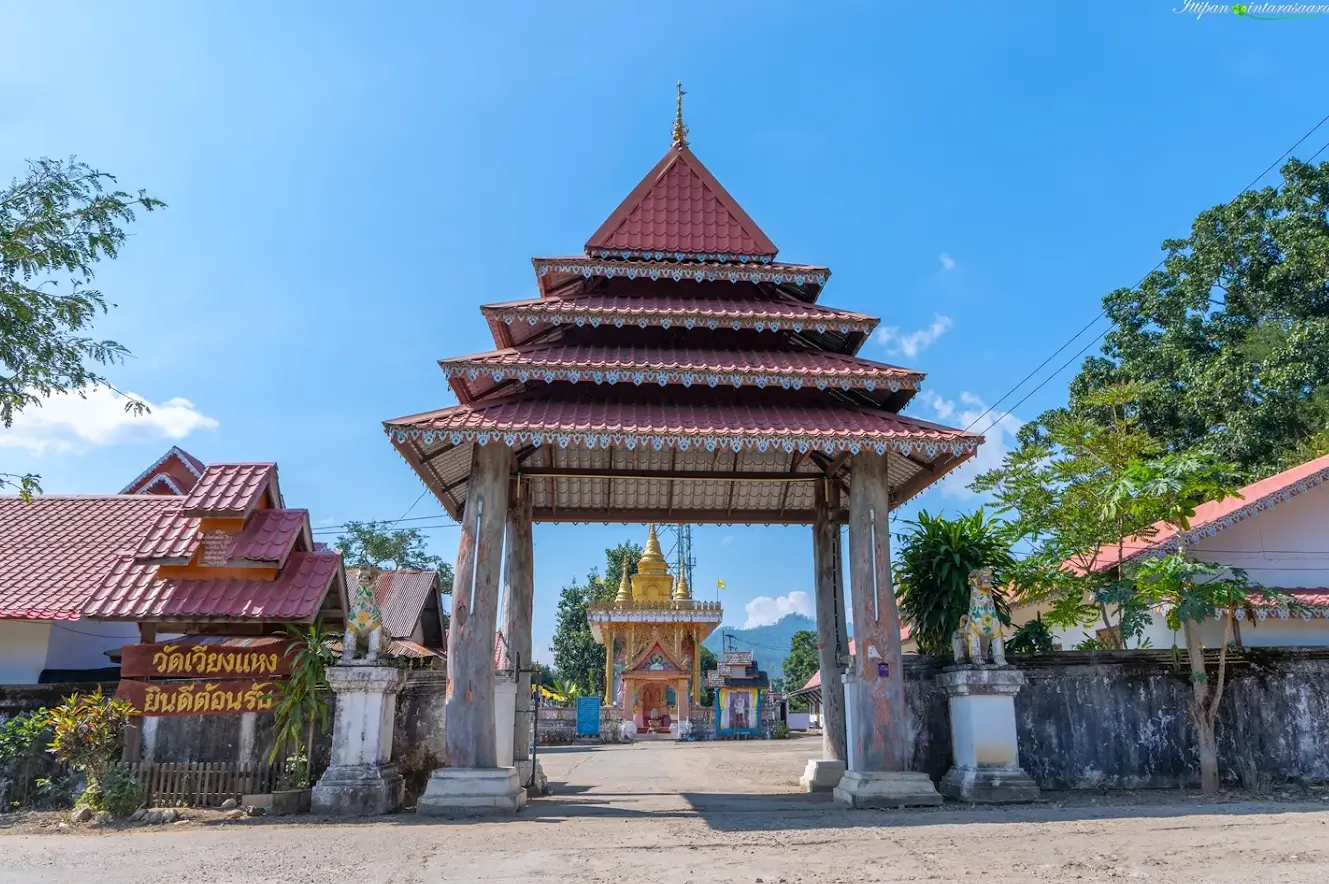
Open Days: Daily
Opening Hours: 08.00 – 17.00
Wat Wiang Haeng is a historic Maha Nikaya community temple in Ban Wiang Haeng, Moo 4, Mueang Haeng Subdistrict, Wiang Haeng District, Chiang Mai Province. Established in B.E. 2472, equivalent to 1929, the temple was founded by Ngeng Sao Wa, a Shan man from Mong Pan in Shan State. Its identity remains strongly connected with Shan Buddhist culture through its timber architecture, Burmese and Shan-influenced Buddha images, and a distinctive collection of Buddhist paintings. The temple is also home to one of Wiang Haeng's most revered sacred images, known locally as Phra Saen Sae or the “Sweating Buddha.” Together, these elements make Wat Wiang Haeng one of the most important cultural sites for understanding the relationship between northern Thailand and Shan State.
Wat Wiang Haeng remains an active registered Buddhist monastery. It appears in the current Maha Nikaya temple registry under code 350200106 and continues to be listed in contemporary Kathin databases for 2025 and 2026. Current public records do not publish a sufficiently verified name for the present abbot, so the historical succession of abbots is treated separately from present leadership.
The temple stands at approximately 19.55390, 98.64252, at an elevation of around 742 metres above sea level. Ban Wiang Haeng occupies part of a broad mountain basin surrounded by forested ridges, agricultural land, roads, and local settlements. The highland setting gives the temple a much quieter and more rural character than Chiang Mai's famous urban monasteries.
The temple's location has historical importance because its northern boundary was traditionally recorded as adjoining the old city moat. This physical relationship connects Wat Wiang Haeng with the historic settlement landscape of the valley. The monastery was founded in the twentieth century, but the urban landscape around it has much older roots.
Local information describes the temple compound as covering approximately 4 rai, while the monastery also owns one parcel of monastic land measuring 3 rai, 3 ngan, and 15 square wah. The temple's traditional boundaries connected the monastery with the old moat, village roads, and the surrounding settlement.
The historically supported foundation year is 1929. Some later transcriptions incorrectly show B.E. 2572, but the national temple history gives B.E. 2472, which also corresponds with the beginning of the first recorded abbot's tenure.
The founder, Ngeng Sao Wa, came from Mong Pan in Shan State. His Shan background is important because it explains much of the temple's distinctive cultural character. Wiang Haeng lies close to Myanmar and has long been connected with communities across Shan State through migration, trade, religious networks, and family relationships.
Shan Theravada Buddhism developed its own architectural and artistic traditions while also interacting with Burmese Buddhist culture. Wat Wiang Haeng reflects this cultural exchange through its timber monastic buildings and sacred objects, making it visually and historically different from many mainstream Lanna temples in central Chiang Mai.
Historically recorded structures include a sermon hall and monks' residences built from hardwood in Shan style. Timber construction was common in Shan religious architecture, where layered roofs, elaborate eaves, carved details, and raised wooden structures were adapted to local climate and craftsmanship.
Visitors should pay attention to roof proportions, wooden walls, decorative edges, and the overall massing of the buildings. These details provide a clearer understanding of the temple's Shan identity than simply viewing it as another northern Thai monastery.
The sermon hall historically served as a gathering place for Buddhist teaching, merit-making, community ceremonies, and larger lay assemblies. The monks' residences supported residential monastic life, Buddhist study, chanting, and the daily routines of resident monks.
Wat Wiang Haeng has naturally changed over the decades. Religious buildings have been repaired, rebuilt, or adapted as the community's needs changed. The modern compound should therefore be understood as a living monastery rather than a preserved architectural museum frozen in its 1929 form.
Important sacred objects recorded at the temple include a Phra Phuttha Sihing image and Burmese Buddha images. Local tourism sources also identify another particularly revered Buddha image known as Phra Saen Sae, or the Sweating Buddha, which has become one of the best-known sacred objects associated with Wiang Haeng.
Phra Saen Sae is traditionally described as a bronze Buddha image in the Mara-Vijaya posture. Local accounts regard the image as considerably older than Wat Wiang Haeng itself, suggesting that it was brought to the monastery rather than produced when the temple was founded.
The name “Sweating Buddha” comes from a local belief that droplets resembling perspiration may appear on the image before dangerous events or serious disturbances affect the community. This story should be understood as a local religious tradition rather than a scientific claim, but it is culturally significant because it expresses how closely the community associates the Buddha image with protection and collective wellbeing.
The image therefore carries meaning beyond artistic age or material. Generations of residents have treated it as a protective sacred object for Wiang Haeng. Visitors should approach the image respectfully and avoid touching the surface or entering the raised sacred area without permission.
Another major feature is the temple's collection of Buddhist paintings. The paintings are approximately 80 by 150 centimetres each and were produced using oil paint on canvas and smooth metal sheets. They were created around B.E. 2513, equivalent to 1970, and combine Shan and Burmese stylistic influences with the work of local craftsmen.
The paintings present stories from the Vessantara Jataka, the life of the Buddha, and previous lives of the Bodhisattva. These themes reflect the traditional educational role of Buddhist art. Before printed books and modern media became widely accessible, narrative paintings helped temple visitors learn Buddhist stories visually.
The Vessantara Jataka is especially important in northern Thai and Shan Buddhist culture because it tells the story of the Bodhisattva's extraordinary practice of generosity. The narrative has long been associated with major sermon traditions and communal merit-making.
The paintings depicting the life of the Buddha similarly transform religious history into a sequence of visual lessons. Scenes from the Buddha's life could be understood by temple visitors regardless of literacy level, making the artwork part of the monastery's educational function.
The use of oil paint on canvas and metal differs from the plaster-wall mural traditions found in many Lanna temples. The movable-panel format was well suited to timber buildings and demonstrates how local artists adapted religious painting techniques to available materials and architectural conditions.
The combination of Shan, Burmese, and local artistic elements also reveals how cultural exchange operated in a borderland community. Clothing, architectural details, gestures, colors, and background scenes within the paintings provide visual evidence of the environment in which local artists worked.
Wat Wiang Haeng is also closely associated with the late Phra Athikan Panya Panyawaro, an important Shan monk who served the monastery for decades. Born in Shan State, he later came to Thailand and eventually became abbot of Wat Wiang Haeng. He was widely respected among Shan Buddhist communities and served as an adviser to a Shan monks' association in Thailand.
Phra Athikan Panya died on August 29, 2010, at the age of 82 after 61 rains retreats. His funeral ceremonies in early 2011 drew monks and devotees from the wider Shan community, showing that Wat Wiang Haeng had become important beyond the immediate village.
The historical succession of abbots begins with Phra Tan-or Utama from B.E. 2472 to 2484, followed by Phra Mung Siha, Phra Luang Kham Santiko from B.E. 2494 to 2504, Phra Athikan Bunlue Panyasuro from B.E. 2504 to 2510, and Phra Athikan Panya Panyawaro, who served for several decades before his death in 2010.
The presence of Shan monks at the temple is part of the wider multicultural history of Wiang Haeng. The district has long been connected with Shan State, and Shan migrants, traders, monks, and families have contributed to the social and religious landscape of the valley.
At the same time, Wat Wiang Haeng is fully integrated into northern Thai community life. Local Northern Thai residents also make merit and participate in Buddhist activities at the temple. Festivals such as Buddhist Lent, the end of the rains retreat, Kathin, robe offerings, Songkran, and Buddhist holy days allow Shan and Lanna traditions to coexist within the same religious community.
The temple also belongs to the historical landscape of old Wiang Haeng. The surviving moat near the monastery preserves evidence of an earlier settlement pattern. Local history additionally contains traditions connected with ancient routes, Shan-Lanna relations, and King Naresuan, although some interpretations of these traditions remain historically debated.
Visitors should therefore observe not only the temple buildings but also the moat, roads, and surrounding settlement. The relationship between these features explains how Wat Wiang Haeng developed within an existing historical landscape.
The monastery has also been associated with local historical learning, making it a useful starting point for travelers who want to understand the wider Wiang Haeng basin rather than treating each temple as an isolated attraction.
The first priority during a visit should be the revered Phra Saen Sae or Sweating Buddha, followed by Burmese and Shan-influenced Buddha images, the timber architecture, and the narrative paintings. Together, these elements communicate the temple's distinctive Shan identity.
Visitors examining the paintings should avoid touching the painted surfaces, moving panels, or using flash photography if temple rules restrict it. Older oil-painted surfaces can be vulnerable to moisture, heat, and physical abrasion.
Standard temple etiquette applies. Visitors should dress modestly, cover shoulders and knees, remove shoes before entering designated religious buildings, and keep noise low. Religious ceremonies and monastic activities should always take priority over tourism.
Wat Wiang Haeng is especially rewarding for travelers interested in Shan culture because architecture, sacred images, paintings, oral traditions, and monastic history can all be encountered in a functioning temple rather than in a museum.
Wat Huai Hok is a useful companion visit for travelers interested in Buddhist art. The temple is associated with important old Buddha images and provides a comparison between Lanna artistic heritage and the stronger Shan influence visible at Wat Wiang Haeng.
Wat Kamphaeng Mai at Ban Pa Phai is another nearby historic temple. Its setting is closely connected with the archaeological landscape of ancient Wiang Haeng. Visiting both temples helps travelers compare the living Shan heritage of Wat Wiang Haeng with the wider historical development of the valley.
Wat Kong Lom also lies within Mueang Haeng and is an important district-level monastic center. Its history of novice education and ecclesiastical administration adds another dimension to an itinerary focused on Buddhist institutions in Wiang Haeng.
Phra That Wiang Haeng is another nearby religious destination closely tied to local historical traditions. Combining the stupa area, the old moat, and Wat Wiang Haeng provides a stronger sense of the historical settlement than visiting the temple alone.
Mae Hat Waterfall can be added for travelers who want to include natural scenery. It lies within Mueang Haeng Subdistrict and can be visited after a morning temple route, although road and water conditions should be checked during the rainy season.
Food and coffee are easy to find around central Mueang Haeng. Wiang Haeng Coffee is a well-established local cafe, Chapter four combines coffee, bakery items, and meals, Pa Khin Restaurant is associated with northern Thai food, FoodFactory serves a wider range of dishes, and Sukjai Cafe provides another casual local option.
Accommodation in the Mueang Haeng area includes Chiang Tung Rooms, Muang Haeng Resort & Spa, Kru Ae Homestay, Wianghaengresort, and Baan Somwang Resort. Staying locally is useful for travelers planning to continue toward Saen Hai or Piang Luang the following day.
The cool season from approximately November to February is the most comfortable time to explore the temple. Mornings and evenings are noticeably cooler than central Chiang Mai. The rainy season brings green mountain scenery but may also produce fog and slippery roads.
Getting There from Chiang Mai city is easiest by private car or rental vehicle. Follow Highway 107 north toward Chiang Dao, then continue on the mountain route into Wiang Haeng District. In Mueang Haeng, proceed to Ban Wiang Haeng, Moo 4. The temple can be found using “Wat Wiang Haeng” or the approximate coordinates 19.55390, 98.64252.
The mountain road into Wiang Haeng contains numerous bends and elevation changes. Brakes, tyres, fuel, and vehicle lighting should be checked before departure, and daytime travel is preferable for first-time visitors.
A half-day itinerary can combine Wat Wiang Haeng, Phra That Wiang Haeng, and Wat Kamphaeng Mai. A full-day cultural route can add Wat Kong Lom, Wat Huai Hok, and Mae Hat Waterfall.
With two days and one night, travelers can spend the first day exploring Mueang Haeng temples and the historic settlement, then travel on the second day to Wat Phra That Saen Hai and the Shan and Yunnanese Chinese communities of Piang Luang.
Wat Wiang Haeng is particularly suitable for travelers interested in historic temples, Shan Buddhist art, borderland history, and cultural connections between Lanna and Shan State. Its importance comes from the combination of architecture, sacred objects, paintings, monastic history, and the old settlement landscape.
At community level, the temple represents a shared Buddhist space where Northern Thai and Shan traditions have interacted over generations. This interaction created a distinctive religious identity rather than separating the two cultural traditions.
The paintings created around 1970 are one of the clearest expressions of this cultural exchange. Buddhist narratives remain central, but Shan, Burmese, and local artistic influences are combined in a form adapted to the temple's timber architecture.
Phra Saen Sae, or the Sweating Buddha, adds another layer of cultural meaning. Whether understood through art history or local belief, the image is deeply connected with community memory and remains one of the most important sacred objects in Wiang Haeng.
Wat Wiang Haeng ultimately provides an unusually complete introduction to the cultural history of the district. Its 1929 Shan foundation, timber architecture, sacred Buddha images, Buddhist paintings, long history of Shan monastic leadership, and location beside the historic moat combine in one living religious site. Travelers who spend time understanding these elements will find that the temple is not simply a place to stop for worship, but one of the most valuable cultural gateways into the history of Wiang Haeng.
| Name | Wat Wiang Haeng |
| Temple Type | Public Buddhist Temple, Maha Nikaya Order |
| Temple Registry Code | 350200106 |
| Location | Ban Wiang Haeng, Moo 4, Mueang Haeng Subdistrict, Wiang Haeng District, Chiang Mai Province 50350, Thailand |
| Coordinates | Approximately 19.55390, 98.64252 |
| Elevation | Approximately 742 Metres Above Sea Level |
| Established | B.E. 2472 / 1929 |
| Founder | Ngeng Sao Wa, A Shan Resident From Mong Pan, Shan State |
| Temple Area In Local Records | Approximately 4 Rai |
| Monastic Land | One Parcel Measuring 3 Rai, 3 Ngan, And 15 Square Wah |
| Historic Setting | Northern Boundary Adjoins The Historic City Moat; Other Sides Connect With Village Roads And Ban Wiang Haeng |
| Important Structures | Hardwood Shan-Style Sermon Hall And Monks' Residences, Together With Active Contemporary Religious Buildings |
| Important Sacred Images | Phra Saen Sae / Sweating Buddha, Phra Phuttha Sihing, And Burmese Buddha Images |
| Important Paintings | Shan-Burmese And Local-Style Oil Paintings Created Around B.E. 2513 / 1970, Depicting The Vessantara Jataka, The Life Of The Buddha, And Bodhisattva Stories |
| Highlights | Historic Shan Temple Of Wiang Haeng, Known For Its Sacred Buddha Image, Timber Architecture, Buddhist Paintings, And Location Beside The Historic City Moat |
| Historical Abbots | 1. Phra Tan-or Utama, B.E. 2472-2484 2. Phra Mung Siha 3. Phra Luang Kham Santiko, B.E. 2494-2504 4. Phra Athikan Bunlue Panyasuro, B.E. 2504-2510 5. Phra Athikan Panya Panyawaro, Long-Serving Abbot Who Died In 2010 |
| Current Status | Active Registered Maha Nikaya Temple And Still Listed In 2025-2026 Kathin Databases |
| Contact | 053-477-048 |
| Open Days | Daily |
| Opening Hours | 08.00 – 17.00 |
| Travel Information | Travel From Chiang Mai Via Highway 107 And Chiang Dao, Then Continue Into Wiang Haeng District And Ban Wiang Haeng, Moo 4. Private Car Or Rental Vehicle Is Recommended. |
| Nearby Tourist Attractions | 1. Phra That Wiang Haeng, About 1 km 2. Wat Kamphaeng Mai, About 2 km 3. Wat Kong Lom, About 4 km 4. Wat Huai Hok, About 4 km 5. Mae Hat Waterfall, About 8 km 6. Wat Phra That Saen Hai, About 14 km |
| Nearby Restaurants & Cafes | 1. Wiang Haeng Coffee, About 1 km, Tel. 087-496-5932 2. FoodFactory, About 1 km, Tel. 089-968-5520 3. Pa Khin Restaurant, About 2 km, Tel. 089-854-9071 4. Chapter four, About 2 km, Tel. 090-742-4044 5. Sukjai Cafe, About 2 km, Tel. 098-981-1177 |
| Nearby Accommodations | 1. Chiang Tung Rooms, About 1 km, Tel. 053-477-251, 089-835-4932, 082-895-6271 2. Muang Haeng Resort & Spa, About 2 km, Tel. 053-477-185 3. Kru Ae Homestay, About 3 km, Tel. 087-179-4631 4. Wianghaengresort, About 3 km, Tel. 090-891-8392 5. Baan Somwang Resort, About 3 km |
Frequently Asked Questions (FAQ)
Q: Where is Wat Wiang Haeng located?
A: Wat Wiang Haeng is located in Ban Wiang Haeng, Moo 4, Mueang Haeng Subdistrict, Wiang Haeng District, Chiang Mai Province 50350, at approximately 19.55390, 98.64252.
Q: When was Wat Wiang Haeng established?
A: Wat Wiang Haeng was established in B.E. 2472, equivalent to 1929, by Ngeng Sao Wa, a Shan resident from Mong Pan in Shan State.
Q: What are the main highlights of Wat Wiang Haeng?
A: The temple is known for its Shan-style timber architecture, the revered Phra Saen Sae or Sweating Buddha, Burmese Buddhist images, and Shan-Burmese paintings created by local craftsmen.
Q: What is the Sweating Buddha?
A: Phra Saen Sae, locally called the Sweating Buddha, is a revered Buddha image associated with a community belief that droplets resembling perspiration may appear before serious events. The story is an important part of local religious tradition.
Q: What do the temple paintings depict?
A: The paintings were created around 1970 using oil paint on canvas and metal sheets. Their themes include the Vessantara Jataka, the life of the Buddha, and stories of the Bodhisattva.
Q: Is Wat Wiang Haeng still active?
A: Yes. It remains registered as a Maha Nikaya temple under code 350200106 and continues to appear in contemporary 2025-2026 Kathin temple databases.
Q: What nearby attractions can be combined with Wat Wiang Haeng?
A: Nearby destinations include Phra That Wiang Haeng, Wat Kamphaeng Mai, Wat Kong Lom, Wat Huai Hok, Mae Hat Waterfall, and Wat Phra That Saen Hai.
Q: What type of traveler will appreciate Wat Wiang Haeng?
A: The temple is especially suitable for travelers interested in historic temples, Shan culture, Buddhist art, Lanna-Shan connections, borderland history, and community-based cultural travel.
 Category: ●Places of Worship
 Group: ●Temple
Last Update : 1 MonthAgo
 Last Update : 1 MonthAgo
 Click to Access the Navigation Map GPS

 Muang Chiang Mai(121)Chom Thong(47)Mae Chaem(25)Chiang Dao(33)Doi Saket(68)Mae Taeng(85)Mae Rim(69)Samoeng(29)Fang(71)Mae Ai(59)Phrao(70)San Pa Tong(103)San Kamphaeng(66)San Sai(73)Hang Dong(73)Hot(32)Doi Tao(22)Omkoi(11)Saraphi(74)Wiang Haeng(15)Chai Prakan(28)Mae Wang(32)Mae On(22)Doi Lo(33)Galyani Vadhana(1)


