
lovethailand home >North Travel Attractions >Chiang Mai Travel Attractions >Wiang Haeng >Piang Luang > Wat Muang Khruea
TL;DR: Wat Muang Khruea is located at Ban Muang Khruea, Piang Luang Subdistrict, Wiang Haeng District, Chiang Mai Province 50350, Thailand, open Daily, hours 08.00 – 17.00.

Wat Muang Khruea
Open Days: Daily
Opening Hours: 08.00 – 17.00
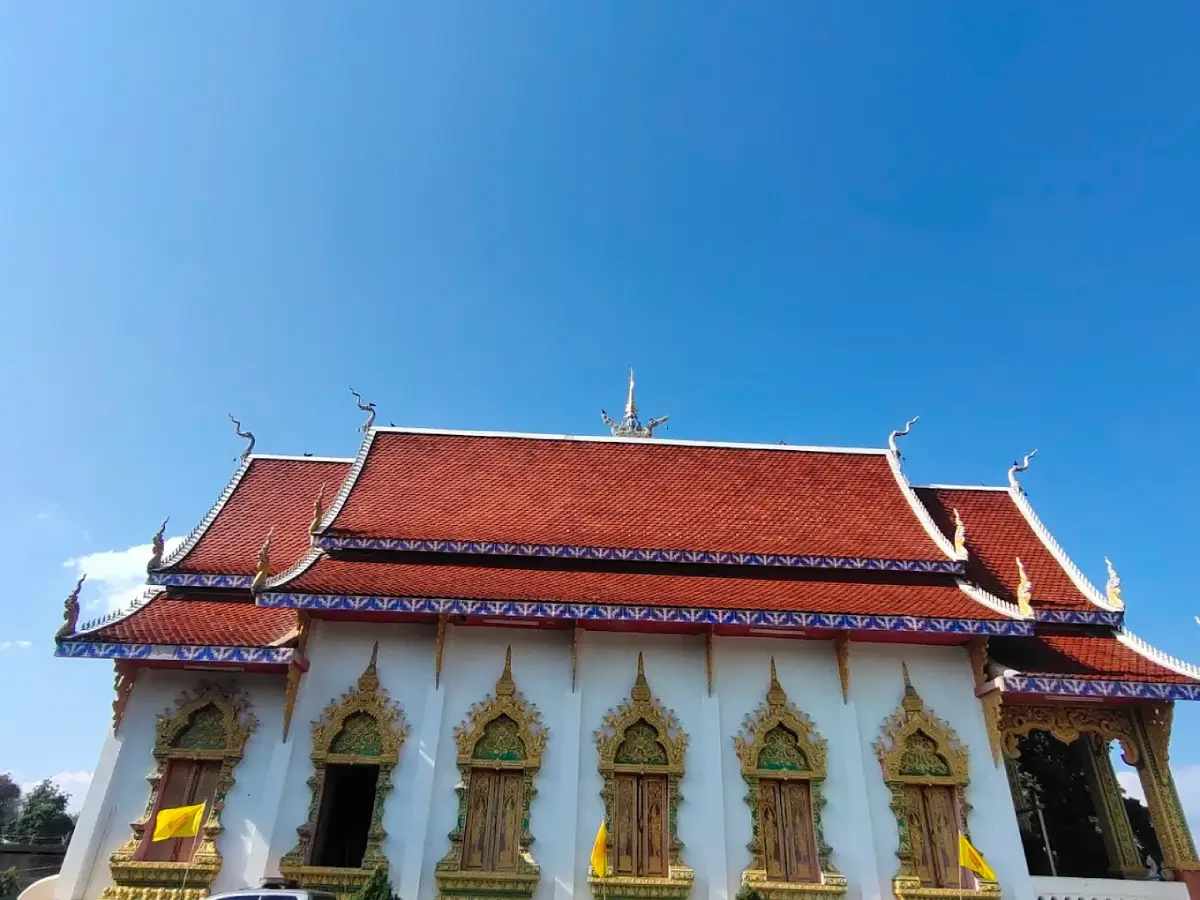
Wat Muang Khruea is a historic community temple in Piang Luang Subdistrict, Wiang Haeng District, Chiang Mai Province. Established in B.E. 2448, equivalent to 1905, it is a registered public Buddhist temple under the Maha Nikaya order and remains listed in Thailand's contemporary temple registry. The temple's historically recorded structures include a sermon hall, a viharn, and monks' living quarters. More importantly, Wat Muang Khruea represents over a century of Buddhist life in one of Chiang Mai's remote mountain border communities, where Northern Thai, Shan, and Yunnanese Chinese cultural influences have long existed side by side.
The temple is located in the Ban Muang Khruea community of Piang Luang, close to the Thai–Myanmar border. Its approximate coordinates are 19.64556, 98.64136, at an elevation of about 775 metres above sea level. The surrounding landscape is defined by mountains, forest, agricultural areas, village roads, and small settlements. This setting gives the temple a very different character from Chiang Mai's famous urban temples. Wat Muang Khruea is not primarily a monumental sightseeing attraction; it is a living community temple embedded in everyday village life.
Wat Muang Khruea carries temple registry code 350200204. Its continuing presence in the current Maha Nikaya temple database is an important confirmation that the temple remains active rather than abandoned. A B.E. 2568 national Dhamma examination record also lists a monk affiliated with Wat Muang Khruea, providing contemporary evidence that the temple still participates in Buddhist religious education.
The temple was officially established in 1905, during the late reign of King Chulalongkorn. At that time, Wiang Haeng was far more isolated from Chiang Mai city than it is today. Mountain travel was difficult, and villages depended heavily on local religious and social institutions. Establishing a temple in such a setting was therefore an important step in consolidating community life. The temple became a place for merit-making, religious teaching, seasonal ceremonies, and social gatherings.
The wider Piang Luang area is essential to understanding Wat Muang Khruea. Historical cultural records identify several important communities in the subdistrict, including Ban Piang Luang, Ban Chong, Ban Mai Makayon, Ban Muang Khruea, and Ban Huai Khrai. Northern Thai, Shan, and Yunnanese Chinese populations have all played important roles in the area's development. Contemporary community tourism projects also emphasize the area's ethnic diversity. Buddhist temples in these villages therefore preserve not only religious traditions but also the social history of a borderland shaped by migration and cultural exchange.
Historical temple information records approximately 5 rai of temple land. The northern boundary extended roughly 85 wa to a road, the southern boundary about 85 wa toward a cemetery, and the eastern and western boundaries approximately 105 wa toward roads and village areas. This layout reveals the original social role of the temple clearly. It stood among homes, roads, and a burial area rather than apart from village life.
This spatial relationship matters because traditional community temples served people throughout the cycle of life. They were places for ordinary merit-making and Buddhist observance, but also locations connected with funerals, remembrance, and community support. The proximity of roads and homes further shows how Wat Muang Khruea functioned as part of the village's social core.
The temple structures recorded in its history are the sermon hall, viharn, and monks' quarters. Together, these provide the basic architectural framework necessary for a functioning community monastery. The sermon hall accommodates lay gatherings and Buddhist teaching, the viharn provides the principal devotional space, and the monks' quarters support residential monastic life.
The viharn deserves particular attention during a visit. In northern Thai temple culture, the viharn is more than a shrine containing a Buddha image. It is the central space in which villagers gather to make merit, listen to sermons, chant, and participate in ceremonies. In a culturally mixed border district such as Wiang Haeng, the viharn also represents the continuity of Theravada Buddhist practice across generations.
The sermon hall is equally important because it supports larger gatherings. Community merit-making, sermons, meetings, and seasonal Buddhist activities require a flexible shared space. In rural villages, a sermon hall can function as both a religious building and an informal community hall, strengthening the relationship between the monastery and lay residents.
The monks' quarters confirm the temple's role as a residential Buddhist institution. Monks living in a community temple do more than officiate ceremonies. They study and teach Buddhist doctrine, observe the rains retreat, support local merit-making, and maintain a spiritual relationship with villagers. In a remote border district, this local religious presence historically played an especially important role.
Historical records preserved by the community name several former abbots: Phra Duangchan Inthawangso, Phra Daeng Aphatharo, Phra Charoen Silanantho, Phra Bunpeng Yanatharo, and Phra Baidika Bunchuai Kantacharo. The surviving historical material indicates that Phra Baidika Bunchuai began serving from B.E. 2527. Public contemporary sources do not provide a sufficiently clear current abbot listing, so the historical names are best treated as part of the temple's administrative history rather than as a statement about present leadership.
More recent evidence shows continued monastic activity. The B.E. 2568 national Dhamma examination list includes Phra Thanaphat Worapunyo Khamlaeng, age 24, affiliated with Wat Muang Khruea in Wiang Haeng. This detail is valuable because it demonstrates that the temple remains connected with formal Buddhist study and is not merely a historical building preserved without an active religious community.
The role of Wat Muang Khruea can therefore be understood through three connected dimensions. First is faith: villagers use the temple for merit-making and Buddhist ceremonies. Second is community: the temple provides a common gathering space. Third is cultural continuity: religious customs, social relationships, and local traditions are transmitted through activities that take place around the temple.
Ban Muang Khruea is itself a noteworthy community. A Thai PBS feature on the village documented local residents and young people working together to care for community forest and using ingredients gathered from streams and surrounding nature in local food traditions. This provides useful context for understanding the temple. Wat Muang Khruea exists within a community whose daily life remains closely tied to forest, water, agriculture, and mountain ecology.
A visit can therefore be approached as community-based cultural travel rather than a simple temple stop. Travelers can observe the village landscape, agricultural areas, roads, and surrounding mountains before continuing toward Ban Piang Luang. This creates a more complete picture of Wiang Haeng as a culturally diverse highland district.
Piang Luang's traditional festival calendar reflects its ethnic diversity. Historical research records Shan traditions such as Poy Sang Long, elder blessing ceremonies, Songkran, Poy Hang Nam, and Poy Tian. Northern Thai traditions include Yi Peng, the northern New Year, Buddhist Lent, and the end of Buddhist Lent. Yunnanese Chinese communities also celebrate Lunar New Year and religious festivals associated with Chinese beliefs.
Poy Sang Long is one of the best-known Shan traditions in northern Thailand. Boys preparing for novice ordination are elaborately dressed as “crystal sons” before entering monastic life. The ceremony represents both religious merit and community identity. Although the festival is organized at community level rather than being exclusive to Wat Muang Khruea, it provides essential cultural context for understanding the Buddhist temples of Piang Luang.
Songkran and the northern New Year also strengthen the relationship between temples and villages. Families make merit, visit monasteries, pay respect to elders, and participate in traditional blessing ceremonies. In this setting, the temple becomes a place where Buddhism, respect for elders, family relationships, and local identity come together.
Buddhist Lent and the end of the rains retreat form another important cycle. Monks remain in residence during the rains retreat, while villagers offer food, attend sermons, and participate in merit-making. After the retreat, Kathin robe offerings and other community donations traditionally follow. Wat Muang Khruea appeared in a Chiang Mai provincial list of temples without a Kathin sponsor in B.E. 2564, confirming its participation in the wider Kathin system administered through the Buddhist authorities.
Visitors should focus on the viharn, sermon hall, monks' quarters, and the overall temple courtyard. The site's value lies less in monumental architecture than in its relationship with Ban Muang Khruea. Architecture enthusiasts should look at the practical scale of the buildings and the way they fit into the village rather than expecting the ornate scale of Chiang Mai's major tourist temples.
Respectful behavior is essential because Wat Muang Khruea remains an active religious site. Visitors should wear modest clothing, remove shoes where required, keep noise low, and avoid climbing onto sacred platforms. Monks and villagers participating in ceremonies should not be photographed closely without permission.
The quiet atmosphere makes the temple particularly suitable for travelers interested in living culture rather than crowded sightseeing. There are no major tourism facilities or large commercial zones within the temple. The experience comes from seeing how a local monastery functions naturally within a mountain village.
Wat Muang Khruea also provides an entry point into the wider history of the border region. Piang Luang historically connected northern Thailand with Shan State and later became home to Shan migrants and Yunnanese Chinese communities. Buddhist temples, Chinese religious institutions, and Christian churches can all be found within the broader cultural landscape, reflecting a degree of religious and ethnic diversity unusual in many rural Thai districts.
Wat Makayon is located very close to Wat Muang Khruea. Mapping data places it roughly 430 metres away in straight-line terms, making the two temples easy to combine in one local itinerary. Wat Makayon is associated with Ban Chong and Shan cultural architecture, while Wat Muang Khruea preserves a history dating to 1905. Visiting both helps travelers understand how neighboring communities developed their own religious centers.
Wat Huai Khrai is another Maha Nikaya temple in Piang Luang and can be included before continuing north toward Ban Piang Luang. Traveling through these villages reveals how local Buddhist temples form a network across the valley rather than functioning as isolated attractions.
Ban Piang Luang should also be included in a cultural itinerary. The Tourism Authority of Thailand presents it as a Thai–Myanmar border community strongly shaped by Shan and Yunnanese Chinese culture, while community development agencies promote it as a cultural tourism destination. Visitors can explore village life, local food, markets, and different religious traditions before continuing to natural viewpoints.
Xinglongshan Viewpoint adds a scenic element to the route. The viewpoint offers mountain landscapes around Piang Luang and is best visited in the morning or late afternoon. A practical itinerary is to visit temples during the middle of the day and continue to the viewpoint when the light is softer.
Wat Fa Wiang In is another important Shan Buddhist temple near the border and can be added for travelers with sufficient time. Because areas near the international border can be subject to access controls, visitors should always follow current local instructions and avoid entering restricted zones.
Travelers staying overnight can also visit Wat Phra That Saen Hai in Saen Hai Subdistrict. Combining Muang Khruea and Piang Luang on the first day with the central Wiang Haeng area on the second provides a broader understanding of the district without rushing mountain-road travel.
Piang Luang now has several restaurants and cafes serving travelers and local residents. Krua Piang Luang is one established restaurant, while Chomview Cafe, Long Oei Cafe, Pang Luang Cafe, Little Happiness, and Boonpan Coffee provide drinks, snacks, and casual meals. Businesses in small mountain communities often close earlier than those in Chiang Mai city, so planning meals before evening is advisable.
Accommodation options include small resorts, guesthouses, and local hotels. Baan Rabiang Mai Resort, Baan Suan Chomview Resort, Huean Mok Kham Resort, Piang Luang Guesthouse, and Huen Kingkhala are among the places serving travelers in the Piang Luang area. Staying overnight makes cultural exploration significantly more comfortable and avoids unnecessary night driving.
The cool season is generally the most comfortable time to visit because Wiang Haeng's higher elevation brings lower temperatures than Chiang Mai city. The rainy season offers lush green mountain scenery but can also bring wet roads, fog, and reduced visibility.
Drivers should check brakes, tyres, fuel, and vehicle condition before entering Wiang Haeng. The route from Chiang Mai includes extended mountainous sections and repeated bends. Daytime driving is strongly preferable, particularly for visitors unfamiliar with the road.
Getting There from Chiang Mai city is easiest by private car or rental vehicle. Travel north toward Chiang Dao, then take the route into Wiang Haeng District before continuing toward Piang Luang and Ban Muang Khruea. The temple can be located using “Wat Muang Khruea” or the coordinates 19.64556, 98.64136. It is near Provincial Highway 1178 and close to Wat Makayon, Ban Chong, and Ban Huai Khrai.
For a one-day itinerary, staying in Wiang Haeng or Piang Luang the previous night is ideal. Begin with Wat Muang Khruea, continue to Wat Makayon and Wat Huai Khrai, explore Ban Piang Luang, and end the day at Xinglongshan Viewpoint. Travelers with two days can add Wat Fa Wiang In, Wat Mai Hung Lai, and Wat Phra That Saen Hai.
Wat Muang Khruea is particularly rewarding for travelers interested in local history rather than landmark collecting. Its principal value is the continuity between a temple founded in 1905 and the contemporary community surrounding it. The viharn, sermon hall, monks' quarters, roads, houses, and religious activity together create a living historical landscape.
The temple also offers a broader lesson about Chiang Mai's cultural diversity. Northern Thailand is not represented only by the mainstream Lanna traditions of Chiang Mai's old city. In Wiang Haeng, visitors encounter Shan, Northern Thai, and Yunnanese Chinese influences layered together through language, food, religious architecture, migration history, and community rituals.
Photography is best approached by capturing the wider setting rather than focusing only on individual buildings. Roads leading into the temple, surrounding mountains, the courtyard, and the neighboring village help explain Wat Muang Khruea's identity more effectively than isolated architectural photographs.
For students and cultural researchers, the temple can be linked with the geography of Piang Luang, migration history, religious diversity, and community forest practices. The coexistence of Buddhist temples, Chinese religious institutions, and churches in the wider subdistrict makes Piang Luang an especially useful case study of cultural pluralism in a northern Thai border district.
Wat Muang Khruea is therefore best understood as living heritage. Its significance comes from more than age alone. Founded in 1905, still registered as a functioning Maha Nikaya temple, and still connected with Buddhist education and community life, it offers travelers a quiet but meaningful perspective on the spiritual and cultural landscape of Wiang Haeng.
| Name | Wat Muang Khruea |
| Temple Type | Public Buddhist Temple, Maha Nikaya Order |
| Temple Registry Code | 350200204 |
| Location | Ban Muang Khruea, Piang Luang Subdistrict, Wiang Haeng District, Chiang Mai Province 50350, Thailand |
| Coordinates | 19.64556, 98.64136 |
| Elevation | Approximately 775 metres above sea level |
| Established | B.E. 2448 / 1905 |
| Historical Temple Area | Approximately 5 rai |
| Important Structures | Sermon Hall, Viharn, and Monks' Quarters |
| Highlights | Historic community temple founded in 1905, representing Buddhist life in the multicultural Wiang Haeng border region |
| Community Role | Local center for merit-making, Buddhist teaching, religious ceremonies, and community activities |
| Historical Abbots | 1. Phra Duangchan Inthawangso 2. Phra Daeng Aphatharo 3. Phra Charoen Silanantho 4. Phra Bunpeng Yanatharo 5. Phra Baidika Bunchuai Kantacharo |
| Current Status | Active Maha Nikaya temple; a monk affiliated with Wat Muang Khruea appears in the B.E. 2568 national Dhamma examination records |
| Open Days | Daily |
| Opening Hours | 08.00 – 17.00 |
| Travel Information | Travel from Chiang Mai via Chiang Dao and Wiang Haeng before continuing to Piang Luang and Ban Muang Khruea. Private car or rental vehicle is recommended, preferably during daylight. |
| Nearby Tourist Attractions | 1. Wat Makayon, about 1 km 2. Wat Huai Khrai, about 2 km 3. Ban Piang Luang, about 5 km 4. Xinglongshan Viewpoint, about 6 km 5. Wat Fa Wiang In, about 9 km 6. Wat Mai Hung Lai, about 9 km |
| Nearby Restaurants & Cafes | 1. Chomview Cafe, about 2 km, Tel. 093-278-7501 2. Long Oei Cafe, about 3 km, Tel. 085-033-8198 3. Krua Piang Luang Restaurant, about 5 km, Tel. 086-665-6607 4. Little Happiness, about 5 km, Tel. 085-998-2426 5. Pang Luang Cafe, about 5 km, Tel. 088-267-3365 6. Boonpan Coffee, about 6 km, Tel. 084-165-4109 |
| Nearby Accommodations | 1. Baan Rabiang Mai Resort, about 1 km, Tel. 085-622-6591 2. Baan Suan Chomview Resort, about 2 km, Tel. 084-487-5399 3. Huen Kingkhala, about 5 km, Tel. 097-979-8563 4. Huean Mok Kham Resort, about 5 km, Tel. 083-260-5222 5. Piang Luang Guesthouse, about 5 km, Tel. 053-476-066 |
Frequently Asked Questions (FAQ)
Q: Where is Wat Muang Khruea located?
A: Wat Muang Khruea is located in the Ban Muang Khruea community, Piang Luang Subdistrict, Wiang Haeng District, Chiang Mai Province, at approximately 19.64556, 98.64136.
Q: When was Wat Muang Khruea established?
A: The temple was established in B.E. 2448, equivalent to 1905, making it a Buddhist community temple with more than a century of history.
Q: Is Wat Muang Khruea still an active temple?
A: Yes. It remains listed in the current Maha Nikaya temple registry, and a monk affiliated with the temple appears in the B.E. 2568 national Dhamma examination records.
Q: What can visitors see at Wat Muang Khruea?
A: Historically documented structures include a viharn, sermon hall, and monks' quarters, together with the quiet atmosphere of a traditional mountain community temple.
Q: Who is the current abbot of Wat Muang Khruea?
A: Current public records do not provide a sufficiently verified name for the present abbot, so historical abbot names should not be interpreted as current leadership.
Q: What type of traveler will appreciate Wat Muang Khruea?
A: It is best suited to travelers interested in local history, Shan and Lanna culture, Buddhist community life, and lesser-known destinations in northern Chiang Mai.
Q: What places can be visited together with Wat Muang Khruea?
A: A cultural route can include Wat Makayon, Wat Huai Khrai, Ban Piang Luang, Xinglongshan Viewpoint, Wat Fa Wiang In, and Wat Mai Hung Lai.
Q: Is it worth staying overnight in Piang Luang?
A: Yes. An overnight stay reduces the need for mountain driving after dark and gives travelers enough time to explore the surrounding temples, communities, and viewpoints at a comfortable pace.
 Category: ●Places of Worship
 Group: ●Temple
Last Update : 1 MonthAgo
 Last Update : 1 MonthAgo
 Click to Access the Navigation Map GPS

 Muang Chiang Mai(121)Chom Thong(47)Mae Chaem(25)Chiang Dao(33)Doi Saket(68)Mae Taeng(85)Mae Rim(69)Samoeng(29)Fang(71)Mae Ai(59)Phrao(70)San Pa Tong(103)San Kamphaeng(66)San Sai(73)Hang Dong(73)Hot(32)Doi Tao(22)Omkoi(11)Saraphi(74)Wiang Haeng(15)Chai Prakan(28)Mae Wang(32)Mae On(22)Doi Lo(33)Galyani Vadhana(1)


