
lovethailand home >North Travel Attractions >Chiang Mai Travel Attractions >Wiang Haeng >Piang Luang > Wat Piang Luang
TL;DR: Wat Piang Luang is located at Ban Piang Luang, Moo 1, Piang Luang Subdistrict, Wiang Haeng District, Chiang Mai Province, open Daily, hours 08.00 – 17.00.

Wat Piang Luang
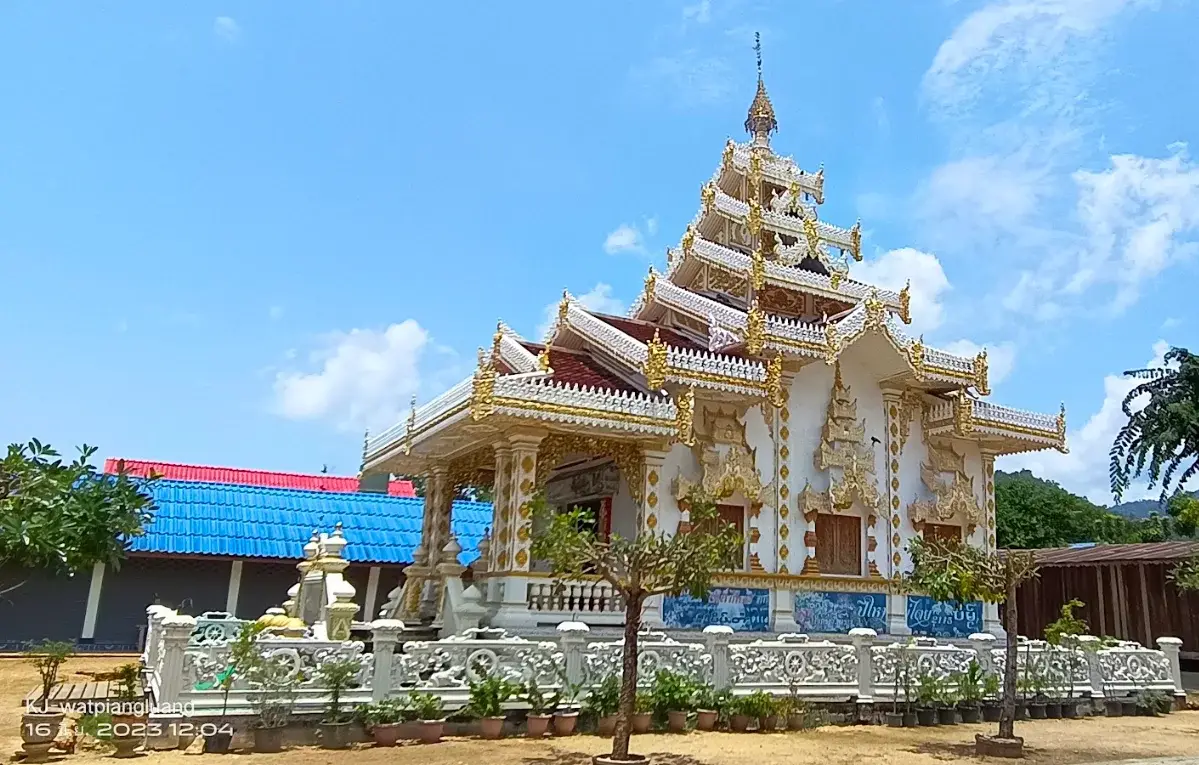
Open Days: Daily
Opening Hours: 08.00 – 17.00
Wat Piang Luang in Ban Piang Luang, Piang Luang Subdistrict, Wiang Haeng District, Chiang Mai Province, is one of the most culturally meaningful temples in this remote Thai–Myanmar border area. Established in 1687, or B.E. 2230, the temple has long served as a spiritual center for the Shan community of Ban Piang Luang. Its significance lies not in monumental scale, but in its deep connection with local history, Shan Buddhist identity, borderland culture, and religious art influenced by Lanna, Shan, and Burmese traditions.
Wat Piang Luang is located at No. 65, Ban Piang Luang, Moo 1, Piang Luang Subdistrict, Wiang Haeng District, Chiang Mai 50350. The temple occupies an area of 2 rai, 1 ngan, and 67 square wah. It stands within Ban Piang Luang, a highland border community surrounded by mountains and valleys. The setting gives the temple a quiet, local, and lived-in atmosphere. Travelers who come here do not find a polished urban temple; they find a community temple that still reflects the daily religious life and cultural memory of the people who live around it.
Ban Piang Luang is one of the most interesting communities in Wiang Haeng because it is home to several ethnic groups, including Shan, Yunnanese Chinese, Lisu, Dara-ang, and northern Thai people. This cultural mix gives the area a distinct identity. Wat Piang Luang is one of the places where this identity can be seen most clearly. The temple functions as a Buddhist sanctuary, a community gathering place, and a cultural landmark that helps preserve Shan Buddhist traditions in northern Thailand.
The history of Wat Piang Luang dates back to B.E. 2230. Older accounts describe the original temple as a raised wooden monastery, a form that matched both the highland environment and the architectural traditions of Shan and Burmese Buddhist communities. Timber construction, elevated floors, and local craftsmanship were practical responses to climate and terrain, but they also expressed the visual identity of borderland Buddhist culture. For this reason, Wat Piang Luang should be understood as both a temple and a cultural document of the community that built and maintained it.
The name Wat Piang Luang is directly linked to Ban Piang Luang itself. Piang Luang is a major border community in Wiang Haeng District, located near the Thai–Myanmar frontier. The temple therefore carries the name of the village and has remained closely tied to the local community. For generations, villagers have used the temple for merit-making, religious ceremonies, Buddhist observances, and community gatherings. It is a place where faith and everyday life meet naturally.
The temple grounds were traditionally bordered by roads, village areas, local houses, and a nearby school. This position places the temple at the heart of community life rather than in isolation. Visitors arriving in Ban Piang Luang will notice that the temple is surrounded by homes, roads, and ordinary village activity. This is part of its charm. Wat Piang Luang is not a detached tourist site; it is a living temple embedded in the social fabric of the village.
One of the temple’s distinctive features is its Shan-Burmese-style monks’ residence. Important sacred objects associated with the temple include a gilded Buddha image from the Chiang Saen period, Shan-Burmese-style Buddha images, and a chedi. These elements show how Buddhist art in this area developed through cultural contact between Lanna, Shan, and Burmese traditions. For travelers interested in Buddhist art, Wat Piang Luang offers a valuable opportunity to see how regional styles overlap in a borderland setting.
The gilded Chiang Saen-era Buddha image links the temple to the broader artistic heritage of northern Thailand, while the Shan-Burmese-style Buddha images reflect the faith and identity of the Shan community in Piang Luang. The chedi and temple structures add another layer of religious meaning. Visitors should take time to look carefully at the architecture, sacred images, and temple atmosphere. The value of Wat Piang Luang is found in these details, not in a quick photo stop.
The known abbots in the temple’s history include Phra Nanta Nantako, who served from B.E. 2441 to 2476, Phra Chino from B.E. 2476 to 2486, Phra Tong Suchino from B.E. 2486 to 2501, and Phra Athikan Panchum Chino from B.E. 2501 onward. The 1979 renovation of the temple was especially important. It was led by Phra Athikan Panchum Chino, later known as Phrakhru Anuraksathanakit, together with Shan leadership and local villagers. During that renovation, the old monastery was replaced by a new structure, marking a major phase in the temple’s modern development.
This renovation was more than a construction project. It showed the strength of local faith and the community’s commitment to preserving its temple. Wat Piang Luang has survived because people in the area continued to see it as central to their identity. The temple is therefore a useful place to understand how border communities maintain religious continuity even as political, social, and economic conditions change around them.
Wat Piang Luang is deeply connected with Shan Buddhist culture. Shan communities in Piang Luang preserve several important Buddhist traditions, including Poy Sang Long, merit-making during Buddhist Lent and the end of Buddhist Lent, Kathin robe offerings, Salak Phat merit-making, Songkran, and other seasonal ceremonies. These traditions keep the temple active throughout the year and allow younger generations to learn religious values, social manners, language, music, dance, and community identity.
Poy Sang Long is one of the most meaningful Shan traditions. It is a novice ordination ceremony in which boys are dressed beautifully as “crystal sons,” symbolically recalling Prince Siddhartha before he renounced worldly life. The ceremony teaches children discipline, morality, Buddhist practice, and community responsibility. In a place like Piang Luang, such traditions help connect religious practice with ethnic identity and social education.
Another important Shan Buddhist tradition is the Chong Para custom associated with the end of Buddhist Lent. A temporary ceremonial structure is made to welcome the Buddha’s descent from heaven. Villagers decorate it with colorful paper, bamboo, lanterns, and offerings, then gather at temples for merit-making, almsgiving, sermons, and cultural performances. These ceremonies show how Wat Piang Luang and nearby temples function as cultural stages as well as religious spaces.
For visitors, Wat Piang Luang is a good starting point for understanding the wider Piang Luang area. Nearby sites such as Wat Fa Wiang In, Xi Long Zang Viewpoint, Wat Mai Hung Lai, Wat Phra That Doi Saeng Khao, and Wat Phra Borommathat Saen Hai can be combined into a broader cultural route. This makes Wat Piang Luang especially suitable for travelers who prefer slow cultural travel rather than a rushed sightseeing schedule.
The temple atmosphere is calm and modest. Its appeal comes from authenticity rather than grandeur. Visitors can experience a temple that still belongs closely to its community. The surrounding village, mountain setting, and borderland history create a sense of place that is different from the more famous temples in central Chiang Mai. This makes Wat Piang Luang valuable for travelers who want to understand another side of Chiang Mai Province.
Important things to observe inside the temple include the Shan-Burmese-style monks’ residence, the gilded Chiang Saen-era Buddha image, Shan-Burmese-style Buddha images, the chedi, and the temple courtyard. Travelers interested in architecture should look for timber details and Shan-style influences. Travelers interested in local history should view the temple as part of a larger cultural landscape that includes border trade, migration, ethnic diversity, and Buddhist devotion.
Visitors should dress respectfully, keep noise low, and behave appropriately inside the temple grounds. Photography should be done with care, especially around Buddha images, monks’ residences, and active religious areas. If monks or villagers are conducting religious activities, visitors should keep a respectful distance. Wat Piang Luang is still an active religious place, and respectful behavior is part of a meaningful visit.
Getting There from Chiang Mai city requires traveling north toward Chiang Dao, then continuing toward Wiang Haeng District and Piang Luang Subdistrict. The route includes mountain roads and winding sections, so travelers should use a well-maintained vehicle and preferably travel during daylight. Ban Piang Luang is about 176 km from Chiang Mai city and about 16 km from Wiang Haeng District Office. The journey takes time, but it rewards visitors with a quiet cultural landscape rarely seen on standard Chiang Mai itineraries.
Travelers planning to visit Wat Piang Luang should consider staying overnight in Wiang Haeng or Piang Luang. A day trip from Chiang Mai city is possible but rushed because of the mountain route. An overnight stay allows more time to visit Wat Fa Wiang In, Xi Long Zang Viewpoint, Wat Mai Hung Lai, Wat Phra That Doi Saeng Khao, and other nearby community attractions. This slower pace is more suitable for understanding the area.
A good first-time itinerary begins at Wat Piang Luang to understand the historical and spiritual foundation of the community. From there, visitors can continue to Wat Fa Wiang In, also known as the temple of two nations, then visit Xi Long Zang Viewpoint for mountain scenery. The route can be combined with local restaurants and small accommodations in Piang Luang or Wiang Haeng, making it a complete cultural and scenic trip.
The best travel season is the cool season, when the weather is more comfortable and the mountain scenery is at its best. Morning mist can appear in the area, so drivers should be careful on mountain roads. Travelers interested in viewpoints and seasonal flowers should plan ahead and check local conditions before departure. Wat Piang Luang itself can be visited daily during its opening hours.
Wat Piang Luang is most suitable for cultural travelers, temple enthusiasts, researchers of Shan culture, and visitors who want to see a quieter side of Chiang Mai. It is not a mainstream attraction, but it offers depth, atmosphere, and historical context. The temple helps reveal how Buddhist faith, ethnic identity, and borderland life have shaped the Piang Luang community over many generations.
What makes Wat Piang Luang memorable is its connection to real community life. The temple tells its story through sacred images, Shan-Burmese artistic influence, village rituals, mountain surroundings, and the continued devotion of local people. For travelers willing to spend time here, Wat Piang Luang offers a grounded and meaningful experience of northern Thailand’s border culture.
| Name | Wat Piang Luang |
| Location | Ban Piang Luang, Moo 1, Piang Luang Subdistrict, Wiang Haeng District, Chiang Mai Province |
| Address | No. 65, Ban Piang Luang, Moo 1, Piang Luang Subdistrict, Wiang Haeng District, Chiang Mai 50350, Thailand |
| Highlights | Historic Shan community temple established in B.E. 2230, with Shan-Burmese artistic influence and important sacred objects |
| History | Established in B.E. 2230; originally a raised wooden monastery; an important renovation took place in 1979 |
| Name Origin | Named after Ban Piang Luang, an important border community in Wiang Haeng District |
| Distinctive Features | Shan-Burmese-style monks’ residence, gilded Chiang Saen-era Buddha image, Shan-Burmese-style Buddha images, chedi, and local temple atmosphere |
| Travel Information | Travel from Chiang Mai toward Chiang Dao, then continue to Wiang Haeng and Piang Luang. The road is mountainous and best traveled during daylight. |
| Current Status | Active Buddhist temple under the Maha Nikaya order and open to visitors |
| Open Days | Daily |
| Opening Hours | 08.00 – 17.00 |
| Facilities | Temple grounds, worship area, courtyard, and parking area according to the local temple setting |
| Main Areas / Zones | Buddha image area, chedi, Shan-Burmese-style monks’ residence, and temple courtyard |
| Caretaker / Contact Information | Phra Maha Kraisorn Phongphan |
| Main Contact Number | 053-476-136 |
| Nearby Tourist Attractions | 1. Wat Fa Wiang In, about 4 km 2. Xi Long Zang Viewpoint, about 5 km 3. Wat Mai Hung Lai, about 5 km 4. Wat Phra That Doi Saeng Khao, about 6 km 5. Ban Paek Sam Agricultural Demonstration Station, about 16 km 6. Wat Phra Borommathat Saen Hai, about 25 km |
| Nearby Restaurants | 1. Krua Piang Luang, about 1 km, Tel. 086-665-6607 2. QQ Fresh Ramen Piang Luang, about 1 km, Tel. 092-979-8540 3. Moo 5 Noodle Shop, about 2 km, Tel. 080-131-2049 4. Huen King Karah, about 2 km, Tel. 097-979-8563 5. FoodFactory, about 16 km, Tel. 089-968-5520 6. Wiang Haeng Coffee, about 16 km, Tel. 089-951-6074 |
| Nearby Accommodations | 1. Baan Rabiang Mai Resort, about 2 km, Tel. 085-622-6591 2. Baan Suan Chom View Resort, about 3 km, Tel. 084-487-5399, 081-784-9830 3. Huen King Karah, about 2 km, Tel. 097-979-8563 4. Huen Mok Kham Resort, about 3 km, Tel. 053-476-190, 093-038-7743, 091-735-7298 5. Piang Luang Guesthouse, about 1 km, Tel. 053-476-066 6. Chiang Tung Rooms, about 16 km, Tel. 053-477-251, 089-835-4932, 082-895-6271 |
Frequently Asked Questions (FAQ)
Q: Where is Wat Piang Luang located?
A: Wat Piang Luang is located at No. 65, Ban Piang Luang, Moo 1, Piang Luang Subdistrict, Wiang Haeng District, Chiang Mai 50350, Thailand.
Q: When was Wat Piang Luang established?
A: Wat Piang Luang was established in B.E. 2230, or 1687, making it one of the historic temples of Ban Piang Luang.
Q: What makes Wat Piang Luang important?
A: The temple is important as a historic Shan community temple with Shan-Burmese artistic influence, a Chiang Saen-era gilded Buddha image, Shan-Burmese-style Buddha images, and a chedi.
Q: Is Wat Piang Luang open every day?
A: Yes. Wat Piang Luang is open daily from 08.00 to 17.00.
Q: What nearby attractions can be visited with Wat Piang Luang?
A: Nearby places include Wat Fa Wiang In, Xi Long Zang Viewpoint, Wat Mai Hung Lai, Wat Phra That Doi Saeng Khao, and Wat Phra Borommathat Saen Hai.
Q: Who should visit Wat Piang Luang?
A: The temple is best suited for cultural travelers, temple enthusiasts, and visitors interested in Shan culture, border communities, and lesser-known parts of Chiang Mai.
Q: What is the best way to travel to Wat Piang Luang?
A: The most practical way is by private car or rented vehicle via Chiang Dao and Wiang Haeng. Because the route includes mountain roads, daytime travel is recommended.
 Category: ●Places of Worship
 Group: ●Temple
Last Update : 1 MonthAgo
 Last Update : 1 MonthAgo

 Click to Access the Navigation Map GPS
Wat Piang Luang Map
Recommend

 Muang Chiang Mai(121)Chom Thong(47)Mae Chaem(25)Chiang Dao(33)Doi Saket(68)Mae Taeng(85)Mae Rim(69)Samoeng(29)Fang(71)Mae Ai(59)Phrao(70)San Pa Tong(103)San Kamphaeng(66)San Sai(73)Hang Dong(73)Hot(32)Doi Tao(22)Omkoi(11)Saraphi(74)Wiang Haeng(15)Chai Prakan(28)Mae Wang(32)Mae On(22)Doi Lo(33)Galyani Vadhana(1)


