
lovethailand home >North Travel Attractions >Chiang Mai Travel Attractions >Mae Ai >San Tonmue > Wat Chai Chanaram
TL;DR: Wat Chai Chanaram is located at Moo 2, Ban San Po Thong, San Ton Mue Subdistrict, Mae Ai District, Chiang Mai Province.

Wat Chai Chanaram
Operating day: Daily
Operating time: 08.00 - 17.00
Wat Chai Chanaram, also known locally as Wat San Po Thong, is a community Buddhist temple in Moo 2, Ban San Po Thong, San Ton Mue Subdistrict, Mae Ai District, Chiang Mai Province. It is a private-sector temple under the Mahanikaya order. The temple was officially established in 1901 and received its Wisungkham Sima in 1975. Today, Wat Chai Chanaram remains an important spiritual center for Ban San Po Thong, serving as a place for Buddhist ceremonies, local merit-making, and Lanna community traditions.
The temple is located in San Ton Mue Subdistrict, a rural area in northern Chiang Mai. The surrounding landscape is shaped by villages, agricultural land, local roads, and a slower rhythm of community life. Ban San Po Thong, where the temple stands, is one of the villages of the subdistrict. For local residents, Wat Chai Chanaram is more than a place of worship. It is a shared space for merit-making, religious gatherings, village relationships, and the preservation of Buddhist values across generations.
The official history of Wat Chai Chanaram dates back to 1901, making it one of the long-established temples of San Ton Mue Subdistrict. At that time, village temples in northern Thailand were deeply connected with daily life. They supported Buddhist learning, ordination, ceremonies, community meetings, and seasonal merit-making. Wat Chai Chanaram grew from this setting as a temple created and sustained by local faith. Its age of more than 100 years gives it clear historical value within the local Buddhist landscape of Mae Ai.
The temple received Wisungkham Sima in 1975. In Thai Buddhist tradition, Wisungkham Sima is a formally granted sacred boundary used for monastic acts. This recognition is closely connected with an ordination hall and important religious functions of the Sangha. For Wat Chai Chanaram, the granting of this boundary marked a significant stage in its development and confirmed its role as a fully functioning Buddhist temple for the Ban San Po Thong community.
The name Wat Chai Chanaram has an auspicious meaning. The word “chai” suggests victory, success, and blessing, while “aram” refers to a peaceful temple or monastic residence. Together, the name gives the sense of a sacred place associated with inner victory, calmness, and Buddhist merit. Its local name, Wat San Po Thong, connects the temple directly with Ban San Po Thong, showing how closely the temple identity and village identity are tied together.
The current abbot of Wat Chai Chanaram is Phra Khru Sangharak Chiraphong Sutthachitto. As abbot, he is associated with the temple’s religious administration and community role. A village temple such as Wat Chai Chanaram depends on the cooperation of monks, local leaders, lay supporters, and residents. This relationship allows the temple to continue serving Buddhist ceremonies, local traditions, and community gatherings throughout the year.
The atmosphere of Wat Chai Chanaram is quiet, modest, and community-based. It is not a large tourist temple, and that is part of its value. Visitors can experience the feeling of a real local temple in Mae Ai rather than a busy landmark designed mainly for tourism. The temple grounds are suitable for paying respect, making merit, observing local Buddhist life, and spending a calm moment while traveling through northern Chiang Mai.
Important areas of Wat Chai Chanaram include Buddhist worship spaces, the temple courtyard, sala areas, spaces for merit-making, and areas used for community religious events. Public information does not provide full architectural details for every structure, but the temple’s long history and Wisungkham Sima status show that it has served as a complete Buddhist temple for the local community. For visitors, the most meaningful experience is to see how the temple functions as a living part of Ban San Po Thong.
Visitors should approach Wat Chai Chanaram as a sacred community space. Recommended things to do include paying respect to the Buddha images, observing the temple courtyard, appreciating the peaceful atmosphere, and learning how a Lanna village temple supports local life. Visitors should dress modestly, speak quietly, avoid disturbing monks or local worshippers, and take photographs respectfully, especially during ceremonies.
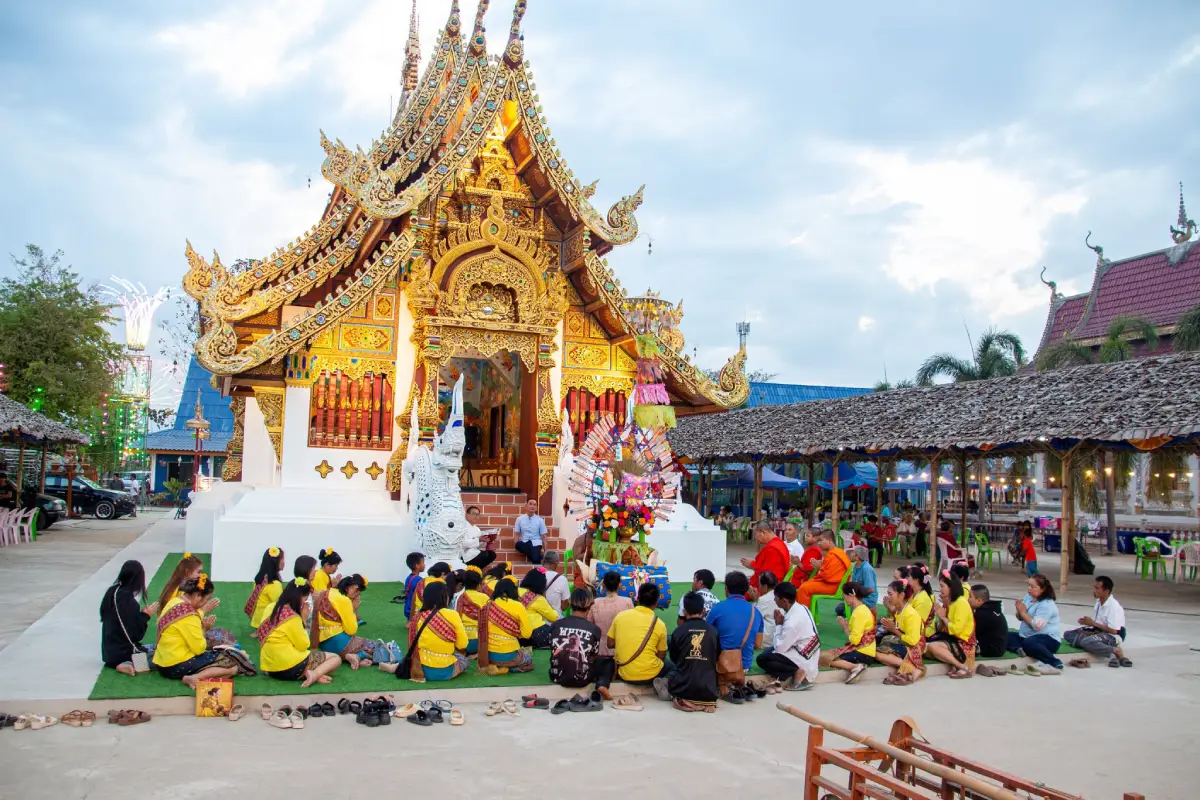
One of the important traditions associated with Wat Chai Chanaram is the Salak Phat merit-making ceremony. Salak Phat is a northern Thai Buddhist tradition in which offerings are made to monks as a way to accumulate merit, dedicate blessings, and strengthen community bonds. At Wat Chai Chanaram in Ban San Po Thong, this ceremony reflects the relationship between the temple, local families, Buddhist faith, and Lanna cultural practice.
During merit-making events, Wat Chai Chanaram becomes a gathering place for local residents, families, elders, and Buddhist devotees from nearby communities. The atmosphere of a village temple event is warm, simple, and close to everyday life. Participants join in offerings, prayer, blessings, and communal activities. This type of temple event gives travelers a clearer understanding of northern Thai Buddhist culture than a brief visit to a famous landmark.
The role of Wat Chai Chanaram in Ban San Po Thong is multi-layered. It is a religious site, a place of memory, a venue for annual merit-making, and a symbol of the village. It helps preserve Buddhist customs, Lanna social practices, and the habit of gathering around the temple at important moments in the year. The significance of the temple is therefore not measured only by buildings or size, but by how deeply it supports the life of the local community.
San Ton Mue Subdistrict has several temples distributed across its villages, including Wat Santiwan, Wat Chai Chanaram, Wat Sai Daeng, Wat San Ton Mue, Wat Hong Ha Noi, Wat Tham Charoen, and Wat Mai Ton Son. This pattern reflects the traditional relationship between northern Thai villages and their temples. Each temple serves its own village, while all of them are connected through shared Buddhist traditions, local ceremonies, and community networks across the subdistrict.
For cultural travelers, Wat Chai Chanaram can be included in a local temple route through Mae Ai District. A practical route can begin at Wat Chai Chanaram in Ban San Po Thong, then continue to Wat Sai Daeng, Wat San Ton Mue, Wat Hong Ha Noi, Wat Phra Chedi Chiang Phaya or Wat Pa Tueng, and eventually to Wat Thaton and the Kok River area. This route is suitable for travelers who want to explore a quieter, more local side of Chiang Mai beyond the city center.
Getting There is easiest by private car, rental car, or local hired transport. From Chiang Mai city, travel north toward Mae Ai District, passing through the main routes that connect Fang and Mae Ai. Then continue into San Ton Mue Subdistrict and Ban San Po Thong. Travelers can search for “Wat Chai Chanaram San Ton Mue Mae Ai Chiang Mai” or “Wat Chai Chanaram Ban San Po Thong” in a map application to find the most convenient route.
Because Mae Ai is located far from Chiang Mai city, visitors should plan enough travel time. A day trip from Chiang Mai is possible with an early start, but an overnight stay in Mae Ai, Thaton, or Fang makes the journey more comfortable. Staying nearby also allows travelers to visit several temples in San Ton Mue Subdistrict, explore the Thaton area, and continue toward natural attractions in Mae Ai and Fang.
Wat Chai Chanaram is best suited for travelers interested in local temples, Lanna culture, Buddhist community life, and quieter routes in northern Chiang Mai. It is not a temple for those seeking a large-scale tourist attraction. Its value lies in its history, its connection with Ban San Po Thong, and its continuing role as a spiritual center for the community.
From a local history perspective, Wat Chai Chanaram is evidence of settlement, faith, and community organization in Ban San Po Thong since the early 20th century. The temple was established alongside the growth of the village and has continued to support Buddhist life for generations. Visiting the temple gives travelers a deeper view of Mae Ai, beyond mountains and natural scenery, by showing the religious and cultural roots of its communities.
In summary, Wat Chai Chanaram is a historic community temple of Ban San Po Thong in San Ton Mue Subdistrict, Mae Ai District, Chiang Mai Province. It is valuable for its history, Buddhist role, Lanna cultural setting, and connection with local people. The temple is suitable for merit-making, quiet worship, cultural learning, and as part of a temple route through Mae Ai. Travelers who enjoy slow, meaningful exploration will find Wat Chai Chanaram a small but culturally significant destination.
| Name | Wat Chai Chanaram / Wat San Po Thong |
| Location | Moo 2, Ban San Po Thong, San Ton Mue Subdistrict, Mae Ai District, Chiang Mai Province |
| Address | W7RF+7FF, San Ton Mue Subdistrict, Mae Ai District, Chiang Mai 50280, Thailand |
| Coordinates / Map Code | W7RF+7FF |
| Temple Type | Private-Sector Buddhist Temple, Mahanikaya Order |
| Highlights | Historic community temple of Ban San Po Thong, suitable for merit-making, quiet worship, and learning about Lanna village temple culture in Mae Ai |
| History | Officially established in 1901 and granted Wisungkham Sima in 1975 |
| Name Origin | The name Wat Chai Chanaram carries an auspicious meaning related to victory, peace, and blessing, while the local name Wat San Po Thong links the temple to Ban San Po Thong |
| Distinctive Features | A village temple that reflects the relationship between Buddhist faith, community life, merit-making, and Lanna traditions |
| Travel Information | Best reached by private car, rental car, or local hired transport from Chiang Mai toward Mae Ai, then into San Ton Mue Subdistrict and Ban San Po Thong |
| Current Status | Listed in temple directories, local subdistrict information, and travel references; no public record found indicating permanent closure |
| Open Days | Daily |
| Main Areas / Zones | Buddhist worship area, temple courtyard, sala areas, merit-making spaces, and community ceremony areas |
| Abbot / Caretaker | Phra Khru Sangharak Chiraphong Sutthachitto |
| Important Traditions / Ceremonies | Salak Phat merit-making ceremony at Wat Chai Chanaram, Buddhist holy day merit-making, and annual Lanna community ceremonies |
| Nearby Tourist Attractions | 1. Wat Sai Daeng, about 1 km 2. Wat San Ton Mue, about 3 km 3. Wat Hong Ha Noi, about 4 km 4. Wat Phra Chedi Chiang Phaya / Wat Pa Tueng, about 7 km 5. Chaloem Phrakiat Public Park, Ban San Pa Hiao, about 7 km 6. Wat Thaton, about 22 km |
| Nearby Restaurants | 1. Ban Suan Khun Yai, about 7 km 2. Thaton Riverview Restaurant, about 22 km 3. Chanka Sem Restaurant, about 22 km 4. Sunshine Cafe @Thaton, about 22 km 5. Ban Rai Chai Daen, about 23 km 6. Hompandin Cafe, about 24 km |
| Nearby Accommodations | 1. Ban Suan Khun Yai, about 7 km 2. Yoga Art Home, about 17 km 3. LoveShack @ Thailand, about 19 km 4. Thaton Hill Resort, about 22 km 5. Thaton Chalet, about 22 km 6. Areeya Phuree Resort, about 23 km |
Frequently Asked Questions (FAQ)
Q: Where is Wat Chai Chanaram located?
A: Wat Chai Chanaram is located in Moo 2, Ban San Po Thong, San Ton Mue Subdistrict, Mae Ai District, Chiang Mai Province.
Q: What is the history of Wat Chai Chanaram?
A: Wat Chai Chanaram was officially established in 1901 and received its Wisungkham Sima in 1975, making it a long-established community temple of Ban San Po Thong.
Q: Does Wat Chai Chanaram have another name?
A: Yes. It is also known locally as Wat San Po Thong because it is located in Ban San Po Thong, Moo 2, San Ton Mue Subdistrict.
Q: Who is the abbot of Wat Chai Chanaram?
A: The abbot of Wat Chai Chanaram is Phra Khru Sangharak Chiraphong Sutthachitto.
Q: What kind of travelers is Wat Chai Chanaram suitable for?
A: It is suitable for travelers interested in quiet temples, merit-making, Lanna culture, local Buddhist communities, and temple routes in Mae Ai District.
Q: What important tradition is associated with Wat Chai Chanaram?
A: The temple is associated with the Salak Phat merit-making ceremony, a northern Thai Buddhist tradition of offering and community merit-making.
Q: How can travelers get to Wat Chai Chanaram?
A: The most convenient way is by private car, rental car, or local hired transport from Chiang Mai toward Mae Ai, then into San Ton Mue Subdistrict and Ban San Po Thong.
Q: What places can be visited together with Wat Chai Chanaram?
A: Nearby places include Wat Sai Daeng, Wat San Ton Mue, Wat Hong Ha Noi, Wat Phra Chedi Chiang Phaya / Wat Pa Tueng, Chaloem Phrakiat Public Park, and Wat Thaton.
 Category: ●Places of Worship
 Group: ●Temple
Last Update : 1 MonthAgo
 Last Update : 1 MonthAgo
 Click to Access the Navigation Map GPS

 Muang Chiang Mai(121)Chom Thong(47)Mae Chaem(25)Chiang Dao(33)Doi Saket(68)Mae Taeng(85)Mae Rim(69)Samoeng(29)Fang(71)Mae Ai(59)Phrao(70)San Pa Tong(103)San Kamphaeng(66)San Sai(73)Hang Dong(73)Hot(32)Doi Tao(22)Omkoi(11)Saraphi(74)Wiang Haeng(15)Chai Prakan(28)Mae Wang(32)Mae On(22)Doi Lo(33)Galyani Vadhana(1)


