
lovethailand home >North Travel Attractions >Chiang Mai Travel Attractions >Mae Ai >Mae Sao > Wat Rattanawas
TL;DR: Wat Rattanawas is located at Ban Nong Teng, Village No. 3, Mae Sao Subdistrict, Mae Ai District, Chiang Mai Province, open Daily, hours 08.00 – 17.00.

Wat Rattanawas
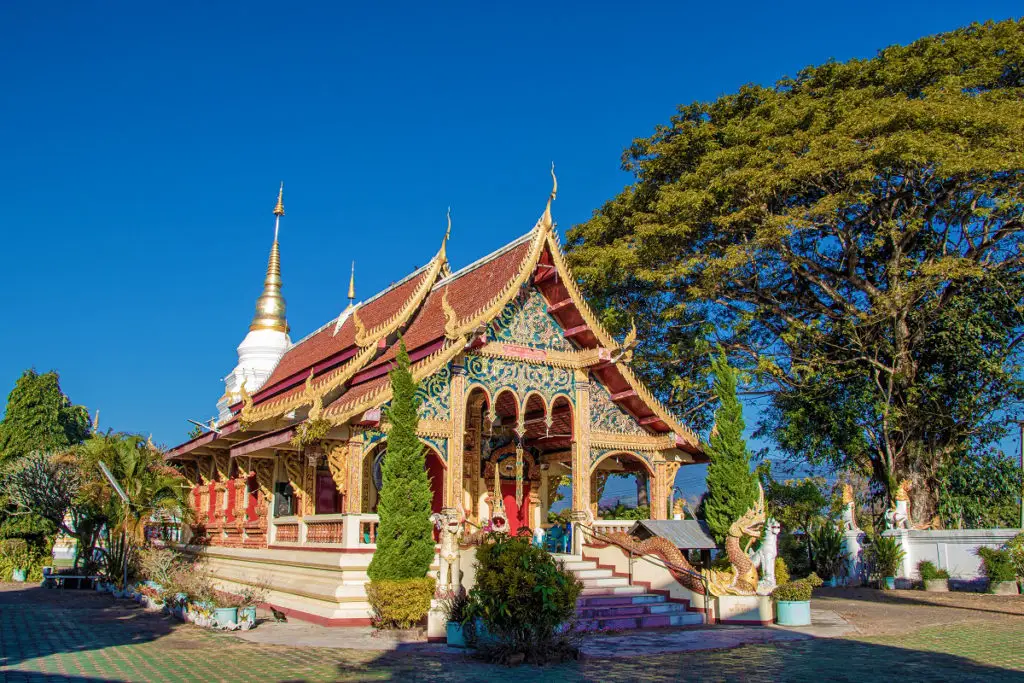
Open Days: Daily
Opening Hours: 08.00 – 17.00
Wat Rattanawas is located at 199 Moo 3, Ban Nong Teng, on the Fang–Tha Ton road in Mae Sao Subdistrict, Mae Ai District, Chiang Mai Province. It is a private Buddhist temple under the Mahanikaya order. The temple was officially permitted to be established in 1923 and received its royal Wisungkhamasima boundary in 1989. The current abbot is Phra Baidika Chairat Chayasophano. Wat Rattanawas is also associated with the local name Wat Nong Teng and was historically known as Wat Nong Leng before later becoming Wat Rattanawas.
Wat Rattanawas is one of the most distinctive community temples in Mae Sao because of its temple gate and its ancient teak Buddha image. The temple’s most important sacred image is Phra Phuttha Si Rattanachai Suwan, a standing Buddha image carved from ancient golden teak. The image stands on a lotus base with both hands lowered beside the body and palms facing forward, representing the Buddha in the posture of opening the worlds. The image has become a major symbol of faith for Ban Nong Teng and for visitors who come to make merit at the temple.
The story of the ancient teak gives Wat Rattanawas a special cultural value. Villagers found four old golden teak logs within the village area. Part of the wood was carved into the standing Buddha image, while the remaining wood was used for the posts of the temple gate. This means the temple gate and the Buddha image are not merely decorative features. They are physical expressions of local faith, village memory, natural material, craftsmanship, and collective merit-making.
The temple’s history began in 1923, when Phra Inthachak Inthapanyo, also referred to as Phra Athikan Inthachak, encouraged local villagers to establish the temple. At that time, Ban Nong Teng had a small population and the area had many ponds, which is why the temple was first known as Wat Nong Leng. It was later renamed Wat Rattanawas in connection with the identity of Ban Nong Teng. This history shows how the temple grew from local faith and from the community’s need for a Buddhist center close to village life.
The royal Wisungkhamasima granted in 1989 is an important religious milestone. A Wisungkhamasima boundary is a formally designated area for important monastic acts, especially ordination. With this status, Wat Rattanawas became more complete in its religious function and better able to support key Buddhist ceremonies in Ban Nong Teng and Mae Sao. The temple is therefore not just a place for casual worship, but an active religious center within the local Sangha system.
Wat Rattanawas was also recognized as an exemplary developed temple with outstanding work in 1999. This reflects the continued care of the temple by monks and the local community. In a rural temple, development does not only mean constructing buildings. It also includes maintaining clean grounds, caring for monastic buildings, supporting Buddhist activities, and keeping the temple useful as a shared space for villagers.
Phra Baidika Chairat Chayasophano is the abbot of Wat Rattanawas. In a community temple, the abbot plays a central role in caring for monks, guiding merit-making, maintaining temple order, and supporting local Buddhist life. Wat Rattanawas therefore reflects the close relationship between the Sangha, villagers, and the Buddhist culture of Mae Sao Subdistrict.
The temple’s main buildings and areas include Chedi Rattanachai Mongkhonwat, a viharn or ordination hall, a sermon hall, monks’ quarters, a merit-making pavilion, a multipurpose pavilion, a bell tower, a kitchen, restrooms, the Trai Lak cremation cemetery, and the teak-carved Buddha pavilion or gate connected with the Buddha image in the posture of opening the worlds. These features allow the temple to support worship, monastic ceremonies, village merit-making, funerals, community activities, and daily religious use.
Chedi Rattanachai Mongkhonwat is an important sacred structure within the temple. In Thai and Lanna Buddhist tradition, a chedi is connected with reverence for the Buddha, the Triple Gem, and the continuation of Buddhist faith. The chedi gives Wat Rattanawas a deeper sacred atmosphere and provides visitors with another point for quiet worship and reflection.
The viharn or ordination hall is an important place for worship, Dhamma listening, and Buddhist ceremonies. Wat Rattanawas is also associated with a Chiang Saen-style Buddha image, often described as a Phra Sing Nueng type. Its features include a lotus-bud-like ushnisha, clearly curled hair, a robe fold above the chest, and a Mara-vijaya posture on a lotus base. This adds artistic value to the temple and connects it with the wider Buddhist art traditions of northern Thailand.
Phra Phuttha Si Rattanachai Suwan is the main image that visitors should respectfully pay attention to. The posture of opening the worlds carries a meaning of illumination, spiritual clarity, and the Buddha’s power to reveal truth. Because this image was carved from ancient teak found in Ban Nong Teng, it is both a sacred object and a record of local faith. It links the village, the temple, the material, and the craftsmanship into one meaningful religious work.
The carving of Phra Phuttha Si Rattanachai Suwan is also part of the temple’s important story. The ancient teak was first used in relation to the temple gate, and later a group of devotees sponsored the carving of the Buddha image. A Lanna craftsman from Lamphun carved the image in nine days, producing a standing Buddha approximately 4.39 meters tall. This detail shows how local faith, outside sponsorship, and regional craftsmanship came together to create the temple’s most memorable image.
The temple gate of Wat Rattanawas is another feature visitors should notice. Part of the ancient teak was used as posts for the temple gate, making the entrance more than a practical structure. It stands as a symbol of community faith and of natural material transformed into a sacred architectural element. Understanding this story helps visitors appreciate why Wat Rattanawas is different from many other local temples in Mae Sao.
Ban Nong Teng, Village No. 3 of Mae Sao Subdistrict, is the community directly connected with Wat Rattanawas. Mae Sao is a rural area in northern Chiang Mai, with villages, farmland, local roads, and landscapes connected with Fang, Mae Ai, and Tha Ton. Wat Rattanawas stands within this living community setting, making it suitable for travelers who want to understand the local Buddhist life of Mae Ai beyond the main tourist route.
Wat Rattanawas serves Ban Nong Teng as a place for worship, merit-making, Buddhist ceremonies, funerals, and community activities. Northern Thai community temples often function as much more than worship places. They are meeting spaces, religious centers, places for Kathin, robe-offering ceremonies, Buddhist Lent activities, Buddhist holy days, and village merit-making. The presence of a sermon hall, merit-making pavilion, multipurpose pavilion, kitchen, and cremation area shows the temple’s strong role in local life.
In the context of Lanna rural culture, Wat Rattanawas reflects the close relationship between temple and village. Villagers are not only visitors; they are supporters, caretakers, builders, and inheritors of the temple’s meaning. The ancient teak found in the village became both a Buddha image and part of the temple gate. This is a powerful example of how local material and village memory can be transformed into Buddhist art and sacred architecture.
Key things to see at Wat Rattanawas include the temple gate, Phra Phuttha Si Rattanachai Suwan, the Chiang Saen-style Buddha image, Chedi Rattanachai Mongkhonwat, the viharn or ordination hall, the sermon hall, the bell tower, and the overall atmosphere of Ban Nong Teng’s community temple. Travelers interested in local history should pay special attention to the story of the ancient teak and how it became the temple’s central sacred feature.
Visitors should behave respectfully when visiting Wat Rattanawas. Modest clothing, soft speech, and awareness of monastic areas are important. Visitors should not touch sacred objects or old items without permission. If monks or villagers are conducting religious activities, visitors should keep a respectful distance. This is an active community temple, so the visit is most meaningful when the temple is treated as a sacred living space rather than just a photo location.
Wat Rattanawas can be included in a temple route through Mae Sao Subdistrict. Nearby temples include Wat Mae Sao, Wat Phra That Doi Nam Khang, Wat Si Don Kaeo, Wat Si Bun Rueang, Wat Panja Kana Nusorn, and Wat Si Wiang. Each temple has a different character: Wat Mae Sao has a prominent gate, Wat Phra That Doi Nam Khang is linked with meditation practice, Wat Si Don Kaeo has a two-storey ordination hall and murals, while Wat Si Bun Rueang and Wat Panja Kana Nusorn are linked with Buddhist art traditions in the Fang and Mae Ai area.
Beyond Mae Sao, Wat Rattanawas can connect with major Mae Ai and Tha Ton attractions, including Wat Tha Ton, Wat Phra That Sob Fang, Thanathon Orchard, Wiang Malika, and Doi Pu Muen. Wat Tha Ton is a well-known riverside temple near the Kok River. Thanathon Orchard is a popular agricultural attraction, while Doi Pu Muen is associated with mountain scenery, coffee, tea, and highland community life. Including Wat Rattanawas in this route adds faith, art, community culture, and local history to the journey.
Getting There is easiest by private car. Travelers can use the Fang–Tha Ton road to enter Mae Sao Subdistrict and Ban Nong Teng. From Chiang Mai city, the route heads north through Mae Rim, Mae Taeng, Chiang Dao, Chai Prakan, and Fang before reaching Mae Ai. Because the distance is long, the trip is best planned as an overnight or multi-stop journey in the Fang, Mae Ai, and Tha Ton area rather than a rushed same-day return from Chiang Mai city.
Travelers starting from Fang or Mae Ai will reach Wat Rattanawas more conveniently. Ban Nong Teng lies along the Fang–Tha Ton route, which also connects toward Tha Ton and the Kok River area. During the rainy season or in the evening, visitors should drive carefully on local roads, especially where agricultural vehicles, motorcycles, and village traffic may share the route. Preparing the route in advance will make the journey smoother.
Food and accommodation options are more concentrated around Tha Ton and Mae Ai than directly beside the temple. Riverside restaurants and resort restaurants near Tha Ton are practical stops after visiting the temple. For overnight stays, the Tha Ton area offers convenient access to the Kok River and onward routes toward Chiang Rai, Doi Mae Salong, Fang, and other northern destinations.
In summary, Wat Rattanawas is a Mahanikaya community temple in Ban Nong Teng, Mae Sao Subdistrict, Mae Ai District, Chiang Mai Province. Established in 1923 and granted royal Wisungkhamasima in 1989, it is led by Phra Baidika Chairat Chayasophano. Its main highlights are the temple gate, Phra Phuttha Si Rattanachai Suwan carved from ancient golden teak, the Chiang Saen-style Buddha image, Chedi Rattanachai Mongkhonwat, and its role as a spiritual center for Ban Nong Teng. Travelers interested in local Lanna temples, teak Buddhist art, community faith, and quieter northern Chiang Mai routes should include Wat Rattanawas as a meaningful stop in Mae Sao.
| Name | Wat Rattanawas |
| Alternative Names | Wat Nong Teng / Wat Nong Leng |
| Location | Ban Nong Teng, Village No. 3, Mae Sao Subdistrict, Mae Ai District, Chiang Mai Province |
| Address | 199 Moo 3, Ban Nong Teng, Fang–Tha Ton Road, Mae Sao Subdistrict, Mae Ai District, Chiang Mai 50280, Thailand |
| Temple Type | Private Buddhist temple under the Mahanikaya order |
| History | Officially established as a temple in 1923 and granted royal Wisungkhamasima in 1989 |
| Abbot | Phra Baidika Chairat Chayasophano |
| Highlights | Temple gate, Phra Phuttha Si Rattanachai Suwan, ancient golden teak Buddha image in the posture of opening the worlds, Chedi Rattanachai Mongkhonwat, and Chiang Saen-style Buddha image |
| Sacred Objects / Key Evidence | Phra Phuttha Si Rattanachai Suwan, a standing Buddha image carved from ancient golden teak, and a Chiang Saen-style Buddha image |
| Main Buildings / Areas | Chedi Rattanachai Mongkhonwat, viharn/ordination hall, sermon hall, monks’ quarters, merit-making pavilion, multipurpose pavilion, bell tower, kitchen, restrooms, Trai Lak cremation cemetery, and teak-carved Buddha pavilion or gate |
| Distinctive Features | A community temple where ancient teak found in Ban Nong Teng was transformed into a Buddha image and temple gate, symbolizing local faith |
| Travel Information | Best reached by private car via the Fang–Tha Ton road into Mae Sao Subdistrict and Ban Nong Teng |
| Current Status | Open for temple visits, merit-making, and religious activities during the stated visiting hours |
| Open Days | Daily |
| Opening Hours | 08.00 – 17.00 |
| Related Traditions | Buddhist holy days, Buddhist Lent, the end of Lent, Kathin, robe-offering ceremonies, merit-making, funerals, and Ban Nong Teng community religious activities |
| Local Administrative Contact | Mae Sao Subdistrict Administrative Organization, Tel. 053-054100 |
| Nearby Tourist Attractions | 1. Wat Mae Sao, about 3 km 2. Wat Phra That Doi Nam Khang, about 7 km 3. Wat Si Don Kaeo, about 9 km 4. Wiang Malika, about 12 km 5. Wat Tha Ton, about 18 km 6. Thanathon Orchard, about 20 km 7. Doi Pu Muen, about 34 km |
| Nearby Restaurants | 1. Tha Ton River View, about 18 km, Tel. 053-459-289, 053-373-173-5, 093-256-7969 2. Tha Ton Chom Chan Cafe & Restaurant Homestay, about 18 km, Tel. 088-435-4467 3. Tha Ton Hill, about 16 km, Tel. 053-053-669 4. Khun Mai Baan Suan Resort, about 18 km, Tel. 053-053-551, 088-952-6196, 081-885-3564 5. Hom Phaen Din Vineyard Restaurant, about 24 km, Tel. 080-860-0368 |
| Nearby Accommodations | 1. Thaton River View Resort, about 18 km, Tel. 053-373-174 2. Thaton Chalet, about 18 km, Tel. 053-373-155 3. Apple House Resort, about 18 km, Tel. 053-373-144 4. Thaton Garden Resort, about 18 km, Tel. 053-373-154 5. Thammachat Garden Home Resort, about 18 km, Tel. 053-373-015 |
Frequently Asked Questions (FAQ)
Q: Where is Wat Rattanawas located?
A: Wat Rattanawas is located at 199 Moo 3, Ban Nong Teng, Fang–Tha Ton Road, Mae Sao Subdistrict, Mae Ai District, Chiang Mai Province.
Q: What are the opening hours of Wat Rattanawas?
A: Wat Rattanawas is open daily from 08.00 to 17.00.
Q: What is the history of Wat Rattanawas?
A: Wat Rattanawas was officially established as a temple in 1923 and received its royal Wisungkhamasima in 1989. It was historically known as Wat Nong Leng before becoming Wat Rattanawas.
Q: Who is the abbot of Wat Rattanawas?
A: The abbot of Wat Rattanawas is Phra Baidika Chairat Chayasophano.
Q: What makes Wat Rattanawas distinctive?
A: Its highlights include the temple gate, Phra Phuttha Si Rattanachai Suwan carved from ancient golden teak, Chedi Rattanachai Mongkhonwat, and a Chiang Saen-style Buddha image.
Q: Why is Phra Phuttha Si Rattanachai Suwan important?
A: Phra Phuttha Si Rattanachai Suwan is a standing Buddha image in the posture of opening the worlds, carved from ancient golden teak found in Ban Nong Teng. It is a sacred symbol of community faith.
Q: What nearby attractions can be visited with Wat Rattanawas?
A: Nearby places include Wat Mae Sao, Wat Phra That Doi Nam Khang, Wat Si Don Kaeo, Wiang Malika, Wat Tha Ton, Thanathon Orchard, and Doi Pu Muen.
 Category: ●Places of Worship
 Group: ●Temple
Last Update : 2 MonthAgo
 Last Update : 2 MonthAgo
 Click to Access the Navigation Map GPS

 Muang Chiang Mai(121)Chom Thong(47)Mae Chaem(25)Chiang Dao(33)Doi Saket(68)Mae Taeng(85)Mae Rim(69)Samoeng(29)Fang(71)Mae Ai(59)Phrao(70)San Pa Tong(103)San Kamphaeng(66)San Sai(73)Hang Dong(73)Hot(32)Doi Tao(22)Omkoi(11)Saraphi(74)Wiang Haeng(15)Chai Prakan(28)Mae Wang(32)Mae On(22)Doi Lo(33)Galyani Vadhana(1)


