
lovethailand home >North Travel Attractions >Chiang Mai Travel Attractions >Mae Ai >Tha Ton > Wat Hua Mueang Ngam
TL;DR: Wat Hua Mueang Ngam is located at Ban Hua Mueang Ngam / Ban Saen Suk, Moo 11, Tambon Tha Ton, Mae Ai District, Chiang Mai Province, open Contact The Temple Or Local Community Before Visiting, hours Daytime Visits Are Recommended.

Wat Hua Mueang Ngam
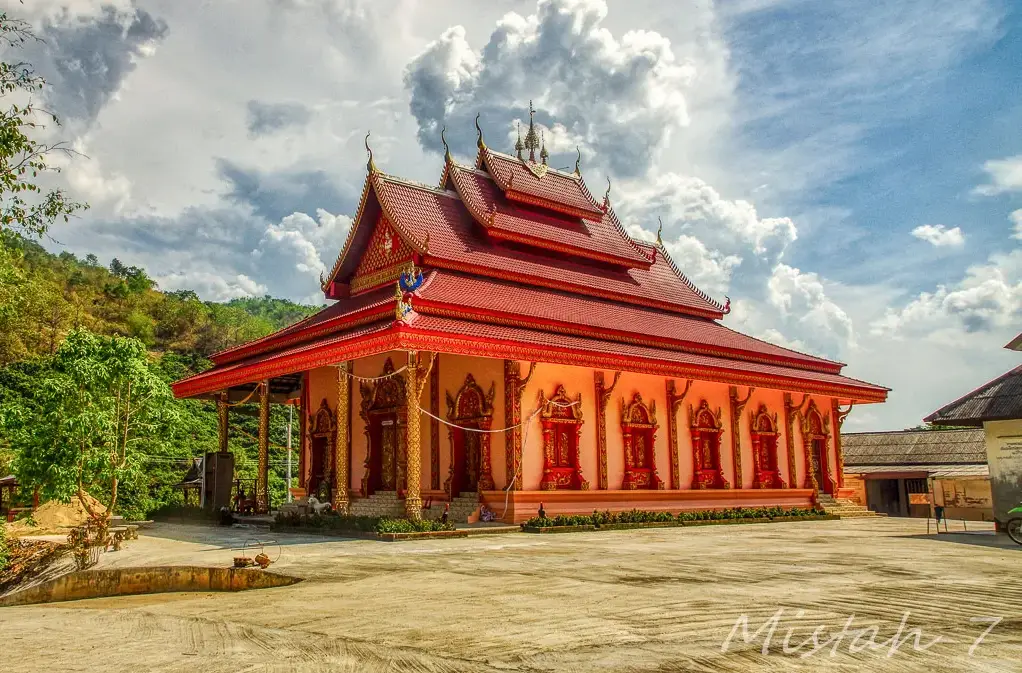
Open Days: Contact The Temple Or Local Community Before Visiting
Opening Hours: Daytime Visits Are Recommended
Wat Hua Mueang Ngam is located in Ban Hua Mueang Ngam, also known as Ban Saen Suk, Tambon Tha Ton, Mae Ai District, Chiang Mai Province. It is a local community temple serving a highland village with a diverse population of Tai Yai, Lahu, and northern Thai residents. The temple is an important Buddhist center for the village, supporting worship, merit-making, Kathin ceremonies, Buddhist observances, and local community gatherings.
Ban Hua Mueang Ngam or Ban Saen Suk is located in Moo 11, Tambon Tha Ton, Mae Ai District. The village is surrounded by mountains on all sides and lies along the route from Tha Ton in Mae Ai District toward Mae Chan District in Chiang Rai Province. Its environment includes forest, mountain landscapes, cool weather, agricultural areas, and a stream that supports local livelihoods. This setting makes the temple part of a wider highland community landscape rather than an isolated religious site.
The community was established under the name Ban Saen Suk in 1957, with local residents migrating from Mae Chan District in Chiang Rai Province. The village includes Tai Yai, Lahu, and northern Thai residents. Because of this ethnic diversity, Wat Hua Mueang Ngam is meaningful not only as a Buddhist temple but also as a shared community space where local people maintain religious practice, cultural activities, and social relationships.
The name Wat Hua Mueang Ngam is directly connected with Ban Hua Mueang Ngam, the village where the temple is located. The name reflects the community’s place identity in the upper or head area of the Mueang Ngam landscape. Like many village temples in northern Thailand, the temple name preserves the name of the local settlement and shows the close relationship between the temple and its lay supporters.
Wat Hua Mueang Ngam plays an important role in local Buddhist life. The majority of residents in Ban Saen Suk are Buddhist and use the temple for Buddhist rituals and ceremonies. At the same time, some families in the village are Christian and there is a church in the village. This makes the community especially interesting because different religious and cultural traditions exist in the same village landscape.
Recent Kathin information lists five resident monks at Wat Hua Mueang Ngam and identifies Phra Panya Thiwakaro as the abbot. Kathin is one of the most important Buddhist ceremonies after the end of Buddhist Lent. The presence of resident monks and Kathin activity shows that the temple remains an active religious site and continues to support the spiritual life of the community.
The abbot of a village temple has an important role as spiritual leader, temple caretaker, coordinator with lay supporters, and guardian of religious continuity. Wat Hua Mueang Ngam continues to function through cooperation between monks, villagers, local leaders, and devotees. In a highland community, temple care is both a religious responsibility and a social commitment.
The temple is distinctive because it serves a culturally diverse highland village. Tai Yai, Lahu, and northern Thai residents live in the same community, and the temple provides one of the main shared spaces for Buddhist ceremonies, merit-making, village gatherings, and local social life. Its value lies in the way it reflects everyday community Buddhism rather than large-scale tourist architecture.
Ban Hua Mueang Ngam has a range of cultural and community activities. These include the red-egg or Easter tradition practiced by some Lahu families, the swing festival, bamboo firework or “phu fai” competitions during the end of Buddhist Lent, Loy Krathong, Buddhist Lent activities, New Year celebrations, and Songkran. This variety shows the layered cultural life of the village and the way religious and community traditions coexist.
The bamboo firework competition during the end of Buddhist Lent is especially connected with local Buddhist observance. Villagers prepare bamboo tubes as fireworks or “phu fai” to honor the Triple Gem. The event includes judging by beauty and height, Tai Yai-style martial performance, and local games inside the temple area. This kind of activity shows how the temple becomes both a place of merit and a space for community cultural expression.
Salak Phat merit-making at Wat Hua Mueang Ngam is another important example of community participation. Salak Phat is a northern Buddhist merit-making tradition connected with offerings, dedication of merit, and community gathering. At Wat Hua Mueang Ngam, such activities also show the participation of villagers from diverse ethnic backgrounds, making the temple a place where faith and local identity are expressed together.
Within Tambon Tha Ton, Wat Hua Mueang Ngam is part of a wider network of temples and cultural places. Nearby and related destinations include Wat Tha Ton Royal Temple, Wat Mai Mok Cham, Wat Phawana Nimit, Wat Phra That Sop Fang, Wat Hat Chomphu, Wat San Ton Du, Wat Tha Ma Kaeng, and Wat Huai Sala. Each temple has its own identity. Wat Hua Mueang Ngam represents the highland village-temple side of Tha Ton.
The atmosphere of Wat Hua Mueang Ngam is best appreciated by visitors who want to understand a working community temple rather than a large tourist landmark. The temple is a place where villagers worship, make merit, gather for ceremonies, and continue local traditions. It offers a deeper view of Mae Ai beyond well-known viewpoints and larger temples.
Important things to appreciate at Wat Hua Mueang Ngam include the quiet temple compound, worship areas, merit-making spaces, village atmosphere, and the surrounding mountain landscape of Ban Hua Mueang Ngam. Visitors should move calmly, observe respectfully, and understand that the temple is an active religious space for local people.
Wat Hua Mueang Ngam is suitable for travelers interested in local temples, highland communities, Tai Yai and Lahu cultural contexts, and the Tha Ton–Mae Ai travel route. It is especially meaningful for visitors who want to see how Buddhism, ethnicity, village life, and local traditions remain connected in northern Chiang Mai.
Visitors should follow proper temple etiquette. Dress modestly, speak quietly, avoid disturbing monks or villagers during ceremonies, and do not enter monastic or restricted areas without permission. If visiting during a festival or merit-making event, visitors should give priority to local residents and follow the guidance of temple caretakers or community members.
Getting There can be done by road from Chiang Mai city via Mae Rim, Mae Taeng, Chiang Dao, Fang, and Mae Ai before entering Tambon Tha Ton. Continue to Ban Hua Mueang Ngam, Moo 11, on the route connecting Tha Ton and Mae Chan. Because the village is located in a highland area, daytime travel is recommended. A private car, rental car, or local transport familiar with the route is the most practical option.
A practical itinerary can combine Wat Hua Mueang Ngam with Wat Tha Ton Royal Temple, Tha Ton Pier, Wat Mai Mok Cham, the Mok Cham Royal Project Development Center, Thanathon Orchard, and Malika Hot Spring. Travelers continuing toward Chiang Rai can also use the Tha Ton–Mae Chan route to build a cultural and nature-based itinerary between Chiang Mai and Chiang Rai.
Wat Hua Mueang Ngam is therefore a meaningful destination for travelers who want to understand the quieter highland community-temple side of Tha Ton. Its resident monks, Kathin activity, ethnic diversity, Buddhist ceremonies, and relationship with Ban Hua Mueang Ngam make it a valuable stop for merit-making and cultural observation in northern Chiang Mai.
| Name | Wat Hua Mueang Ngam |
| Location | Ban Hua Mueang Ngam / Ban Saen Suk, Moo 11, Tambon Tha Ton, Mae Ai District, Chiang Mai Province |
| Address | Tambon Tha Ton, Mae Ai District, Chiang Mai 50280, Thailand |
| Map Code | 4G2W+VF2, Tambon Tha Ton, Mae Ai District, Chiang Mai 50280, Thailand |
| Temple Type | Community Temple |
| History / Community Context | A local temple of Ban Hua Mueang Ngam or Ban Saen Suk, a highland village established in 1957 with Tai Yai, Lahu, and northern Thai residents. The temple is used for Buddhist rituals and community merit-making. |
| Name Origin | The temple name is connected with Ban Hua Mueang Ngam, the village where the temple is located, and reflects the community’s highland place identity along the Tha Ton–Mae Chan route. |
| Highlights | A highland village temple in Tambon Tha Ton with five resident monks, Kathin activity, and a community setting shaped by Tai Yai, Lahu, and northern Thai cultural life. |
| Distinctive Features | A local temple reflecting ethnic diversity, Buddhist ceremonies, and village-temple life in the highland area of Mae Ai District. |
| Main Structures / Areas | Temple courtyard, worship areas, religious activity spaces, and community merit-making areas |
| What To See | Village-temple atmosphere, worship areas, merit-making spaces, and the mountain landscape of Ban Hua Mueang Ngam |
| Travel Information | Travel from Chiang Mai through Mae Rim, Mae Taeng, Chiang Dao, Fang, and Mae Ai to Tambon Tha Ton, then continue to Ban Hua Mueang Ngam, Moo 11, on the route toward Mae Chan. Daytime travel by private car, rental car, or local transport is recommended. |
| Current Status | Active community temple used for Buddhist worship, merit-making, Kathin, and local religious activities |
| Open Days | Contact the temple or local community before visiting |
| Opening Hours | Daytime visits are recommended |
| Abbot / Caretaker | Phra Panya Thiwakaro |
| Resident Monks | 5 Monks |
| Local Coordination Contact | Tha Ton Subdistrict Administrative Organization, Tel. 0-5337-3138 |
| Related Religious Events | Kathin after Buddhist Lent, Salak Phat merit-making, Buddhist holy day activities, Buddhist Lent, the end of Buddhist Lent, Loy Krathong, Songkran, and regular merit-making |
| Community Cultural Context | The village has Tai Yai, Lahu, and northern Thai residents and maintains diverse traditions such as the red-egg tradition, swing festival, bamboo firework competition during the end of Buddhist Lent, Salak Phat, Loy Krathong, Buddhist Lent, New Year, and Songkran. |
| Nearby Tourist Attractions | 1. Wat Tha Ton Royal Temple, about 30 km 2. Tha Ton Pier / Kok River Boat Route, about 30 km 3. Wat Mai Mok Cham / Wat Mok Cham, about 32 km 4. Mok Cham Royal Project Development Center, about 34 km 5. Thanathon Orchard, about 35 km 6. Malika Hot Spring, about 40 km |
| Nearby Restaurants | 1. Tha Ton River View, about 30 km, Tel. 053-459-289, 053-373-173-5, 093-256-7969 2. Tha Ton Hill, about 31 km, Tel. 053-053-669 3. Tha Ton Chom Chan, about 31 km, Tel. 088-435-4467 4. Khun Mai Baan Suan Resort, about 32 km, Tel. 053-053-551, 088-952-6196, 081-885-3564 5. Nam Som Thanathon, about 35 km, Tel. 083-734-9555 |
| Nearby Accommodations | 1. Tha Ton River View Resort, about 30 km, Tel. 053-373-173 2. Tha Ton Chalet, about 30 km, Tel. 053-373-155 3. Tha Ton Hill Resort, about 31 km, Tel. 053-053-669 4. Khun Mai Baan Suan Resort, about 32 km, Tel. 053-053-551, 088-952-6196, 081-885-3564 5. Nicha Homestay Tha Ton, about 35 km, Tel. 093-549-7419 |
Frequently Asked Questions (FAQ)
Q: Where Is Wat Hua Mueang Ngam Located?
A: Wat Hua Mueang Ngam is located in Ban Hua Mueang Ngam or Ban Saen Suk, Moo 11, Tambon Tha Ton, Mae Ai District, Chiang Mai Province.
Q: What Is Wat Hua Mueang Ngam Known For?
A: It is known as a highland community temple used for Buddhist ceremonies in a culturally diverse village of Tai Yai, Lahu, and northern Thai residents.
Q: Who Is The Abbot Of Wat Hua Mueang Ngam?
A: The abbot is Phra Panya Thiwakaro.
Q: How Many Resident Monks Are Listed At Wat Hua Mueang Ngam?
A: Kathin information lists five resident monks at the temple.
Q: What Makes Ban Hua Mueang Ngam Interesting?
A: The village is a highland community surrounded by mountains, with Tai Yai, Lahu, and northern Thai residents, and traditions such as Salak Phat, the swing festival, bamboo firework activities, Loy Krathong, Buddhist Lent, and Songkran.
Q: Who Should Visit Wat Hua Mueang Ngam?
A: It is suitable for travelers who want to make merit, visit a local highland temple, and understand community Buddhism and ethnic diversity in Mae Ai District.
Q: How Can Visitors Travel To Wat Hua Mueang Ngam?
A: From Chiang Mai city, travel through Mae Rim, Mae Taeng, Chiang Dao, Fang, and Mae Ai to Tambon Tha Ton, then continue toward Ban Hua Mueang Ngam on the route toward Mae Chan. Daytime travel is recommended.
Q: What Nearby Places Can Be Visited With Wat Hua Mueang Ngam?
A: Nearby route options include Wat Tha Ton Royal Temple, Tha Ton Pier, Wat Mai Mok Cham, Mok Cham Royal Project Development Center, Thanathon Orchard, and Malika Hot Spring.
 Category: ●Places of Worship
 Group: ●Temple
Last Update : 2 MonthAgo
 Last Update : 2 MonthAgo
 Click to Access the Navigation Map GPS
Wat Hua Mueang Ngam Map
Recommend

 Muang Chiang Mai(121)Chom Thong(47)Mae Chaem(25)Chiang Dao(33)Doi Saket(68)Mae Taeng(85)Mae Rim(69)Samoeng(29)Fang(71)Mae Ai(59)Phrao(70)San Pa Tong(103)San Kamphaeng(66)San Sai(73)Hang Dong(73)Hot(32)Doi Tao(22)Omkoi(11)Saraphi(74)Wiang Haeng(15)Chai Prakan(28)Mae Wang(32)Mae On(22)Doi Lo(33)Galyani Vadhana(1)


