
lovethailand home >North Travel Attractions >Chiang Mai Travel Attractions >Mae On >On Nuea > Wat On Luai
TL;DR: Wat On Luai is located at Ban On Luai, On Nuea Subdistrict, Mae On District, Chiang Mai 50130. The current Buddhist registry lists Moo 6, while local community.

Wat On Luai
Operating day: Daily
Operating time: 08.00 - 17.00
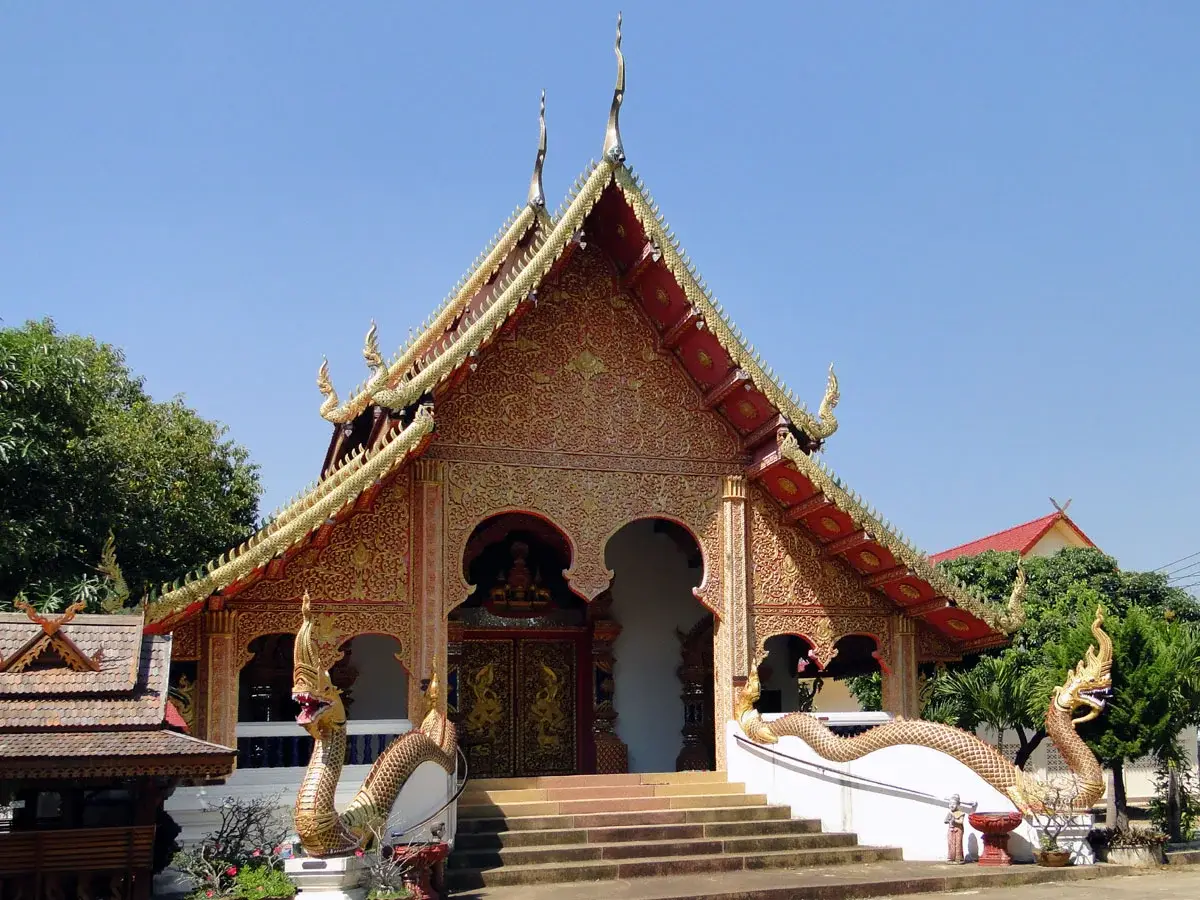
Wat On Luai is a historic community temple in Ban On Luai, On Nuea Subdistrict, Mae On District, Chiang Mai Province. It is a public Buddhist temple of the Maha Nikaya order and was formally established in 1807. By 2026, the temple has a documented history extending for more than 219 years. Its importance is closely connected with the Tai Lue community that settled in the Mae On River basin, while its most distinctive architectural feature is an old scripture library traditionally used to preserve Buddhist texts. The temple also includes a vihara, sermon and assembly hall, monks’ residences, a gilded masonry Buddha image in the Mara-Vijaya posture, and active religious spaces. Wat On Luai remains a functioning community monastery. In 2025 six monks spent the Buddhist rains retreat at the temple, with Phra Baidika Narin Sirikutto identified as abbot, while in 2026 the temple hosted a Buddhist Lent candle-offering and community robe-offering ceremony organized together with Chiang Mai University.
Wat On Luai differs from the large landmark temples of central Chiang Mai. Its appeal is not based on monumental scale or mass tourism but on the continuity of community history. The story of the temple encompasses Tai Lue migration from Mueang Luai in the border region of Shan State and Sipsongpanna, settlement along the Mae On River, the creation of a Buddhist center, relocation of the monastery as the village expanded, and the preservation of an old Buddhist scripture library that still represents the cultural heritage of the local Tai Lue community.
The history of Ban On Luai reaches back to the late eighteenth century, during the reconstruction of Chiang Mai and the wider Lanna region. Local historical accounts connect the community with the period of King Kawila and the population-restoration policies remembered in northern Thai history as the era of bringing people back to rebuild towns and settlements. Around 1782, Tai Lue families associated with Mueang Luai in the border areas of Shan State and Sipsongpanna migrated into the Mae On River basin and established homes in this fertile valley.
The name On Luai preserves both geography and memory. “On” derives from the Mae On River, an important watercourse of the area, while “Luai” reflects the name Mueang Luai, associated with the ancestral homeland of the Tai Lue settlers. As the community grew and became established along the river, the combined name On Luai gradually became the identity of the village.
The Tai Lue settlers practiced Buddhism, and a temple was therefore central to the formation of the new community. Early residents established a monastery south of the village known as Wat Ming Kaeo. It functioned not only as a religious center but also as a place for learning, reading, writing, cultural transmission, and traditional knowledge. As the population increased and the original monastery deteriorated, the community relocated the temple to the northern side of the settlement in 1852, close to the Mae On River. The monastery subsequently became known as Wat On Luai.
Temple registration records place the formal establishment of Wat On Luai in 1807. The temple’s history can therefore be understood in two connected phases. The first is the establishment of a Tai Lue Buddhist institution in the early nineteenth century. The second is the relocation of the monastery from the old Wat Ming Kaeo site to the riverbank in 1852, after which the name Wat On Luai became established.
Today Wat On Luai is located in On Nuea Subdistrict, Mae On District, Chiang Mai. The current Buddhist temple registry places Wat On Luai in Moo 6, while local administrative activities identify the temple as serving the communities of both Moo 6 and Moo 7. This reflects the temple’s broader social role as the religious center of Ban On Luai rather than a site whose importance is limited to a single administrative village number.
The temple stands at approximately 18.78879, 99.25777, at an elevation of around 389 meters above sea level. Its location in the Mae On River basin explains the relationship between the temple name and the river. Ban On Luai lies close to Ban Don Sai, Ban Hua Fai, Ban Mae Pa Khang, and Ban Sa Ha Khon, placing the temple within easy reach of Muang On Cave, San Kamphaeng Hot Springs, and other attractions in Mae On District.
The historic scripture library is one of the most important features of Wat On Luai. Traditionally, a Buddhist scripture library was used to preserve the Tripitaka and other religious manuscripts. Many northern Thai Buddhist texts were written on palm leaves, making protection from humidity, insects, and deterioration essential. Specialized scripture buildings therefore played an important role in maintaining Buddhist learning and manuscript culture.
Wat On Luai’s scripture library is described as a two-storey cruciform building. The lower level is constructed in masonry and is associated with Burmese craftsmanship, while the upper level is made of wood and is associated with Tai Lue artisans. The building is therefore significant not only as a storage place for sacred texts but also as architectural evidence of cultural exchange between different communities in northern mainland Southeast Asia.
On 15 July 2026, the Faculty of Science at Chiang Mai University organized a Buddhist Lent candle-offering and community robe-offering ceremony at Wat On Luai. Participants were taken to see the historic scripture library, which Chiang Mai University described as an old Tripitaka repository of historical value to the local Tai Lue community. This recent activity confirms that the structure remains an important element in the temple’s cultural interpretation and is still used to introduce visitors to the history of Ban On Luai.
The vihara is another important religious building. In a traditional Lanna temple, the vihara serves as the principal space where lay Buddhists worship Buddha images, listen to sermons, make merit, and participate in ceremonies. The coexistence of the vihara and scripture library illustrates the temple’s two major historical functions: religious practice and the preservation of Buddhist knowledge.
The sermon and assembly hall provides additional space for religious gatherings, merit-making ceremonies, meetings, and community events. In a village temple such as Wat On Luai, the hall strengthens direct connections between monks and residents. During major ceremonies it can support preparation, collective worship, community coordination, and other activities involving large numbers of participants.
Monks’ residences are also part of the temple compound, confirming Wat On Luai’s continuing function as a living monastery rather than a historic architectural site alone. During the 2025 rains retreat, six monks were recorded as residing at the temple. The presence of a resident monastic community allows regular Buddhist practice, chanting, alms-related activities, merit-making, and annual ceremonies to continue throughout the year.
An important sacred object at the temple is a gilded masonry Buddha image in the Mara-Vijaya posture. The posture represents the Buddha’s victory over Mara immediately before enlightenment. The right hand reaches downward toward the earth while the left remains in meditation, symbolizing unwavering spiritual strength and the triumph of wisdom over obstacles. Paying respect to this Buddha image is an important part of a visit to Wat On Luai.
Wat On Luai also has a long educational history. A Buddhist doctrinal school was opened in 1940, while a Buddhist Sunday study center began operating in 1983. The temple has also maintained a library. These institutions reflect the monastery’s broader educational role and correspond with community history describing the temple as an early center for reading, writing, Buddhist instruction, culture, and local traditions before modern schooling became widespread.
Ban On Luai established a modern community school in 1930. The proximity of temple and school illustrates the gradual development of education in the village. As formal schooling expanded, the school assumed responsibility for general education, while the temple continued to serve religious, ethical, cultural, and ceremonial functions. This relationship remains an important part of the social structure of Ban On Luai.
Historical records mention several abbots associated with Wat On Luai, including Phra Athikan Ban, Phra Athikan Chan Chanto, Phra Athikan Bunpan Aphichoto, and Phra Khru Kasem Chinawiso. Later information also refers to Phra Khru Phiphat Chinawong and Phra Songkran Chantasilo. For the contemporary period, the 2025 Kathin program identifies Phra Baidika Narin Sirikutto as the abbot, and this is the current name used for the temple in this article.
Phra Baidika Narin Sirikutto also has a documented connection with the Wat On Luai community before the 2025 Kathin program. Chiang Mai cultural information previously identified the Wat On Luai community as a moral community in Mae On District and listed Phra Narin as an important local religious figure. The later Kathin record confirms his role as abbot.
Kathin is one of Wat On Luai’s documented annual Buddhist traditions. In 2025 the Kathin ceremony was scheduled for 26 October at 13:00, when six monks had completed the rains retreat at the temple. Kathin is held after the Buddhist Lent period and allows lay Buddhists to offer robes and other necessities to the monastic community, while also contributing to temple maintenance and religious activities.
The temple’s continuing cultural importance was especially visible on 15 July 2026, when Chiang Mai University organized a Buddhist Lent candle offering and community robe offering at Wat On Luai. The event began with a procession into the temple, where participants were welcomed by local residents performing traditional music and dance. The ceremony demonstrated that Buddhist observance at Wat On Luai remains closely connected with the cultural traditions of the Tai Lue and wider Lanna community.
The community robe offering also raised funds to restore a temple wall damaged by heavy rain and storms. The event therefore had a practical conservation role in addition to its religious meaning. Participation by university administrators, staff, retirees, students, monks, and villagers illustrates how Wat On Luai continues to connect the local community with outside institutions.
School supplies were also presented to local children during the 2026 event, reinforcing the temple’s long historical relationship with education. Although modern schools now provide formal instruction, the temple remains a place where religious life, cultural heritage, community service, and support for younger generations can be brought together.
Wat On Luai also participates in the wider Buddhist Lent activities of On Nuea Subdistrict. Local authorities have organized candle offerings at Wat On Luai together with Wat Nong Hoi, Wat Hua Fai, Wat Don Sai, and the monastic residence at Ban Mae Pa Khang. These activities demonstrate that the temples of On Nuea form an interconnected religious network serving different village communities.
For travelers interested in Tai Lue culture, Wat On Luai deserves particular attention. Community history includes language, migration, Buddhism, and local traditions. Tai Lue was historically widely spoken within the village, while younger generations increasingly use Northern Thai and standard Thai as education, employment, and marriage connect residents with wider society. Ban On Luai therefore represents an ethnic community that preserves historical roots while continuing to adapt.
The historic scripture library offers the most visible architectural expression of this heritage. Its upper wooden level is associated with Tai Lue craftsmanship, while the masonry lower level reflects Burmese influence. The structure demonstrates that Lanna religious architecture developed through exchanges among multiple peoples rather than within a single isolated tradition.
A visit to Wat On Luai is best approached slowly. Rather than entering only to pay respects before leaving immediately, visitors should observe the layout of the temple, including the vihara, assembly hall, monks’ residences, community spaces, and scripture library. The site becomes much more meaningful when viewed as part of the surrounding village rather than as a tourist attraction separated from everyday life.
The atmosphere is well suited to travelers interested in village temples, vernacular architecture, ethnic history, and slow cultural travel. Architecture enthusiasts should pay particular attention to the scripture library. History enthusiasts can explore the connection between the temple and Tai Lue migration from Mueang Luai, while travelers interested in living culture can look at Kathin, Buddhist Lent ceremonies, community robe offerings, music, and traditional dance as evidence of continuing cultural practice.
Visitors should dress modestly, covering shoulders and knees, remove footwear before entering designated religious buildings, speak quietly, and avoid touching Buddha images or historic objects. Access to the old scripture library should respect any restrictions established by the temple because the building is both historically significant and potentially vulnerable to damage.
When ceremonies are taking place, monks and local participants should be given priority. Visitors should avoid blocking processions or prayer areas and should ask permission before taking close photographs of individuals. Religious festivals at Wat On Luai are genuine community events rather than staged tourist performances.
Getting There is easiest by private car or rental vehicle. From central Chiang Mai, travel east through San Kamphaeng toward Mae On District, then continue to On Nuea Subdistrict and Ban On Luai. The temple is located at approximately 18.78879, 99.25777. Searching specifically for “Wat On Luai, On Nuea, Mae On” in a navigation app helps avoid confusion with other similarly named places.
Private transport is particularly convenient because attractions in Mae On are spread across villages, limestone hills, and rural roads. From Wat On Luai, travelers can continue to Wat Santisuk at Mae Pa Khang, Wat Tham Muang On, Muang On Cave, Wat Phrathat Doi Pha Tang, Wang Yen Waterfall, and San Kamphaeng Hot Springs without returning to central Chiang Mai.
Wat Santisuk at Mae Pa Khang lies roughly 1–2 kilometers from Wat On Luai and provides another example of a local Buddhist temple serving On Nuea communities. Visiting several nearby temples helps travelers understand the northern Thai settlement pattern in which individual villages maintain their own religious centers.
Wat Tham Muang On and Muang On Cave are approximately 2–3 kilometers away. The cave landscape offers a very different experience from Wat On Luai, combining limestone formations, stalactites, stalagmites, and Buddhist devotional spaces. Visiting both places on the same route combines Tai Lue cultural history with Mae On’s natural landscape.
Wat Phrathat Doi Pha Tang in nearby On Klang offers another type of Buddhist setting, while Wang Yen Waterfall, around 4 kilometers from Wat On Luai, can add a natural stop to the itinerary. These attractions make it easy to create a varied half-day or full-day trip through Mae On.
San Kamphaeng Hot Springs, around 4 kilometers away, is one of Mae On District’s best-known attractions. It offers natural hot springs, foot-soaking areas, mineral bathing, gardens, and relaxation spaces. A practical itinerary is to visit Wat On Luai in the morning, continue to Muang On Cave, and finish at the hot springs.
Dining options are spread along the roads linking On Nuea, Ban Sa Ha Khon, Muang On Cave, and the hot springs. Nearby choices include Krua Jira, OonBox, e'Laa, Muang On Cave Coffee, and Krua Patnaree. It is usually more efficient to plan meals along the onward route rather than expecting a dense group of restaurants immediately outside the temple.
Accommodation in the Mae On area ranges from small homestays to resorts. Nearby options include Swiss Valley Mae On Homestay, Monraumsuk Home Stay Chiang Mai, Monmailua, OnSen Health Spa & Hot Spring Resort, and Sippa Hotspring Resort. Staying overnight in Mae On can reduce travel time from central Chiang Mai and is particularly useful for travelers planning to continue toward Mae Kampong.
A half-day itinerary can begin at Wat On Luai with time to study the historic scripture library and Tai Lue history, continue to Muang On Cave, and end at San Kamphaeng Hot Springs. A full-day itinerary can add Wat Phrathat Doi Pha Tang, Wang Yen Waterfall, additional village temples, and a local meal in Ban Sa Ha Khon.
Wat On Luai has significance on several levels. Religiously, it remains an active monastery. Architecturally, its scripture library preserves a distinctive combination of Burmese and Tai Lue craftsmanship. Historically, it is connected with Tai Lue migration from Mueang Luai. Educationally, it once supported Buddhist doctrinal study and Sunday religious education. Socially, it continues to host Kathin, Buddhist Lent, robe offerings, traditional music, dance, and community gatherings.
Viewed through the scripture library, Wat On Luai tells the history of manuscripts and craftsmanship. Viewed through its name, it tells the story of Tai Lue migration and the Mae On River. Viewed through the vihara and assembly hall, it reveals everyday Buddhist practice. Viewed through the ceremonies of 2025 and 2026, it shows that the monastery remains active rather than frozen in the past.
Travelers heading to Muang On Cave, San Kamphaeng Hot Springs, or Mae Kampong can therefore add Wat On Luai to their route for a stronger historical and cultural dimension. Allowing around 30–60 minutes makes it possible to pay respect to the Buddha image, observe the temple layout, and appreciate the old scripture library without rushing.
Wat On Luai is ultimately one of Mae On’s culturally valuable community temples because it connects Tai Lue settlement, the establishment of a Buddhist monastery in 1807, relocation and renaming in 1852, historic architecture, Buddhist education, local traditions, and living religious activity extending into 2026. For visitors who want to understand Chiang Mai beyond its famous urban temples, Wat On Luai provides a clear example of the traditional Lanna temple as the spiritual and cultural heart of a village.
| Name | Wat On Luai |
| Type | Public Buddhist Temple, Maha Nikaya Order |
| Location | Ban On Luai, On Nuea Subdistrict, Mae On District, Chiang Mai 50130. The current Buddhist registry lists Moo 6, while local community activities serve both Moo 6 and Moo 7. |
| Coordinates | 18.78879, 99.25777 |
| Temple Code | 350230104 |
| Established | 1807; approximately 219 years of history in 2026 |
| Former Temple And Development | The Tai Lue community originally maintained Wat Ming Kaeo south of the village. In 1852 the monastery was relocated north to the Mae On River bank and became known as Wat On Luai. |
| Highlights | Historic Tai Lue scripture library, Mueang Luai migration history, Buddhist architecture, and continuing community religious traditions |
| Historic Scripture Library | Two-storey cruciform building used for Buddhist scriptures; the masonry lower level is associated with Burmese craftsmanship and the wooden upper level with Tai Lue craftsmanship |
| Main Areas | Historic scripture library, vihara, sermon and assembly hall, monks’ residences, and active religious areas |
| Sacred Object | Gilded masonry Buddha image in the Mara-Vijaya posture |
| Buddhist Education | Buddhist doctrinal school opened in 1940; Buddhist Sunday study center opened in 1983; the temple also maintained a library |
| Abbot | Phra Baidika Narin Sirikutto |
| Resident Monks | 6 monks during the 2025 rains retreat |
| Important Traditions | Kathin, Buddhist Lent candle offering, community robe offerings, local music and dance, and community religious activities |
| Current Status | Active community monastery; a Buddhist Lent candle-offering and community robe-offering ceremony was held on 15 July 2026 |
| Main Contact Number | 053-859-291 |
| Travel Information | Drive east from Chiang Mai through San Kamphaeng toward Mae On, then continue to On Nuea and Ban On Luai. Search for “Wat On Luai, On Nuea, Mae On” in navigation apps. |
| Nearby Tourist Attractions | 1. Wat Santisuk (Mae Pa Khang), about 1.3 km 2. Wat Tham Muang On, about 2.1 km 3. Muang On Cave, about 2.1 km 4. Wat Phrathat Doi Pha Tang, about 2.3 km 5. Wang Yen Waterfall, about 4 km 6. San Kamphaeng Hot Springs, about 4.1 km, Tel. 087-659-1791 |
| Nearby Restaurants | 1. Krua Jira, about 1.7 km, Tel. 087-193-9709 2. OonBox, about 2.1 km, Tel. 081-783-1742 3. e'Laa, about 4.2 km, Tel. 095-542-0750 4. Muang On Cave Coffee, about 2–3 km, Tel. 064-253-5551 5. Krua Patnaree on the Mae On–Hot Springs route, Tel. 096-696-3740 |
| Nearby Accommodations | 1. Swiss Valley Mae On Homestay, about 1–2 km 2. Monraumsuk Home Stay Chiang Mai, On Nuea, Tel. 084-074-5329 3. Monmailua, Ban Mae Ruam, Tel. 088-266-7952 4. OnSen Health Spa & Hot Spring Resort, about 3.2 km, Tel. 053-037-074 5. Sippa Hotspring Resort, Ban Sa Ha Khon, Tel. 094-925-4628 |
Frequently Asked Questions (FAQ)
Q: Where is Wat On Luai located?
A: Wat On Luai is located in Ban On Luai, On Nuea Subdistrict, Mae On District, Chiang Mai, at approximately 18.78879, 99.25777. The current temple registry lists Moo 6, while the temple serves the wider On Luai community including Moo 6 and Moo 7.
Q: When was Wat On Luai established?
A: Wat On Luai was formally established in 1807. In 1852 the earlier monastery was relocated from the southern part of the village to the Mae On River bank and became known as Wat On Luai.
Q: Who founded Wat On Luai?
A: Community history connects the establishment of the temple with Tai Lue settlers who migrated from Mueang Luai in the border areas of Shan State and Sipsongpanna and settled in the Mae On River basin.
Q: What is the main highlight of Wat On Luai?
A: The most distinctive feature is the historic two-storey scripture library. Its masonry lower level is associated with Burmese craftsmanship, while the wooden upper level is associated with Tai Lue craftsmanship.
Q: Who is the current abbot of Wat On Luai?
A: The 2025 Kathin record identifies Phra Baidika Narin Sirikutto as abbot, with six monks residing at the temple during the rains retreat.
Q: Is Wat On Luai still an active temple?
A: Yes. Wat On Luai remains an active community monastery. A Buddhist Lent candle-offering and community robe-offering ceremony was held at the temple on 15 July 2026.
Q: What important traditions are associated with Wat On Luai?
A: Documented activities include Kathin, Buddhist Lent candle offerings, community robe offerings, traditional music and dance, and other religious and cultural activities of Ban On Luai.
Q: What attractions can be visited after Wat On Luai?
A: Nearby options include Wat Tham Muang On, Muang On Cave, Wat Phrathat Doi Pha Tang, Wang Yen Waterfall, and San Kamphaeng Hot Springs, making the temple suitable for a half-day or full-day Mae On itinerary.
 Category: ●Places of Worship
 Group: ●Temple
Last Update : 1 MonthAgo
 Last Update : 1 MonthAgo
 Click to Access the Navigation Map GPS

 Muang Chiang Mai(121)Chom Thong(47)Mae Chaem(25)Chiang Dao(33)Doi Saket(68)Mae Taeng(85)Mae Rim(69)Samoeng(29)Fang(71)Mae Ai(59)Phrao(70)San Pa Tong(103)San Kamphaeng(66)San Sai(73)Hang Dong(73)Hot(32)Doi Tao(22)Omkoi(11)Saraphi(74)Wiang Haeng(15)Chai Prakan(28)Mae Wang(32)Mae On(22)Doi Lo(33)Galyani Vadhana(1)


