
lovethailand home >North Travel Attractions >Chiang Mai Travel Attractions >Mae On >On Klang > Wat Phra That Doi Pha Tang
TL;DR: Wat Phra That Doi Pha Tang is located at 125, Moo 9, Ban On Klang, On Klang Subdistrict, Mae On District, Chiang Mai 50130, Thailand, open Daily, hours 08:00 - 17:00.

Wat Phra That Doi Pha Tang
Open Days: Daily
Opening Hours: 08:00 - 17:00
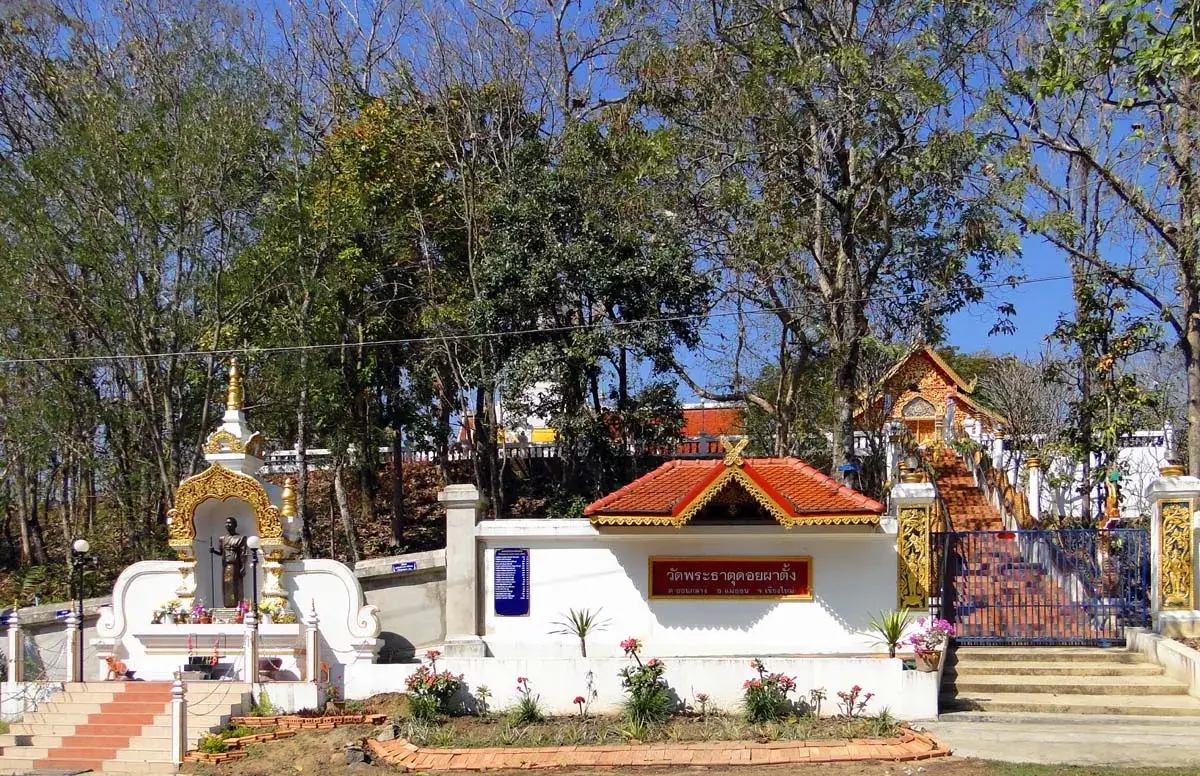
Wat Phra That Doi Pha Tang is located at 125, Moo 9, Ban On Klang, On Klang Subdistrict, Mae On District, Chiang Mai 50130. It is a community Buddhist temple of the Mahanikaya order and one of the most important religious sites in Mae On. The temple stands on a small hill within the rural landscape of On Klang and is centered on an ancient relic stupa traditionally believed to enshrine a hair relic of the Buddha. The sacred site existed before 1929 and was formerly known as Wat Mon That. In 1929, Kruba Srivichai, the celebrated Lanna monk and religious builder, became directly involved in restoring the old stupa and initiating the construction of a viharn. This period shaped much of the temple's present historical identity.
Wat Phra That Doi Pha Tang has long served as a spiritual focus for On Klang and the wider Mae On community. The relic stupa is regarded locally as a sacred landmark of the district, and its significance is reflected in the local expression describing Pha Tang as the relic shrine of the town. The monastery is therefore more than an architectural attraction. It remains an active place for worship, Buddhist ceremonies, meditation, Kathin, annual relic-bathing traditions and community gatherings.
The temple belongs to Ban On Klang, Moo 9, a rural community characterized by both agricultural lowland and nearby hills. The settlement slopes toward the Mae On watershed, where fertile soil supports rice and vegetable cultivation. Wat Phra That Doi Pha Tang developed within this agricultural Lanna environment, where a temple traditionally serves not only as a religious institution but also as a place for communal ceremonies, family merit-making, cultural transmission and village cooperation.
The earlier name Wat Mon That directly reflects the character of the site. In northern Thai usage, “mon” refers to a small hill or raised area, while “that” refers to a sacred Buddhist relic or stupa. The name therefore describes a temple centered on a relic shrine standing on a small hill and indicates that the stupa was already the defining feature of the site before the twentieth-century restoration.
The precise construction date of the earliest stupa is not known. Local history, however, places the relic shrine before 1929 and preserves the belief that it enshrines a hair relic of the Buddha. This tradition gave the stupa exceptional importance to Mae On residents and ultimately became the foundation of the annual Phra That Doi Pha Tang relic-bathing festival.
A major turning point came in 1929. Kruba Srivichai was spending time in the Muang On Cave area when local devotees learned of his presence. Residents invited him to Wat Mon That to lead restoration of the sacred site. Kruba Srivichai then mobilized local faith and labor to enlarge the relic monument by constructing a new stupa around the smaller original structure.
This method of construction preserved the older sacred core rather than replacing it. The stupa seen today therefore represents layers of religious history: an older relic monument remains enclosed within the structure associated with Kruba Srivichai's restoration. This gives Wat Phra That Doi Pha Tang particular value within the wider network of northern Thai sacred sites connected with the famous monk.
Kruba Srivichai also began construction of a viharn to the north of the stupa. Before the project was completed, he became ill and returned to Chiang Mai for treatment. Responsibility for the remaining work was passed to two disciples, Phra In Kaeo and Phra Nun, who continued the construction until the viharn was completed.
In 1945, another disciple in the Kruba tradition, Kruba Duang Ta, created three principal Buddha images for the viharn. All three are in the Maravijaya posture, depicting the Buddha overcoming Mara. These images remain an important focus of worship and mark another stage in the development of the temple after the period of Kruba Srivichai.
The temple later developed an ubosot for formal Sangha ceremonies. Wat Phra That Doi Pha Tang received its royal Wisungkhamasima boundary on 22 November 2005, followed by the formal boundary ceremony on 22 May 2006. This later development reflects the monastery's expansion from an old relic-centered sacred site into a more complete Buddhist institution supporting formal monastic functions.
Important areas within the temple complex include the relic stupa, ubosot, viharn, monks' residences, a Bodhi tree, office facilities, dining hall and lion statues. Together they show that Wat Phra That Doi Pha Tang functions not only as a pilgrimage destination but also as an active monastic compound supporting resident monks, Buddhist administration, communal ceremonies and daily religious life.
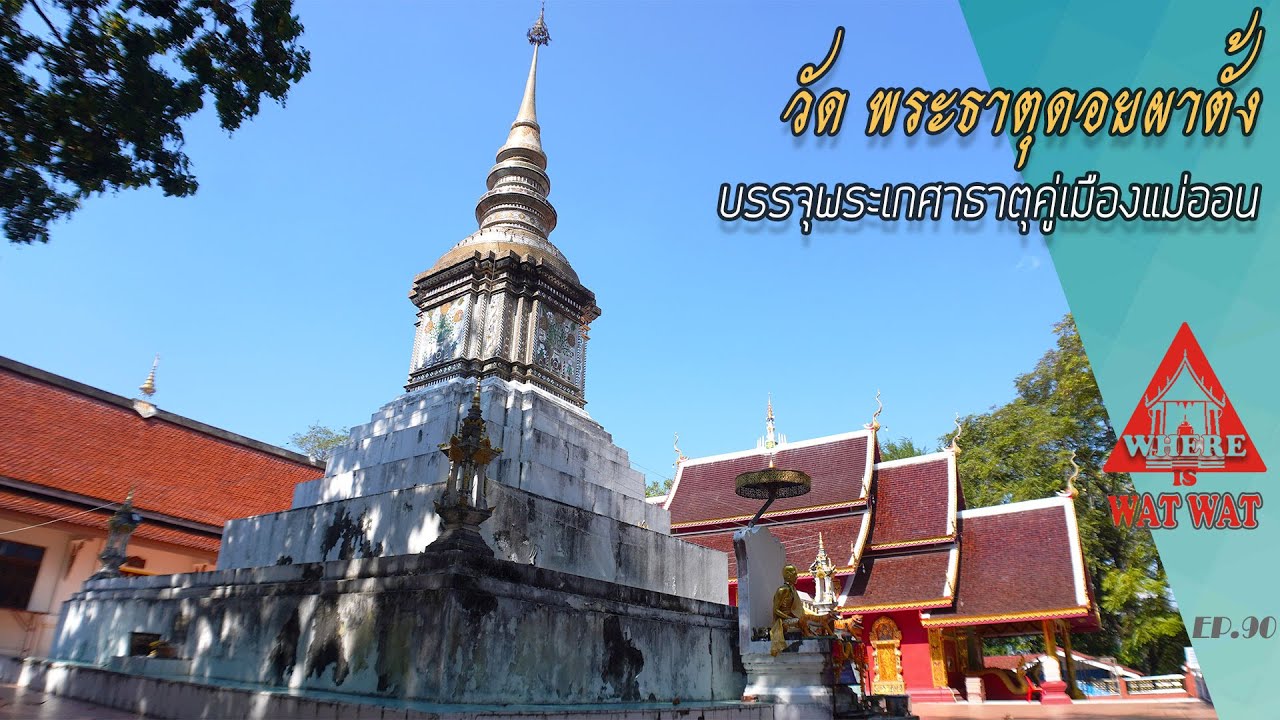
The Phra That Doi Pha Tang stupa should be the first focus of a visit. It is the spiritual heart of the monastery and the sacred feature most closely associated with Mae On's identity. Devotees come to worship, reflect on the Buddha's qualities and make merit around the stupa. The temple remains relatively quiet outside major festival periods, making it suitable for visitors seeking a reflective religious atmosphere.
The belief that the stupa contains a hair relic of the Buddha is directly connected with the temple's most important annual tradition, the Phra That Doi Pha Tang Relic-Bathing Festival. The festival is traditionally associated with the eighth waning day of the eighth northern lunar month. In 2026, the annual event was held on 6–7 June and attracted local residents, devotees and visitors to make merit and participate in the bathing ceremony.
The tradition historically involved more than pouring scented water at the stupa. Community accounts describe a ceremonial procession in which sacred relics were brought out for public veneration, accompanied by Lanna offerings and devotional activities. The relics would later return to the temple, allowing residents from across the subdistrict to participate in a shared expression of faith.
Older accounts also describe Buddhist chanting and northern Thai cultural performances during the annual festival. In some periods, local musical traditions and community activities were added to the religious ceremonies. The festival therefore served simultaneously as a Buddhist observance, community reunion and expression of Lanna cultural identity.
The annual bathing ceremony has particular social importance because Phra That Doi Pha Tang is regarded as a sacred site for more than one village. Communities throughout On Klang participate, creating a shared religious center at the subdistrict and district level rather than a temple used only by Moo 9 residents.
The monastery also holds an annual Kathin ceremony. Current 2026 information records five monks in residence and schedules the Kathin ceremony for 31 October 2026 at 09:00. The presence of resident monks and continuing Kathin observances confirms that the site remains an active monastery rather than a historical monument alone.
Phra Khru Sirisut Anusit, Abhipunno is the current abbot. Contemporary 2026 information continues to identify him as the head of Wat Phra That Doi Pha Tang. His association with the temple extends back to 1992, when the monastic community invited Phra Maha Amnat Abhipunno from Wat On Klang to reside at the monastery and take responsibility for its religious development.
The abbot's role has included more than maintaining buildings. Community records describe participation in Sangha administration, Buddhist teaching, support for senior citizens, scholarships and public-benefit activities. This illustrates the continuing northern Thai model of a village monastery serving both religious and social functions.
Wat Phra That Doi Pha Tang also serves as a meditation and Buddhist practice site. Visitors seeking a quiet religious experience can worship, chant, sit in meditation or spend time in reflection when this does not conflict with monastic activities. The environment is significantly calmer than a commercial sightseeing attraction.
The temple has also been used for district-level Sangha activities and Buddhist administration. Meetings, ceremonies and monastic programs can therefore take place at the monastery, particularly on important religious dates. Visitors should always give priority to monks, local worshippers and official religious activities.
Wat Phra That Doi Pha Tang exists within a wider On Klang cultural landscape that preserves Lanna traditions such as elder-honoring ceremonies during the northern Thai New Year, Suep Chata blessing rites and Tan Kuai Salak merit-making. These customs show that Buddhism in Mae On remains closely connected with family relationships, agriculture, village memory and local identity.
Suep Chata is a traditional Lanna ceremony associated with blessing, longevity and spiritual encouragement, while Tan Kuai Salak connects merit-making with remembrance of deceased relatives and support for those in need. Together with the relic-bathing ceremony, these traditions demonstrate the continuing relationship between seasonal life and Buddhist practice in On Klang.
The connection with Kruba Srivichai gives the monastery special significance for visitors interested in Lanna religious history. Kruba Srivichai was responsible for the restoration or construction of many temples, stupas and religious structures in northern Thailand. Wat Phra That Doi Pha Tang forms part of this wider legacy through the 1929 stupa restoration and viharn project.
Visitors should allow approximately forty-five minutes to one hour to experience the temple properly. Begin with the principal Buddha images in the viharn, continue to the relic stupa, then explore the ubosot and surrounding monastic spaces. The historical relationship among the stupa, viharn and local community becomes much clearer when the site is explored slowly rather than treated as a brief photo stop.
The monastery is suitable for older travelers and families because it can be reached by road without a long mountain trek. Current place information also indicates restroom facilities. The main religious compound can be explored without the extended hiking required at many high-elevation northern Thai temples.
Visitors should dress modestly, covering shoulders and knees, remove shoes before entering buildings where required and speak quietly. Buddha images and the relic stupa should be treated with respect, and visitors should avoid entering monastic residential or administrative areas without permission.
Photography is generally appropriate in public exterior areas when it does not interfere with worship. Visitors should ask before photographing monks or participants at close range. During chanting, meditation sessions, Kathin or the relic-bathing festival, religious activity should take precedence over photography.
Getting There from Chiang Mai city is straightforward. Travel east through San Kamphaeng toward Mae On District and continue into On Klang Subdistrict. The temple is in Ban On Klang Tai, Moo 9, near the On Klang local administrative area and roughly three kilometres from Mae On District Office. Private car, rental car or hired driver are the most convenient options.
The temple can be located at approximately 18.7687, 99.2513. When using navigation, search specifically for “Wat Phra That Doi Pha Tang Mae On Chiang Mai” because other places in northern Thailand use similar names. Confirm that the pin is in Moo 9, On Klang Subdistrict, Mae On District.
Wat Phra That Doi Pha Tang is open daily from 08:00 to 17:00. There is no general admission fee, although voluntary donations are welcome. Access to individual buildings may depend on monastic activities and ceremonies on the day of the visit.
The published temple telephone number is 053-859-257. Calling in advance is useful for visitors planning to attend meditation programs, the annual relic-bathing festival or group religious activities.
The temple is easy to combine with other cultural sites in On Klang. Wat Pao Sam Kha, another historic community temple in the same subdistrict, is known for Buddhist education and Dhamma studies. Wat Ban Wak preserves a different village history and a rich cycle of Lanna traditions. Visiting all three provides a broader understanding of Buddhist community life in Mae On.
Muang On Cave lies approximately four to five kilometres from the temple. The limestone cave contains stalactites, stalagmites, walkways and Buddhist shrines and is open daily from 08:00 to 17:00. It is a convenient nature and spiritual stop after visiting the monastery.
San Kamphaeng Hot Springs is another popular destination in the Mae On area, offering geothermal pools, landscaped grounds and bathing facilities. A practical full-day route can begin at Wat Phra That Doi Pha Tang, continue to Muang On Cave, stop for lunch and finish at the hot springs.
Villa At On Organic Farm combines a farm, café and restaurant setting within the wider On Klang area, making it suitable for families after a temple visit. Skugga Vineyard offers another rural stop combining dining and vineyard surroundings.
Travelers focusing on Buddhist heritage can follow a route linking Wat Phra That Doi Pha Tang, Wat Pao Sam Kha, Wat Ban Wak and Muang On Cave. Each site contributes a different layer: the sacred relic and Kruba Srivichai history at Doi Pha Tang, Buddhist education at Pao Sam Kha and community tradition at Ban Wak.
Nearby dining options include Villa At On Organic Farm Cafe & Farmstay, telephone 083-046-6494, and Krua Jira, telephone 087-193-9709. Both are practical stops for travelers exploring the lower Mae On area.
Lap Khom Mae On, telephone 085-525-2692, is a northern Thai restaurant suitable for visitors looking for local flavors. Mae On Phochana, telephone 095-720-2176 or 090-130-0210, provides another Thai and northern Thai dining option, while Skugga Vineyard, telephone 081-146-2652, combines dining with a vineyard setting.
Restaurant options in Mae On are dispersed across several communities rather than concentrated in a single tourism street. Visitors heading toward Muang On Cave or the hot springs may prefer restaurants in the Ban Sahakon direction, while those returning toward On Klang and San Kamphaeng can choose places closer to the lower district route.
Several accommodations are located within a short distance of the temple. The Oriental Village Resort is approximately 2.0 kilometres away and can be contacted at 095-532-6174.
Blessing Homestay Mae-On Chiang Mai is approximately 2.0 kilometres from the temple, telephone 089-011-4668, while Mae On Miggi's Home is approximately 2.4 kilometres away, telephone 097-251-7691.
lala's house@Mae On is approximately 3.6 kilometres away, telephone 093-296-4616, and Camp Ta Torn Yorn is approximately 3.8 kilometres from Wat Phra That Doi Pha Tang, telephone 093-137-5969. These properties provide additional options for travelers wishing to remain in Mae On rather than return to Chiang Mai city on the same day.
An overnight stay allows a slower itinerary. The first day can focus on Wat Phra That Doi Pha Tang, Wat Pao Sam Kha, Wat Ban Wak and Muang On Cave. The second day can continue to San Kamphaeng Hot Springs or farther into Huai Kaeo, Mae Lai and Mae Kampong.
The cool season offers comfortable conditions for exploring Mae On, while the rainy season brings a greener landscape but wetter surfaces. Early June has particular significance because the annual relic-bathing festival falls within this period according to the northern Thai lunar calendar.
The 2026 relic-bathing festival, held on 6–7 June, demonstrates that the temple's traditional ceremony remains a living practice rather than simply a historical reference. Residents, devotees and visitors can still participate in merit-making and experience the community's Lanna Buddhist identity directly.
The 2026 Kathin ceremony, scheduled for 31 October at 09:00, provides another opportunity to experience an active Buddhist community. Visitors should remember that Kathin is first and foremost a religious ceremony and should avoid interfering with the monks and devotees participating in the event.
For those studying Kruba Srivichai, Wat Phra That Doi Pha Tang holds particular historical value. The 1929 restoration of the stupa around the older relic monument and the initiation of the viharn project are tangible elements of his religious legacy in Mae On.
The historical sequence is especially clear at this temple. An older relic stupa existed before 1929; Kruba Srivichai restored and enlarged it while beginning the viharn; Phra In Kaeo and Phra Nun completed the work; Kruba Duang Ta installed three principal Buddha images in 1945; and Phra Maha Amnat Abhipunno arrived in 1992 before later becoming Phra Khru Sirisut Anusit and continuing as abbot.
This layered development explains the temple's character. New structures and functions were added without erasing the earlier sacred core. The old relic shrine remains within the restored stupa, the viharn continues the Kruba Srivichai period, the principal Buddha images represent the next generation and the modern ubosot reflects the monastery's later institutional development.
The role of Wat Phra That Doi Pha Tang has similarly expanded. It began as a local sacred relic site, became a major community monastery, developed as a meditation and Sangha activity center and continues to host one of Mae On's most important annual religious traditions.
For travelers, the strength of Wat Phra That Doi Pha Tang lies in this combination of faith, history and living community. Devotees can worship at the relic stupa, history enthusiasts can study the Kruba Srivichai connection, architecture enthusiasts can explore the viharn and ubosot, and cultural travelers can experience the annual relic-bathing festival.
The temple is also accessible enough to serve as the first stop of a Mae On itinerary. Families and older visitors can experience an important northern Thai sacred site without undertaking a long mountain trek, then continue to caves, hot springs, farms and nearby village temples.
Weekday visits offer a quieter atmosphere for worship and historical exploration, while the relic-bathing festival reveals the full strength of local participation. Both experiences are valuable but show different aspects of the monastery's identity.
Today, Wat Phra That Doi Pha Tang remains the sacred relic temple of Mae On, a monastery associated with Kruba Srivichai, an active home to resident monks and an important site for meditation and community ceremonies. The pre-1929 relic tradition, Kruba Srivichai restoration, three Maravijaya Buddha images, 2005 Wisungkhamasima, annual relic-bathing festival and continuing Kathin ceremonies together make the temple one of Mae On's most complete destinations for understanding northern Thai Buddhist history and living Lanna faith.
| Name | Wat Phra That Doi Pha Tang |
| Former Name | Wat Mon That |
| Type | Community Buddhist Temple, Mahanikaya Order, Region 7 |
| Address | 125, Moo 9, Ban On Klang, On Klang Subdistrict, Mae On District, Chiang Mai 50130, Thailand |
| Coordinates | Approximately 18.7687, 99.2513 |
| Open Days | Daily |
| Opening Hours | 08:00 - 17:00 |
| Admission | No general admission fee; voluntary donations are welcome |
| Telephone | 053-859-257 |
| Early History | The old relic stupa and Wat Mon That existed before 1929; the precise founding year is unknown |
| 1929 Restoration | Kruba Srivichai led the restoration of the relic stupa, constructed the present larger stupa around the older monument and initiated the viharn |
| Viharn | Initiated by Kruba Srivichai north of the stupa and later completed by Phra In Kaeo and Phra Nun |
| Principal Buddha Images | Three Maravijaya Buddha images created by Kruba Duang Ta in 1945 |
| Relic Stupa | Sacred Mae On stupa traditionally believed to contain a hair relic of the Buddha; the present monument encloses the older stupa |
| Wisungkhamasima | Granted on 22 November 2005; formal boundary ceremony held on 22 May 2006 |
| Main Temple Areas | Relic stupa, ubosot, viharn, monks' residences, Bodhi tree, office, dining hall and lion statues |
| Abbot | Phra Khru Sirisut Anusit, Abhipunno |
| Resident Monks | Five monks according to the 2026 Kathin record |
| Main Annual Tradition | Phra That relic-bathing festival on the eighth waning day of the eighth northern lunar month, plus annual Kathin |
| 2026 Relic-Bathing Festival | 6-7 June 2026 |
| 2026 Kathin | 31 October 2026 at 09:00 |
| Community Role | Sacred center, meditation site, venue for Sangha and community Buddhist activities and a major religious landmark of Mae On |
| Facilities | Parking and restrooms |
| Getting There | From Chiang Mai, travel through San Kamphaeng to Mae On and continue to On Klang. The temple is in Moo 9, Ban On Klang Tai, roughly 3 km from Mae On District Office. |
| Current Status | Active monastery with resident monks, a current abbot and continuing Buddhist ceremonies |
| Nearby Attractions | 1. Wat Pao Sam Kha - about 2 km 2. Wat Ban Wak - about 2-3 km 3. Muang On Cave - about 4-5 km 4. Villa At On Organic Farm - about 3 km, Tel. 083-046-6494 5. San Kamphaeng Hot Springs - about 7 km 6. Skugga Vineyard - about 5-6 km, Tel. 081-146-2652 |
| Nearby Restaurants And Cafés | 1. Villa At On Organic Farm Cafe & Farmstay - about 3 km, Tel. 083-046-6494 2. Krua Jira - about 3-4 km, Tel. 087-193-9709 3. Lap Khom Mae On - about 5 km, Tel. 085-525-2692 4. Skugga Vineyard - about 5-6 km, Tel. 081-146-2652 5. Mae On Phochana - about 6 km, Tel. 095-720-2176 / 090-130-0210 |
| Nearby Accommodations | 1. Blessing Homestay Mae-On Chiang Mai - about 2.0 km, Tel. 089-011-4668 2. The Oriental Village Resort - about 2.0 km, Tel. 095-532-6174 3. Mae On Miggi's Home - about 2.4 km, Tel. 097-251-7691 4. lala's house@Mae On - about 3.6 km, Tel. 093-296-4616 5. Camp Ta Torn Yorn - about 3.8 km, Tel. 093-137-5969 |
Frequently Asked Questions (FAQ)
Q: Where is Wat Phra That Doi Pha Tang?
A: Wat Phra That Doi Pha Tang is at 125, Moo 9, Ban On Klang, On Klang Subdistrict, Mae On District, Chiang Mai 50130. Its approximate coordinates are 18.7687, 99.2513.
Q: When was Wat Phra That Doi Pha Tang founded?
A: The exact founding year is unknown. The original relic stupa and Wat Mon That existed before 1929, when Kruba Srivichai led a major restoration and constructed the larger stupa around the older monument.
Q: How is Wat Phra That Doi Pha Tang connected with Kruba Srivichai?
A: In 1929 local residents invited Kruba Srivichai to restore Wat Mon That. He led the construction of the larger stupa around the original relic monument and began building the viharn before Phra In Kaeo and Phra Nun completed the project.
Q: What Buddha images are inside the viharn?
A: The viharn contains three principal Buddha images in the Maravijaya posture, created by Kruba Duang Ta in 1945.
Q: When is the annual relic-bathing festival?
A: The tradition is associated with the eighth waning day of the eighth northern lunar month. In 2026, the festival was held on 6-7 June.
Q: Who is the abbot of Wat Phra That Doi Pha Tang?
A: Phra Khru Sirisut Anusit, Abhipunno, is the current abbot. The 2026 Kathin information records five resident monks.
Q: Is there an admission fee?
A: There is no general admission fee. The temple is open daily from 08:00 to 17:00, and visitors may make voluntary donations.
Q: What can I visit after Wat Phra That Doi Pha Tang?
A: Nearby options include Wat Pao Sam Kha, Wat Ban Wak, Muang On Cave, Villa At On Organic Farm, San Kamphaeng Hot Springs and Skugga Vineyard, making the area suitable for a full-day cultural and nature itinerary.
 Category: ●Places of Worship
 Group: ●Temple
Last Update : 2 MonthAgo
 Last Update : 2 MonthAgo
 Click to Access the Navigation Map GPS
Wat Phra That Doi Pha Tang Map
Recommend

 Muang Chiang Mai(121)Chom Thong(47)Mae Chaem(25)Chiang Dao(33)Doi Saket(68)Mae Taeng(85)Mae Rim(69)Samoeng(29)Fang(71)Mae Ai(59)Phrao(70)San Pa Tong(103)San Kamphaeng(66)San Sai(73)Hang Dong(73)Hot(32)Doi Tao(22)Omkoi(11)Saraphi(74)Wiang Haeng(15)Chai Prakan(28)Mae Wang(32)Mae On(22)Doi Lo(33)Galyani Vadhana(1)


