
lovethailand home >North Travel Attractions >Chiang Mai Travel Attractions >Mae On >Huai Kaeo > Wat Khantha Phueksa
TL;DR: Wat Khantha Phueksa is located at Moo 3, Mae Kampong Village, Huai Kaeo, Mae On District, Chiang Mai 50130, Thailand., widely known locally as Wat Mae Kampong, is the community Buddhist temple of Mae Kampong Village in Moo 3, Huai Kaeo Subdistrict, Mae On.

Wat Khantha Phueksa
Operating day: Daily
Operating time: 08.00 - 17.00
Wat Khantha Phueksa, widely known locally as Wat Mae Kampong, is the community Buddhist temple of Mae Kampong Village in Moo 3, Huai Kaeo Subdistrict, Mae On District, Chiang Mai Province. The temple belongs to the Mahanikaya monastic order and carries temple registration code 350230401. Established in 1930, Wat Khantha Phueksa has served as Mae Kampong's principal spiritual center for nearly a century. Phra Khru Sukhon Kittisan Kittisaro is identified as the current abbot. The temple is particularly known for its carved teak viharn, the remarkable stream-surrounded ubosot or water-boundary ordination hall, and a white relic stupa completed in 2013. Surrounded by mountain forest and the natural Mae Kampong stream, Wat Khantha Phueksa is one of the places that best explains the relationship between Buddhism, Lanna culture, nature and everyday community life in Mae Kampong.
The temple stands within the landscape that gives Mae Kampong its distinctive character. Traditional houses line a narrow mountain road while streams run through the settlement and dense forest surrounds the valley. The climate is cooler and more humid than the Chiang Mai lowlands. Mosses, ferns and other moisture-loving plants grow easily on shaded roofs, stones and old surfaces. This climate is essential to the visual identity of Wat Khantha Phueksa because the wooden buildings, green vegetation and sound of running water form a single landscape rather than separate attractions.
Wat Khantha Phueksa is located in Moo 3, Huai Kaeo Subdistrict, at approximately 18.866009, 99.351945. The temple stands beside the main road through Mae Kampong and can be reached on foot from the central village area. Once travelers arrive in the village, walking is often more practical than driving between every stop. Roads are narrow and include gradients, and traffic can become heavy on weekends and during the cool-season peak. Walking also allows visitors to notice the wooden houses, streams, small food stalls and everyday details that define Mae Kampong.
Long before Mae Kampong became one of Chiang Mai's best-known community-tourism destinations, the village economy depended heavily on miang, the fermented tea leaves traditionally consumed across northern Thailand. Miang was both a local food tradition and an important cash crop. Coffee cultivation later became another source of income. As settlement expanded, villagers needed a Buddhist center for merit-making, ceremonies, teaching and community gatherings. Wat Khantha Phueksa therefore developed as part of the growth of Mae Kampong itself rather than as an attraction constructed for tourism.
Local history describes an earlier hermitage located at the foot of the mountain about 300 metres from the settlement. The religious center was later moved closer to the village so residents could reach it more easily. Kruba Insom Khantharaso played a major role in initiating the hermitage and temple, using land belonging to his elder sister in an area then surrounded by forest. This origin explains why the monastery has always been closely associated with both the local community and the natural environment.
The name “Khantha Phueksa” is connected with the monastic name of Kruba Insom Khantharaso and the forested surroundings in which the religious site was established. Local residents have nevertheless continued to call the temple Wat Mae Kampong after the village. Both names are now widely used. Wat Khantha Phueksa is the formal registered name, while Wat Mae Kampong is the name most travelers are likely to hear within the community.
The temple was established in 1930. By 2026, this gives Wat Khantha Phueksa a history of approximately ninety-six years. Older travel articles that described the temple as eighty-five years old were accurate only for the year in which they were written. The updated age is important because the temple has now witnessed almost a century of transformation, from a mountain community centered on miang and forest resources to a nationally known destination built around homestays, coffee, local food and community-based tourism.
Community documentation lists the core temple land at approximately 2 ngan and 55 square wah, although older temple records provide different land figures. These differences should not be combined without reference to the same land document. What is clear on the ground is that Wat Khantha Phueksa is not a large lowland temple compound. Its buildings are fitted into limited mountain terrain and follow natural levels beside the stream. Moving through the temple therefore involves short slopes, steps and changes in elevation.
The teak viharn is one of the temple's most recognizable structures. Built largely of wood and decorated with Lanna-style carving, the hall blends naturally into the surrounding forest. Mae Kampong's cool and humid climate encourages moss and small plants to develop on shaded roof surfaces and nearby stonework. During the rainy and early cool seasons, the contrast between weathered timber and vivid green vegetation becomes particularly striking.
The viharn is important for more than photography. It remains a Buddhist worship space used by the community for paying respect, merit-making and religious ceremonies. Its carved wooden details preserve the character of traditional northern craftsmanship. Visitors should look carefully at the exterior and interior without unnecessarily touching old wooden surfaces, which require sensitive care in such a humid environment.
Inside the viharn, golden Buddha images stand against dark wooden walls, creating a calm atmosphere very different from that of brightly lit modern buildings. Visitors should remove their shoes before entering, keep voices low and give priority to people who are praying. Sitting quietly for a few minutes is one of the best ways to understand why this relatively small temple served as the center of village spiritual life long before Mae Kampong became famous among tourists.
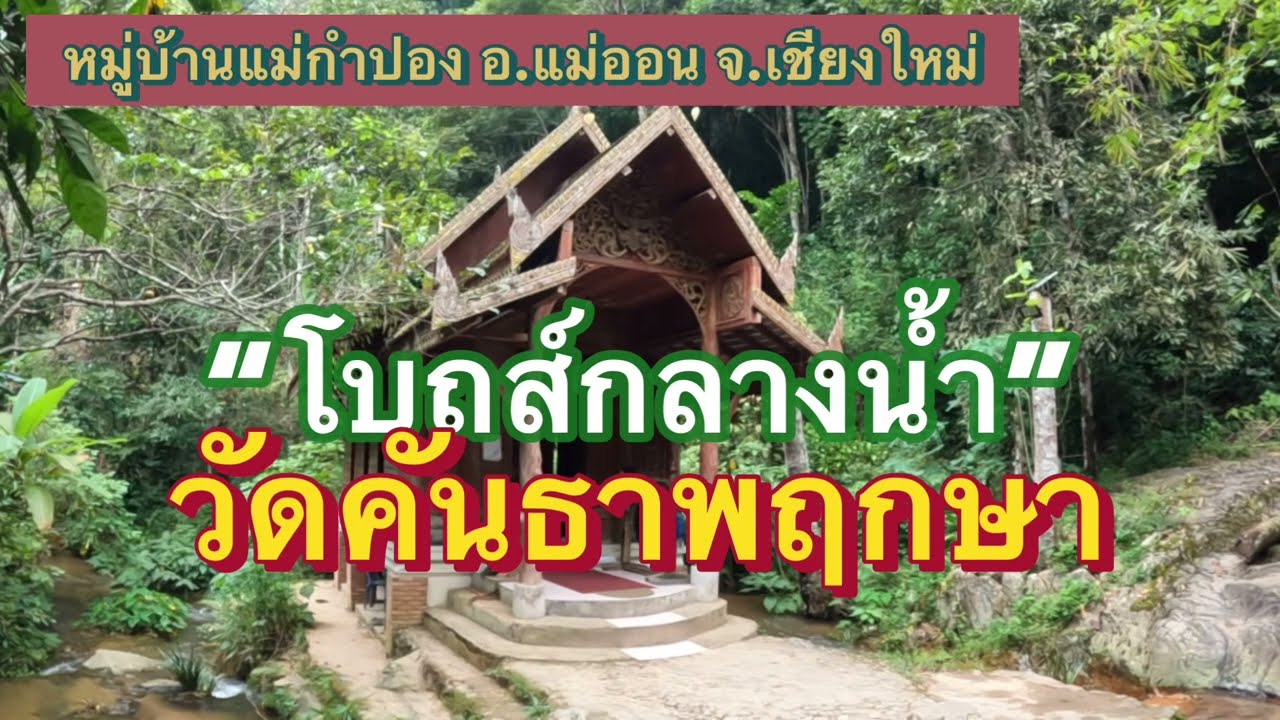
The temple's best-known feature is the water-surrounded ubosot, or udaka-sima ordination hall, located below the main temple level in the natural Mae Kampong stream. This is not an artificial decorative pond. The water forms part of the mountain stream system flowing from the surrounding watershed forest through the village. The building is therefore integrated directly into the natural hydrology of Mae Kampong.
The concept of an udaka-sima uses water as the natural boundary defining an area for Sangha acts rather than relying entirely on stone boundary markers positioned around an ordination hall. At Wat Khantha Phueksa, the stream is consequently part of the religious meaning of the structure, not merely a scenic backdrop. Understanding this transforms the famous “temple in the stream” from a photographic novelty into an architectural expression of Buddhist monastic practice.
The ordination hall is small and surrounded by flowing water, with a path descending from the upper temple area. Extra care is required during the rainy season because rocks, steps and paths may become slippery and the flow of the stream can increase. Visitors should use established access points and should not enter the water or climb onto wet rocks simply to obtain a photograph.
When the hall is open, visitors can enter to pay respect to the Buddha image inside. The sound of the stream remains clearly audible from within the building, giving the space a distinctive sense of seclusion despite its location within a busy tourism village. The building should always be treated first as an active Buddhist sacred space and only second as a sightseeing feature.
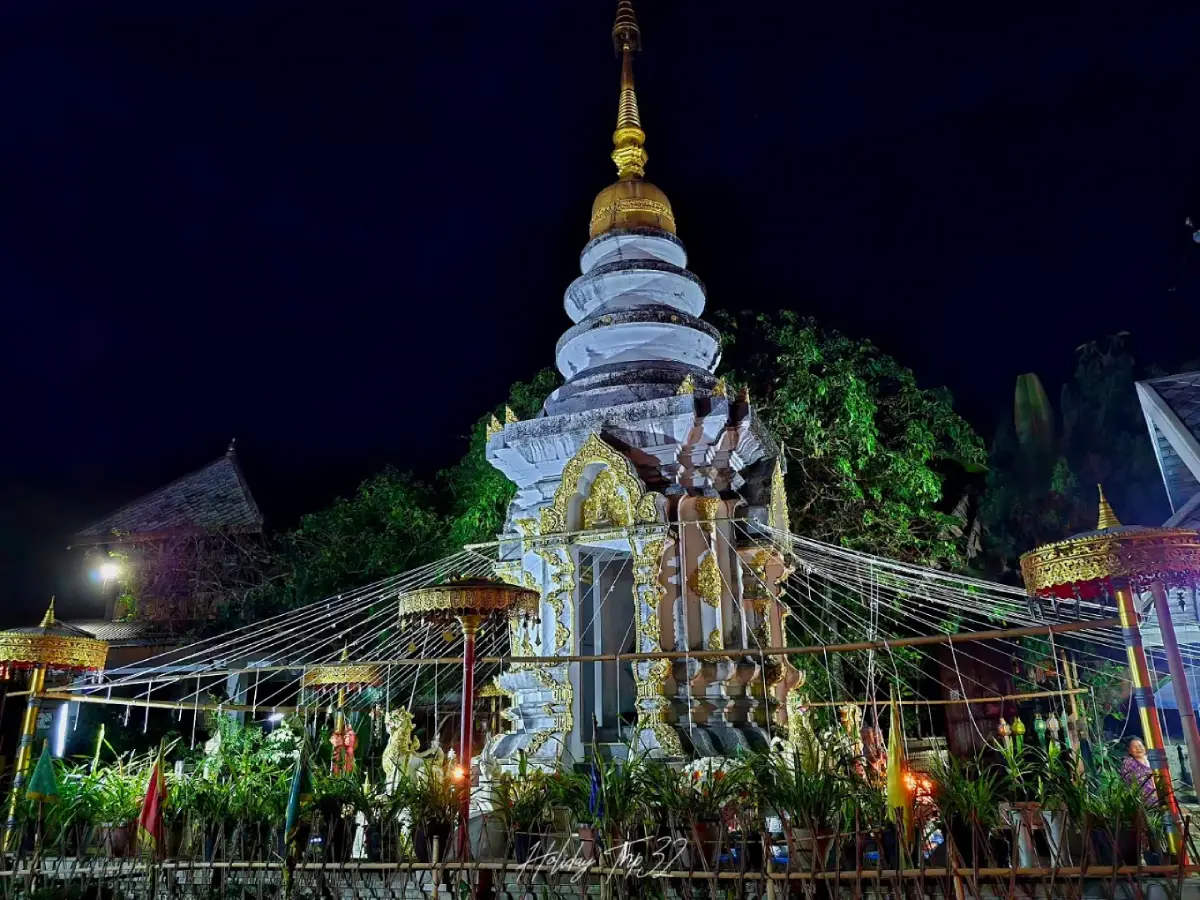
Behind the teak viharn stands the white relic stupa, another major landmark within the monastery. The stupa was constructed in April 2013 using funds generated through a traditional Poi Luang merit-making event. Its creation illustrates how religious architecture in a Lanna village continues to depend on community faith, donations and collective participation.
The white stupa stands out against the dark wood of the viharn and the green forest. Visitors can move from the viharn to the stupa within a short walk before descending to the stream-side ordination hall. Following this sequence reveals several layers of the temple's history: older wooden architecture, a modern community-funded stupa and the unusual water-boundary ordination hall.
Wat Khantha Phueksa holds an annual relic-bathing tradition during the Lanna eighth lunar month, known locally as Duean Paet Peng. The date changes each year according to the lunar calendar and generally falls around May or June. Residents and devotees gather to make merit and ceremonially bathe the stupa. Travelers specifically wishing to participate should check the community's announcement for the relevant year rather than relying on a fixed Gregorian date.
Poi Luang, the merit festival connected with the funding of the stupa, is an important Lanna religious tradition associated with the completion or major dedication of religious buildings. Such events involve donations, village cooperation, merit-making and social gatherings. The fact that the white stupa emerged from this process makes it as much a community monument as a religious structure.
The role of Wat Khantha Phueksa within Mae Kampong is unusually important because community research identifies the temple as the village's principal Buddhist spiritual center. Religious ceremonies, merit-making and community events have long depended on cooperation between monks and residents. Mae Kampong's relatively small population and strong kinship networks reinforce this role, allowing the temple to remain closely connected with local decision-making and communal activities.
Population records for late 2023 listed approximately 410 residents in Moo 3 Mae Kampong, including 202 men and 208 women across 264 households. This helps place tourism in perspective. Although the central street can appear extremely busy on weekends, the permanent village community remains relatively small. Visitors should therefore respect residential areas, avoid blocking household entrances, keep noise under control and remember that the village is a place where people live year-round.
Mae Kampong began developing community-based ecotourism and homestays more systematically around 2000 and became one of Thailand's best-known examples of village-managed tourism. Tourism was built on existing livelihoods rather than replacing them completely. Miang, Arabica coffee, watershed forest management, small-scale hydropower, local food and household hospitality all became part of the visitor experience. Wat Khantha Phueksa remains one of the central cultural elements within that model.
Travelers who visit Mae Kampong only for cafés and photographs miss an important part of the village's identity if they skip Wat Khantha Phueksa. The temple explains the religious and social dimension of Mae Kampong more clearly than almost any other location. Its buildings are products of several generations of village life rather than isolated tourism infrastructure.
The temple is also connected historically with Wat Mae Kampong School, established in 1947. Although modern school administration is independent from the monastery, the shared name preserves the historical relationship between Buddhism and village education. Temples traditionally played an important role in learning and social organization in rural Thailand before the modern public-school system expanded into remote mountain settlements.
Phra Khru Sukhon Kittisan Kittisaro is identified in current temple information as the abbot of Wat Khantha Phueksa. Managing a monastery in a popular tourism village requires balancing normal monastic practice with the needs of residents and large numbers of visitors. This is particularly important on weekends and during the cool season, when central Mae Kampong can become crowded. Visitors should therefore always approach the grounds as a functioning Buddhist monastery rather than simply another attraction.
Early morning offers a very different experience from late morning and afternoon. Temperatures are cooler, the village is quieter and the sound of the stream is more prominent. Travelers staying overnight in Mae Kampong have a particular advantage because they can visit before most day-trippers arrive from Chiang Mai.
The rainy season brings the most intense green scenery. Moss and ferns thrive, the stream carries more water and the wooden temple structures appear deeply integrated with the forest. The trade-off is increased slipperiness around stone paths and the stream. The cool season offers comfortable temperatures but is also the busiest period, especially on weekends.
Mae Kampong remains visitable in the warmer months because of its elevation and forest cover, although midday can still become warm. Morning and late afternoon are usually the most comfortable periods. Comfortable footwear with good grip is advisable throughout the year, and a light rain jacket is useful during the wet season.
Respectful temple clothing is expected. Shoulders and knees should be covered, shoes removed where required and voices kept low. Visitors should not climb religious structures, use sacred areas as staged photography sets or enter monks' private quarters without permission. Permission should also be requested before taking close photographs of monks or villagers participating in ceremonies.
Families with children should take particular care around the stream-side ordination hall because the area includes slopes, steps, rocks and flowing water. Older travelers or those with limited mobility should assess the descent before attempting it. The viharn and white stupa can still be visited from the upper temple area without descending all the way to the stream.
A typical visit takes around forty-five minutes to one hour, enough time to pay respect in the viharn, see the white stupa and visit the water-surrounded ubosot without rushing. Architecture enthusiasts, photographers and travelers interested in local culture may wish to stay longer.
Getting There from Chiang Mai city involves a journey of approximately 50 kilometres, usually via San Kamphaeng and Mae On before continuing into Huai Kaeo Subdistrict and the mountain road to Mae Kampong. Most of the route is paved, but the final mountain sections contain curves and gradients. Drivers should reduce speed in wet conditions.
Mae Kampong is approximately 20 kilometres from central Mae On. Roads become narrower once travelers enter the village, and pedestrian activity is heavy during peak periods. Small vehicles are easier to manage than large vehicles. On busy days, using designated parking and exploring the village on foot helps reduce congestion.
Motorcycles can reach Mae Kampong, but riders should be comfortable with mountain roads and should check brakes and tires before departure. Cycling is possible for experienced riders but is physically demanding because of sustained climbing.
A well-balanced day route can combine Teen Tok Royal Project Development Center, Mae Kampong Village, Wat Khantha Phueksa, Mae Kampong Waterfall and Kew Fin Viewpoint. The Teen Tok center lies about 5 kilometres by road from the temple and explains the agricultural development behind Arabica coffee, shiitake mushrooms and other highland crops promoted in the region.
Teen Tok Royal Project Development Center was established in 1981 to expand livelihood options for local communities. Its work helped diversify the area beyond traditional miang production. This history is directly relevant to the coffee culture travelers now encounter throughout Mae Kampong.
Mae Kampong Waterfall is approximately 0.9 kilometre by route from the temple. The waterfall has flowing water throughout the year and sits within the forest above the village. Walking from Wat Khantha Phueksa toward the waterfall allows visitors to experience the transition from the cultural center of the village into the watershed forest without repeatedly moving a car.
Kew Fin Viewpoint is around 3.2 kilometres by road from Wat Khantha Phueksa. It is a popular high-elevation viewpoint for mountain scenery and, under suitable conditions, morning mist. The road is steeper than the central village route, so travelers should check weather and road conditions before driving upward.
Pha Nam Lod lies approximately 4.6 kilometres by route from the temple and offers another nature-focused stop within the mountain landscape. Travelers continuing toward Ban Pok can also extend the itinerary to forest cafés and other attractions, although a slower route with fewer stops usually provides a better understanding of Mae Kampong than trying to visit every viewpoint in one day.
Several popular restaurants and cafés are within walking distance of the temple. Khao Soi Kloy Jai Mae Kampong, approximately 0.3 kilometre away, can be contacted at 086-198-1010. Lung Pud & Pa Peng Coffee, also about 0.3 kilometre away, can be reached at 082-889-8280 or 084-046-7753. Mae Nim Sai Ua, approximately 0.4 kilometre away, can be contacted at 089-263-5765.
Farther uphill, Chom Nok Chom Mai is approximately 0.6 kilometre from the temple and can be contacted at 081-847-8043. Teddu Coffee is around 0.8 kilometre away and can be reached at 095-893-5237. Together these businesses make it easy to combine a temple visit with local food, coffee and views without repeatedly driving through the village.
Accommodation is also concentrated close to the temple. Huean Ai Aood Homestay is approximately 0.2 kilometre away and can be contacted at 096-779-4642. Chaiyapol Homestay Mae Kampong is about 0.3 kilometre away, with contact numbers 082-556-2997 and 065-965-3893.
The Garret Mae Kampong Chiang Mai is approximately 0.8 kilometre from the temple and can be contacted at 088-209-2067. Him Doi Home Mae Kampong is about 1 kilometre away and can be reached at 095-448-3935. Portare.home Mae Kampong lies approximately 1.2 kilometres from the temple.
Staying overnight offers a substantially different experience from a day trip. Visitors can walk to the temple early in the morning, experience the village after most day visitors leave and spend more time understanding local food and community life. Guests should follow house rules, reduce noise at night and use water and other resources responsibly in a mountain village with limited space and infrastructure.
Environmental care is especially important around the temple because the stream is part of the village's watershed system. Visitors should never leave rubbish beside the water, remove moss or plants, or take stones as souvenirs. Food should not be eaten beside the water-surrounded ordination hall if doing so risks litter entering the stream.
Photographers will find several strong visual compositions. The teak viharn rewards close observation of carved details and moss-covered surfaces. The white stupa contrasts with the green forest, while the stream creates a natural foreground for the ordination hall. Safe established paths should always be used, and drones or disruptive equipment should not be operated without permission.
Online sources currently list different opening hours for Wat Khantha Phueksa, ranging from early morning openings around 06:00 or 06:30 to closing times between 17:00 and 18:00. Because these listings are inconsistent, travelers intending to visit very early or late in the day should confirm locally. Normal daytime visits remain the most practical option.
No ticketing system is used for general temple entry, and current visitor listings describe the temple as free to enter. Visitors may make donations according to their own faith and ability. Parking or other services within Mae Kampong Village may have separate charges and should not be confused with temple admission.
If visitors have time for only three features, the essential stops are the teak viharn, the water-surrounded ubosot and the white stupa. Together they represent three dimensions of Wat Khantha Phueksa: traditional Lanna craftsmanship, Buddhist monastic practice shaped by the natural stream and modern community faith expressed through the 2013 stupa.
Travelers interested in history should also pay attention to the earlier hermitage, Kruba Insom Khantharaso and the movement of the religious center closer to the village. Those interested in sustainable tourism should view the monastery within Mae Kampong's wider community-managed tourism system rather than as a stand-alone attraction.
Wat Khantha Phueksa appeals to Buddhist pilgrims, architecture enthusiasts, photographers, nature travelers, families and visitors who want to understand Mae Kampong beyond cafés and mountain scenery. The monastery links religion, forest, water, miang, coffee and village kinship into a single cultural landscape.
A complete Mae Kampong walking route can begin in the central village, continue to Wat Khantha Phueksa for worship and architectural exploration, and then climb toward Mae Kampong Waterfall and the cafés above the village. This sequence follows the geography naturally from community life to religion, forest and mountain scenery.
Today, Wat Khantha Phueksa is far more than an old temple approaching its centenary. It remains an active Buddhist institution, a repository of Mae Kampong's community memory, an important example of Lanna wooden architecture and one of the clearest demonstrations of how Buddhism can coexist with a living mountain stream and forest environment. In every season, the sound of water surrounding the ordination hall continues to express the relationship between the temple and the landscape that has shaped Mae Kampong for generations.
| Name | Wat Khantha Phueksa / Wat Mae Kampong |
| Type | Community Buddhist Temple, Mahanikaya Order |
| Temple Code | 350230401 |
| Location | Moo 3, Mae Kampong Village, Huai Kaeo, Mae On District, Chiang Mai 50130, Thailand |
| Coordinates | Approximately 18.866009, 99.351945 |
| Established | 1930 |
| Local Name | Wat Mae Kampong |
| Founding Figure | Kruba Insom Khantharaso together with Mae Kampong community devotees |
| Abbot | Phra Khru Sukhon Kittisan Kittisaro |
| Temple Land | Community records list approximately 2 ngan and 55 square wah for the core temple area |
| Main Highlights | Carved teak viharn, water-surrounded ubosot or udaka-sima, white relic stupa and natural mountain stream |
| Viharn | Traditional teak religious hall with Lanna-style carving in Mae Kampong's cool, humid forest environment |
| Ubosot | Water-surrounded ordination hall standing within the natural Mae Kampong stream |
| White Stupa | Built in April 2013 with funding associated with a Poi Luang merit-making festival |
| Important Tradition | Annual relic-bathing ceremony during the Lanna eighth lunar month |
| Community Role | Principal Buddhist spiritual center of Mae Kampong Village and venue for merit-making, traditions and community activities |
| Open Days | Daily |
| Admission | No general admission ticket; voluntary donations are welcome |
| Getting There | Approximately 50 km from Chiang Mai city via San Kamphaeng and Mae On to Huai Kaeo and Mae Kampong; private car, rental car, hired transport and village-bound public transport are possible |
| Recommended Visit Duration | Approximately 45 minutes–1 hour |
| Nearby Attractions | 1. Mae Kampong Village, about 0.4 km 2. Mae Kampong Waterfall, about 0.9 km 3. Kew Fin Viewpoint, about 3.2 km 4. Pha Nam Lod, about 4.6 km 5. Teen Tok Royal Project Development Center, about 5 km |
| Nearby Restaurants And Cafés | 1. Khao Soi Kloy Jai Mae Kampong, about 0.3 km, Tel. 086-198-1010 2. Lung Pud & Pa Peng Coffee, about 0.3 km, Tel. 082-889-8280 / 084-046-7753 3. Mae Nim Sai Ua, about 0.4 km, Tel. 089-263-5765 4. Chom Nok Chom Mai, about 0.6 km, Tel. 081-847-8043 5. Teddu Coffee, about 0.8 km, Tel. 095-893-5237 |
| Nearby Accommodations | 1. Huean Ai Aood Homestay, about 0.2 km, Tel. 096-779-4642 2. Chaiyapol Homestay Mae Kampong, about 0.3 km, Tel. 082-556-2997 / 065-965-3893 3. The Garret Mae Kampong Chiang Mai, about 0.8 km, Tel. 088-209-2067 4. Him Doi Home Mae Kampong, about 1 km, Tel. 095-448-3935 5. Portare.home Mae Kampong, about 1.2 km |
Frequently Asked Questions (FAQ)
Q: Where is Wat Khantha Phueksa?
A: Wat Khantha Phueksa is in Moo 3, Mae Kampong Village, Huai Kaeo Subdistrict, Mae On District, Chiang Mai. Its approximate coordinates are 18.866009, 99.351945.
Q: Are Wat Khantha Phueksa and Wat Mae Kampong the same temple?
A: Yes. Wat Khantha Phueksa is the official registered name, while Wat Mae Kampong is the name commonly used by residents and travelers.
Q: When was Wat Khantha Phueksa established?
A: The temple was established in 1930. Kruba Insom Khantharaso played an important role in the early religious community, which developed from an earlier hermitage into Mae Kampong's village temple.
Q: What is the main highlight of Wat Khantha Phueksa?
A: The most distinctive feature is the water-surrounded ubosot or udaka-sima in the natural stream. Other major features are the carved teak viharn and the white relic stupa behind it.
Q: When was the white stupa built?
A: The white relic stupa was completed in April 2013 using funds associated with a Poi Luang merit festival. The temple holds a relic-bathing tradition during the Lanna eighth lunar month.
Q: Is there an admission fee for Wat Khantha Phueksa?
A: There is no general ticketing system for temple entry. Visitors may make voluntary donations. Parking and other village services may have separate charges.
Q: How long should I spend at Wat Khantha Phueksa?
A: Around 45 minutes to one hour is suitable for visiting the viharn, white stupa and water-surrounded ubosot. Architecture and photography enthusiasts may wish to spend longer.
Q: What can I visit after Wat Khantha Phueksa?
A: Nearby options include Mae Kampong Village, Mae Kampong Waterfall, Kew Fin Viewpoint, Pha Nam Lod and Teen Tok Royal Project Development Center, all of which can be combined into a full-day Mae On itinerary.
 Category: ●Places of Worship
 Group: ●Temple
Last Update : 2 MonthAgo
 Last Update : 2 MonthAgo
 Click to Access the Navigation Map GPS
Wat Khantha Phueksa Map
Recommend

 Muang Chiang Mai(121)Chom Thong(47)Mae Chaem(25)Chiang Dao(33)Doi Saket(68)Mae Taeng(85)Mae Rim(69)Samoeng(29)Fang(71)Mae Ai(59)Phrao(70)San Pa Tong(103)San Kamphaeng(66)San Sai(73)Hang Dong(73)Hot(32)Doi Tao(22)Omkoi(11)Saraphi(74)Wiang Haeng(15)Chai Prakan(28)Mae Wang(32)Mae On(22)Doi Lo(33)Galyani Vadhana(1)


