
lovethailand home >North Travel Attractions >Chiang Mai Travel Attractions >Mae Rim >Rim Nuea > Wat Hua Dong
TL;DR: Wat Hua Dong is located at Moo 3, Rim Nuea Subdistrict, Mae Rim District, Chiang Mai Province, open Daily, hours 06.00 – 18.00.

Wat Hua Dong
Open Days: Daily
Opening Hours: 06.00 – 18.00
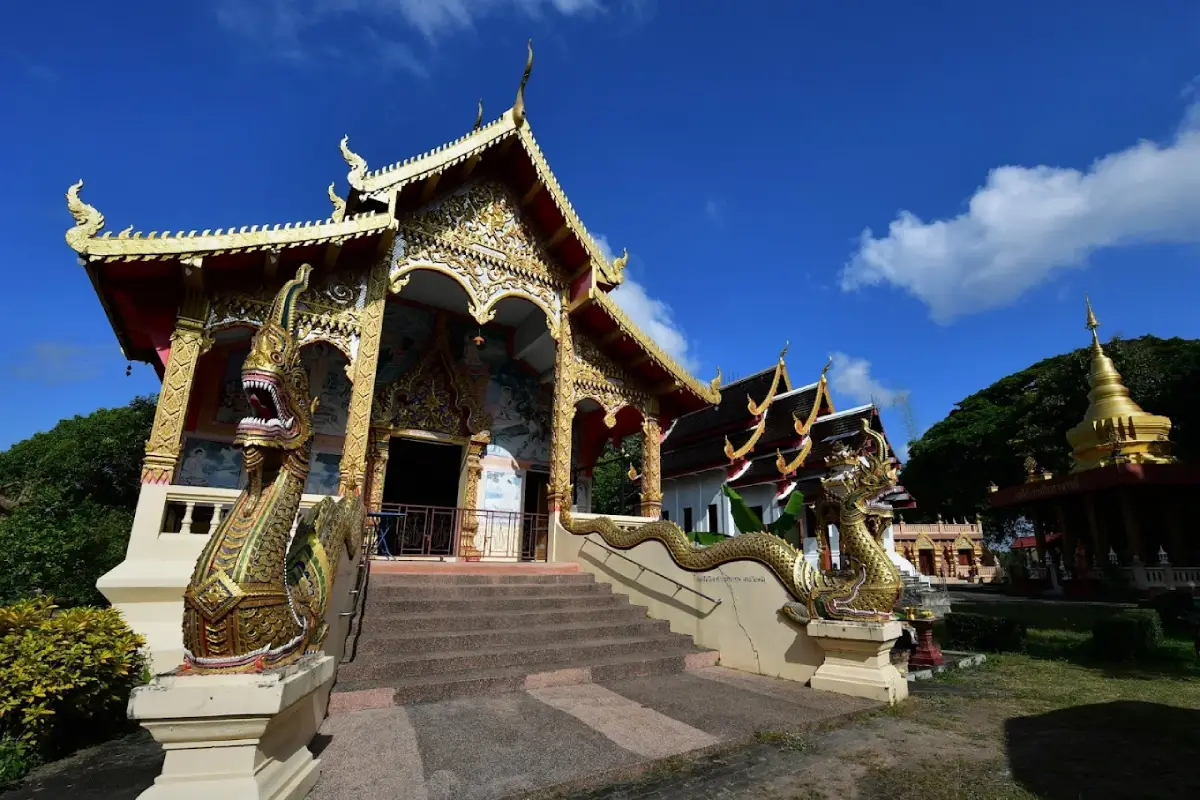
Wat Hua Dong, also found in external listings as Wat Hua Dong Samakkhi Tham, is a Maha Nikaya Buddhist temple in Moo 3, Rim Nuea Subdistrict, Mae Rim District, Chiang Mai Province 50180. It is an active community temple serving Ban Hua Dong and nearby neighborhoods in Rim Nuea. The temple is used for merit-making, worship, Buddhist ceremonies, and local religious activities, while also offering travelers a quiet cultural stop in Mae Rim.
Wat Hua Dong is not a large commercial attraction. Its value lies in its community role, calm atmosphere, and local Buddhist identity. The temple is especially interesting because it contains a Kyaiktiyo-style Golden Rock replica, locally described as a replica of Phra That In Khwaen, as well as an old chedi within the temple grounds. These features make the temple different from many small community temples and give visitors clear points of worship and observation.
Rim Nuea Subdistrict is an important part of Mae Rim District because it sits close to the district center, local government offices, traditional villages, temples, restaurants, accommodations, and routes leading toward Mae Raem, Mae Sa, Pong Yaeng, and Mon Jam. Wat Hua Dong therefore fits well into a Mae Rim cultural itinerary. It helps visitors see that Mae Rim is not only a destination for nature, cafés, resorts, and mountain viewpoints, but also a district with active village temples and local Buddhist life.
The recorded history of Wat Hua Dong begins with its official permission to be established as a temple in 1986. Although this makes the temple younger in official records than many ancient temples in Chiang Mai, its importance comes from its function as a community religious center. A village temple is created and sustained by local faith, local participation, and the need for a shared Buddhist space. Wat Hua Dong reflects this pattern clearly: it exists because the surrounding community needs a place for worship, merit-making, and religious continuity.
The period around 1986 was also a time when Mae Rim was developing from an agricultural and village-based district into a more connected area on the northern edge of Chiang Mai city. Roads, tourism, residences, and local services expanded steadily. In this changing context, Wat Hua Dong became a spiritual anchor for residents of Ban Hua Dong and Rim Nuea. It represents the continuing importance of the temple in a community that has grown alongside modern Mae Rim.
Phra Athikan Thitikon Thitavaṃso is the abbot of Wat Hua Dong. In a village temple, the abbot’s role is not limited to monastic duties. The abbot also helps maintain temple buildings, guide religious activities, coordinate merit-making events, support the lay community, and preserve the temple’s role as a living Buddhist space. For this reason, Wat Hua Dong should be understood as an active temple rather than only a place for sightseeing.
The name “Hua Dong” reflects a local place name. In northern Thai and Thai village naming traditions, names connected with landforms, wooded areas, irrigation routes, or old settlement patterns are common. The word “dong” often suggests a wooded or forested area, while the full name connects the temple to the identity of Ban Hua Dong. The alternative name “Wat Hua Dong Samakkhi Tham” adds another layer of meaning, as “Samakkhi Tham” expresses unity in supporting the Dhamma and maintaining the temple together.
The most distinctive feature of Wat Hua Dong is the Phra That In Khwaen replica, inspired by the Golden Rock tradition. This type of sacred replica gives the temple a recognizable identity and offers visitors a meaningful point of worship. For Buddhist devotees, a sacred stupa or relic-like structure is not simply an object to view; it is a focus for respect, reflection, and merit. The Golden Rock replica therefore strengthens the temple’s spiritual atmosphere and makes Wat Hua Dong notable among smaller temples in Mae Rim.
The old chedi in the temple is another important feature. In Buddhist architecture, a chedi symbolizes remembrance, merit, and devotion. In Lanna temples, a chedi often serves as a spiritual center within the compound, even when it is not monumental in scale. Visitors should take time to observe the chedi respectfully and understand it as part of the temple’s identity, rather than viewing it only as an architectural feature.
Wat Hua Dong is also connected with a merit-making project in 2019 to support the construction of an ordination hall and a 59-inch Lanna-style principal Buddha image. This kind of project reflects how community temples develop through collective faith. Building an ubosot and principal Buddha image requires donations, local support, and sustained commitment from devotees. The Lanna-style Buddha image also connects the temple visually and culturally with northern Thai Buddhist art.
Important areas within Wat Hua Dong include the Phra That In Khwaen replica, the old chedi, the ordination-hall area or ubosot project area, the principal Buddha image area, the temple courtyard, and spaces used for community Buddhist activities. Visitors should move through the temple respectfully because it remains a living religious site. Modest dress, quiet behavior, and awareness of monks and local worshippers are important when visiting.
The atmosphere of Wat Hua Dong is calm and local. It is suitable for travelers who want a quiet temple visit rather than a crowded tourist site. The temple is appropriate for morning worship, simple merit-making, respectful photography, and short cultural stops in Mae Rim. Travelers who enjoy small temples and local community spaces will find Wat Hua Dong more meaningful than those looking only for large-scale attractions.
Religious traditions associated with Wat Hua Dong follow the rhythm of a northern Thai community temple. These include Kathin, robe-offering events, Buddhist holy day merit-making, Buddhist Lent, the end of Lent, and other community merit-making occasions. Kathin is especially important because it takes place after the Buddhist Lent period and brings monks and lay supporters together through robe offerings and donations for temple maintenance.
Robe-offering and community merit-making events are not only religious ceremonies. They are also social occasions that bring villagers, families, and supporters together. For a temple like Wat Hua Dong, these events help maintain the relationship between the Sangha and the lay community. They also help younger generations learn Buddhist etiquette, temple culture, and the value of communal support.
The role of Wat Hua Dong in Ban Hua Dong and Rim Nuea is therefore both religious and social. The temple is a place for making merit, dedicating merit to ancestors, gathering on important days, and preserving local Buddhist practices. In Lanna community life, temples often connect home, family, ancestors, monks, and village identity. Wat Hua Dong continues this function in a Mae Rim setting that has become increasingly connected to tourism and urban growth.
For travelers who want to understand Chiang Mai beyond its most famous temples, Wat Hua Dong offers a more local perspective. Mae Rim is widely known for Mon Jam, Queen Sirikit Botanic Garden, elephant camps, cafés, and resorts, but temples like Wat Hua Dong reveal the everyday religious structure behind the district. They show that Mae Rim remains a lived-in community with local faith, Buddhist activities, and temple-centered social life.
Getting There is easiest by private car, rental car, or local transport. From Chiang Mai city, take the Chiang Mai–Fang Road or Highway 107 toward Mae Rim District, then continue into Rim Nuea Subdistrict and Moo 3, Ban Hua Dong. The temple is close to the Mae Rim district area and can be combined conveniently with Wat Pa Dara Phirom, Daraphirom Palace Museum, Tiger Kingdom Mae Rim, Queen Sirikit Botanic Garden, and Mon Jam.
Travelers using public transport can take a vehicle heading toward Mae Rim and then continue by local hired transport to Moo 3, Rim Nuea. This option requires more planning, especially for the return trip or for continuing toward Mae Raem, Pong Yaeng, and Mon Jam. A private car or rental car is the most practical option for a combined Mae Rim itinerary.
The best time to visit Wat Hua Dong is in the morning or late afternoon, when the weather is more comfortable and the atmosphere is quieter. Visitors should dress modestly, cover shoulders and knees, remove shoes where required, avoid loud behavior, and respect any ceremony taking place. When visiting a community temple, respect for local worshippers is as important as seeing the temple itself.
A practical Mae Rim route can begin from Chiang Mai city, stop at Wat Hua Dong for worship and a look at the Phra That In Khwaen replica, continue to Wat Pa Dara Phirom and Daraphirom Palace Museum for Lanna history, then head toward Queen Sirikit Botanic Garden, Mae Raem, Pong Yaeng, or Mon Jam for nature and mountain scenery. This route balances religious culture, local history, and Mae Rim’s well-known natural attractions.
Overall, Wat Hua Dong is a worthwhile local temple for travelers who want to see Mae Rim in more depth. It has an official temple history dating to 1986, an active abbot, a community role, a Golden Rock replica, an old chedi, and a location that connects easily with other Mae Rim attractions. It is a quiet but meaningful stop that helps visitors understand the religious and cultural life of Rim Nuea Subdistrict.
| Name | Wat Hua Dong, also known as Wat Hua Dong Samakkhi Tham |
| Location | Moo 3, Rim Nuea Subdistrict, Mae Rim District, Chiang Mai Province |
| Address | Moo 3, Rim Nuea, Mae Rim, Chiang Mai 50180, Thailand |
| Coordinates | 18.92097, 98.96143 |
| Highlights | Phra That In Khwaen replica, old chedi, quiet Lanna community-temple atmosphere, and local Buddhist life in Ban Hua Dong |
| History | Officially permitted as a Buddhist temple in 1986; a Maha Nikaya community temple |
| Name Origin | The name Hua Dong connects the temple with the local village identity, while Samakkhi Tham reflects unity in supporting the Dhamma |
| Distinctive Features | A local Mae Rim temple suitable for merit-making, worship, quiet cultural visits, and understanding community Buddhist life |
| Important Structures And Areas | Phra That In Khwaen replica, old chedi, ubosot or ordination-hall project area, principal Buddha image area, temple courtyard, and community activity spaces |
| Abbot / Caretaker | Phra Athikan Thitikon Thitavaṃso |
| Travel Information | From Chiang Mai city, take the Chiang Mai–Fang Road or Highway 107 toward Mae Rim, then continue to Rim Nuea Subdistrict and Moo 3, Ban Hua Dong. Private car, rental car, or local hired transport is recommended. |
| Current Status | Active community Buddhist temple for worship, merit-making, and Buddhist ceremonies |
| Open Days | Daily |
| Opening Hours | 06.00 – 18.00 |
| Fees | No admission fee |
| Main Contact Number | 053-298-595 |
| Related Traditions / Temple Events | Kathin, robe-offering events, Buddhist holy day merit-making, Buddhist Lent, the end of Lent, and community merit-making occasions |
| Nearby Tourist Attractions | 1. Wat Sai Mun, about 1 km 2. Wat Pa Dara Phirom, about 4 km, Tel. 053-862-890 3. Daraphirom Palace Museum, about 4 km, Tel. 053-299-175 4. Tiger Kingdom Mae Rim, about 5 km, Tel. 061-268-2669 5. Queen Sirikit Botanic Garden, about 15 km, Tel. 053-841-234 6. Mon Jam, about 24 km |
| Nearby Restaurants | 1. Baan Suan Mae Rim, about 5 km, Tel. 053-297-421, 088-266-5549 2. Baan Landai Mae Rim, about 6 km, Tel. 064-469-2929 3. Sala Cafe, about 9 km, Tel. 053-860-996, 086-914-0777 4. Zombie Cafe’ Maerim Chiangmai, about 11 km, Tel. 095-325-2153 5. The Ironwood, about 12 km, Tel. 085-111-7777, 081-858-3555 |
| Nearby Accommodations | 1. Rice Villa ChiangMai, about 2 km, Tel. 095-692-1112 2. Mae Rim Grace, about 5 km, Tel. 066-095-7267 3. Four Seasons Resort Chiang Mai, about 6 km, Tel. 053-298-181 4. Raya Heritage, about 11 km, Tel. 053-111-670 to 73 5. Proud Phu Fah Resort, about 19 km, Tel. 053-879-389, 053-879-286, 081-647-7437 |
Frequently Asked Questions (FAQ)
Q: Where is Wat Hua Dong located?
A: Wat Hua Dong is located in Moo 3, Rim Nuea Subdistrict, Mae Rim District, Chiang Mai Province 50180, Thailand.
Q: Is Wat Hua Dong the same as Wat Hua Dong Samakkhi Tham?
A: External listings use the name Wat Hua Dong Samakkhi Tham for the temple in Moo 3, Rim Nuea, Mae Rim, which corresponds to Wat Hua Dong in the same area.
Q: What is the history of Wat Hua Dong?
A: Wat Hua Dong was officially permitted as a Buddhist temple in 1986 and is a Maha Nikaya community temple in Rim Nuea Subdistrict.
Q: Who is the abbot of Wat Hua Dong?
A: The abbot is Phra Athikan Thitikon Thitavaṃso.
Q: What are the main highlights of Wat Hua Dong?
A: The main highlights are the Phra That In Khwaen replica, the old chedi, the quiet Lanna community-temple atmosphere, and the temple’s role in local Buddhist life.
Q: What are the opening hours of Wat Hua Dong?
A: Wat Hua Dong is open daily from 06.00 to 18.00, with no admission fee.
Q: What nearby places can be visited with Wat Hua Dong?
A: Nearby places include Wat Pa Dara Phirom, Daraphirom Palace Museum, Tiger Kingdom Mae Rim, Queen Sirikit Botanic Garden, and Mon Jam.
 Category: ●Places of Worship
 Group: ●Temple
Last Update : 1 MonthAgo
 Last Update : 1 MonthAgo
 Click to Access the Navigation Map GPS

 Muang Chiang Mai(121)Chom Thong(47)Mae Chaem(25)Chiang Dao(33)Doi Saket(68)Mae Taeng(85)Mae Rim(69)Samoeng(29)Fang(71)Mae Ai(59)Phrao(70)San Pa Tong(103)San Kamphaeng(66)San Sai(73)Hang Dong(73)Hot(32)Doi Tao(22)Omkoi(11)Saraphi(74)Wiang Haeng(15)Chai Prakan(28)Mae Wang(32)Mae On(22)Doi Lo(33)Galyani Vadhana(1)


