
lovethailand home >North Travel Attractions >Chiang Mai Travel Attractions >Mae Taeng >San Pa Yang > Wat Nong Bua Noi
TL;DR: Wat Nong Bua Noi is located at Moo 1, Ban Nong Bua Noi, San Pa Yang Subdistrict, Mae Taeng District, Chiang Mai Province, open Daily, hours 08.00 – 17.00.
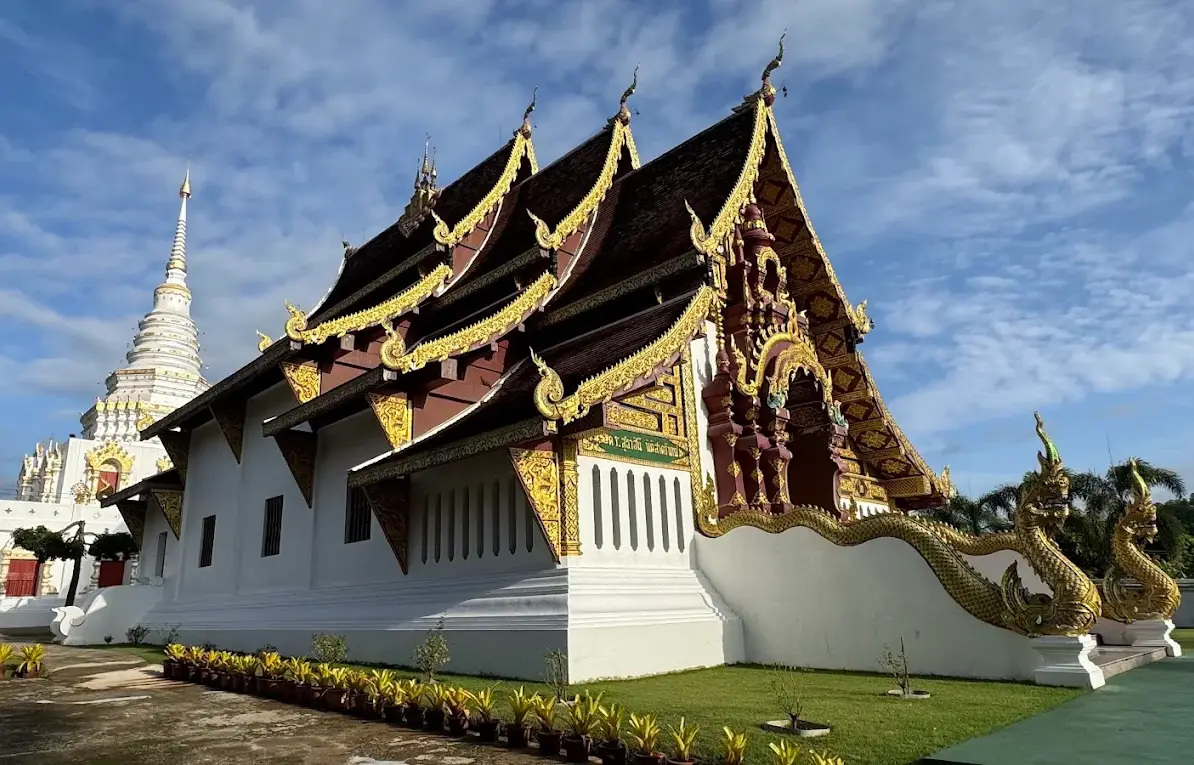
Wat Nong Bua Noi
Open Days: Daily
Opening Hours: 08.00 – 17.00
Wat Nong Bua Noi is an old community temple in Moo 1, Ban Nong Bua Noi, San Pa Yang Subdistrict, Mae Taeng District, Chiang Mai Province. The temple was officially permitted as a Buddhist temple in 1854 and received its royal boundary marker in 1997. Its most important highlight is the large principal Buddha image inside the viharn, which shows Burmese artistic influence. This makes the temple more than a quiet village monastery; it is a local heritage site where Buddhist faith, Lanna community life, and traces of cross-cultural craftsmanship meet in a calm rural setting.
Wat Nong Bua Noi stands within Ban Nong Bua Noi, a village in San Pa Yang Subdistrict of Mae Taeng District. The surrounding area still carries the rhythm of rural northern Thailand, with local homes, agricultural land, schools, village roads, and Buddhist temples connected to everyday life. Unlike major tourist temples in central Chiang Mai, Wat Nong Bua Noi is not defined by large crowds or commercial activity. Its value lies in its role as a living community temple that continues to support religious practice, local memory, and village identity.
The temple’s importance begins with its official religious status. Wat Nong Bua Noi is a royal-recognized community temple under the Mahanikaya order. Registry information places it in Moo 1, San Pa Yang Subdistrict, Mae Taeng District, Chiang Mai Province, and records its official establishment in 1854, with the granting of its royal boundary on 16 May 1997. This gives the temple a documented institutional history of more than 160 years as an officially recognized Buddhist temple.
The history of Wat Nong Bua Noi combines official records with oral memory preserved by local elders. According to local accounts, the temple existed for a long time before detailed written records became widely available. The founding figure remembered in village tradition is Khru Ba Som, who established the temple and originally named it “Wat Nong Bua Chai.” This story has been passed down through elders in the village and is closely associated with Pho Noi Un Sommana, a native of Ban Nong Bua Noi who once studied as a monk at the temple.
Pho Noi Un Sommana is significant because he represents a bridge between the temple’s past and the memory of the local community. He was born in Nong Bua Noi, lived with the temple as part of his own spiritual background, and heard the old stories directly from village elders. His account adds a human layer to the temple’s history, showing how a rural temple is remembered not only through government documents but also through the voices of those who lived around it.
The temple’s story is also connected with Khru Ba Luang Kantiya, also known as Fan Achato, a respected monk in local religious memory. Pho Noi Un Sommana was a disciple of Khru Ba Luang Kantiya. This connection places Wat Nong Bua Noi within a broader network of northern Thai Buddhist teachers, temple students, and villagers who helped preserve local temples through faith, learning, and community support.
The most important artistic evidence at Wat Nong Bua Noi is the large principal Buddha image inside the viharn. The image is described as having Burmese artistic characteristics, making it a key feature for understanding the temple’s past. Local tradition states that the temple was originally built by Burmese people. The style of the principal Buddha image supports this cultural reading and gives visitors a concrete point of focus when exploring the temple’s historical background.
The Burmese artistic influence at Wat Nong Bua Noi is important because northern Thailand has long been connected with Burma and many ethnic communities through politics, trade, migration, religion, and craftsmanship. Burmese-style Buddhist art in a Lanna temple is not simply decorative. It is a visible sign of cultural movement and shared religious devotion across the northern region. For travelers interested in history, this is one of the most meaningful reasons to visit the temple.
Within the wider context of San Pa Yang Subdistrict, Wat Nong Bua Noi is part of a local network of temples that serve the religious and social life of different villages. Other temples in the area include Wat San Pa Yang, Wat San Pa Tueng, Wat Doi Phra Chao Ton Luang, Wat Nong Kai, Wat Ban Iak, and Wat Pha Daen. These temples are not merely religious buildings. They are social anchors that connect each village to Buddhist practice, community ceremonies, and local identity.
Ban Nong Bua Noi, where the temple is located, is a real residential village rather than a tourist zone. Wat Nong Bua Noi therefore functions as a place for merit-making, Buddhist holy days, funerals, seasonal ceremonies, and other village activities. This gives the temple a living character. Visitors should understand it as a community temple that local people continue to use, not as a staged tourist attraction separated from village life.
The main reason to visit Wat Nong Bua Noi is to experience a quiet Lanna community temple with authentic local atmosphere. Visitors can pay respect to the principal Buddha image, observe the viharn, walk around the temple grounds, and spend time in a calm environment. The temple is suitable for cultural travelers, people interested in local history, visitors looking for peaceful Buddhist sites in Mae Taeng, and anyone who wants to explore Chiang Mai beyond the well-known city temples.
Wat Nong Bua Noi is also a good stop on a wider San Pa Yang and Mae Taeng cultural route. Rather than visiting the temple as a single isolated destination, travelers can combine it with Wat San Pa Yang, Wat San Pa Tueng, Wat Nong Kai, Pong Pao Reservoir, and Wat Doi Phra Chao Ton Luang. This route gives a broader view of San Pa Yang as a landscape of temples, villages, reservoirs, and rural northern Thai life.
In terms of tradition, Wat Nong Bua Noi belongs to the cultural setting of San Pa Yang, where important Lanna Buddhist customs include Songkran or Pi Mai Mueang, Yi Peng, Poi Luang, and Buddhist Lent. These traditions show the close relationship between temples and local people. In Lanna society, the temple is a shared space for merit-making, listening to sermons, gathering with relatives, and passing Buddhist manners from one generation to the next.
Pi Mai Mueang is the northern Thai New Year, associated with merit-making, bathing Buddha images, asking blessings from elders, and beginning the year with good intention. Yi Peng is known for lights, lanterns, offerings, and a devotional atmosphere near the end of the year. Poi Luang is a major merit-making festival that reflects the strength of community participation in supporting temples. Buddhist Lent is an important season for monks and villagers to strengthen discipline, merit-making, and religious practice.
The role of Wat Nong Bua Noi in the community extends beyond formal ritual. It is a place of memory for the people of Ban Nong Bua Noi, a space where younger generations learn religious etiquette, and a familiar spiritual ground for older residents. This kind of relationship is a key feature of Lanna village temples. A temple does not need to be large to be important; its significance comes from the way it holds people, memory, and faith together over time.
For travelers interested in history, Wat Nong Bua Noi offers several layers of meaning. The first layer is official documentation: the establishment year and the royal boundary date. The second layer is oral history: Khru Ba Som, the original name Wat Nong Bua Chai, and the local memory preserved by Pho Noi Un Sommana. The third layer is religious art: the Burmese-style principal Buddha image inside the viharn. Together, these layers make the temple a small but rich heritage site.
The main feature to see at Wat Nong Bua Noi is the viharn and its large principal Buddha image. The Buddha image forms the spiritual center of the temple and connects visitors directly with the site’s history. Visitors should enter the sacred area respectfully, keep noise low, dress modestly, and be mindful of monks and local residents who use the temple for religious purposes.
The temple grounds also reveal the character of Wat Nong Bua Noi as a village temple. In rural Lanna communities, temple courtyards often serve many functions: gathering on Buddhist holy days, preparing ceremonies, welcoming laypeople, and providing a quiet space for reflection. When visiting Wat Nong Bua Noi, it is best to see the temple not as an exhibition space but as a shared religious ground that continues to support everyday community life.
Phra Athikan Prapan Pawattano is mentioned as the abbot of Wat Nong Bua Noi. The abbot is important because he oversees the temple, maintains religious discipline, supports ceremonies, and helps connect the temple with the local community. Including the abbot’s name also helps identify the temple as an active Buddhist institution rather than a historical site without a living religious role.
For practical travel planning, Wat Nong Bua Noi does not require a long visit. Its value is best appreciated slowly. Visitors can pay respect to the principal Buddha image, observe the temple architecture, understand the Burmese artistic influence, and then continue to nearby temples and community attractions. Morning and late afternoon are comfortable times to visit, especially for travelers who want a quieter atmosphere.
San Pa Yang Subdistrict lies northwest of Chiang Mai city along the Chiang Mai–Fang route. The subdistrict is about 42 km from Chiang Mai city and about 17 km from Mae Taeng town. Wat Nong Bua Noi is therefore best reached by private car, rental car, or motorbike for travelers familiar with rural routes. It can be included in a Mae Taeng day trip focused on culture, temples, countryside, and local food.
Getting There from Chiang Mai city is straightforward by heading toward Mae Taeng District, then continuing into San Pa Yang Subdistrict and Moo 1, Ban Nong Bua Noi. A private car or rental vehicle is the most convenient option. Public transport requires advance planning and local transfer arrangements because the road into the village is a community route rather than a major tourist transport corridor.
A good one-day route begins at Wat Nong Bua Noi in the morning, then continues to Wat San Pa Yang or Pong Pao Reservoir within San Pa Yang, before visiting Wat San Pa Tueng, Wat Nong Kai, or Wat Doi Phra Chao Ton Luang. This route helps travelers understand the subdistrict as a real cultural landscape shaped by temples, villages, water sources, and rural Mae Taeng scenery.
The strength of Wat Nong Bua Noi as a cultural travel destination is that its story is not generic. It has a documented establishment year, an oral founding story connected with Khru Ba Som, the earlier name Wat Nong Bua Chai, the local witness of Pho Noi Un Sommana, a link to Khru Ba Luang Kantiya, and a Burmese-style principal Buddha image. These details give the temple depth and make it suitable for travelers who want more than a quick temple stop.
Travelers who expect shops, crowds, or large tourist facilities should plan their visit according to the temple’s quiet village character. The beauty of Wat Nong Bua Noi lies in its simplicity. Spending time respectfully, observing the principal Buddha image, understanding the community context, and connecting the visit with nearby temples will make the trip more meaningful than a brief photo stop.
In summary, Wat Nong Bua Noi is an old community temple in San Pa Yang Subdistrict, Mae Taeng District, Chiang Mai Province. It was officially established in 1854, received its royal boundary in 1997, preserves local oral history about Khru Ba Som and the name Wat Nong Bua Chai, and houses a large Burmese-style principal Buddha image in its viharn. It remains a calm spiritual center for Ban Nong Bua Noi and a worthwhile cultural stop for travelers exploring Mae Taeng.
| Name | Wat Nong Bua Noi |
| Location | Moo 1, Ban Nong Bua Noi, San Pa Yang Subdistrict, Mae Taeng District, Chiang Mai Province |
| Address | Road 3009, San Pa Yang Subdistrict, Mae Taeng District, Chiang Mai 50330, Thailand |
| Coordinates | 19.05391, 98.86337 |
| Highlights | Old community temple in Ban Nong Bua Noi with a large Burmese-style principal Buddha image inside the viharn |
| History | Officially permitted as a temple in 1854 and granted its royal boundary on 16 May 1997 |
| Name Origin | Local oral history says Khru Ba Som founded the temple and originally named it Wat Nong Bua Chai |
| Distinctive Features | A peaceful Lanna community temple with Burmese artistic influence in its principal Buddha image |
| Travel Information | Travel from Chiang Mai city toward Mae Taeng District, then continue to San Pa Yang Subdistrict and Moo 1, Ban Nong Bua Noi. Private car or rental car is recommended. |
| Current Status | Community temple under the Mahanikaya order in San Pa Yang, Mae Taeng, Chiang Mai |
| Open Days | Daily |
| Opening Hours | 08.00 – 17.00 |
| Main Areas / Zones | Viharn, large Burmese-style principal Buddha image, temple courtyard, and community religious area |
| Abbot / Caretaker | Phra Athikan Prapan Pawattano |
| Nearby Tourist Attractions | 1. Wat San Pa Yang, about 1 km 2. San Pa Yang Market, about 1 km 3. Pong Pao Reservoir, about 3 km 4. Wat San Pa Tueng, about 3 km 5. Wat Nong Kai, about 3 km 6. Wat Doi Phra Chao Ton Luang, about 3 km |
| Nearby Restaurants | 1. The Farm Cafe Chiang Mai, about 4 km 2. AunJai Cafe, about 5 km 3. Lae Phu Doo Na Cafe, about 12 km, Tel. 093-275-3888 4. Mon Raming Mae Taeng, about 13 km 5. Sib San Cuisine, about 25 km |
| Nearby Accommodations | 1. Butsaba Garden Resort, about 1 km, Tel. 061-959-3694 2. Joy Villa (Mon Saen Suk), about 2 km 3. Phusanfah Resort, about 12 km, Tel. 087-702-9888 4. Maetang Phuphing Resort, about 15 km, Tel. 062-264-5277 5. Sibsan Resort & Spa Maetaeng, about 25 km |
Frequently Asked Questions (FAQ)
Q: Where is Wat Nong Bua Noi located?
A: Wat Nong Bua Noi is located in Moo 1, Ban Nong Bua Noi, San Pa Yang Subdistrict, Mae Taeng District, Chiang Mai Province.
Q: What is the history of Wat Nong Bua Noi?
A: The temple was officially permitted as a Buddhist temple in 1854 and received its royal boundary in 1997. Local oral history says Khru Ba Som founded the temple and originally named it Wat Nong Bua Chai.
Q: What is the main highlight of Wat Nong Bua Noi?
A: The main highlight is the large principal Buddha image inside the viharn, which shows Burmese artistic influence.
Q: What are the opening days and hours of Wat Nong Bua Noi?
A: Wat Nong Bua Noi is open daily from 08.00 to 17.00.
Q: Who is the abbot of Wat Nong Bua Noi?
A: The abbot of Wat Nong Bua Noi is Phra Athikan Prapan Pawattano.
Q: How can travelers get to Wat Nong Bua Noi?
A: Travelers should drive from Chiang Mai city toward Mae Taeng District, then continue into San Pa Yang Subdistrict and Moo 1, Ban Nong Bua Noi. A private car or rental car is the most convenient option.
Q: What nearby places can travelers visit after Wat Nong Bua Noi?
A: Nearby places include Wat San Pa Yang, San Pa Yang Market, Pong Pao Reservoir, Wat San Pa Tueng, Wat Nong Kai, and Wat Doi Phra Chao Ton Luang.
 Category: ●Places of Worship
 Group: ●Temple
Last Update : 1 WeekAgo
 Last Update : 1 WeekAgo
 Click to Access the Navigation Map GPS
Wat Nong Bua Noi Map
Recommend

 Muang Chiang Mai(121)Chom Thong(47)Mae Chaem(25)Chiang Dao(33)Doi Saket(68)Mae Taeng(85)Mae Rim(69)Samoeng(29)Fang(71)Mae Ai(59)Phrao(70)San Pa Tong(103)San Kamphaeng(66)San Sai(73)Hang Dong(73)Hot(32)Doi Tao(22)Omkoi(11)Saraphi(74)Wiang Haeng(15)Chai Prakan(28)Mae Wang(32)Mae On(22)Doi Lo(34)Galyani Vadhana(1)


