
lovethailand home >North Travel Attractions >Chiang Mai Travel Attractions >Mae Taeng >San Pa Yang > Wat San Pa Yang
TL;DR: Wat San Pa Yang is located at No. 121, Moo 2, Ban San Pa Yang, San Pa Yang Subdistrict, Mae Taeng District, Chiang Mai Province.

Wat San Pa Yang
Operating day: Daily
Operating time: 08.00 - 17.00
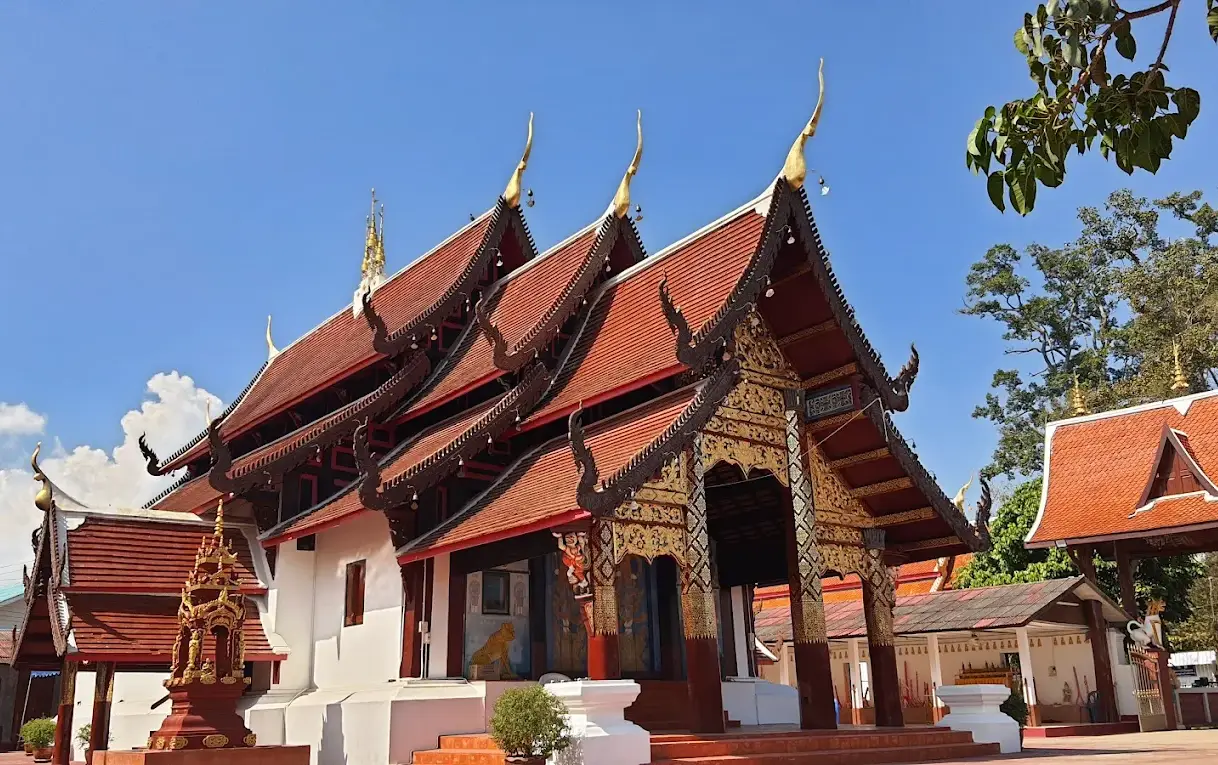
Wat San Pa Yang is a local Buddhist temple under the Mahanikaya order, located at No. 121, Moo 2, Ban San Pa Yang, San Pa Yang Subdistrict, Mae Taeng District, Chiang Mai Province 50330. The temple was officially established in 1732 and received its Wisungkhamsima in 1955. It is one of the historically important community temples of San Pa Yang, known for its old Lanna-style viharn, large century-old yang trees, and its continuing role as a spiritual center for local Buddhists.
Wat San Pa Yang is suitable for travelers who want to make merit, pay respect, and experience a quiet Lanna village temple in Mae Taeng. It is not a large commercial tourist temple. Its value lies in its long history, its connection with Ban San Pa Yang, its old Lanna-style viharn, and the way the temple preserves the relationship between Buddhism, local trees, village memory, and community identity.
The name “San Pa Yang” carries strong local meaning. In northern Thai usage, “san” refers to a ridge, rise, or elevated strip of land, while “pa yang” refers to an area with many yang trees. The name therefore suggests a raised area where yang trees once grew prominently. Because the temple carries the same name as the village and subdistrict, it functions as both a sacred site and a marker of local place identity.
San Pa Yang Subdistrict lies in Mae Taeng District, northwest of Chiang Mai city, connected with the Chiang Mai-Fang route. The area includes old communities, local schools, agricultural villages, rural roads, and nearby natural attractions such as Pong Pao Reservoir. Wat San Pa Yang belongs to this cultural landscape where Buddhism, education, agriculture, local roads, trees, and village life exist together.
The official establishment of Wat San Pa Yang in 1732 gives the temple strong historical value. A village temple of this age reflects long-standing Buddhist faith, settlement continuity, and community cooperation. In northern Thai rural society, temples were not only places for monks. They were shared spaces for worship, Dhamma listening, merit-making, ordination-related activities, funerals, memorial ceremonies, and annual religious festivals.
The granting of Wisungkhamsima in 1955 marks another important stage in the temple’s history. Wisungkhamsima is the formally granted monastic boundary used for Buddhist Sangha acts according to monastic discipline. Together, the temple’s 1732 establishment and 1955 Wisungkhamsima show both early local roots and continued religious development over time.
The old Lanna-style viharn is the main highlight of Wat San Pa Yang. It has been restored across generations and remains a spiritual center for the local Buddhist community. A Lanna viharn is not simply an architectural structure; it is the main devotional and communal space where villagers gather to pay respect, listen to teachings, make merit, and take part in ceremonies.
The large yang trees in and around the temple give Wat San Pa Yang a distinctive identity. Several of these trees are more than 100 years old and have been preserved by the local community. In a northern Thai village temple, old trees contribute to shade, atmosphere, memory, and a sense of continuity. At Wat San Pa Yang, the presence of yang trees also reinforces the meaning of the village name itself.
Local accounts describe the San Pa Yang community as having a history of more than 400 years. The name of the village is connected with an area where many large yang trees once stood, and large trees can still be seen around Wat San Pa Yang. This gives the temple physical evidence of local memory: the name of the village, the trees, the viharn, and community religious life all support one another.
As a Mahanikaya community temple, Wat San Pa Yang supports everyday Buddhist life at the village level. Local residents use the temple for worship, merit-making, Dhamma listening, offerings, Buddhist holy days, family ceremonies, memorial activities, ordination-related events, forest robe offerings, and Kathin offerings after Buddhist Lent. The temple is both a sacred space and a social anchor for Ban San Pa Yang.
The main things to appreciate at Wat San Pa Yang are the old Lanna-style viharn, the large yang trees, the temple courtyard, the worship area, and the relationship between the temple and the surrounding village. Its appeal comes from simplicity, continuity, local memory, and the close relationship between temple and community rather than from large-scale tourism facilities.
Wat San Pa Yang is also meaningful for cultural travel in Mae Taeng. The district is widely known for nature, reservoirs, elephant-related attractions, waterfalls, and rural scenery. Wat San Pa Yang adds another layer to the route by showing the religious, historical, and community-based side of Mae Taeng. It is a suitable stop for travelers who want to understand the district beyond mainstream nature tourism.
Wat San Pa Yang functions as a spiritual center for the local community. Residents use the temple during Buddhist holy days, major Buddhist festivals, family merit-making, ordination-related activities, funerals, memorial ceremonies, and village events. A village temple in northern Thailand often does more than provide a place for worship; it sustains relationships among generations and gives the community a shared spiritual anchor.
Religious activities at Wat San Pa Yang follow the Buddhist calendar and Lanna village traditions. These include Buddhist holy days, Makha Bucha, Visakha Bucha, Asalha Bucha, Buddhist Lent, the end of Buddhist Lent, forest robe offerings, and Kathin offerings after Buddhist Lent. These occasions help maintain the temple, support monks, and strengthen the relationship between the temple and local residents.
San Pa Yang Subdistrict has several nearby Buddhist sites and community temples that can be connected into a cultural route, including Wat Phra Chao Ton Luang, Wat San Pa Tueng, Wat Nong Kai, Wat Nong Bua Noi, and Wat Pa Pha Daen. Wat San Pa Yang stands out in this local network because of its long history, old Lanna viharn, and the preserved yang trees that clearly connect the temple with the village name.
Wat San Pa Yang can be combined with several nearby cultural and natural destinations. Travelers interested in temples can continue to Wat Phra Chao Ton Luang, Wat San Pa Tueng, Wat Nong Kai, and Wat Pa Pha Daen. Travelers who want to add nature can continue to Pong Pao Reservoir, Nong Maeng Da Reservoir, Mae Ngat Somboon Chon Dam, or other nature-based attractions in Mae Taeng.
Getting There is easiest by private car or rental car. From Chiang Mai city, follow the Chiang Mai-Fang route or the main road toward Mae Taeng, then enter San Pa Yang Subdistrict and Ban San Pa Yang in Moo 2 via local roads. San Pa Yang is about 42 kilometers from Chiang Mai city and about 17 kilometers from Mae Taeng District center. Travelers planning to visit nearby temples or reservoirs should allow enough time for local-road driving.
A half-day itinerary can begin at Wat San Pa Yang for merit-making, a quiet temple visit, and a closer look at the Lanna viharn and large yang trees. Visitors can then continue to Wat Phra Chao Ton Luang, Wat San Pa Tueng, or Wat Nong Kai before stopping for a meal or cafe in the Mae Taeng area. A full-day route can include Pong Pao Reservoir, Mae Ngat Somboon Chon Dam, or an overnight stay in the San Pa Yang or Mae Taeng area.
Wat San Pa Yang is best suited to travelers interested in community temples, local Buddhist practice, Lanna village culture, old viharn architecture, large heritage trees, and less crowded cultural routes. Its value lies not only in its age, but also in the way it preserves the relationship between Buddhism, village identity, trees, landscape, and community memory.
Visitors should dress modestly, speak quietly, respect monks’ areas, and avoid disturbing any religious activity. When viewing the old viharn and large trees, visitors should avoid climbing, carving, scratching, or damaging any part of the temple grounds. A meaningful visit to Wat San Pa Yang is one that respects both the sacred atmosphere and the local heritage preserved by the community.
Overall, Wat San Pa Yang is a meaningful Mahanikaya community temple in Ban San Pa Yang, Moo 2, San Pa Yang Subdistrict, Mae Taeng District, Chiang Mai. Officially established in 1732 and granted Wisungkhamsima in 1955, it remains a valuable cultural stop for travelers who want to understand village-based Buddhist life, old Lanna temple architecture, large yang trees, and the cultural route of Mae Taeng beyond mainstream nature tourism.
| Name | Wat San Pa Yang |
| Location | No. 121, Moo 2, Ban San Pa Yang, San Pa Yang Subdistrict, Mae Taeng District, Chiang Mai Province |
| Address | 121 Moo 2, San Pa Yang Subdistrict, Mae Taeng District, Chiang Mai 50330, Thailand |
| Temple Type | Community Buddhist Temple Under The Mahanikaya Order |
| Temple Code | 350060802 |
| History | Officially Established As A Temple In 1732 |
| Wisungkhamsima | Granted In 1955 |
| Highlights | Old Lanna-Style Viharn, Large Yang Trees More Than 100 Years Old, And A Continuing Role As A Spiritual Center Of Ban San Pa Yang |
| Important Structure | Old Lanna-Style Viharn |
| Local Context | Ban San Pa Yang Is An Old Community Whose Name Is Connected With A Raised Landscape And Large Yang Trees Preserved Around The Temple |
| Distinctive Features | A Village Temple Connected With San Pa Yang Community Identity, Lanna Temple Architecture, Heritage Trees, And The Cultural Route Of Mae Taeng |
| Related Traditions | Buddhist Holy Day Merit-Making, Buddhist Festivals, Forest Robe Offerings, And Kathin Offerings After Buddhist Lent |
| Travel Information | From Chiang Mai city, follow the Chiang Mai-Fang route or the main road toward Mae Taeng, then enter San Pa Yang Subdistrict and Ban San Pa Yang in Moo 2. Private car or rental car is the most convenient option. |
| Current Status | Community Buddhist Temple Of Ban San Pa Yang, San Pa Yang Subdistrict, Mae Taeng District, Chiang Mai |
| Nearby Tourist Attractions | 1. Wat Phra Chao Ton Luang, about 2 km 2. Wat San Pa Tueng, about 2 km 3. Wat Nong Kai, about 4 km 4. Pong Pao Reservoir, about 8 km 5. Mae Ngat Somboon Chon Dam, about 18 km |
| Nearby Restaurants / Cafes | 1. AunJai Cafe, about 3 km 2. Ban San Pa Yang Community Market / Food Area, about 1 km 3. Sawana Chiang Mai, about 12 km 4. Baan Rai Lanna Resort Restaurant, about 20 km, Tel. 053-995-470 5. Sibsan Cuisine, about 24 km, Tel. 081-980-9070 |
| Nearby Accommodations | 1. Butsaba Garden Resort, about 7 km, Tel. 093-247-3480 2. Joy Villa (Mon Saen Suk), about 9 km 3. Maetang Phuphing Resort, about 15 km, Tel. 062-264-5277 4. Baan Rai Lanna Resort, about 20 km, Tel. 053-995-470 5. Sibsan Resort & Spa Maetaeng, about 24 km, Tel. 081-980-9070 |
Frequently Asked Questions (FAQ)
Q: Where is Wat San Pa Yang located?
A: Wat San Pa Yang is located at No. 121, Moo 2, Ban San Pa Yang, San Pa Yang Subdistrict, Mae Taeng District, Chiang Mai Province 50330.
Q: What type of temple is Wat San Pa Yang?
A: Wat San Pa Yang is a community Buddhist temple under the Mahanikaya order, listed under temple code 350060802.
Q: Why is Wat San Pa Yang historically important?
A: Wat San Pa Yang was officially established in 1732 and received Wisungkhamsima in 1955, making it one of the long-standing community temples of San Pa Yang Subdistrict.
Q: What is the main highlight of Wat San Pa Yang?
A: The main highlights are the old Lanna-style viharn, the large yang trees more than 100 years old, and the temple’s role as a spiritual center of Ban San Pa Yang.
Q: What does the name San Pa Yang mean?
A: “San” refers to a ridge or raised land, while “pa yang” refers to an area with many yang trees. The name reflects the landscape and tree identity of the local community.
Q: What kind of travelers is Wat San Pa Yang suitable for?
A: It is suitable for travelers interested in community temples, local Buddhist practice, Lanna architecture, heritage trees, and slower cultural routes in Mae Taeng.
Q: What nearby places can be visited with Wat San Pa Yang?
A: Nearby places include Wat Phra Chao Ton Luang, Wat San Pa Tueng, Wat Nong Kai, Pong Pao Reservoir, and Mae Ngat Somboon Chon Dam.
Q: How do travelers get to Wat San Pa Yang from Chiang Mai city?
A: Follow the Chiang Mai-Fang route or the main road toward Mae Taeng, then enter San Pa Yang Subdistrict and Ban San Pa Yang in Moo 2. Private car or rental car is the most convenient option.
 Category: ●Places of Worship
 Group: ●Temple
Last Update : 2 MonthAgo
 Last Update : 2 MonthAgo
 Click to Access the Navigation Map GPS

 Muang Chiang Mai(121)Chom Thong(47)Mae Chaem(25)Chiang Dao(33)Doi Saket(68)Mae Taeng(85)Mae Rim(69)Samoeng(29)Fang(71)Mae Ai(59)Phrao(70)San Pa Tong(103)San Kamphaeng(66)San Sai(73)Hang Dong(73)Hot(32)Doi Tao(22)Omkoi(11)Saraphi(74)Wiang Haeng(15)Chai Prakan(28)Mae Wang(32)Mae On(22)Doi Lo(33)Galyani Vadhana(1)


