
lovethailand home >North Travel Attractions >Chiang Mai Travel Attractions >Mae Taeng >Khi Lek > Wat Huai Rai
TL;DR: Wat Huai Rai is located at Ban Huai Rai, Moo 1, Khi Lek Subdistrict, Mae Taeng District, Chiang Mai Province, open Daily, hours 08.00 - 17.00.

Wat Huai Rai
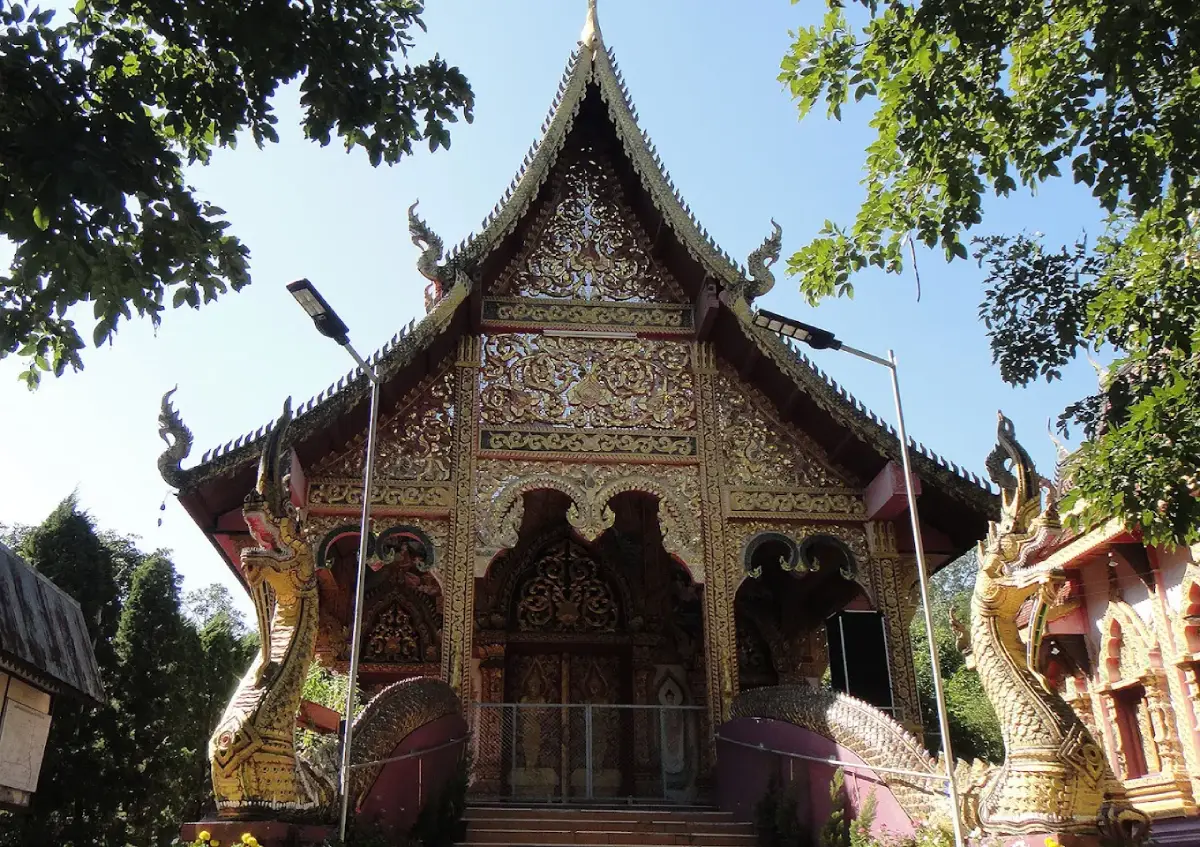
Open Days: Daily
Opening Hours: 08.00 - 17.00
Wat Huai Rai is a local Buddhist temple in Moo 1, Khi Lek Subdistrict, Mae Taeng District, Chiang Mai Province. It is a community temple under the Mahanikaya order and remains an active place of worship for local residents. For travelers, Wat Huai Rai is best understood as a quiet village temple rather than a large tourist landmark. It offers a calm setting for paying respect, making merit, and learning about the religious life of a rural Lanna community in Mae Taeng.
The temple was officially established in 1940 and received its Wisungkhamsima in 1999. This status is important because it marks the temple’s development from a community religious site into a fully recognized Buddhist temple where formal monastic rites can be performed. The foundation of Wat Huai Rai reflects the role of local faith in shaping village life. The temple was initiated by Khru Ba Thip Kantima and Nai Chai Chaiyawong, the village headman of Ban Huai Rai, with support from the surrounding community.
Ban Huai Rai and Khi Lek Subdistrict are part of Mae Taeng District, an area known for its rural landscapes, agricultural communities, northern Thai traditions, and access to several important attractions along the Chiang Mai–Fang route. In this setting, Wat Huai Rai functions as a spiritual center for local residents. It is used for merit-making, Buddhist ceremonies, listening to Dhamma teachings, seasonal religious events, and community gatherings connected to the Buddhist calendar.
Wat Huai Rai is located at No. 41, Ban Huai Rai, Moo 1, Khi Lek Subdistrict, Mae Taeng District, Chiang Mai Province. The temple occupies a modest temple site of about 2 rai, with additional monastic land. Its scale is compact, but its value lies in its continuity as a living community temple. Visitors should not expect a heavily commercialized attraction. Instead, the temple gives a clear view of how local Buddhist temples continue to support village life in northern Thailand.
The important areas and structures within Wat Huai Rai include a sermon hall, monks’ residences, a merit-making pavilion, and spaces for religious activities. The temple also has an ancient Buddha image, which gives the site additional spiritual and historical importance. Although detailed art-historical information about the Buddha image is not sufficient for a stylistic classification, its presence confirms the temple’s role as a place of worship and devotion for the local community.
The list of former abbots reflects the continuity of temple administration from the early period onward. Names recorded in the temple history include Phra Khru Ba Thip Kantima, Phra Duang Kham Duang Ta, Phra Si Nuan Inutachako, Phra Mai Nawathammo, Phra Athikan Sorot Atuttatipo, Phra Sakon Sanunchitto, and Phra Sorot Atuttatipo. The current abbot is Phra Khru Piyakhun Thada Kantadhammo, who also holds an administrative role within the Mae Taeng monastic community. His role connects the temple with broader Buddhist administration in the district.
The appeal of Wat Huai Rai lies in its quiet atmosphere, simple temple environment, and direct connection to local life. Travelers who enjoy large temple complexes may experience Wat Huai Rai differently, because this temple is not defined by grandeur. Its character comes from being a working village temple where monks reside, local people make merit, and religious activities continue throughout the year. This makes the visit especially meaningful for travelers interested in cultural context rather than only photography.
Visitors who come to Wat Huai Rai can pay respect to the Buddha image, make merit according to personal faith, and observe the calm rhythm of a rural Chiang Mai temple. Proper behavior is important. Travelers should dress modestly, speak quietly, avoid disturbing monks’ residential areas, and respect ongoing ceremonies. If a merit-making event is taking place, visitors should follow the guidance of temple members or local residents.
Religious activities at Wat Huai Rai are connected with the normal Buddhist calendar, including Buddhist holy days, merit-making occasions, and annual Kathin offerings after the Buddhist Lent. In 2025, the nationwide Kathin Samakkhi project listed Wat Huai Rai as a participating temple with 5 resident monks, with a Kathin ceremony scheduled for October 14, 2025. This confirms the temple’s continuing role as an active religious site and a center of community faith.
In community life, Wat Huai Rai serves as a place where local people gather for religious observances, family merit-making, offerings to monks, memorial merit, and seasonal ceremonies. Temples of this type are central to the cultural fabric of northern Thai villages. They provide not only a sacred space, but also a social and cultural anchor that connects residents across generations.
Getting to Wat Huai Rai is easiest by private car or rental car. From Chiang Mai city, take Chotana Road or Highway 107 north toward Mae Taeng District, then continue into Khi Lek Subdistrict and Ban Huai Rai. The drive usually takes around 1 hour to 1 hour 20 minutes depending on traffic. The route is suitable for a day trip and can be combined with other attractions in Mae Taeng.
Wat Huai Rai can be included in a Mae Taeng cultural and nature itinerary. Nearby places that fit well with the route include Dantewada, Wat Den Sali Sri Mueang Kaen, Mae Ngat Somboon Chon Dam, Baan Chang Elephant Park, and Bua Tong Waterfall–Nam Phu Chet Si. A practical itinerary is to visit Wat Huai Rai in the morning, continue to a nearby temple or nature attraction, and stop at a local restaurant or cafe in Khi Lek or Mae Taeng before returning to Chiang Mai.
For travelers interested in local history, Wat Huai Rai is valuable because it preserves the story of Ban Huai Rai and its community faith. Its establishment in 1940 and the granting of Wisungkhamsima in 1999 show the temple’s gradual development and its continuing recognition within the Buddhist system. The temple’s history, structures, abbot lineage, and annual religious activities make it a meaningful stop for travelers who want to understand the quieter side of Chiang Mai’s temple culture.
The overall atmosphere of Wat Huai Rai is calm, modest, and suitable for slow travel. It is not a crowded sightseeing site. It is a working Buddhist temple where visitors can respectfully observe local religious life. For this reason, Wat Huai Rai is a good stop for travelers who want to combine merit-making, cultural understanding, and a Mae Taeng travel route beyond the most famous tourist attractions.
| Name | Wat Huai Rai |
| Location | Ban Huai Rai, Moo 1, Khi Lek Subdistrict, Mae Taeng District, Chiang Mai Province |
| Address | No. 41, Ban Huai Rai, Moo 1, Khi Lek Subdistrict, Mae Taeng District, Chiang Mai 50150, Thailand |
| Coordinates | 19.08968, 98.89931 |
| Temple Type | Community Buddhist Temple Under The Mahanikaya Order |
| Highlights | A quiet village temple in Mae Taeng suitable for merit-making, respectful temple visits, and learning about local Lanna Buddhist life |
| History | Officially established in 1940 and granted Wisungkhamsima in 1999 |
| Founders | Khru Ba Thip Kantima and Nai Chai Chaiyawong, the village headman of Ban Huai Rai |
| Distinctive Features | A modest working village temple with long-standing community significance |
| Main Areas / Zones | Sermon hall, monks’ residences, merit-making pavilion, religious activity area, and ancient Buddha image |
| Abbot / Caretaker | Phra Khru Piyakhun Thada Kantadhammo |
| Related Traditions | Buddhist holy day merit-making, annual religious ceremonies, and Kathin offerings after Buddhist Lent |
| Travel Information | From Chiang Mai city, take Chotana Road or Highway 107 toward Mae Taeng, then continue to Khi Lek Subdistrict and Ban Huai Rai. Private car or rental car is the most convenient option. |
| Current Status | Active community Buddhist temple used for regular religious activities |
| Open Days | Daily |
| Opening Hours | 08.00 - 17.00 |
| Nearby Tourist Attractions | 1. Dantewada, about 8 km 2. Wat Den Sali Sri Mueang Kaen, about 13 km 3. Mae Ngat Somboon Chon Dam, about 22 km 4. Baan Chang Elephant Park, about 18 km 5. Bua Tong Waterfall-Nam Phu Chet Si, about 36 km |
| Nearby Restaurants | 1. Kani Coffee & Steak House, about 5 km, Tel. 081-914-3419, 092-541-5645 2. Kin-Nuea, about 6 km, Tel. 096-996-7996, 065-616-9655 3. Mae Taeng Tukta Restaurant, about 7 km, Tel. 082-183-0691 4. Sai Ua Ban It, about 7 km, Tel. 081-033-3740 5. Mon Raming Mae Taeng, about 8 km, Tel. 089-956-3674 |
| Nearby Accommodations | 1. Air Diamond Hotel, about 5 km, Tel. 061-229-8282 2. Mae Taeng Hotel, about 7 km, Tel. 053-471-777-8 3. Mae Malai Mansion, about 8 km, Tel. 053-842-620, 095-610-6489 4. MonPanaNont Wellness Resort, about 9 km, Tel. 095-352-4566 5. Le Cocotier Resort, about 17 km, Tel. 080-499-3300 |
Frequently Asked Questions (FAQ)
Q: Where is Wat Huai Rai located?
A: Wat Huai Rai is located in Ban Huai Rai, Moo 1, Khi Lek Subdistrict, Mae Taeng District, Chiang Mai Province.
Q: What are the opening days and hours of Wat Huai Rai?
A: Wat Huai Rai is open daily from 08.00 to 17.00.
Q: Why is Wat Huai Rai historically important?
A: The temple was officially established in 1940 and received Wisungkhamsima in 1999, making it an important long-standing community temple in Ban Huai Rai.
Q: Who is the abbot of Wat Huai Rai?
A: The abbot of Wat Huai Rai is Phra Khru Piyakhun Thada Kantadhammo.
Q: What can visitors see at Wat Huai Rai?
A: Visitors can see the sermon hall, monks’ residences, merit-making pavilion, religious activity areas, and an ancient Buddha image.
Q: What kind of travelers is Wat Huai Rai suitable for?
A: It is suitable for travelers interested in quiet temple visits, merit-making, local Lanna culture, and a Mae Taeng day trip.
Q: How do travelers get to Wat Huai Rai from Chiang Mai city?
A: Travelers can take Chotana Road or Highway 107 toward Mae Taeng, then continue to Khi Lek Subdistrict and Ban Huai Rai. A private car or rental car is the most convenient option.
 Category: ●Places of Worship
 Group: ●Temple
Last Update : 1 HourAgo
 Last Update : 1 HourAgo
 Click to Access the Navigation Map GPS
 Muang Chiang Mai(121)Chom Thong(47)Mae Chaem(25)Chiang Dao(33)Doi Saket(68)Mae Taeng(85)Mae Rim(69)Samoeng(29)Fang(71)Mae Ai(62)Phrao(70)San Pa Tong(105)San Kamphaeng(66)San Sai(73)Hang Dong(74)Hot(32)Doi Tao(22)Omkoi(11)Saraphi(74)Wiang Haeng(15)Chai Prakan(28)Mae Wang(32)Mae On(22)Doi Lo(34)Galyani Vadhana(1)


