
lovethailand home >North Travel Attractions >Chiang Mai Travel Attractions >Phrao >Pa Tum > Wat Pa Tum Don
TL;DR: Wat Pa Tum Don is located at Ban Pa Tum Don, Moo 9, Pa Tum Subdistrict, Phrao District, Chiang Mai Province, open Daily, hours 08.00 – 17.00.

Wat Pa Tum Don
Open Days: Daily
Opening Hours: 08.00 – 17.00
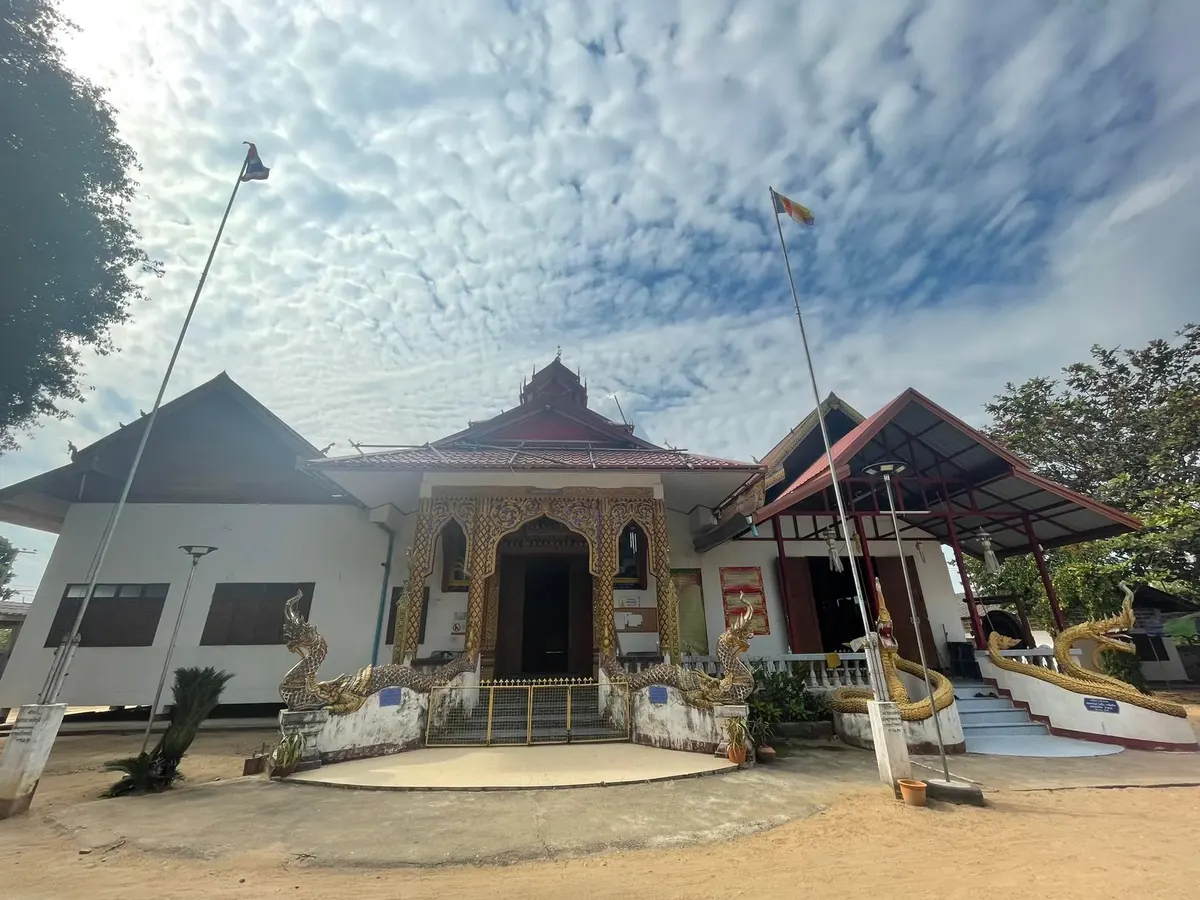
Wat Pa Tum Don is a Mahanikaya Buddhist temple located in Ban Pa Tum Don, Moo 9, Pa Tum Subdistrict, Phrao District, Chiang Mai Province. It is an important community temple with deep connections to Shan or Tai Yai heritage, Lanna Buddhism, local village history, and the cultural landscape of Phrao. The temple is not a large commercial tourist attraction, but it is highly valuable for travelers interested in Buddhist art, ethnic heritage, traditional temple architecture, and the living role of village temples in northern Thailand.
Wat Pa Tum Don was established in 1832 and received Wisungkhamsima, the royal consecrated boundary for monastic acts, on 15 May 1975. The temple grounds cover 3 rai, 1 ngan, and 75 square wah. Its main monastic structures include one viharn, two monks’ residences, one bell tower, and one small pavilion. These structures support the religious life of the local community and reflect the practical function of a village temple: worship, merit-making, Dhamma listening, community gatherings, and the preservation of cultural memory.
Ban Pa Tum Don is a village in Pa Tum Subdistrict, Phrao District. The name Pa Tum is associated with the Tum tree, once found in the area, while the word Don refers to higher ground that is not easily flooded. The village name therefore reflects both natural environment and settlement geography. Ban Pa Tum Don is especially significant because it is a Shan or Tai Yai community whose ancestors migrated and settled in Phrao over generations. This ethnic history is one of the key reasons Wat Pa Tum Don has a distinctive cultural identity.
The foundation story of Wat Pa Tum Don is closely tied to Shan migration and community formation. The temple was established by a group of Shan people, historically referred to in Thai sources as Ngiao or Tai Yai, with Pho Sang Jai Langka as a leading figure. As the Shan population grew, the community needed a shared sacred place for merit-making, worship, and strengthening unity. The group searched for a suitable site and found a calm, shaded area with a large banyan tree, known locally as Mai Hung. This site was chosen for the construction of a jong, or Shan-style monastery, which became known as Jong Ban Pa Tum Don and later developed into Wat Pa Tum Don.
After the founding generation, later Shan community leaders continued to restore and maintain the temple. Local names remembered in the temple’s history include Pho Phaka Ching, Pho Phaka La, Pho Phada On, Chare Nan Ta, Chare Ong Kham, Pho Sang Ang, Mae Nang Khae, and others. These figures helped sustain the monastery and brought skilled artisans from Myanmar and Shan cultural areas to create Buddha images and sacred objects. Their work allowed the temple to become a cultural repository for Buddhist art, Shan identity, and community faith.
The most distinctive architectural feature of Wat Pa Tum Don is its Shan-style jong architecture blended with Lanna artistic influence. The temple was built according to Tai Yai religious concepts as a group of three connected buildings. The central building is the viharn, also known as Jong Phara and Jong Tan, while the buildings to the south and north function as monks’ residences and a dining hall, known in Shan cultural terms as Jong Sangkha, Luk Wun Chao, and Jong Som. These buildings are linked by a continuous interior floor plan, creating a unified sacred space.
The interior arrangement of the temple uses different floor levels to express sacred hierarchy. The monks’ seating area and the platform for the principal Buddha image are raised above the surrounding floor level. This elevated area is called Kha Pan. The roof reflects Shan architectural style known locally as Song Kho Sam Chai, and the eaves are decorated with carved teak fretwork called Pan Soi. These wooden details give the temple its distinctive character and distinguish it from many more typical Lanna village temples in Chiang Mai.
Inside the viharn are three stucco principal Buddha images created in 1911. These images combine Chiang Saen and Mandalay artistic influences, making them important both as sacred objects and as evidence of cultural exchange across northern Thailand, Shan areas, and Myanmar. The temple also preserves several other important Buddha images, including Chiang Saen-style Phra Singh images associated with the Fang artisan tradition, Lanna silver Buddha images, Pan Pong or flower Buddha images, and numerous stone Buddha images known locally as Hin No. Together, these objects make Wat Pa Tum Don an important site for studying Buddhist art in Phrao.
The Pan Pong or flower Buddha images are among the most remarkable sacred objects at Wat Pa Tum Don. These images are linked to Shan Buddhist art and local ritual creativity. Over time, flower Buddha images that had been kept in different parts of the temple were collected, cleaned, and arranged in a dedicated area within the viharn in a museum-like manner. This preservation effort has helped the community recognize the value of sacred objects that belong to both the temple and local households. It also turns the temple into a cultural learning space, not only a place of worship.
Wat Pa Tum Don is also associated with manuscripts and traditional knowledge. Local sources mention old Shan-style manuscripts known as Pap Tamra Lik Long, reflecting the presence of Shan written culture and religious learning in the community. The temple has also hosted cultural activities related to palm-leaf manuscripts, traditional folded manuscripts, and Lanna script learning, connecting elderly villagers, local knowledge holders, and cultural institutions. This continuing use of the temple as a learning space shows that Wat Pa Tum Don remains relevant to cultural preservation today.
The role of Wat Pa Tum Don in the community is deep and continuous. It is the spiritual center of Ban Pa Tum Don, a place for worship, merit-making, Buddhist ceremonies, community gatherings, and the transmission of Shan cultural identity. Annual Buddhist activities such as Kathin, Pha Pa, Buddhist holy day merit-making, Buddhist Lent, and the end of Buddhist Lent help maintain the relationship between the temple and local residents. For descendants of Shan families in the village, the temple also preserves memory, ancestry, and a sense of belonging.
For visitors, the key highlights of Wat Pa Tum Don are the Shan-style jong buildings, the connected three-building layout, the raised Kha Pan platform, the Pan Soi carved teak decoration, the three stucco Buddha images, the Pan Pong flower Buddha images, and the quiet atmosphere of a living community temple. Travelers interested in art history, Buddhist iconography, ethnic heritage, and village culture will find the temple especially meaningful. It is best visited slowly, with time to observe architectural details and the relationship between temple, village, and local memory.
Unlike Chiang Mai’s best-known temple attractions, Wat Pa Tum Don offers a quieter and more localized experience. It is not designed as a mass-tourism site. Its value lies in the fact that it still belongs to the community. Visiting the temple allows travelers to understand that Buddhist culture in Chiang Mai is not only Lanna in a narrow sense, but also includes Shan and Tai Yai cultural layers that have shaped local settlements, temple art, manuscripts, rituals, and community identity in Phrao District.
Ban Pa Tum Don is also connected with other local cultural and natural attractions in Pa Tum Subdistrict. The community is known for sugarcane, the Phra That Chom Hin tradition, Chinese onion cultivation, local caves, waterfalls, cliffs, and rural scenery. Nearby sacred and cultural sites include Phra That Chom Hin, Wat Pa Tum Hong, Wat Thung Ha, Wat Thung Ku, Wat Ton Rung, and Wat Phra Chao Lan Thong. A visit to Wat Pa Tum Don can therefore become part of a broader cultural route through Pa Tum and Phrao, combining village temples, sacred hills, local history, and rural landscapes.
Getting There is easiest by private car, rental car, or local hired transport. From Chiang Mai city, travel toward Phrao District, then continue into Pa Tum Subdistrict and Ban Pa Tum Don, Moo 9. Before departure, search for “Wat Pa Tum Don” or “Ban Pa Tum Don, Pa Tum, Phrao” in a map application. Since the temple is located within a village area rather than on a major tourist road, preparing navigation in advance will make the trip smoother. A private vehicle also allows travelers to visit nearby temples, Phra That Chom Hin, local restaurants, and accommodations around Phrao more conveniently.
The best time to visit is in the morning or late afternoon, when the weather is more comfortable and the atmosphere is calm. Visitors who wish to observe the architecture and sacred objects should allow at least 30 minutes to 1 hour. The cool season and the late rainy season are especially pleasant for exploring Phrao, as the rural landscape, mountains, and farming areas around Pa Tum Subdistrict become more scenic and comfortable for slow cultural travel.
Visitors should dress modestly, speak quietly, and avoid touching sacred objects or old Buddha images without permission. Photography should be respectful, especially inside the viharn and around preserved sacred objects. Visitors should not enter monks’ residences or private monastic areas unless allowed. If a merit-making activity or community ceremony is taking place, local worshippers should be given priority. Respectful behavior is essential because Wat Pa Tum Don is an active community temple, not simply a sightseeing venue.
Overall, Wat Pa Tum Don is one of the most culturally significant temples in Phrao District. It preserves the history of a Shan community, the memory of migration, Shan-style jong architecture, Lanna and Mandalay-influenced Buddha images, Pan Pong flower Buddha images, local manuscripts, and the living role of a Buddhist temple in village life. Its beauty is not based on grandeur, but on depth: the depth of faith, ancestry, craftsmanship, and cultural continuity. For travelers who want to understand Chiang Mai through local communities and ethnic heritage, Wat Pa Tum Don is a valuable and meaningful destination.
| Name | Wat Pa Tum Don |
| Location | Ban Pa Tum Don, Moo 9, Pa Tum Subdistrict, Phrao District, Chiang Mai Province |
| Address | Ban Pa Tum Don, Moo 9, Pa Tum Subdistrict, Phrao District, Chiang Mai 50190, Thailand |
| Coordinates | 19.351301, 99.209243 |
| Temple Type | Private-sector Buddhist temple under the Mahanikaya order; listed as a temple and religious art site |
| History | Established in 1832 by a Shan or Tai Yai community and received Wisungkhamsima on 15 May 1975 |
| Name Origin | Connected with Ban Pa Tum Don, a village on higher ground associated with the Tum tree and Shan settlement history |
| Temple Area | 3 rai, 1 ngan, and 75 square wah |
| Highlights | Shan-style jong architecture blended with Lanna art, three stucco Buddha images, Pan Pong flower Buddha images, and a living Shan community temple atmosphere |
| Distinctive Features | Three connected jong buildings, Kha Pan raised sacred platform, Pan Soi carved teak eaves, and Shan-Lanna artistic character |
| Important Structures | One viharn, two monks’ residences, one bell tower, and one small pavilion |
| Sacred Objects | Three stucco Buddha images combining Chiang Saen and Mandalay art, Chiang Saen-style Phra Singh images, Lanna silver Buddha images, Pan Pong flower Buddha images, and stone Buddha images |
| Main Areas / Zones | Viharn or Jong Phara and Jong Tan, monks’ residences, dining hall, monks’ seating area, principal Buddha platform, temple courtyard, and Pan Pong Buddha preservation area inside the viharn |
| Community Role | Spiritual center of Ban Pa Tum Don, used for merit-making, Dhamma listening, Shan cultural preservation, and community religious activities |
| Important Activities / Ceremonies | Kathin, Pha Pa, Buddhist holy day merit-making, Buddhist Lent, end-of-Lent activities, and cultural activities related to manuscripts, palm leaves, and Lanna script |
| Travel Information | Best reached by private car, rental car, or local hired transport from Chiang Mai toward Phrao District, then into Pa Tum Subdistrict and Ban Pa Tum Don, Moo 9 |
| Current Status | Active community temple and Shan Buddhist art learning site in Pa Tum Subdistrict, Phrao District, Chiang Mai Province |
| Open Days | Daily |
| Opening Hours | 08.00 – 17.00 |
| Facilities | Worship area, viharn, temple courtyard, pavilion, merit-making area, and parking space within or near the temple community |
| Main Contact Number | 063-940-8609, Novice Warakit |
| Nearby Tourist Attractions | 1. Wat Pa Tum Hong, about 1 km 2. Phra That Chom Hin, about 2 km 3. Wat Thung Ha, about 3 km 4. Wat Thung Ku, about 4 km 5. Wat Ton Rung, about 4 km 6. Wat Phra Chao Lan Thong, about 16 km |
| Nearby Restaurants | 1. Nong Prince Chicken Rice, about 11 km, Tel. 094-559-0182 2. 135 Cafe, about 13 km, Tel. 083-549-6399 3. Jin Jum And Made-To-Order Food, about 14 km, Tel. 053-475-209 4. Krua Jae Kee Wild Food And River Fish, about 15 km, Tel. 084-488-8560 5. Rain Tree Cafe, about 19 km, Tel. 093-131-0928 |
| Nearby Accommodations | 1. PK Hotel / PK Hostel, about 13 km, Tel. 088-992-2444 2. Phrao Boutique Hotel, about 14 km, Tel. 094-412-3466 3. Inthang Boutique Hotel, about 15 km, Tel. 084-849-5725 4. Phrao Camping Village, about 16 km 5. Anothai Place, about 17 km, Tel. 086-658-0405 |
Frequently Asked Questions (FAQ)
Q: Where is Wat Pa Tum Don located?
A: Wat Pa Tum Don is located in Ban Pa Tum Don, Moo 9, Pa Tum Subdistrict, Phrao District, Chiang Mai 50190, Thailand.
Q: What is the history of Wat Pa Tum Don?
A: Wat Pa Tum Don was established in 1832 by a Shan or Tai Yai community led by Pho Sang Jai Langka. It later received Wisungkhamsima on 15 May 1975.
Q: What makes Wat Pa Tum Don special?
A: The temple is known for Shan-style jong architecture blended with Lanna art, three connected buildings, carved teak Pan Soi decoration, three stucco Buddha images, Pan Pong flower Buddha images, and its role as a cultural center of the Shan community.
Q: What sacred objects can visitors see at Wat Pa Tum Don?
A: Visitors can see three stucco Buddha images combining Chiang Saen and Mandalay art, Chiang Saen-style Phra Singh images, Lanna silver Buddha images, Pan Pong flower Buddha images, and stone Buddha images.
Q: What are the opening days and hours of Wat Pa Tum Don?
A: Wat Pa Tum Don is open daily from 08.00 to 17.00.
Q: How can travelers get to Wat Pa Tum Don?
A: The temple is best reached by private car, rental car, or local hired transport from Chiang Mai toward Phrao District, then into Pa Tum Subdistrict and Ban Pa Tum Don, Moo 9.
Q: What kind of travelers is Wat Pa Tum Don suitable for?
A: It is suitable for travelers interested in Shan culture, Lanna-Shan Buddhist art, community temples, local history, Buddhist iconography, and cultural travel in Phrao District.
Q: What nearby places can be visited with Wat Pa Tum Don?
A: Nearby places include Wat Pa Tum Hong, Phra That Chom Hin, Wat Thung Ha, Wat Thung Ku, Wat Ton Rung, and Wat Phra Chao Lan Thong.
 Category: ●Places of Worship
 Group: ●Temple
Last Update : 2 MonthAgo
 Last Update : 2 MonthAgo
 Click to Access the Navigation Map GPS

 Muang Chiang Mai(121)Chom Thong(47)Mae Chaem(25)Chiang Dao(33)Doi Saket(68)Mae Taeng(85)Mae Rim(69)Samoeng(29)Fang(71)Mae Ai(59)Phrao(70)San Pa Tong(103)San Kamphaeng(66)San Sai(73)Hang Dong(73)Hot(32)Doi Tao(22)Omkoi(11)Saraphi(74)Wiang Haeng(15)Chai Prakan(28)Mae Wang(32)Mae On(22)Doi Lo(33)Galyani Vadhana(1)


