
lovethailand home >North Travel Attractions >Chiang Mai Travel Attractions >Phrao >Nam Phrae > Wat San Khwang
TL;DR: Wat San Khwang is located at Ban San Khwang, Moo 3, Nam Phrae Subdistrict, Phrao District, Chiang Mai Province.

Wat San Khwang
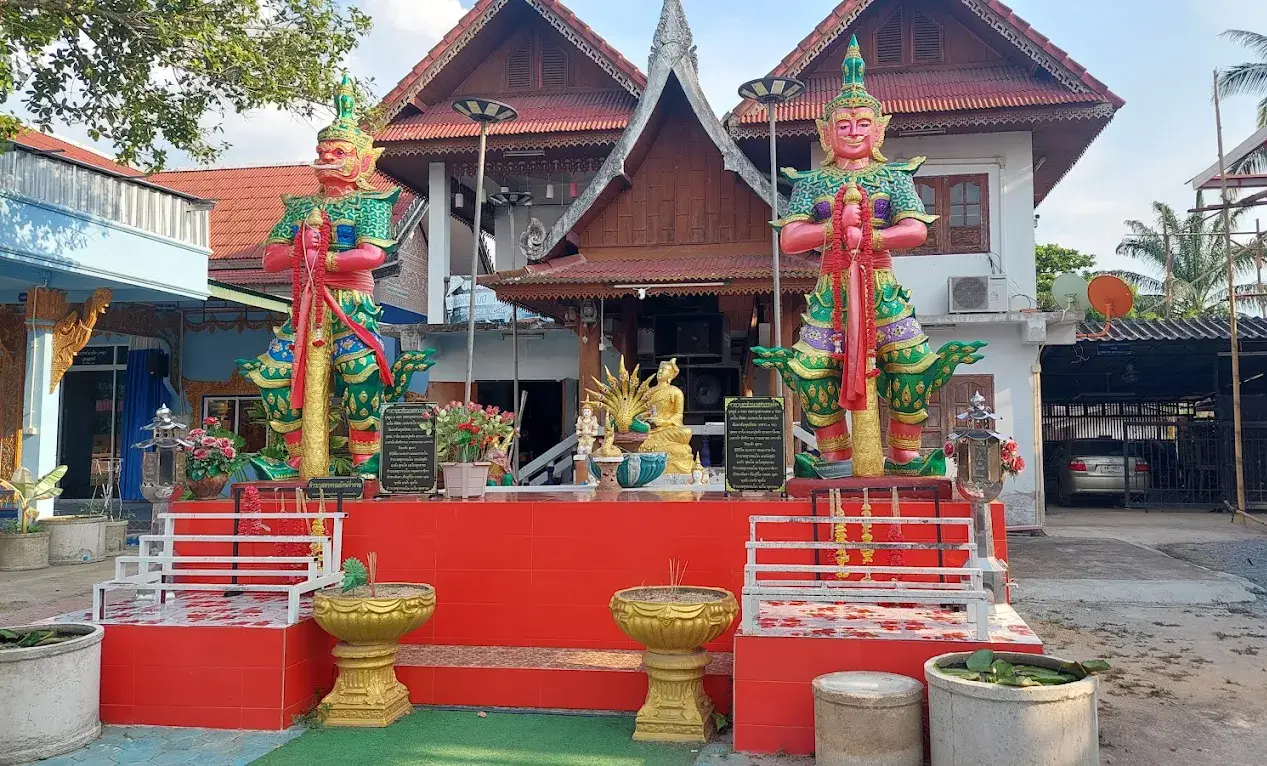
Operating day: Daily
Operating time: 08.00 - 17.00
Wat San Khwang is a private-sector Buddhist temple under the Mahanikaya order in Ban San Khwang, Moo 3, Nam Phrae Subdistrict, Phrao District, Chiang Mai Province. The temple covers 2 rai, 2 ngan and 82 square wah of land under title deed number 5363. It was first built in 1875 by Khruba Panya, a monk of Shan or Tai Yai descent. Wat San Khwang is therefore more than a village temple. It is a spiritual center that preserves the memory of Tai Yai settlement, migration from the Shan State area, the village’s relationship with the Mae Ngat River, and the earthen ridge known as “san khwang” that became the name of both the village and the temple.
Ban San Khwang lies west of the Phrao District office, about 3 kilometers from the district center. The village was officially recognized as a government village around 19 March 1889 and was recorded as the third village in the area, with around 104 original households. Local history describes Ban San Khwang as a Tai Yai community that separated from Ban Pa Tum Don. According to inherited village memory, two Tai Yai siblings from Hsenwi, Ban Nam Kham, in the Shan State area of Myanmar migrated with their families and settled into two communities: Ban Pa Tum Don and present-day Ban San Khwang.
The Tai Yai background of Ban San Khwang gives the temple a distinctive cultural character. The temple preserves the memory of migration, settlement, Buddhist identity, and coexistence with the Lanna communities of northern Thailand. Local accounts describe how these Tai Yai families were connected with the broader Shan and Myanmar frontier context before settling in Phrao. In 1889, Buddhist households in the community were granted Thai nationality. The temple therefore became both a religious center and a place that affirmed the identity of a Tai Yai Buddhist community in Phrao.
The name “San Khwang” comes from the village’s physical landscape. “San” refers to an earthen ridge or raised bank, while “khwang” means across or obstructing. In the past, the area had a long ridge extending from the Mae Ngat River toward the village. It functioned like an embankment or a boundary between two old areas. Later, the old ridge was no longer used, and villagers built a new road in its place. Traces of the former ridge can still be remembered in the rice-field area north of the road before reaching the Mae Ngat River. The temple’s name therefore preserves both geography and community memory.
The construction of Wat San Khwang in 1875 took place during the period when Ban San Khwang was forming a stable village identity. A temple in a Tai Yai community was essential because it provided a space for worship, merit-making, Dhamma listening, ceremonies, social gatherings, and cultural continuity. Wat San Khwang grew from the faith of Khruba Panya and local residents who wanted a Buddhist center for the new village.
Khruba Panya is the key figure in the foundation history of Wat San Khwang. As a monk of Tai Yai descent, his role connects the temple directly with the ethnic and cultural roots of the village. The temple later developed through the continued support of local devotees. Today, it remains a working village temple and a living sacred space for Ban San Khwang.
The temple land covers 2 rai, 2 ngan and 82 square wah. Although it is not a large tourist complex, its size is appropriate for a functioning community temple. It supports monastic residence, merit-making, annual Buddhist ceremonies, and community gatherings. The value of a temple like Wat San Khwang lies in its close relationship with local life rather than in monumental scale.
Wat San Khwang is currently associated with Phra Khru Baidika Kamphanat Sutthijitto, who is connected with the temple’s current monastic care and administration. In a village temple, the abbot or caretaker plays a central role in maintaining religious life, temple buildings, annual ceremonies, and cooperation with local devotees. This helps keep Wat San Khwang active as a living community temple.
The important structures within Wat San Khwang include the viharn, a water ordination hall, monks’ residences, temple courtyard, merit-making areas, and community ceremony spaces. The viharn is a brick-and-mortar building with seven bays, including two bays in the front hall. It has front and side entrances, a gabled roof with a layered front section, and side roof extensions. Inside is a principal Buddha image on a chukchi base in Tai Yai artistic style.
The principal Buddha image inside the viharn is in the Mara-Vijaya posture, seated in the diamond posture. It has a round face, a large facial frame, decorative rows of small round mirror pieces, a prominent chest, a flame-shaped radiance, a white-painted body, and a gold-painted robe worn over one shoulder. Behind the principal image is a shrine-like structure in Tai Yai style. These details make the viharn an important place to study the temple’s Tai Yai artistic identity.
The viharn is one of the most meaningful places to see at Wat San Khwang. It reflects the meeting of Lanna village temple culture and Tai Yai Buddhist art brought by the community’s ancestors. Its Buddha image, chukchi base, shrine, mirror decoration, and building form should be appreciated as part of the temple’s cultural identity, not only as ordinary temple decoration.
The water ordination hall is another major highlight. It was designed by Khruba Prasert Pawaro during the period when he resided at Wat San Khwang before moving to Wat Nong Pla Man. The building is a wooden rectangular hall set in water in front of the temple, linked to the shore by a bridge. Its roof follows a Tai Yai style with raised, layered roof forms and a two-tiered structure. This gives the temple a distinctive architectural identity.
The water ordination hall makes Wat San Khwang especially memorable. Instead of standing on an ordinary temple courtyard, the ordination hall is separated by water and approached by a bridge. This setting creates a calm and sacred atmosphere around an important monastic space. It also reflects the idea of separating the sacred boundary from ordinary ground, giving the hall both religious and architectural significance.
Another important group of sacred objects at Wat San Khwang is the set of flower Buddha images. These were given to the temple by villagers on 15 April 2012, totaling 12 images. The set includes 10 Phra Bua Khem images, one brass Buddha image, and one sandalwood Buddha image. These images show the direct relationship between the temple and local households because they were preserved through community faith.
The flower Buddha images are important as objects of both devotion and memory. They connect individual families with temple history and preserve names, offerings, and faith from the village. By keeping these images at the temple, Wat San Khwang becomes a repository of community memory as well as a place of worship.
Wat San Khwang plays several roles in the local community. Religiously, it is a place for worship, merit-making, Dhamma listening, precepts, and Buddhist ceremonies. Socially, it is a gathering place for villagers during holy days, ordinations, funerals, annual festivals, and community activities. Culturally, it preserves Tai Yai and Lanna heritage through its viharn, water ordination hall, principal Buddha image, and annual merit-making traditions. Historically, it records the settlement history of Ban San Khwang and the relationship between Tai Yai migrants and Phrao.
Temple activities at Wat San Khwang follow the Buddhist calendar and the local Lanna-Tai Yai community rhythm. Important activities include Buddhist holy day merit-making, Pha Pa, Kathin, Dhamma listening, Buddhist Lent, end-of-Lent activities, Northern Thai New Year, Loy Krathong, and annual village merit-making events. These activities bring villagers together to prepare the temple, offer food, receive blessings, listen to Dhamma, and maintain community unity.
Wat San Khwang is suitable for visitors interested in Tai Yai community temples, settlement history, and distinctive temple architecture. A visit can begin with paying respect to the principal Buddha image in the viharn, observing the Tai Yai artistic details, walking to the water ordination hall, and learning the meaning of the village name connected with the old earthen ridge and the Mae Ngat River. The temple is best appreciated slowly because its value lies in cultural detail rather than large-scale spectacle.
Nam Phrae Subdistrict adds further context to a visit to Wat San Khwang. The area includes important sacred sites such as Wat Phra Chao Lan Thong, Wat Nam Phrae, Wat Tham Dok Kham, Wat Pa Ngio, Wat Nong Pla Man, Wat Lo Pa Tong, and Wat Doi Mae Pang. Wat San Khwang adds the Tai Yai community dimension to this broader Nam Phrae temple route.
Getting There is most convenient by private car, rental car, or local hired transport. From Chiang Mai city, travel toward Phrao District, then continue into Nam Phrae Subdistrict and Ban San Khwang, Moo 3. The temple is about 3 kilometers west of the Phrao District office. Travelers can search for “Wat San Khwang, Nam Phrae, Phrao, Chiang Mai” or “Ban San Khwang, Moo 3, Nam Phrae” in a map application before departure.
From Phrao town, Wat San Khwang can be included in a half-day Nam Phrae route with Wat Phra Chao Lan Thong, Wat Nam Phrae, and Wat Pa Ngio. With more time, visitors can continue to Wat Tham Dok Kham, Wat Nong Pla Man, Wat Lo Pa Tong, or Wat Doi Mae Pang. This route allows travelers to experience old-town history, village temples, cave temples, and Tai Yai Buddhist heritage in one journey.
Visitors should dress modestly, speak quietly, respect monks and worshippers, avoid entering private monastic areas, and refrain from touching Buddha images or sacred objects without permission. Photography should be respectful, especially inside the viharn, around the principal Buddha image, and near the water ordination hall. Visitors should also take care when walking on bridges and around water areas.
In summary, Wat San Khwang is a Mahanikaya private-sector temple in Ban San Khwang, Moo 3, Nam Phrae Subdistrict, Phrao District, Chiang Mai Province. The temple covers 2 rai, 2 ngan and 82 square wah and was founded in 1875 by Khruba Panya, a monk of Tai Yai descent. Its key features include a Tai Yai-style viharn, a Tai Yai principal Buddha image, a water ordination hall, flower Buddha images, and a village history connected with Hsenwi, Shan State, the Mae Ngat River, and the old earthen ridge known as San Khwang. The temple is suitable for worship, merit-making, learning about Tai Yai community history, and joining a cultural temple route through Nam Phrae and Phrao District.
| Name | Wat San Khwang |
| Location | Ban San Khwang, Moo 3, Nam Phrae Subdistrict, Phrao District, Chiang Mai Province |
| Place Type | Private-Sector Buddhist Temple, Mahanikaya Order / Tai Yai Community Temple |
| Temple Area | 2 rai, 2 ngan and 82 square wah, title deed number 5363 |
| Highlights | Historic Tai Yai community temple of Nam Phrae, Tai Yai-style viharn, Tai Yai principal Buddha image, water ordination hall, flower Buddha images, and settlement history connected with the Shan State area and Mae Ngat River |
| History | Founded in 1875 by Khruba Panya, a monk of Tai Yai descent |
| Village Context | Ban San Khwang is a Tai Yai community that separated from Ban Pa Tum Don, with inherited stories of ancestors from Hsenwi and Ban Nam Kham in the Shan State area of Myanmar |
| Name Origin | The name San Khwang comes from an old earthen ridge crossing the landscape from the Mae Ngat River toward the village area |
| Abbot / Caretaker | Phra Khru Baidika Kamphanat Sutthijitto |
| Main Areas / Structures | Viharn, water ordination hall, monks’ residences, temple courtyard, merit-making area, sermon area, community ceremony spaces, and bridge to the water ordination hall |
| Principal Image / Sacred Objects | Tai Yai-style principal Buddha image in the Mara-Vijaya posture, 12 flower Buddha images, 10 Phra Bua Khem images, one brass Buddha image, and one sandalwood Buddha image |
| Water Ordination Hall | Wooden rectangular ordination hall set in water in front of the temple, connected by a bridge, with layered Tai Yai-style roof design |
| Community Role | Spiritual center of Ban San Khwang, place for worship, merit-making, Dhamma listening, Buddhist ceremonies, and preservation of Tai Yai community memory in Nam Phrae |
| Important Activities / Ceremonies | Buddhist holy day merit-making, Pha Pa, Kathin, Dhamma sermons, Buddhist Lent, end-of-Lent activities, Northern Thai New Year, Loy Krathong, and annual Lanna-Tai Yai community merit-making events |
| Travel Information | Best reached by private car, rental car, or local hired transport from Chiang Mai toward Phrao District, then into Nam Phrae Subdistrict and Ban San Khwang, Moo 3; the temple is about 3 km west of the Phrao District office |
| Current Status | Active community temple in Nam Phrae Subdistrict, listed in temple directories and used for local Buddhist activities |
| Nearby Tourist Attractions | 1. Wat Phra Chao Lan Thong, about 2 km 2. Wat Nam Phrae, about 3 km 3. Wat Pa Ngio, about 4 km 4. Wat Nong Pla Man, about 4 km 5. Wat Tham Dok Kham, about 6 km 6. Wat Lo Pa Tong, about 6 km 7. Wat Doi Mae Pang, about 15 km |
| Nearby Restaurants | 1. Mae Oei Khanom Chin, about 2 km 2. Pa Phen Noodle Shop, San Khwang, about 1 km 3. 135 Cafe, about 11 km, Tel. 083-549-6399 4. Jin Jum And Made-To-Order Food, about 12 km, Tel. 053-475-209 5. Krua Jae Kee, about 13 km, Tel. 084-488-8560 6. Krua Ban Mong, about 14 km, Tel. 099-345-0782 |
| Nearby Accommodations | 1. Phrao Camping Village, about 7 km, Tel. 091-564-2641 2. Suan Doctor, about 8 km 3. PK Hotel / PK Hostel, about 12 km, Tel. 088-992-2444 4. Phrao Boutique Hotel, about 13 km 5. Inthang Boutique Hotel, about 14 km 6. Mae Wan Resort, about 24 km |
Frequently Asked Questions (FAQ)
Q: Where is Wat San Khwang located?
A: Wat San Khwang is located in Ban San Khwang, Moo 3, Nam Phrae Subdistrict, Phrao District, Chiang Mai Province, about 3 km west of the Phrao District office.
Q: What is the history of Wat San Khwang?
A: Wat San Khwang was founded in 1875 by Khruba Panya, a monk of Tai Yai descent, as a spiritual center for the Ban San Khwang community.
Q: How is Ban San Khwang connected with the Tai Yai people?
A: Ban San Khwang is a Tai Yai community that separated from Ban Pa Tum Don, with local memory describing ancestors who migrated from Hsenwi and Ban Nam Kham in the Shan State area of Myanmar.
Q: What does the name San Khwang mean?
A: The name refers to an earthen ridge crossing the landscape from the Mae Ngat River toward the village, once remembered as a boundary or embankment in the area.
Q: What important structures are found at Wat San Khwang?
A: Important structures include the viharn, water ordination hall, monks’ residences, temple courtyard, merit-making area, and community ceremony spaces. The water ordination hall is one of the temple’s key architectural highlights.
Q: What sacred objects are important at Wat San Khwang?
A: Important sacred objects include the Tai Yai-style principal Buddha image inside the viharn and a set of 12 flower Buddha images donated by villagers.
Q: What kind of visit is Wat San Khwang suitable for?
A: It is suitable for worship, merit-making, learning about Tai Yai community history, observing Tai Yai temple art, visiting the water ordination hall, and joining a Nam Phrae temple route.
Q: What places can be visited together with Wat San Khwang?
A: Nearby places include Wat Phra Chao Lan Thong, Wat Nam Phrae, Wat Pa Ngio, Wat Nong Pla Man, Wat Tham Dok Kham, Wat Lo Pa Tong, and Wat Doi Mae Pang.
 Category: ●Places of Worship
 Group: ●Temple
Last Update : 2 MonthAgo
 Last Update : 2 MonthAgo

 Click to Access the Navigation Map GPS
Wat San Khwang Map
Recommend

 Muang Chiang Mai(121)Chom Thong(47)Mae Chaem(25)Chiang Dao(33)Doi Saket(68)Mae Taeng(85)Mae Rim(69)Samoeng(29)Fang(71)Mae Ai(59)Phrao(70)San Pa Tong(103)San Kamphaeng(66)San Sai(73)Hang Dong(73)Hot(32)Doi Tao(22)Omkoi(11)Saraphi(74)Wiang Haeng(15)Chai Prakan(28)Mae Wang(32)Mae On(22)Doi Lo(33)Galyani Vadhana(1)


