
lovethailand home >North Travel Attractions >Chiang Mai Travel Attractions >Phrao >Thung Luang > Wat Ban Mo
TL;DR: Wat Ban Mo is located at Ban Mo, Moo 5, Thung Luang Subdistrict, Phrao District, Chiang Mai Province, open Daily, hours 08.00 – 17.00.
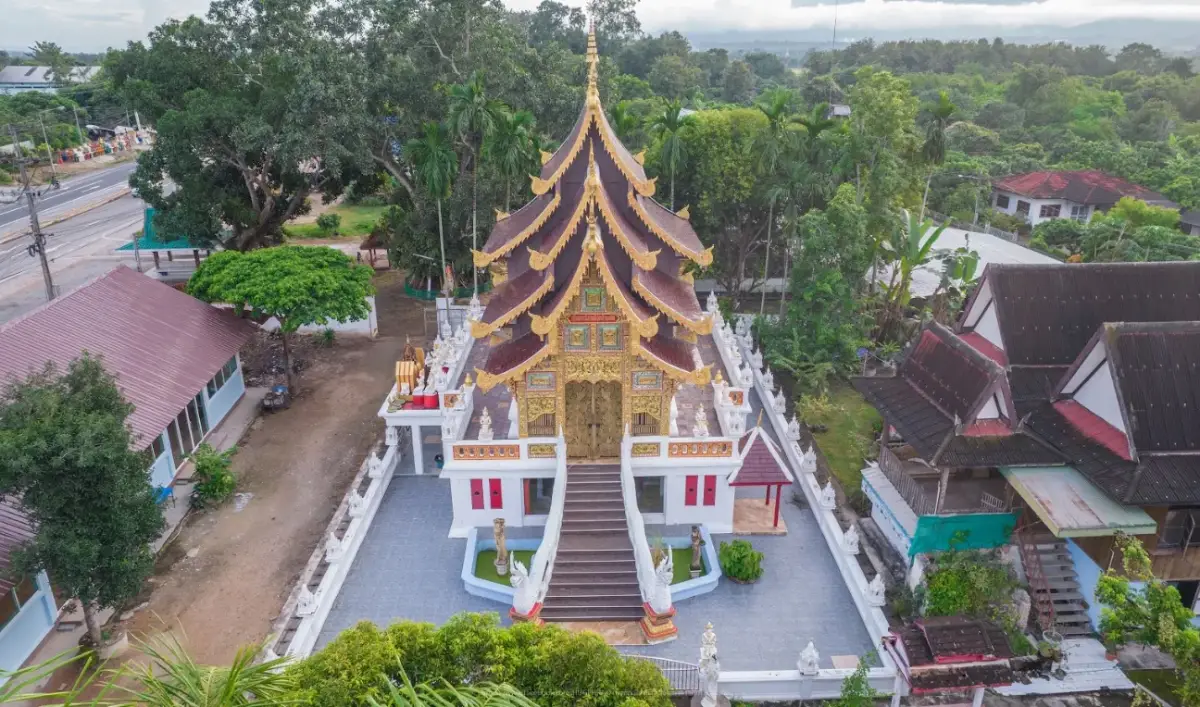
Wat Ban Mo
Open Days: Daily
Opening Hours: 08.00 – 17.00
Wat Ban Mo is a private-sector Buddhist temple under the Mahanikaya order in Ban Mo, Moo 5, Thung Luang Subdistrict, Phrao District, Chiang Mai Province. Built in 1907, the temple occupies 2 rai, 1 ngan and 20 square wah of land and is regarded as one of the old temples of Phrao District. Its most important historical feature is its connection with the former Wat Ban Mo site, located about 500 meters from the present temple, where an old abandoned ordination hall still remains. Although the old hall is no longer usable, it continues to be respected by local residents as a sacred and historically meaningful place.
Ban Mo is an important village in Thung Luang Subdistrict, a historic rural area south of the old Wiang Phrao settlement. The name Thung Luang evokes a broad rice-field landscape, and the subdistrict has long been connected with farming, waterways, local temples, and Lanna community traditions. Wat Ban Mo stands within this cultural setting, where village life, temple life, rice fields, and annual merit-making remain closely linked.
The history of Ban Mo itself adds depth to the temple’s story. Local accounts say that the community was once located in a lowland area to the northwest of the present village, but flooding caused residents to move to higher ground. This relocation gives Wat Ban Mo a meaning beyond that of a simple village temple. The temple represents settlement, adaptation, memory, and the continuing Buddhist faith of the Ban Mo community.
Wat Ban Mo was established in 1907, at a time when local temples in Phrao were central to religious and social life. A village temple of this kind was built through the faith and cooperation of monks, village leaders, and local residents. It provided a place for worship, merit-making, Dhamma listening, Buddhist ceremonies, and community gathering. More than a century later, Wat Ban Mo continues to serve as a spiritual center for Ban Mo and nearby communities.
The name Wat Ban Mo is directly tied to the village. A temple that carries the same name as its community preserves local identity and memory. When people speak of Wat Ban Mo, they are also referring to Ban Mo itself, its elders, annual ceremonies, village stories, and the long relationship between Buddhism and rural life in Thung Luang Subdistrict.
The former Wat Ban Mo site is one of the key reasons the temple is historically significant. It lies about 500 meters from the present temple and still has one old abandoned ordination hall. The building is ancient and damaged, but local people continue to respect it as a sacred place. This gives Wat Ban Mo two connected layers: the living temple in current use and the old temple site that preserves community memory.
The old ordination hall is important because an ordination hall is one of the most sacred buildings in a Buddhist temple. Even though the old hall can no longer be used, it remains a witness to the earlier religious life of Ban Mo. Respect for the old hall is therefore not merely respect for a building; it is respect for the people, monks, and community faith that shaped the village in the past.
The temple structures of Wat Ban Mo include one viharn, two monks’ residences, a Dhamma hall, a bell tower, and the old ordination hall at the former temple site. These structures reflect the role of a Lanna village temple. The viharn is used for worship and Dhamma listening, the monks’ residences support monastic life, the Dhamma hall supports sermons and community activities, and the bell tower marks the rhythm of temple life.
Wat Ban Mo received its Phatthasima in 2002, strengthening its formal Buddhist status. The sacred boundary is associated with important monastic acts and confirms the temple’s role not only as a village merit-making place but also as a recognized Buddhist institution within the Sangha structure.
The current abbot of Wat Ban Mo is Phra Khru Sunthon Piyawan Piyawanno. As abbot, he oversees the temple’s religious life and relationship with the local community. A village temple depends on cooperation among monks, temple caretakers, local leaders, and lay supporters. Through this cooperation, Wat Ban Mo remains an active sacred space rather than only a historical site.
Wat Ban Mo is known as a temple where many local residents gather for Buddhist ceremonies. Activities such as Buddhist holy day merit-making, Dhamma listening, Pha Pa, Kathin, Buddhist Lent ceremonies, and annual community events bring people together at the temple. These activities maintain both religious practice and social unity within the village.
In recent years, Wat Ban Mo has continued to serve the community through religious, cultural, and public activities. It has been used for events celebrating the temple’s 118th anniversary, local cultural activities, and coordination with Wiang Phrao Municipality concerning monastic land for public benefit. This shows that the temple remains active and relevant to local life.
The temple plays several roles in the community. Religiously, it is a place for worship, merit-making, Dhamma listening, precepts, and Buddhist ceremonies. Socially, it is a gathering space for villagers during annual events. Historically, it connects the present village with the former temple site and its old ordination hall. Culturally, it helps preserve Lanna Buddhist traditions and the shared identity of Ban Mo.
Wat Ban Mo is suitable for travelers interested in old village temples, Lanna Buddhist culture, and local history in Phrao District. Visitors can pay respect at the present temple, observe the atmosphere of a working community temple, and learn about the former Wat Ban Mo site nearby. The value of a visit lies not in large-scale architecture but in the temple’s historical layers and its continuing role in community life.
Ban Mo and Thung Luang Subdistrict are also suitable for a cultural travel route. Nearby places include Wat Thung Luang, Wat Pa Chi, Mae Chat religious site, Wat Phra That Doi Wiang Chai Mongkhon, Wat Khuean Phak, Wat Huai Bong, and Wat Sahakon Plaeng Song. This route allows travelers to experience old temples, folk museums, community learning centers, Lanna temple art, and rural landscapes in Phrao District.
Getting There is most convenient by private car, rental car, or local hired transport. From Chiang Mai city, travel toward Phrao District, then continue into Thung Luang Subdistrict and Ban Mo, Moo 5. Travelers can search for “Wat Ban Mo, Thung Luang, Phrao, Chiang Mai” or use the address 17 Moo 5, Ban Mo, Thung Luang Subdistrict, Phrao District, Chiang Mai 50190 in a map application.
From Phrao town, the temple can be combined easily with other nearby temples. A half-day route can include Wat Ban Mo, Wat Thung Luang, Wat Pa Chi, and Mae Chat religious site. With more time, visitors can continue toward Wat Phra That Doi Wiang Chai Mongkhon or the Khuean Phak route, which includes Wat Khuean Phak, Wat Huai Bong, and Wat Sahakon Plaeng Song.
Visitors should dress modestly, speak quietly, respect monks and worshippers, and avoid entering private monastic areas. If visiting the old ordination hall at the former temple site, extra care is needed because the building is old and damaged. Visitors should not climb, touch, or enter unsafe areas without permission. Respectful behavior is important because the site remains sacred to the local community.
In summary, Wat Ban Mo is a Mahanikaya private-sector temple in Ban Mo, Moo 5, Thung Luang Subdistrict, Phrao District, Chiang Mai Province. Established in 1907, occupying 2 rai, 1 ngan and 20 square wah, and granted Phatthasima in 2002, the temple is led by Phra Khru Sunthon Piyawan Piyawanno. Its main value lies in its old temple history, the abandoned ordination hall at the former Wat Ban Mo site, and its continuing role as a spiritual and ceremonial center for the Ban Mo community.
| Name | Wat Ban Mo |
| Location | Ban Mo, Moo 5, Thung Luang Subdistrict, Phrao District, Chiang Mai Province |
| Address | 17 Moo 5, Ban Mo, Thung Luang Subdistrict, Phrao District, Chiang Mai 50190, Thailand |
| Open Days | Daily |
| Opening Hours | 08.00 – 17.00 |
| Temple Type | Private-Sector Buddhist Temple, Mahanikaya Order |
| Temple Area | 2 rai, 1 ngan and 20 square wah |
| Highlights | Old community temple of Phrao, established in 1907, connected with the former Wat Ban Mo site about 500 meters away, where an old abandoned ordination hall remains respected by local residents |
| History | Established in 1907 and granted Phatthasima in 2002 |
| Former Wat Ban Mo Site | Located about 500 meters from the present temple; one old abandoned ordination hall remains, damaged but still revered by local residents |
| Main Areas / Structures | 1 viharn, 2 monks’ residences, Dhamma hall, bell tower, temple courtyard, merit-making area, sermon area, and old ordination hall at the former temple site |
| Abbot / Caretaker | Phra Khru Sunthon Piyawan Piyawanno |
| Community Role | Spiritual center for worship, merit-making, Dhamma listening, Buddhist ceremonies, and the preservation of Ban Mo community memory |
| Important Activities / Ceremonies | Buddhist holy day merit-making, Pha Pa, Kathin, Dhamma sermons, Buddhist Lent activities, local cultural ceremonies, and annual community merit-making events |
| Travel Information | Best reached by private car, rental car, or local hired transport from Chiang Mai toward Phrao District, then into Thung Luang Subdistrict and Ban Mo, Moo 5 |
| Current Status | Active community temple used for religious activities, cultural events, and public community-related purposes in Ban Mo and Thung Luang Subdistrict |
| Nearby Tourist Attractions | 1. Former Wat Ban Mo Site, about 0.5 km 2. Wat Thung Luang, about 3 km 3. Wat Pa Chi, about 4 km 4. Mae Chat Religious Site, about 5 km 5. Wat Phra That Doi Wiang Chai Mongkhon, about 18 km 6. Wat Khuean Phak, about 20 km 7. Wat Huai Bong, about 22 km |
| Nearby Restaurants | 1. 135 Cafe, about 6 km, Tel. 083-549-6399 2. Jin Jum And Made-To-Order Food, about 8 km, Tel. 053-475-209 3. Krua Jae Kee, about 9 km, Tel. 084-488-8560 4. Krua Ban Mong, about 10 km, Tel. 099-345-0782 5. Rain Tree Cafe, about 16 km, Tel. 087-660-0933 6. Nong Prince Chicken Rice, about 18 km, Tel. 094-559-0182 |
| Nearby Accommodations | 1. PK Hotel / PK Hostel, about 8 km, Tel. 088-992-2444 2. Phrao Boutique Hotel, about 9 km 3. Inthang Boutique Hotel, about 10 km 4. Phrao Camping Village, about 13 km, Tel. 091-564-2641 5. Mae Wan Resort, about 20 km |
Frequently Asked Questions (FAQ)
Q: Where is Wat Ban Mo located?
A: Wat Ban Mo is located in Ban Mo, Moo 5, Thung Luang Subdistrict, Phrao District, Chiang Mai Province 50190.
Q: What is the history of Wat Ban Mo?
A: Wat Ban Mo is a private-sector Mahanikaya temple established in 1907 and regarded as one of the old temples of Phrao District.
Q: How is the former Wat Ban Mo site related to the present temple?
A: The former Wat Ban Mo site is located about 500 meters from the present temple. It still has one old abandoned ordination hall that is damaged but remains revered by local residents.
Q: Who is the abbot of Wat Ban Mo?
A: The abbot of Wat Ban Mo is Phra Khru Sunthon Piyawan Piyawanno.
Q: What important structures are found at Wat Ban Mo?
A: The temple has one viharn, two monks’ residences, a Dhamma hall, a bell tower, and the old ordination hall at the former temple site.
Q: What kind of visit is Wat Ban Mo suitable for?
A: It is suitable for worship, merit-making, learning about old temples in Phrao, exploring Ban Mo community history, and joining a temple route through Thung Luang Subdistrict.
Q: How can travelers get to Wat Ban Mo?
A: The most convenient way is by private car, rental car, or local hired transport from Chiang Mai toward Phrao District, then into Thung Luang Subdistrict and Ban Mo, Moo 5.
Q: What places can be visited together with Wat Ban Mo?
A: Nearby places include the former Wat Ban Mo site, Wat Thung Luang, Wat Pa Chi, Mae Chat religious site, Wat Phra That Doi Wiang Chai Mongkhon, Wat Khuean Phak, and Wat Huai Bong.
 Category: ●Places of Worship
 Group: ●Temple
Last Update : 2 WeekAgo
 Last Update : 2 WeekAgo
 Click to Access the Navigation Map GPS
 Muang Chiang Mai(121)Chom Thong(47)Mae Chaem(25)Chiang Dao(33)Doi Saket(68)Mae Taeng(85)Mae Rim(69)Samoeng(29)Fang(71)Mae Ai(59)Phrao(70)San Pa Tong(103)San Kamphaeng(66)San Sai(73)Hang Dong(73)Hot(32)Doi Tao(22)Omkoi(11)Saraphi(74)Wiang Haeng(15)Chai Prakan(28)Mae Wang(32)Mae On(22)Doi Lo(33)Galyani Vadhana(1)


