
lovethailand home >North Travel Attractions >Chiang Mai Travel Attractions >Phrao >Khuean Phak > Wat Huai Bong
TL;DR: Wat Huai Bong is located at Ban Huai Bong, Moo 3, Khuean Phak Subdistrict, Phrao District, Chiang Mai Province.

Wat Huai Bong
Operating day: Daily
Operating time: 08.00 - 17.00
Wat Huai Bong is a private-sector Buddhist temple under the Mahanikaya order in Ban Huai Bong, Moo 3, Khuean Phak Subdistrict, Phrao District, Chiang Mai Province. The temple was officially permitted to be established in 1927 and received its Wisungkham Sima on 18 October 2004. Its abbot is Phra Jaroon Chayawattho. Wat Huai Bong is one of the important temples of Khuean Phak Subdistrict and Phrao District, best known for its large Chinese-style viharn, a striking Thai-Chinese architectural landmark set among rice fields, mountains, and the rural landscape of Ban Huai Bong.
The temple is located at 163 Moo 3, Khuean Phak Subdistrict, Phrao District, Chiang Mai 50190. Ban Huai Bong is a rural community surrounded by hills, agricultural land, forests, waterways, and village settlements. Local life is closely linked with farming, especially fruit orchards and seasonal agriculture. Wat Huai Bong therefore stands in a landscape where Buddhist faith, farming life, and northern Thai village culture remain closely connected.
Khuean Phak Subdistrict has old community roots connected with the Mae Ngat River, forest resources, agriculture, and cooperative land settlement. Local community history records several villages in the subdistrict, including Ban Phae Phatthana, Ban Khuean Phak, Ban Huai Bong Nuea, Ban Huai Bong Tai, Ban Sai Mun, Ban Sahakon Plaeng Song, Ban Sai Thong, Ban Chai Ngam, Ban Khwan Pracha, and Ban Muang Luang. Wat Huai Bong belongs to this wider cultural landscape of village temples, agricultural communities, and Buddhist settlement history.
Ban Huai Bong and Ban Huai Bong Nuea have an interesting settlement history. The area was once associated with Lua communities. Later, families from Phan District in Chiang Rai and people from several other places moved into the area. Around 1970–1971, government land allocation under the cooperative settlement system increased the population and led to the division of communities into multiple villages. In this context, Wat Huai Bong became important as a shared spiritual space that helped unite people, preserve Buddhist identity, and support community life.
The official history of Wat Huai Bong began in 1927, when it was permitted to be established as a temple. During that time, village temples in rural northern Thailand served as centers of religious and social life. Establishing a temple required local faith, land, monks, community support, and continuing care from laypeople. Wat Huai Bong therefore represents the long-standing Buddhist devotion of the Huai Bong community.
Community information records that Wat Huai Bong was founded by Phra Khru Techa Dechapanyo. The temple later received Wisungkham Sima on 18 October 2004. In Thai Buddhist tradition, Wisungkham Sima is a royal grant of sacred boundary used for monastic acts, especially those associated with an ordination hall. This status confirms the temple’s recognized Buddhist function and its continuing role within the Sangha.
The name Wat Huai Bong is closely connected with the local village and landscape. “Huai” means a small stream or watercourse, while “Bong” is a local place name. Together, the name preserves the identity of the village and its relationship with water, land, and settlement. Referring to Wat Huai Bong also means referring to Ban Huai Bong, its farming life, and its community memory.
The current abbot of Wat Huai Bong is Phra Jaroon Chayawattho. As abbot, he serves as the temple’s religious leader and caretaker of its relationship with the community. A village temple depends on cooperation between monks, local leaders, and lay supporters. This cooperation allows the temple to maintain its grounds, organize merit-making activities, support Buddhist ceremonies, and remain a living spiritual center for local residents.
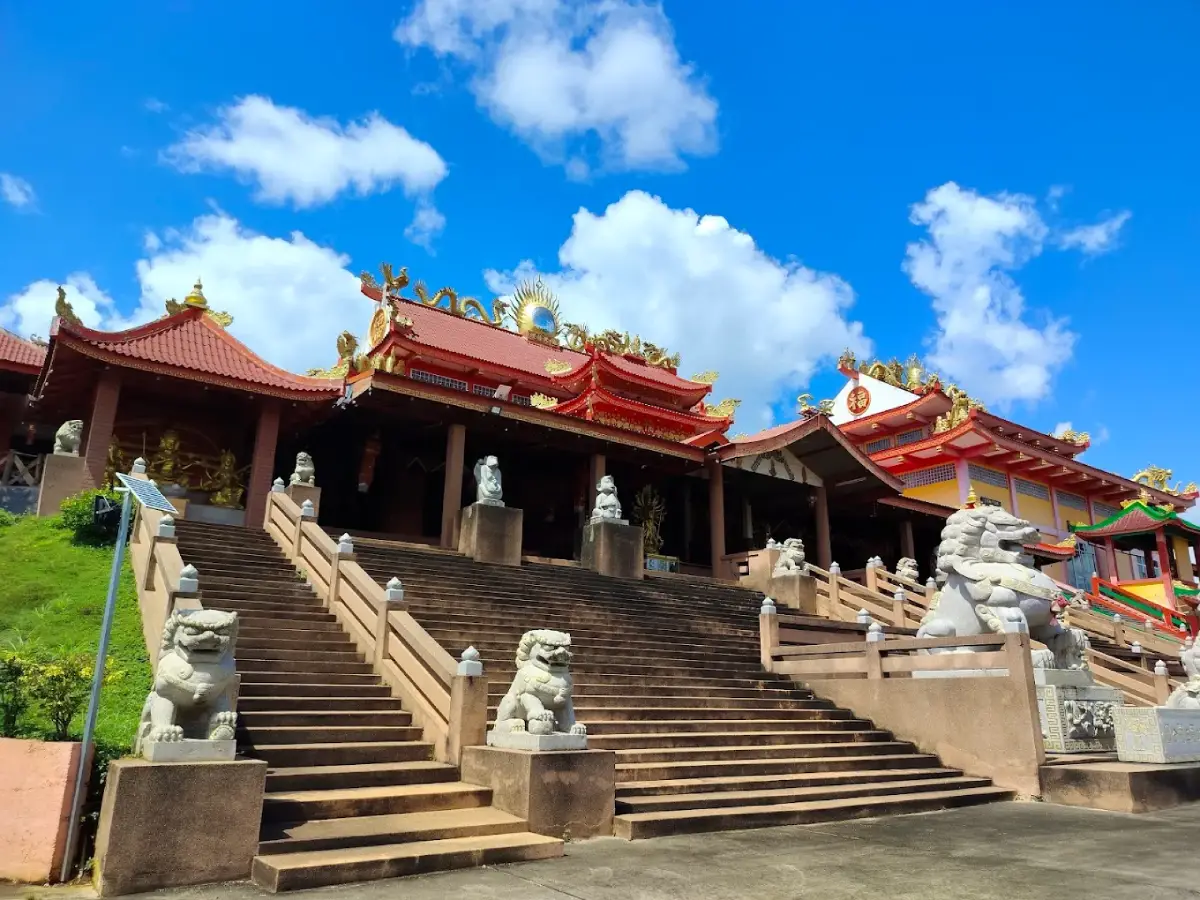
The most distinctive feature of Wat Huai Bong is its large Chinese-style viharn. The building is visually striking, with red, yellow, and green tones standing out against the green rice fields and surrounding hills. This makes Wat Huai Bong one of the most visually memorable temples in Phrao District. It is a Mahanikaya community temple that combines Thai Buddhist identity with Chinese artistic and devotional elements.
The Chinese viharn was built in 2004 through the support of disciples of Chao Khun Mongkhon Sri Rattanaphon and relatives. The building features bold colors, Chinese-style ornamentation, and large guardian lion statues at the stairway entrance. Seen from below, the viharn rises prominently from the surrounding landscape, creating a strong sense of sacred presence and architectural character.
Inside and around the Chinese viharn are many sacred images and devotional figures, including Phra Si Ariya Maitreya, bodhisattvas, Guanyin, Brahma, and various deities and immortals associated with Chinese Buddhist and folk devotional traditions. This combination of sacred figures makes the temple a place where visitors can experience both Thai Buddhist worship and Chinese-influenced devotional art in the same space.
The temple’s appeal also comes from its hillside setting. From the viharn area, visitors can see houses, rice fields, and the surrounding mountain scenery. The colors of the viharn become especially vivid against the green rural landscape. This gives Wat Huai Bong a peaceful atmosphere suitable for worship, merit-making, photography, and slow cultural travel.
Wat Huai Bong has cultural value as well as religious value. Visitors can pay respect to Buddha images, worship sacred figures inside the viharn, observe the guardian lions and Chinese-style sculptures, and learn how Thai and Chinese Buddhist artistic elements can coexist in a rural Lanna temple. The temple is suitable for travelers interested in community temples, Chinese-style Buddhist art, and cultural routes through Phrao District.
The temple plays several roles in the local community. Religiously, it is a place for worship, merit-making, Dhamma listening, precepts, and Buddhist ceremonies. Socially, it is a gathering place for villagers during holy days, annual merit-making, and community events. Culturally, it helps preserve Lanna Buddhist traditions while also presenting a strong Thai-Chinese artistic identity through its viharn.
Temple activities at Wat Huai Bong can be connected with the Buddhist calendar and local village life. Suitable events include Buddhist holy day merit-making, Pha Pa, Kathin, Dhamma listening, Northern Thai New Year activities, Loy Krathong, and annual Lanna community merit-making events. During these events, villagers gather to prepare the temple, offer food, receive blessings, listen to Dhamma, and strengthen community ties.
The surrounding community reflects the agricultural character of Phrao District. Residents are involved in farming, orchards, longan cultivation, and seasonal agricultural work. The temple supports this rhythm of life by providing a place for merit-making, reflection, and community gathering before and after farming seasons. In this way, Wat Huai Bong links labor, faith, gratitude, and community hope.
Ban Huai Bong Nuea is also known as a large community with pleasant natural surroundings, forests, rice fields, and village activity spaces. Khuean Phak Witthaya School is known as the only school for novices in Phrao District, while the area also has an elderly activity school. This wider community context shows that the area around Wat Huai Bong is not only a temple destination but also a living rural community with education, senior activities, agriculture, and religious life.
Wat Huai Bong is suitable for visitors who want a peaceful temple with a strong architectural highlight. A visit can begin with worship inside the temple area, then continue to the Chinese viharn, the guardian lion statues, the sacred images, and viewpoints over the village and fields. Visitors should allow enough time to appreciate the details of the viharn and the calm setting rather than rushing through the site.
For photography, the temple offers several good viewpoints: the stairway leading to the viharn, the pair of lion statues at the entrance, wide-angle views of the red, yellow, and green building against fields and hills, and elevated views from the viharn area. Photography should remain respectful, especially near sacred images and worshippers.
Wat Huai Bong can be included in a temple and rural culture route through Khuean Phak and Phrao. Nearby places include Wat Khuean Phak, Wat Sahakon Plaeng Song, Phra That Dok Kham, Nong Hiang Reservoir, Huai Mae Lat Reservoir, and Wat Tham Dok Kham. With more time, visitors can continue to important Phrao temple routes such as Wat Doi Mae Pang, Wat Phra That Doi Wiang Chai Mongkhon, Luang Pu Khao Anālayo’s awakening memorial, and Wat Pa Acharn Mun Bhuridatto.
Getting There is most convenient by private car, rental car, or local hired transport. From Chiang Mai city, travel toward Phrao District, then continue into Khuean Phak Subdistrict and Ban Huai Bong, Moo 3. Travelers can search for “Wat Huai Bong, Khuean Phak, Phrao, Chiang Mai” or use the address 163 Moo 3, Khuean Phak Subdistrict, Phrao District, Chiang Mai 50190 in a map application before departure.
From Phrao town, reaching Khuean Phak Subdistrict and Ban Huai Bong is easier than traveling from Chiang Mai city. Visitors who want to explore several places in one day can begin at Wat Huai Bong, then continue to Wat Khuean Phak, Wat Sahakon Plaeng Song, Phra That Dok Kham, nearby reservoirs, or cafés and restaurants along the Phrao route. This allows travelers to experience temples, villages, fields, local food, and the rural landscape of Phrao in one trip.
Visitors should dress modestly, speak quietly, respect monks and worshippers, avoid entering private monastic areas, and take photographs respectfully. Extra care is recommended on stairs and walkways during or after rain, as surfaces may become slippery. A visit to the temple should be based on respect for the sacred space, not only on taking photographs.
In summary, Wat Huai Bong is a Mahanikaya private-sector temple in Ban Huai Bong, Moo 3, Khuean Phak Subdistrict, Phrao District, Chiang Mai Province. Established in 1927 and granted Wisungkham Sima on 18 October 2004, it is led by Phra Jaroon Chayawattho. Its main highlight is the large Chinese-style viharn built in 2004, with red, yellow, and green architecture, guardian lions, and sacred figures such as Phra Si Ariya Maitreya, bodhisattvas, Guanyin, Brahma, and Chinese deities. The temple is suitable for worship, merit-making, studying Thai-Chinese Buddhist art, and joining a wider cultural route through Phrao District.
| Name | Wat Huai Bong |
| Location | Ban Huai Bong, Moo 3, Khuean Phak Subdistrict, Phrao District, Chiang Mai Province |
| Address | 163 Moo 3, Khuean Phak Subdistrict, Phrao District, Chiang Mai 50190, Thailand |
| Temple Type | Private-Sector Buddhist Temple, Mahanikaya Order |
| Highlights | Large red, yellow, and green Chinese-style viharn, Thai-Chinese architecture, guardian lion statues, Chinese devotional figures, and views of rice fields and mountains around Ban Huai Bong |
| History | Officially permitted to be established as a temple in 1927 and granted Wisungkham Sima on 18 October 2004 |
| Founder Mentioned In Community Sources | Phra Khru Techa Dechapanyo |
| Abbot / Caretaker | Phra Jaroon Chayawattho |
| Important Structures | Chinese-style viharn, Thai-style viharn, Buddha worship area, temple courtyard, merit-making area, and viewpoint area over the village and rice fields |
| Sacred Figures | Phra Si Ariya Maitreya, bodhisattvas, Guanyin, Brahma, Chinese deities and immortals, and Buddha images inside the temple |
| Community Context | Ban Huai Bong and Ban Huai Bong Nuea are agricultural communities in Khuean Phak Subdistrict, connected with rice fields, hills, waterways, and cooperative land-settlement history |
| Community Role | Spiritual center for worship, merit-making, Dhamma listening, annual ceremonies, and learning about Thai-Chinese temple art in Phrao District |
| Important Activities / Ceremonies | Buddhist holy day merit-making, Pha Pa, Kathin, Dhamma sermons, Northern Thai New Year, Loy Krathong, and annual Lanna community merit-making activities |
| Travel Information | Best reached by private car, rental car, or local hired transport from Chiang Mai toward Phrao District, then into Khuean Phak Subdistrict and Ban Huai Bong, Moo 3 |
| Current Status | Listed in temple directories, Phrao tourism information, community information, and map references; no public record found indicating permanent closure |
| Nearby Tourist Attractions | 1. Wat Khuean Phak, about 6 km 2. Wat Sahakon Plaeng Song, about 8 km 3. Nong Hiang Reservoir, about 8 km 4. Phra That Dok Kham, about 9 km 5. Huai Mae Lat Reservoir, about 10 km 6. Wat Tham Dok Kham, about 17 km |
| Nearby Restaurants | 1. Nong Prince Chicken Rice, about 3 km, Tel. 094-559-0182 2. Rain Tree Cafe, about 6 km, Tel. 087-660-0933 3. 135 Cafe, about 8 km, Tel. 083-549-6399 4. Jin Jum And Made-To-Order Food, about 9 km, Tel. 053-475-209 5. Krua Jae Kee, about 10 km, Tel. 084-488-8560 6. Krua Ban Mong, about 11 km, Tel. 099-345-0782 |
| Nearby Accommodations | 1. PK Hotel / PK Hostel, about 7 km 2. Phrao Boutique Hotel, about 8 km 3. Inthang Boutique Hotel, about 9 km 4. Phrao Camping Village, about 12 km, Tel. 091-564-2641 5. Mae Wan Resort, about 19 km |
Frequently Asked Questions (FAQ)
Q: Where is Wat Huai Bong located?
A: Wat Huai Bong is located at 163 Moo 3, Khuean Phak Subdistrict, Phrao District, Chiang Mai 50190, Thailand.
Q: What is the history of Wat Huai Bong?
A: Wat Huai Bong is a private-sector Mahanikaya temple officially established in 1927 and granted Wisungkham Sima on 18 October 2004.
Q: Who is the abbot of Wat Huai Bong?
A: The abbot of Wat Huai Bong is Phra Jaroon Chayawattho.
Q: What are the main highlights of Wat Huai Bong?
A: The main highlight is the large Chinese-style viharn with red, yellow, and green architecture, guardian lion statues, sacred Chinese Buddhist figures, and views of rice fields and mountains.
Q: What sacred figures are found inside the Chinese viharn?
A: The viharn includes sacred figures such as Phra Si Ariya Maitreya, bodhisattvas, Guanyin, Brahma, Chinese deities and immortals, as well as Buddha images.
Q: What kind of visit is Wat Huai Bong suitable for?
A: It is suitable for worship, merit-making, observing Thai-Chinese temple art, respectful photography, learning about community temples, and joining a temple route through Phrao District.
Q: How can travelers get to Wat Huai Bong?
A: The most convenient way is by private car, rental car, or local hired transport from Chiang Mai toward Phrao District, then into Khuean Phak Subdistrict and Ban Huai Bong, Moo 3.
Q: What places can be visited together with Wat Huai Bong?
A: Nearby places include Wat Khuean Phak, Wat Sahakon Plaeng Song, Nong Hiang Reservoir, Phra That Dok Kham, Huai Mae Lat Reservoir, and Wat Tham Dok Kham.
 Category: ●Places of Worship
 Group: ●Temple
Last Update : 2 MonthAgo
 Last Update : 2 MonthAgo
 Click to Access the Navigation Map GPS
Wat Huai Bong Map
Recommend

 Muang Chiang Mai(121)Chom Thong(47)Mae Chaem(25)Chiang Dao(33)Doi Saket(68)Mae Taeng(85)Mae Rim(69)Samoeng(29)Fang(71)Mae Ai(59)Phrao(70)San Pa Tong(103)San Kamphaeng(66)San Sai(73)Hang Dong(73)Hot(32)Doi Tao(22)Omkoi(11)Saraphi(74)Wiang Haeng(15)Chai Prakan(28)Mae Wang(32)Mae On(22)Doi Lo(33)Galyani Vadhana(1)


