
lovethailand home >North Travel Attractions >Chiang Mai Travel Attractions >Doi Lo >Santi Suk > Wat Sila Mongkhon
TL;DR: Wat Sila Mongkhon is located at Ban Nong Hiang, Moo 2, Santi Suk Subdistrict, Doi Lo District, Chiang Mai 50160, Thailand. is a community Buddhist temple in Ban Nong Hiang, Moo 2, Santi Suk Subdistrict, Doi Lo District, Chiang Mai Province 50160. The temple.

Wat Sila Mongkhon
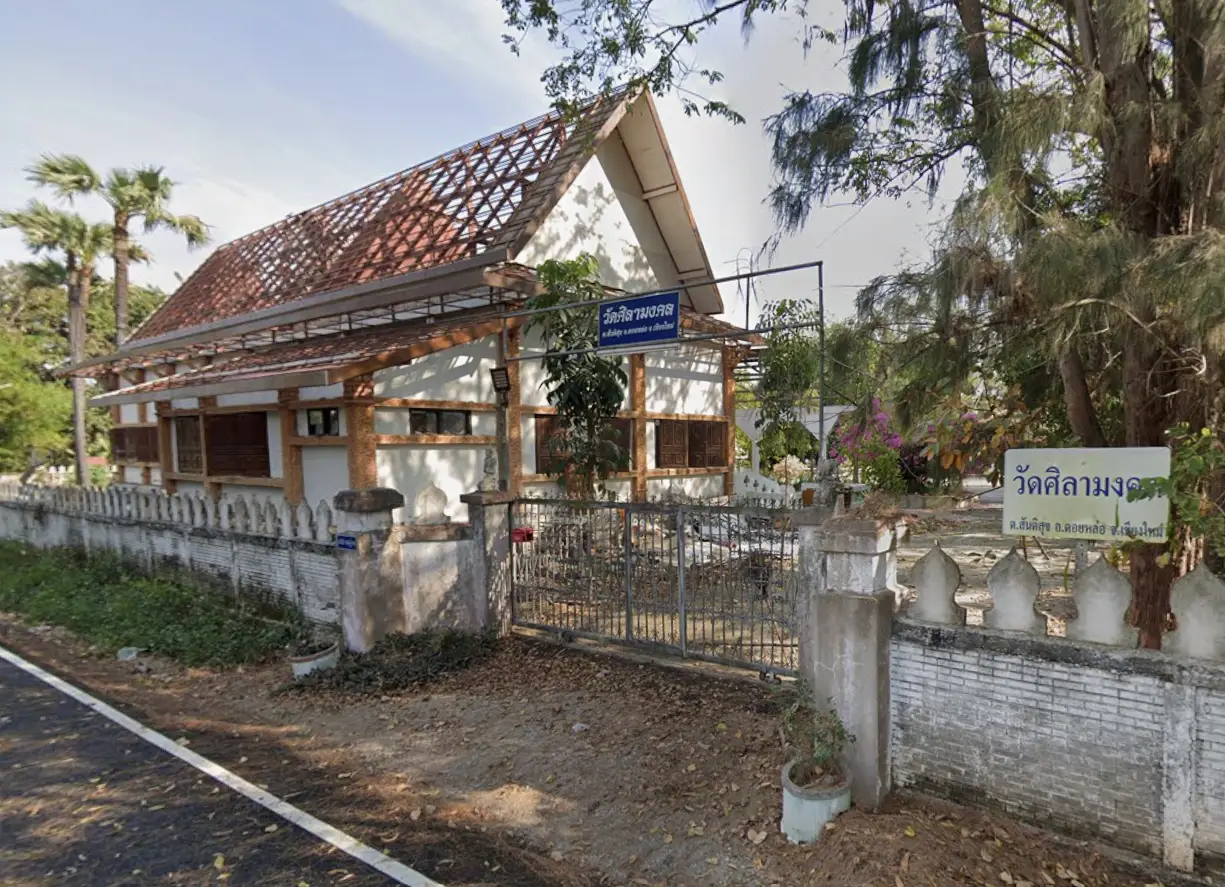
Operating day: Daily
Operating time: 08.00 - 17.00
Wat Sila Mongkhon is a community Buddhist temple in Ban Nong Hiang, Moo 2, Santi Suk Subdistrict, Doi Lo District, Chiang Mai Province 50160. The temple belongs to the Maha Nikaya tradition and is registered under temple code 350240402. Wat Sila Mongkhon continues to serve as a religious and cultural center for the surrounding community, with the annual Phra That bathing tradition forming one of its most distinctive living traditions.
The temple stands within Ban Nong Hiang, a rural community in Santi Suk Subdistrict. The surrounding landscape is characterized by local homes, agricultural land, village roads, and several nearby Buddhist temples. Wat Sila Mongkhon is therefore closely integrated into everyday village life rather than functioning as an isolated tourist attraction.
Ban Nong Hiang contains more than one Buddhist temple. Wat Sila Mongkhon and Wat Nong Hiang are both associated with Moo 2, illustrating how a single Lanna community can contain multiple religious centers that developed in different periods and serve different devotional traditions.
This pattern is not unusual in northern Thailand. As communities expand and different groups of residents develop their own religious centers, several temples may exist within a relatively small area. Wat Sila Mongkhon should therefore be understood as part of the wider Buddhist landscape of Santi Suk rather than only as a stand-alone destination.
Within the local Sangha structure, Wat Sila Mongkhon forms part of the same network as Wat Khanthawat, Wat Pa Lan, Wat Nong Hiang, Wat Huai Din Chi, and Wat Mai Nong Hoi. Together, these temples provide religious centers for the villages of Santi Suk and preserve Buddhist and Lanna traditions across the subdistrict.
The temple's name, “Sila Mongkhon,” combines words associated with stone and auspiciousness, but there is not enough detailed local historical material to define a specific origin for the name. The name is therefore best treated as the established identity of the temple rather than given a speculative interpretation.
Wat Sila Mongkhon also remains connected with the practical development of the surrounding community. In 2026, the temple land was involved in a land-use review related to a village water-supply system. This illustrates how temple property in rural Thailand may be linked not only to religious activities but also to the infrastructure and collective needs of the village.
The continued management of temple land also confirms that Wat Sila Mongkhon remains an active institutional religious site rather than an abandoned monastery. Its property, religious traditions, and relationship with the village continue to require active administration.
The annual Phra That bathing tradition is one of the strongest features of Wat Sila Mongkhon. The ceremony continues to be supported as part of Santi Suk's local cultural traditions, demonstrating the temple's continuing role in community Buddhist life.
Bathing a sacred stupa is a major Lanna Buddhist tradition. Local residents gather to make merit, pay respect to the Phra That, and symbolically bathe the sacred structure. The ceremony creates an important meeting point between Buddhist devotion and community identity.
The tradition is especially meaningful because it brings together several generations. Older residents transmit ritual knowledge and local customs, monks lead Buddhist ceremonies, and younger members of the community participate in preparing the temple, offerings, food, and festival activities.
Similar stupa-bathing traditions are maintained at several religious sites in Santi Suk, including Wat Pa Lan, Wat Khanthawat, and Wat Huai Din Chi. Together, these ceremonies demonstrate how devotion to sacred stupas remains an important part of Lanna Buddhist culture in Doi Lo.
At Wat Sila Mongkhon, the existence of the annual ceremony makes the Phra That one of the principal sacred elements for visitors to respect. Current documentation does not provide enough detail to assign an exact construction date, architectural period, or relic history to the stupa, so its importance is best understood through the living tradition associated with it.
The temple also has historical links with senior monks in the Doi Lo area. Phra Khru Bunmee Sumetho of Wat Sila Mongkhon participated with other Lanna monks in an important consecration ceremony at Wat Fa Lang in 1997. His involvement places Wat Sila Mongkhon within a wider network of respected monks serving communities in what was historically the Chom Thong area and later became Doi Lo District.
Phra Khru Bunmee Sumetho is therefore relevant to the historical record of the temple, but his name should not automatically be presented as that of the present abbot. More than two decades have passed, and a sufficiently recent confirmation of the current abbot is not available for inclusion here.
Reliable current information is also insufficient to describe the exact architectural history of the vihara, ubosot, principal Buddha image, sermon hall, bell tower, or individual monastic structures. This is particularly important because several temples elsewhere in Thailand share the name Wat Sila Mongkhon, making it easy for architectural information from another province to be incorrectly attached to the Chiang Mai temple.
Visitors should therefore focus on the sacred stupa, the active religious spaces, and the atmosphere of a working community temple. Buildings used by monks should be approached respectfully, and access should follow the conditions in place on the day of the visit.
The atmosphere is well suited to travelers who prefer quiet local temples rather than heavily visited tourist landmarks. Santi Suk retains a rural character, with orchards, farmland, and village communities surrounding the religious sites.
Morning visits are particularly suitable for travelers seeking a peaceful atmosphere and the possibility of merit-making. During the annual Phra That bathing tradition, the temple becomes more active as residents and Buddhist supporters gather for the ceremony.
Wat Sila Mongkhon serves the community throughout the year as a place for Buddhist worship, family ceremonies, merit-making, and village religious activities. The temple's importance therefore extends beyond any single festival.
The temple's location makes it easy to combine with other religious sites in Santi Suk. Wat Nong Hiang is also located in Moo 2, while Wat Khanthawat is associated with Moo 3, Wat Huai Din Chi with Moo 5, and Wat Mai Nong Hoi with Moo 6.
Wat Nong Hiang is one of the most natural additions to the route because it serves the same village area. While Wat Nong Hiang is known for Buddhist murals relating to the Five Precepts, Wat Sila Mongkhon is particularly associated with its Phra That bathing tradition.
Wat Huai Din Chi can also be included in the same cultural route. Its history includes the revival of an abandoned religious site and its own stupa-bathing tradition. Visiting both temples illustrates how similar Lanna ceremonies can develop within different local histories.
Wat Mai Nong Hoi provides another contrast because it developed together with a planned agricultural settlement, while Wat Khanthawat is one of the established religious centers of Santi Suk. A multi-temple journey therefore provides a broader understanding of the subdistrict than visiting only one monastery.
Travelers interested in religious art and belief can continue to the Ganesha Museum in Doi Lo. Those seeking a nature component can extend the journey toward Pha Chor in Mae Wang National Park, where a walking trail leads through dramatic eroded earth formations.
Food options are available along the roads of Santi Suk and the wider Doi Lo area. Local choices include Auntie Tui's Northern Thai Sausage, Kao Lam Yai Noodle Shop at Ban Rai Wan Mai, Ran Ku Restaurant, Khao Hom Restaurant, and smaller village food shops.
Accommodation in and around Doi Lo includes Pimprajan Homestay, Huan Janto Homestay, Baan Kiang Chan Resort, NY Garden Homestay, and Doi Lo Coff or Drunk Homestay. Staying locally can be useful for travelers continuing toward Chom Thong, Doi Inthanon, Mae Wang, or San Pa Tong.
Getting There is easiest by private car or rental car. From central Chiang Mai, travel south along the Chiang Mai-Hot road through Hang Dong and San Pa Tong toward Doi Lo District. Continue into Santi Suk Subdistrict and Ban Nong Hiang, Moo 2.
When using navigation services, search for the full name “Wat Sila Mongkhon, Santi Suk, Doi Lo, Chiang Mai” and confirm that the destination is in Ban Nong Hiang, Moo 2. Several temples in Thailand share the name Wat Sila Mongkhon, including temples in other provinces.
Visitors should dress modestly, cover shoulders and knees, remove shoes where required, and keep noise to a minimum around active religious and monastic areas. Sacred structures should not be touched unless local practice clearly permits it.
During the Phra That bathing ceremony, visitors should follow the order of the local ritual and respect instructions from monks and residents. The ceremony is first and foremost a community religious tradition rather than a staged tourist event.
Wat Sila Mongkhon is particularly suitable for cultural travelers, visitors interested in Lanna Buddhist traditions, and those exploring community temples in southern Chiang Mai. It offers a quieter and more locally grounded experience than major urban temples.
The continuing Phra That bathing tradition demonstrates that the temple remains culturally active. Local participation and the continued use of temple space for community religious activities show that Wat Sila Mongkhon is not merely a historical site but a living religious institution.
For visitors seeking to understand rural Lanna culture, Wat Sila Mongkhon provides a useful example of how a temple functions as a home for monks, a merit-making center, a festival venue, and a focal point for relationships within the village.
Wat Sila Mongkhon is therefore best approached not simply as another temple to photograph but as part of the living cultural landscape of Ban Nong Hiang and Santi Suk. Paying respect at the Phra That, observing the atmosphere of the community temple, and visiting during the annual bathing tradition offer the clearest understanding of its significance.
| Name | Wat Sila Mongkhon |
| Type | Community Buddhist Temple, Maha Nikaya Tradition |
| Temple Code | 350240402 |
| Location | Ban Nong Hiang, Moo 2, Santi Suk Subdistrict, Doi Lo District, Chiang Mai 50160, Thailand |
| Tradition | Maha Nikaya |
| Main Sacred Feature | Phra That associated with the temple's annual bathing tradition |
| Important Tradition | Annual Phra That bathing tradition |
| Historical Monk | Phra Khru Bunmee Sumetho, associated with the temple's wider Lanna monastic network in the late twentieth century |
| Community Role | Religious center for merit-making, Buddhist ceremonies, festivals, and community traditions in Ban Nong Hiang and Santi Suk |
| Current Status | Active registered Buddhist temple with continuing religious and community cultural activities |
| Getting There | Travel south from Chiang Mai through Hang Dong and San Pa Tong toward Doi Lo, then continue into Santi Suk and Ban Nong Hiang, Moo 2. Private car or rental car is recommended. |
| Nearby Attractions | 1. Wat Nong Hiang 2. Wat Khanthawat 3. Wat Huai Din Chi 4. Wat Mai Nong Hoi 5. Wat Pa Santi Suk 6. Ganesha Museum |
| Nearby Restaurants | 1. Auntie Tui's Northern Thai Sausage, Tel. +66 81 322 2448 2. Kao Lam Yai Noodle Shop, Tel. +66 80 679 6973 3. Ran Ku Restaurant, Tel. +66 88 285 5979 4. Khao Hom Restaurant, Tel. +66 93 195 4302 5. Koi Food & Drinks, Tel. +66 81 672 0830 |
| Accommodation In And Around Doi Lo | 1. Pimprajan Homestay, Tel. +66 90 885 1545 2. Huan Janto Homestay, Tel. +66 94 683 0659 3. Baan Kiang Chan Resort, Tel. +66 81 783 5581 4. NY Garden Homestay, Tel. +66 81 750 0517 5. Doi Lo Coff or Drunk Homestay, Tel. +66 96 698 5875 |
Frequently Asked Questions (FAQ)
Q: Where is Wat Sila Mongkhon located?
A: Wat Sila Mongkhon is located in Ban Nong Hiang, Moo 2, Santi Suk Subdistrict, Doi Lo District, Chiang Mai Province 50160.
Q: Which Buddhist tradition does Wat Sila Mongkhon belong to?
A: Wat Sila Mongkhon is a Maha Nikaya temple registered under temple code 350240402.
Q: What is the main sacred feature of Wat Sila Mongkhon?
A: The temple's Phra That is an important sacred feature and serves as the focus of the annual Phra That bathing tradition.
Q: What important tradition is held at Wat Sila Mongkhon?
A: The temple is associated with an annual Phra That bathing tradition maintained by the Santi Suk community.
Q: Is Wat Sila Mongkhon still active?
A: Yes. The temple remains registered within the local Sangha structure and continues to be associated with religious and cultural activities in Santi Suk.
Q: Who is the current abbot of Wat Sila Mongkhon?
A: A sufficiently recent confirmation of the current abbot is not available. Phra Khru Bunmee Sumetho appears in the temple's historical monastic record.
Q: What can be visited after Wat Sila Mongkhon?
A: Nearby options include Wat Nong Hiang, Wat Khanthawat, Wat Huai Din Chi, Wat Mai Nong Hoi, Wat Pa Santi Suk, and the Ganesha Museum.
Q: What is the easiest way to reach Wat Sila Mongkhon?
A: Private car or rental car is the most convenient option. Travel south from Chiang Mai through Hang Dong and San Pa Tong toward Doi Lo, then continue to Santi Suk and Ban Nong Hiang, Moo 2.
 Category: ●Places of Worship
 Group: ●Temple
Last Update : 2 MonthAgo
 Last Update : 2 MonthAgo
 Click to Access the Navigation Map GPS

 Muang Chiang Mai(121)Chom Thong(47)Mae Chaem(25)Chiang Dao(33)Doi Saket(68)Mae Taeng(85)Mae Rim(69)Samoeng(29)Fang(71)Mae Ai(59)Phrao(70)San Pa Tong(103)San Kamphaeng(66)San Sai(73)Hang Dong(73)Hot(32)Doi Tao(22)Omkoi(11)Saraphi(74)Wiang Haeng(15)Chai Prakan(28)Mae Wang(32)Mae On(22)Doi Lo(33)Galyani Vadhana(1)


