
lovethailand home >North Travel Attractions >Chiang Mai Travel Attractions >Doi Lo >Doi Lo > Wat Mon Huai Kaeo
TL;DR: Wat Mon Huai Kaeo is located at Ban Lang Mon, Moo 14, Doi Lo Subdistrict, Doi Lo District, Chiang Mai 50160, Thailand, open Daily, hours 06:00 - 19:00.
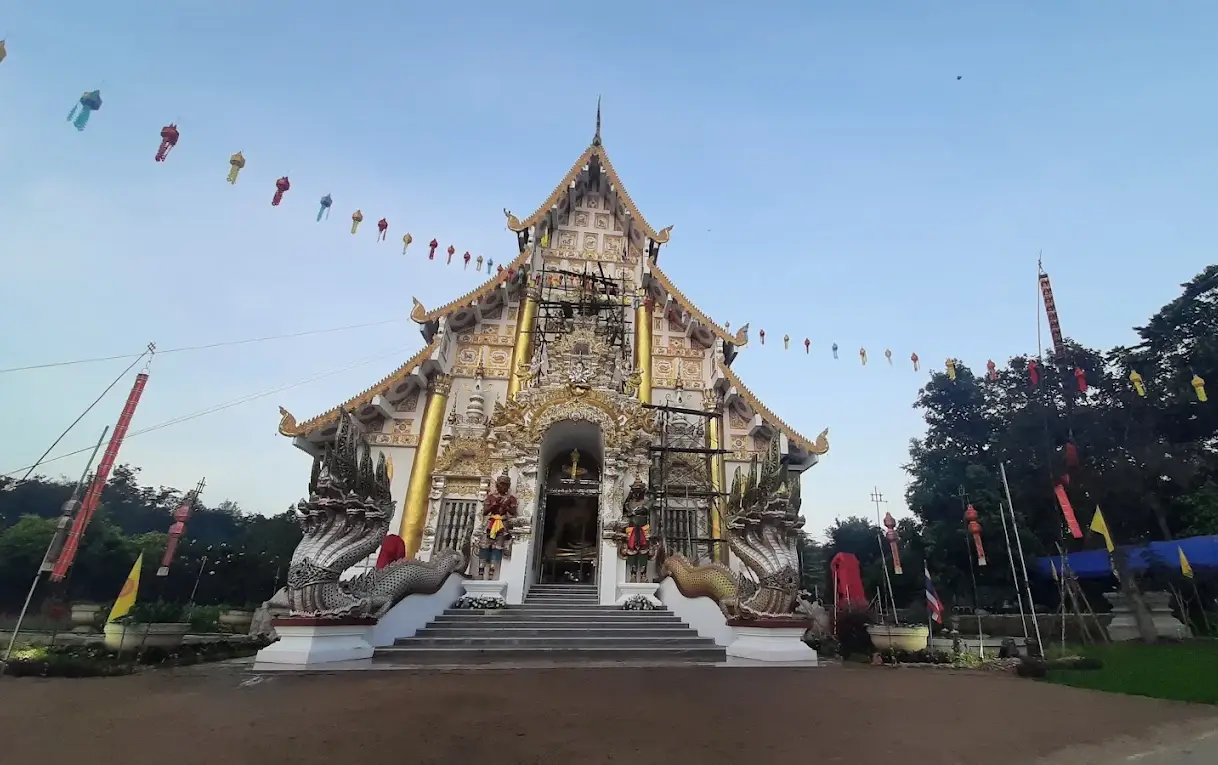
Wat Mon Huai Kaeo
Open Days: Daily
Opening Hours: 06:00 - 19:00
Wat Mon Huai Kaeo is a community Buddhist temple of the Maha Nikaya tradition located in Ban Lang Mon, Moo 14, Doi Lo Subdistrict, Doi Lo District, Chiang Mai Province. Unlike many centuries-old temples for which Chiang Mai is famous, Wat Mon Huai Kaeo has a relatively recent but exceptionally well-documented history. The temple grew directly from the needs of local residents in 1994, first operating as Rattanaram Monastic Residence before being formally established as Wat Mon Huai Kaeo on 22 June 1999. Today, it remains an active religious center for the surrounding community, where local people make merit, take part in Buddhist ceremonies, and maintain a close relationship with the resident monastic community.
The significance of Wat Mon Huai Kaeo lies not in monumental architecture or mass tourism, but in the story of how the temple was created by the people who lived around it. Before the temple existed, the site was communal public land covered by woodland, low hills, and a small stream known as Huai Kaeo. The stream was fed by natural seepage and once provided drinking water for villagers. This older landscape remains embedded in the temple's name, preserving a direct link between the Buddhist site and the natural environment that supported the local community long before the temple was built.
The temple stands in Ban Lang Mon, Moo 14, in Doi Lo Subdistrict. Historical information identifies the land as title deed No. 889, Nor Sor 4 Jor. The eastern and southern sides adjoin a residential development, while the northern and western sides border state property. The word “mon” in northern Thai usage refers to a hill or elevated rise, while “Huai Kaeo” was the name of the small stream in the area. The present name, Wat Mon Huai Kaeo, therefore reflects the physical geography of the original site rather than being an unrelated religious title.
The temple's story began in 1994 with cooperation between two nearby communities. Residents of Ban Huai Jo, Moo 5, led by Kamnan Amnuay Kabwang, and residents of Ban Lang Mon, Moo 14, led by village headman Ta Wong Takiao, agreed that a new Buddhist center was needed closer to their homes. In earlier years, villagers normally traveled to Wat Doi Lo to make merit and participate in religious ceremonies. Because Wat Doi Lo was relatively far from the two communities, especially under the transportation conditions of rural Chiang Mai at the time, residents wanted a temple that could become part of everyday community life.
Work to prepare the land began on 9 January 1994. This date marks the practical beginning of the future temple. The project was not conceived as a tourist attraction or commercial development. Its purpose was straightforward: the residents wanted a nearby place for merit-making, Buddhist observances, sermons, community ceremonies, and religious gatherings.
Only a few days after the land preparation began, an important monastic event helped establish the Buddhist character of the site. On 12 January 1994, Phra Suphromyanthera, then abbot of Wat Phra That Si Chom Thong, together with ecclesiastical leaders from Doi Lo zones 1 and 2, presided over a seven-day monastic forest-practice observance. The event marked the transition of the former communal land into a place dedicated to Buddhist practice and provided an early spiritual foundation for the new religious community.
The site was initially known as Rattanaram Monastic Residence. During this stage, the religious center developed gradually rather than emerging as a completed temple complex all at once. Buildings, monastic facilities, community activities, and the resident Sangha were established over time through donations and collective effort.
Dr. Wirat Hongbuntrai became one of the important lay supporters of the developing temple. He brought groups of Buddhist devotees from Bangkok to assist with the construction of permanent facilities. Their support complemented the work of villagers and demonstrated how the development of a rural temple could extend beyond the immediate community through wider networks of Buddhist faith and patronage.
Phra Somwang Kalyano was invited from Wat Fa Lang to serve as acting abbot and oversee both the monastic community and the continuing development of the site. His presence provided continuity as Rattanaram Monastic Residence developed toward formal recognition as a temple. The transition involved not only physical construction but also the establishment of regular Buddhist practice, resident monks, religious activities, and sustained interaction with the surrounding villages.
After approximately five years of development, the Department of Religious Affairs formally recognized the monastic residence as a temple on 22 June 1999. The official name became Wat Mon Huai Kaeo, and Phra Somwang Kalyano was appointed abbot. He continued to lead the temple's development and later received the ecclesiastical title Phra Khru Kalyanapramot. Current temple information from 2025 continues to identify Phra Khru Kalyanapramot as the abbot of Wat Mon Huai Kaeo.
The period between 1994 and 1999 is especially important for understanding the temple. In roughly five years, a former area of communal woodland and streamside land became a fully recognized Buddhist temple. This history illustrates how newer temples can hold deep cultural value even without centuries of architectural history. Their significance may come instead from community participation, collective faith, and the role they play in meeting the spiritual and social needs of local residents.
Wat Mon Huai Kaeo is officially classified as a private community temple within the Maha Nikaya order. Temple registers identify it under code 350240107 and list its address at Moo 14, Ban Lang Mon, Doi Lo Subdistrict, Doi Lo District, Chiang Mai Province. These contemporary records confirm the continuity between the temple's documented founding history and its current institutional status.
Evidence of active religious life at the temple continues into the present. In 2025, Wat Mon Huai Kaeo was included in a nationwide Kathin program. A Kathin robe-offering ceremony was scheduled for 11 October 2025 at 09:30, and the temple was recorded as having five monks in residence during the Buddhist rains retreat. This contemporary information confirms that Wat Mon Huai Kaeo remains an active place of worship rather than a historical site without a functioning monastic community.
The temple's role in the Doi Lo community can best be understood through the reason it was created. Villagers in Ban Huai Jo and Ban Lang Mon wanted easier access to Buddhist religious life. By establishing a temple closer to their homes, the community created a shared spiritual space where people could make merit, attend ceremonies, and maintain regular relationships with monks without traveling as far as they had in the past.
In northern Thai communities, temples traditionally function as more than places for individual worship. They provide spaces where generations of villagers gather during Buddhist holy days, seasonal merit-making ceremonies, Kathin celebrations, and community events. Wat Mon Huai Kaeo continues within this social and religious pattern, as demonstrated by its resident monks and continuing Buddhist activities.
For travelers, the most rewarding way to experience Wat Mon Huai Kaeo is as a living community temple rather than as a site built around a single tourist landmark. Visitors can make merit, pay respect in the temple grounds, spend some quiet time away from the crowds of central Chiang Mai, and consider the history of the surrounding villages that created the temple.
The name itself is one of the site's most meaningful cultural details. “Mon” evokes the low hills that once characterized the landscape, while “Huai Kaeo” preserves the name of the local stream and natural water source formerly used by villagers. When the site was formally recognized as a temple in 1999, this geographical name was retained, ensuring that the memory of the pre-temple landscape remained part of the institution's identity.
Wat Mon Huai Kaeo is particularly suitable for travelers interested in seeing a quieter side of Chiang Mai beyond the historic old city. Doi Lo District forms part of southern Chiang Mai Province and combines rural communities, temples, agricultural landscapes, and access to several major natural attractions. A visit to Wat Mon Huai Kaeo can therefore be incorporated naturally into a route through Doi Lo, Mae Wang, Chom Thong, or onward toward Doi Inthanon.
Wat Phra That Doi Noi is approximately 2.8 km from Wat Mon Huai Kaeo and is one of the easiest nearby religious sites to combine in the same itinerary. Visiting the two temples together gives travelers two different perspectives on Buddhist heritage in the Doi Lo area: the community-based modern history of Wat Mon Huai Kaeo and the elevated temple setting of Wat Phra That Doi Noi.
Travelers who want to add a nature destination can continue to Pha Chor in Mae Wang National Park, approximately 7 km from the temple area. Pha Chor is one of the better-known geological attractions south of Chiang Mai and makes it possible to combine Buddhist culture and natural landscapes in one half-day or full-day trip.
Pak Thang Charoen Market is approximately 3.7 km away and adds a more everyday community dimension to the route. Stopping in the local market area or eating in Doi Lo after visiting the temple is a practical way to spend more time in the district rather than treating Wat Mon Huai Kaeo as a brief roadside stop.
Doi Lo also has a growing selection of restaurants and cafés. Popular listings in the district include TigerMother Cafe, Cafe De Aerng, Pa Tui Northern Sausage, De Doi Lo, and Suan Ahan Khrua Doi Lo. Businesses with currently verifiable contact information include Ta Ton Yon Coffee Bar on Highway 108, Tel. 052-000-566; Jungle Cafe at Doi Lo Market, Tel. 094-836-9497; PunThai Coffee Doi Lo 3, Tel. 098-253-4175; and Phuttharaksa Gallery Coffee, Tel. 089-950-5407.
Travelers wishing to stay overnight in the district also have several options with verifiable contact details. These include De Aerng Boutique Hotel, Tel. 061-316-0822; Baan Rim Ping River Side Resort, Tel. 089-894-9172; Baan Suan Rabiang Thung at Doi Lo, Tel. 082-225-2354; Pimprajan Homestay, Tel. 090-885-1545; and Chiang Mai Inthanon Golf and Natural Resort, Tel. 052-001-645. Staying in the Doi Lo area can also be convenient for continuing south toward Chom Thong and Doi Inthanon.
Getting There from Chiang Mai city is straightforward by private car or rental vehicle. Follow Highway 108, the Chiang Mai-Hot Road, south through Hang Dong and San Pa Tong toward Doi Lo District. The Doi Lo area is approximately 40-45 km from central Chiang Mai. From the main highway, continue toward Ban Lang Mon, Moo 14. The temple is located close to the main transportation corridor. Approximate coordinates are 18.46475, 98.77711.
Wat Mon Huai Kaeo is also a convenient cultural stop for travelers continuing toward Chom Thong, Doi Inthanon, or Mae Wang. Morning is generally a comfortable time to visit because temperatures are lower and the temple atmosphere is quieter. From here, travelers can continue to Wat Phra That Doi Noi, Pha Chor, or other southern Chiang Mai attractions without returning to the city first.
Visitors should dress respectfully and remember that Wat Mon Huai Kaeo is an active temple with resident monks and regular community religious activities. Keep voices low around worship areas, avoid disturbing monks during prayers or daily duties, and give priority to local residents when a ceremony or community merit-making event is taking place.
For photography, the strongest story is not necessarily monumental architecture but the relationship between the temple and its setting. Wat Mon Huai Kaeo represents the transformation of former communal woodland and a small streamside landscape into a functioning Buddhist institution created through local cooperation. The continued use of the name Huai Kaeo preserves this environmental memory.
Compared with Chiang Mai's ancient temples, Wat Mon Huai Kaeo is young, yet its founding history is unusually detailed. The names of the community leaders, the date land preparation began, the seven-day monastic observance, the lay patrons, the first resident leader, and the exact date of formal temple recognition are all recorded. This makes the temple a useful example of how a modern Buddhist temple was established through local initiative in late twentieth-century northern Thailand.
From the first land preparation on 9 January 1994, through the monastic observance beginning on 12 January, the years as Rattanaram Monastic Residence, and formal recognition on 22 June 1999, Wat Mon Huai Kaeo demonstrates how community need and Buddhist faith can gradually create a lasting religious institution. More than three decades after the project began, the temple remains part of the spiritual landscape of Doi Lo.
For travelers interested in Buddhism, Lanna community life, and places beyond Chiang Mai's main tourist circuit, Wat Mon Huai Kaeo offers a quiet but meaningful stop. Its value lies in the opportunity to make merit, experience a working village temple, and understand how local residents created a religious center that continues to serve their community today.
| Name | Wat Mon Huai Kaeo |
| Temple Type | Community Buddhist Temple, Maha Nikaya |
| Location | Ban Lang Mon, Moo 14, Doi Lo Subdistrict, Doi Lo District, Chiang Mai 50160, Thailand |
| Coordinates | 18.46475, 98.77711 |
| Former Name | Rattanaram Monastic Residence |
| Development Began | 9 January 1994 |
| Established As A Temple | 22 June 1999 |
| Temple Code | 350240107 |
| Abbot | Phra Khru Kalyanapramot |
| Name Origin | The name refers to the original hilly landscape and Huai Kaeo, a small stream and natural water source once used by villagers. |
| Highlights | A community-founded temple with a well-documented modern history and a continuing role as a spiritual center for Doi Lo residents. |
| Open Days | Daily |
| Opening Hours | 06:00 - 19:00 |
| Admission Fee | Free admission |
| Facilities | Parking area |
| Travel Information | Follow Highway 108 south from Chiang Mai through Hang Dong and San Pa Tong to Doi Lo, then continue toward Ban Lang Mon, Moo 14. Private car or rental car is the most convenient option. |
| Current Status | Active Buddhist temple with resident monks and regular religious activities. |
| Nearby Tourist Attractions | 1. Wat Phra That Doi Noi, about 2.8 km 2. Pak Thang Charoen Market, about 3.7 km 3. Pha Chor, Mae Wang National Park, about 7 km 4. Mae Wang National Park, about 7 km 5. Pong Samit Waterfall, about 7 km |
| Nearby Restaurants And Cafés In Doi Lo | 1. Ta Ton Yon Coffee Bar, Tel. 052-000-566 2. Jungle Cafe Doi Lo Market, Tel. 094-836-9497 3. PunThai Coffee Doi Lo 3, Tel. 098-253-4175 4. Phuttharaksa Gallery Coffee, Tel. 089-950-5407 5. Suan Ahan Khrua Doi Lo |
| Nearby Accommodations In Doi Lo | 1. De Aerng Boutique Hotel, Tel. 061-316-0822 2. Baan Rim Ping River Side Resort, Tel. 089-894-9172 3. Baan Suan Rabiang Thung @ Doi Lo, Tel. 082-225-2354 4. Pimprajan Homestay, Tel. 090-885-1545 5. Chiang Mai Inthanon Golf and Natural Resort, Tel. 052-001-645 |
Frequently Asked Questions (FAQ)
Q: Where is Wat Mon Huai Kaeo located?
A: Wat Mon Huai Kaeo is in Ban Lang Mon, Moo 14, Doi Lo Subdistrict, Doi Lo District, Chiang Mai Province 50160, Thailand.
Q: When was Wat Mon Huai Kaeo established?
A: Local residents began preparing the site on 9 January 1994. It was initially known as Rattanaram Monastic Residence and was formally recognized as Wat Mon Huai Kaeo on 22 June 1999.
Q: Why was Wat Mon Huai Kaeo built?
A: Residents of Ban Huai Jo and Ban Lang Mon wanted a Buddhist temple closer to their communities because they previously had to travel farther to Wat Doi Lo for merit-making and religious activities.
Q: Who is the abbot of Wat Mon Huai Kaeo?
A: The current abbot is Phra Khru Kalyanapramot, formerly known as Phra Somwang Kalyano, who has been involved in the temple's development since its early monastic-residence period.
Q: What are the opening hours and admission fee?
A: Wat Mon Huai Kaeo is open daily from 06:00 to 19:00. Admission is free, although visitors may make voluntary donations to support the temple.
Q: What does the name Wat Mon Huai Kaeo mean?
A: The name reflects the original landscape. “Mon” refers to a hill or elevated area, while Huai Kaeo was the name of the small stream and natural water source once used by local villagers.
Q: What attractions can be combined with a visit to Wat Mon Huai Kaeo?
A: Nearby options include Wat Phra That Doi Noi, Pak Thang Charoen Market, Pha Chor, Mae Wang National Park, and Pong Samit Waterfall.
Q: How do I travel to Wat Mon Huai Kaeo from Chiang Mai?
A: Drive south from Chiang Mai on Highway 108 through Hang Dong and San Pa Tong toward Doi Lo District, then follow the local route to Ban Lang Mon, Moo 14. A private or rental car is the most convenient way to visit.
 Category: ●Places of Worship
 Group: ●Temple
Last Update : 2 DayAgo
 Last Update : 2 DayAgo
 Click to Access the Navigation Map GPS
 Muang Chiang Mai(121)Chom Thong(47)Mae Chaem(25)Chiang Dao(33)Doi Saket(68)Mae Taeng(85)Mae Rim(69)Samoeng(29)Fang(71)Mae Ai(59)Phrao(70)San Pa Tong(103)San Kamphaeng(66)San Sai(73)Hang Dong(73)Hot(32)Doi Tao(22)Omkoi(11)Saraphi(74)Wiang Haeng(15)Chai Prakan(28)Mae Wang(32)Mae On(22)Doi Lo(33)Galyani Vadhana(1)


