
lovethailand home >North Travel Attractions >Chiang Mai Travel Attractions >Fang >San Sai > Wat Nantararam (San Sai)
TL;DR: Wat Nantararam (San Sai) is located at Moo 2, Ban Nantararam, Chotana Road, Tambon San Sai, Fang District, Chiang Mai Province, open Daily, hours 08.00 – 17.00.

Wat Nantararam (San Sai)
Open Days: Daily
Opening Hours: 08.00 – 17.00
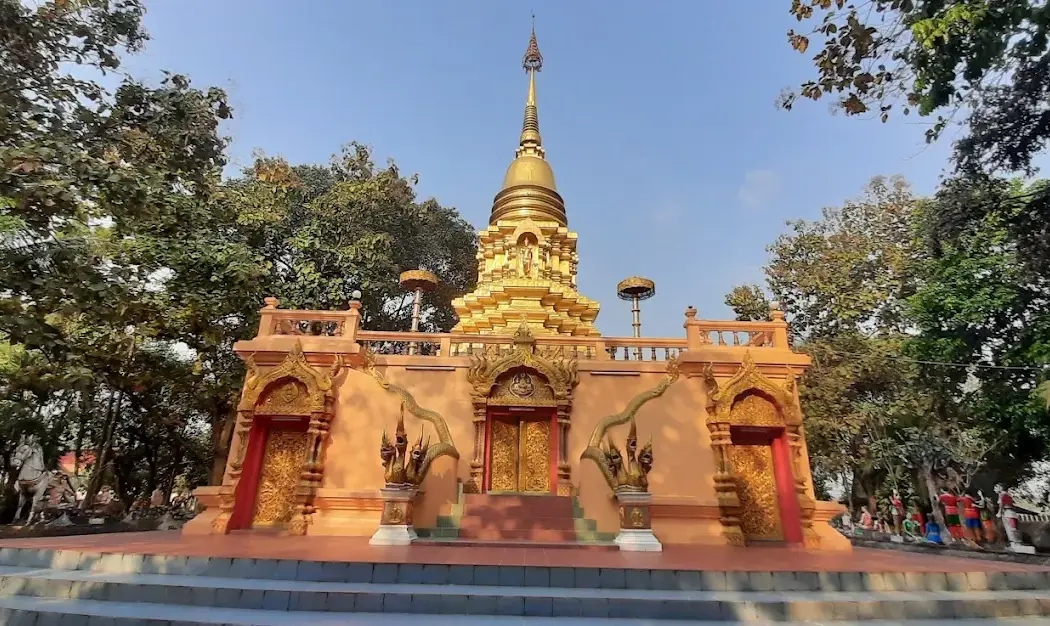
Wat Nantararam (San Sai) in Fang District, Chiang Mai Province, is a local Buddhist temple under the Maha Nikaya order. It is an important spiritual landmark for the San Sai community and a meaningful cultural stop for travelers who want to understand Fang beyond its better-known hot springs and mountain routes. The temple is known for its long community history, its role as a district learning center, its meditation practice function for Tambon San Sai, and its significant Buddha images, including the ancient Phra Phuttha Saen Sae and the 18-meter reclining Buddha named Phra Phuttha Nantalai Punyaphon.
The temple is located at 155 Moo 2, Ban Nantararam, Chotana Road, Tambon San Sai, Fang District, Chiang Mai 50110. Its location along the local community route makes it convenient for visitors traveling by private car, rental car, or local transport from Fang town. Wat Nantararam is suitable for travelers who prefer quiet temple visits, Buddhist heritage, local history, and cultural routes that connect temples, communities, hot springs, and mountain landscapes in northern Chiang Mai.
Before becoming known as Wat Nantararam, the temple was called Wat Ton Tueng because it was located near a tueng forest. As local roads and settlement patterns changed, the temple was moved to its present site during the time of Khruba Kantha Yanawaro, the abbot at that period. Wat Nantararam was officially permitted as a temple in 1917, placing it among the long-standing community temples of Fang District. Its history reflects the relationship between Buddhist faith, road development, land donation, and the formation of the San Sai community.
The early establishment of the temple was made possible by local donors, especially Pho Pa Singkaew, Kamnan Tha Jaiboon, and other devotees whose names were not fully recorded. They donated about 4 rai, 3 ngan, and 92 square wah of land for the temple. Later, temple supporters purchased an additional 4 rai and 2 ngan from land belonging to Nang Nuan Fongmanee and her children, with part of the land also donated as merit. The temple grounds now cover roughly more than 9 rai, giving Wat Nantararam enough space to support religious ceremonies, community activities, learning, meditation practice, and merit-making events.
Wat Nantararam received its Wisungkham Sima in 1978, officially establishing the consecrated boundary for monastic acts. This was a major milestone in the temple’s development because it confirmed the temple’s formal religious status and its importance to the local Buddhist community. In 1999, the temple was recognized as a model development temple, showing that it had continued to improve its religious grounds, organization, and community role over time.
The temple has been strongly developed during the period of Phra Khru Wisit Punyaphon Nandhammo, also known as Boonmai Nandhammo, the current abbot of Wat Nantararam. Since 1968, the temple has been associated with serious development work, including the care of sacred objects, the improvement of temple areas, and the strengthening of its role as a place of worship and learning for the people of Fang District.
The ubosot is one of the most important areas of Wat Nantararam. It houses Phra Phuttha Loketsuan Udom Mongkhon Chiang Mai Nantararam Suphasiri Sathit, a principal Buddha image revered by devotees. Visitors should enter this area respectfully, keep their voices low, and observe the temple’s sacred atmosphere. This is the main space for paying respect and understanding the spiritual center of the temple.
Another major sacred object is Phra Phuttha Saen Sae, an ancient Buddha image believed to be around 600–700 years old. Its age gives Wat Nantararam a deeper historical dimension than an ordinary local temple. For travelers interested in Lanna Buddhist heritage, this image is one of the key reasons to visit the temple because it represents the continuity of Buddhist devotion in the Fang area and northern Chiang Mai.
The temple also enshrines an 18-meter reclining Buddha named Phra Phuttha Nantalai Punyaphon. A reclining Buddha image symbolizes calmness, reflection, and the remembrance of the Buddha’s final passing into Parinirvana. The presence of this large reclining Buddha gives visitors a more complete worship experience: paying respect to the principal Buddha image, the ancient Buddha image, and the reclining Buddha within one temple compound.
Wat Nantararam has the quiet character of a living Lanna community temple. It is not designed as a large commercial tourist attraction. Its value lies in its history, sacred objects, devotional space, and relationship with the village. The temple courtyard, religious areas, and Buddha images create a calm environment suitable for travelers who want to spend time learning rather than making only a quick stop.
For the local community, Wat Nantararam functions as a spiritual center for Tambon San Sai. It supports merit-making, Buddhist holy day observances, Kathin ceremonies, forest robe offerings, local religious activities, and community gatherings. The existence of Wat Nantararam School in the same local area also reflects the close connection between the temple, education, and daily community life.
One important annual religious activity connected with the temple is the Kathin ceremony after Buddhist Lent. In 2025, Wat Nantararam was listed with a Kathin event on 21 October 2025 at 15.00. Kathin is one of the most important Buddhist merit-making ceremonies in Thailand, in which lay supporters offer robes and requisites to monks after the rains retreat. This shows that Wat Nantararam remains an active temple with resident monks, community supporters, and continuing religious life.
The temple’s strongest appeal for travelers is the combination of local history and sacred heritage. Wat Nantararam preserves the story of its earlier name, Wat Ton Tueng, its relocation, its land donations, its official establishment in 1917, its Wisungkham Sima in 1978, and its later recognition as a model development temple in 1999. These details make the temple a useful starting point for understanding how village temples in Fang District are tied to land, roads, faith, and community identity.
Visitors should focus on three key points: Phra Phuttha Loketsuan Udom Mongkhon Chiang Mai Nantararam Suphasiri Sathit inside the ubosot, the ancient Phra Phuttha Saen Sae, and the 18-meter reclining Buddha Phra Phuttha Nantalai Punyaphon. When visiting, dress modestly, avoid loud behavior, do not interrupt monks or local ceremonies, and respect any areas that are not open to general visitors.
Wat Nantararam is suitable for cultural travelers, Buddhist pilgrims, history-focused visitors, and anyone staying in Fang town who wants to add a meaningful temple visit to the trip. The temple can be included in a route with Wat Chedi Ngam, Fang Hot Spring, Doi Pha Hom Pok National Park, and other attractions in northern Chiang Mai. Its location makes it practical for a half-day or full-day itinerary around Fang District.
Getting There is straightforward by using Chotana Road in Fang District. From Chiang Mai city, travelers can follow Highway 107 through Mae Rim, Mae Taeng, Chiang Dao, and Chai Prakan before entering Fang District. From Fang town, continue toward Tambon San Sai and Ban Nantararam. Visitors without a private car can travel to Fang town by bus or van and then use local transport to reach the temple.
A practical travel route is to visit Wat Nantararam in the morning, continue to Wat Chedi Ngam in Fang town, and then go to Fang Hot Spring or Doi Pha Hom Pok National Park. Travelers with more time can extend the route toward Doi Pu Muen or Doi Ang Khang. This makes Wat Nantararam a useful cultural stop before exploring the natural attractions of Fang District.
The best visiting time is from morning to early afternoon, when the weather is more comfortable and there is enough time to continue to other places nearby. Visitors who want to take photographs should do so respectfully and avoid interfering with ceremonies, monks, or local worshippers. As with any Thai temple, polite clothing and quiet behavior are expected.
Wat Nantararam is therefore worth including in a Fang itinerary for travelers who want more than scenery. It offers a strong local story, sacred Buddha images, an ancient Buddha image, a large reclining Buddha, and an active community role that continues to connect Buddhism with daily life in Tambon San Sai.
| Name | Wat Nantararam (San Sai) |
| Location | Moo 2, Ban Nantararam, Chotana Road, Tambon San Sai, Fang District, Chiang Mai Province |
| Address | 155 Moo 2, Nantararam, Chotana Road, Tambon San Sai, Fang District, Chiang Mai 50110, Thailand |
| Temple Type | Community temple under the Maha Nikaya order |
| Highlights | Phra Phuttha Loketsuan Udom Mongkhon Chiang Mai Nantararam Suphasiri Sathit, the ancient Phra Phuttha Saen Sae, and the 18-meter reclining Buddha Phra Phuttha Nantalai Punyaphon |
| History | Formerly known as Wat Ton Tueng, officially permitted as a temple in 1917, received Wisungkham Sima in 1978, and was recognized as a model development temple in 1999 |
| Name Origin | The temple was formerly called Wat Ton Tueng because it was located near a tueng forest; it later became known as Wat Nantararam after its relocation and connection with Ban Nantararam |
| Distinctive Features | A historic San Sai community temple with important Buddha images, a quiet local atmosphere, and a role as a learning and meditation place for Fang District |
| Travel Information | Accessible via Chotana Road in Fang District by private car, rental car, or local transport from Fang town |
| Current Status | Active community temple used for worship, merit-making, Buddhist ceremonies, learning, and meditation practice |
| Open Days | Daily |
| Opening Hours | 08.00 – 17.00 |
| Main Areas / Zones | Ubosot, area of Phra Phuttha Saen Sae, reclining Buddha area, temple courtyard, and community meditation area |
| Abbot / Caretaker | Phra Khru Wisit Punyaphon Nandhammo |
| Related Religious Event | Kathin ceremony after Buddhist Lent; the 2025 Kathin event was listed for 21 October 2025 at 15.00 |
| Nearby Tourist Attractions | 1. Wat Chedi Ngam, about 5 km 2. Wat Phrabath Udom, about 7 km 3. Fang Hot Spring, about 11 km 4. Doi Pha Hom Pok National Park, about 14 km 5. Doi Pu Muen, about 30 km |
| Nearby Restaurants | 1. Khao Soi Parichat Fang, about 2 km, Tel. 053-451-164 2. Oliang Roasted Duck Fang, about 3 km, Tel. 064-520-0241, 082-993-8124 3. PunThai Coffee Makro Fang, about 3 km, Tel. 062-197-0983 4. Fang Cafe, about 4 km, Tel. 086-191-2101 5. Ban Rim Nam Garden Restaurant Fang, about 6 km, Tel. 053-382-174 |
| Nearby Accommodations | 1. Tangerine Ville Hotel, about 1 km, Tel. 053-452-114 2. Fang Modern Hotel, about 2 km, Tel. 086-439-1843 3. Khunyuw Place Fang, about 4 km, Tel. 053-453-319 4. Phumanee Lahu Home Hotel, about 5 km, Tel. 086-431-3564 5. Fang Villa Hotel, about 6 km, Tel. 086-451-7682, 053-452-448 |
Frequently Asked Questions (FAQ)
Q: Where is Wat Nantararam (San Sai)?
A: Wat Nantararam is located at 155 Moo 2, Ban Nantararam, Chotana Road, Tambon San Sai, Fang District, Chiang Mai 50110, Thailand.
Q: What is the history of Wat Nantararam?
A: The temple was formerly called Wat Ton Tueng because it was near a tueng forest. It was officially permitted as a temple in 1917 and received Wisungkham Sima in 1978.
Q: What are the important Buddha images at Wat Nantararam?
A: Important Buddha images include Phra Phuttha Loketsuan Udom Mongkhon Chiang Mai Nantararam Suphasiri Sathit, the ancient Phra Phuttha Saen Sae, and the 18-meter reclining Buddha Phra Phuttha Nantalai Punyaphon.
Q: What are the opening days and hours of Wat Nantararam?
A: The temple is open daily from 08.00 to 17.00.
Q: Who should visit Wat Nantararam?
A: The temple is suitable for cultural travelers, Buddhist visitors, history-focused travelers, and anyone exploring Fang District’s temple and nature routes.
Q: Does Wat Nantararam have important religious events?
A: Yes. The temple is connected with regular Buddhist merit-making activities, including the Kathin ceremony after Buddhist Lent.
Q: What nearby places can be visited with Wat Nantararam?
A: Nearby places include Wat Chedi Ngam, Wat Phrabath Udom, Fang Hot Spring, Doi Pha Hom Pok National Park, and Doi Pu Muen.
Mobile : 0638193320
 Mobile : 0638193320
 Category: ●Places of Worship
 Group: ●Temple
Last Update : 2 MonthAgo
 Last Update : 2 MonthAgo

 Click to Access the Navigation Map GPS
Wat Nantararam (San Sai) Map
Recommend

 Muang Chiang Mai(121)Chom Thong(47)Mae Chaem(25)Chiang Dao(33)Doi Saket(68)Mae Taeng(85)Mae Rim(69)Samoeng(29)Fang(71)Mae Ai(59)Phrao(70)San Pa Tong(103)San Kamphaeng(66)San Sai(73)Hang Dong(73)Hot(32)Doi Tao(22)Omkoi(11)Saraphi(74)Wiang Haeng(15)Chai Prakan(28)Mae Wang(32)Mae On(22)Doi Lo(33)Galyani Vadhana(1)


