
lovethailand home >North Travel Attractions >Chiang Mai Travel Attractions >Fang >Mae Kha > Wat Udom Mongkhon
TL;DR: Wat Udom Mongkhon is located at 190 Moo 5, Ban Mae Kha, Mae Kha Subdistrict, Fang District, Chiang Mai Province, open Daily, hours Daytime.
Wat Udom Mongkhon
Open Days: Daily
Opening Hours: Daytime
Wat Udom Mongkhon is located at 190 Moo 5, Ban Mae Kha, Mae Kha Subdistrict, Fang District, Chiang Mai Province 50320. It is a local Buddhist temple under the Mahanikaya order and one of the most distinctive community temples in Mae Kha. The temple was founded in 1887 and was originally known as Wat Mae Kha. It later became Wat Udom Mongkhon and received its royal consecrated boundary on March 24, 1969. The consecrated boundary measures 15 meters wide and 30 meters long. The current abbot is Phra Khru Prakhun Chittakan Thanchitto. With more than a century of history, Wat Udom Mongkhon remains an important spiritual center for the Mae Kha community in northern Chiang Mai.
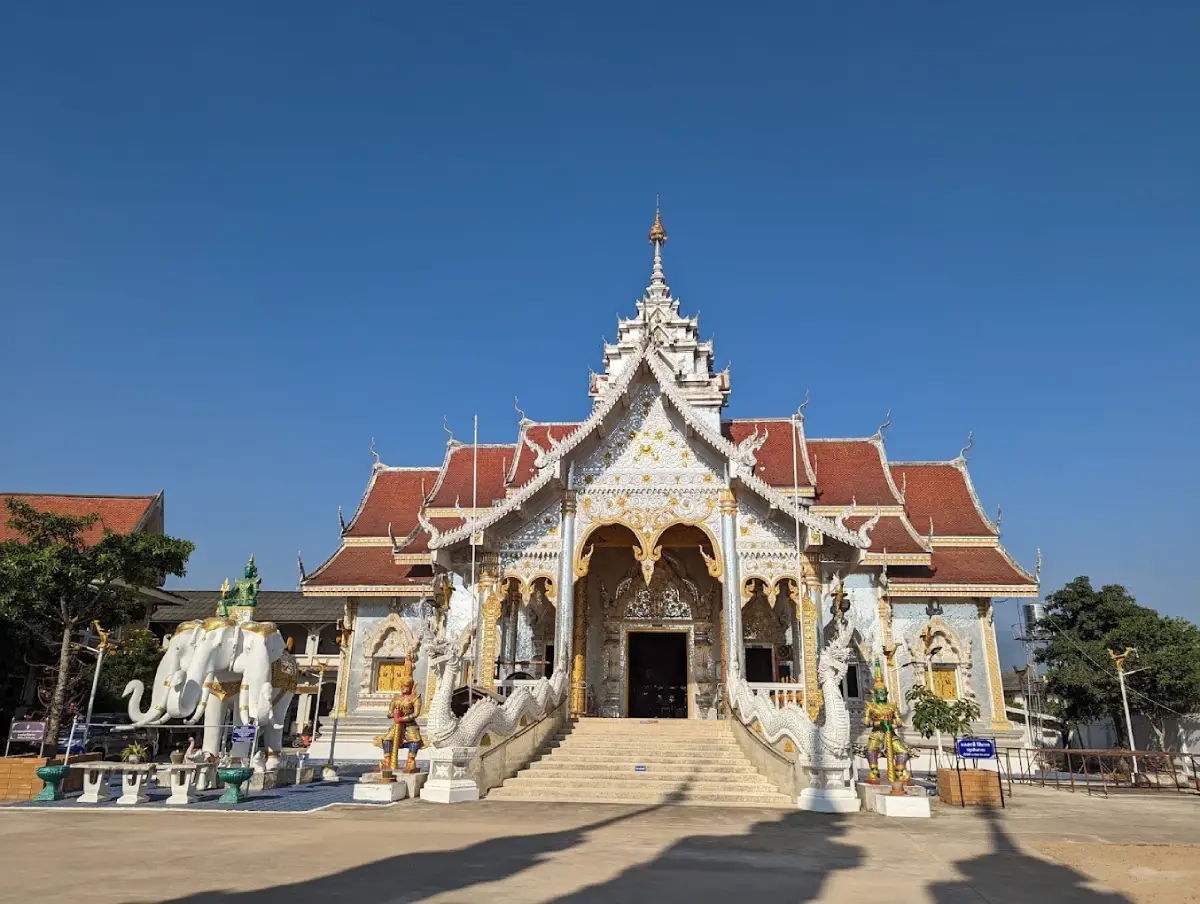
Wat Udom Mongkhon is valuable for its local history, Lanna-inspired Buddhist art, and continuing role in village life. The temple’s most memorable feature is its mirror-decorated viharn, which uses reflective glass and mosaic details to create a bright, silver-like appearance. Inside the viharn, a white-and-gold principal Buddha image is enshrined as the main object of worship. The interior is decorated with black-and-gold motifs, Buddhist narrative paintings, and religious scenes that give the space both visual richness and a calm devotional atmosphere.
The temple’s former name, Wat Mae Kha, reflects its close connection with Ban Mae Kha, Moo 5, Mae Kha Subdistrict. Naming a temple after the village it serves is common among local temples in northern Thailand because these temples often grow directly from village faith and community support. The later name, Wat Udom Mongkhon, carries an auspicious meaning associated with abundance, merit, prosperity, and spiritual well-being. The name preserves the temple’s community identity while adding a strong sense of blessing and sacredness.
Founded in 1887, Wat Udom Mongkhon is one of the long-established temples in Mae Kha and Fang District. During that period, village temples in northern Thailand were not only religious sites. They were also centers of moral learning, community gathering, seasonal merit-making, and social continuity. Wat Udom Mongkhon has carried this role forward for generations, serving local residents as a place for worship, merit-making, Buddhist ceremonies, and community participation.
The granting of the royal consecrated boundary on March 24, 1969 was a major milestone in the temple’s development. In Thai Buddhism, a consecrated boundary is required for important monastic ceremonies. The presence of a 15-by-30-meter consecrated boundary shows that Wat Udom Mongkhon is not merely a village worship place but a formally recognized Buddhist temple with a clear role in the Sangha system and local religious practice.
Mae Kha Subdistrict has several community temples spread across its villages, including Wat Huai Cho, Wat Hat Samran, Wat San Ton Pao, Wat Sri Bua Ngoen, Wat Khongkha Ram, Wat Uthok Wari, and Wat Udom Mongkhon. Together, these temples form a local Buddhist network that reflects the cultural structure of Mae Kha. Wat Udom Mongkhon is especially significant because it is located in Ban Mae Kha, an important community area along the main route through Fang District.
The most striking element of Wat Udom Mongkhon is the mirror-decorated viharn. Its reflective glasswork and shimmering surface make the building stand out from other nearby community temples. When sunlight touches the mirrored details, the viharn appears bright and almost silver. The multi-tiered roof, ornamental elements, and gilded patterns give the structure a distinct Lanna-inspired character. This makes the temple a worthwhile stop for visitors interested in northern Thai temple architecture, local craftsmanship, and contemporary expressions of Buddhist art.
Inside the viharn, the principal Buddha image in white and gold creates a calm focal point for worship. The white tone suggests serenity and purity, while the gold details add sacredness and warmth. Smaller Buddha images are arranged around the main altar, creating a balanced devotional setting. Visitors should enter respectfully, remove shoes before entering the sacred space, dress modestly, and keep their voices low while inside the viharn.
The interior wall paintings and decorative details include scenes from Buddhist narratives, including the life of the Buddha and episodes associated with the Vessantara Jataka. These paintings are more than visual decoration. They function as teaching images, presenting themes of generosity, compassion, patience, sacrifice, and the cultivation of virtue. Visitors who take time to observe the paintings will gain a deeper understanding of how Buddhist stories are communicated through temple art in northern Thailand.
The temple entrance and gateway area are also worth seeing. The use of transparent glass pieces and reflective decoration gives the entrance a bright, elegant character. In a Buddhist temple, the gateway marks the transition from the ordinary world into a sacred space. At Wat Udom Mongkhon, the decorative entrance reinforces the temple’s identity as a place of merit, beauty, and community faith.
The temple grounds connect the viharn, worship areas, ceremonial spaces, and community activity areas. Local residents use the temple for religious gatherings, Buddhist holy days, merit-making, and seasonal ceremonies. The atmosphere is peaceful and suitable for a short visit, especially in the morning or late afternoon when the light is softer and the reflective details of the viharn are easier to appreciate.
Wat Udom Mongkhon plays an important role in the Mae Kha community. It serves as the village’s religious anchor, a place for Buddhist ceremonies, a gathering space for residents, and a center of local faith. Families, elders, and younger generations continue to use the temple for making merit, listening to sermons, offering food to monks, and participating in Buddhist festivals. This continuity keeps the temple connected to everyday community life rather than separating it as a purely tourist destination.
The temple’s annual religious life follows the Buddhist calendar and local Lanna traditions. Important activities include Buddhist holy days, candlelight ceremonies on major Buddhist festivals, Buddhist Lent, the end of Buddhist Lent, Kathin, Pha Pa, and village merit-making events. These activities strengthen the relationship between monks and laypeople and help preserve the religious customs of Mae Kha.
Phra Khru Prakhun Chittakan Thanchitto, the abbot of Wat Udom Mongkhon, is central to the temple’s religious and community role. In a local temple, the abbot’s responsibilities include caring for monks, maintaining temple buildings, guiding religious activities, and coordinating with local residents. This leadership allows the temple to remain active and accessible throughout the year.
For travelers, Wat Udom Mongkhon is suitable for a quiet cultural stop. Visitors can pay respect to the Buddha image, admire the mirror-decorated viharn, observe the Buddhist narrative paintings, and spend a short time in a peaceful temple environment. The temple is especially suitable for travelers who appreciate local temples, Lanna-inspired art, and meaningful stops along the Fang and Mae Kha route.
The temple is located near Highway 107, the main route connecting Chiang Mai city with Fang, Mae Ai, and Tha Ton. This makes Wat Udom Mongkhon easier to access than many rural temples located deep inside villages. Travelers passing through Mae Kha can use the temple as a short merit-making stop or as part of a broader cultural route through Fang District.
Getting There from Chiang Mai city is straightforward but takes time. Travelers can take Highway 107 north toward Fang District, passing Mae Taeng, Chiang Dao, and Chai Prakan before continuing to Mae Kha Subdistrict and Ban Mae Kha in Moo 5. From central Fang or Wiang Fang, the temple can be reached by private car, motorcycle, or local hired transport. When using a map application, search specifically for “Wat Udom Mongkhon Mae Kha Fang Chiang Mai” to avoid confusion with temples of the same name elsewhere in Thailand.
Wat Udom Mongkhon can be combined with nearby Mae Kha temples such as Wat Huai Cho, Wat Hat Samran, Wat San Ton Pao, Wat Sri Bua Ngoen, and Wat Khongkha Ram. Travelers who want a fuller Fang itinerary can continue to Fang Hot Springs, Doi Pha Hom Pok National Park, or the First Royal Factory Museum Fang. This creates a route that combines Buddhist faith, temple art, local community life, nature, and regional history.
Visitors should dress modestly, behave respectfully, avoid loud conversations inside the viharn, and refrain from touching Buddha images, murals, or sacred objects unnecessarily. Photography should be done appropriately and without disturbing worshippers. A visit to a community temple is most meaningful when approached with respect for the local people who continue to use the temple as part of their religious life.
In summary, Wat Udom Mongkhon is a long-established community temple in Ban Mae Kha, Fang District, Chiang Mai. Founded in 1887, formerly known as Wat Mae Kha, and granted its royal consecrated boundary in 1969, the temple is known today for its mirror-decorated viharn, white-and-gold Buddha image, Buddhist narrative paintings, and continuing role as a spiritual center for the Mae Kha community. It is a worthwhile stop for travelers seeking a peaceful temple visit, Lanna-inspired art, and a deeper understanding of local Buddhist culture in northern Chiang Mai.
| Name | Wat Udom Mongkhon |
| Location | 190 Moo 5, Ban Mae Kha, Mae Kha Subdistrict, Fang District, Chiang Mai Province |
| Address | 190 Moo 5, Mae Kha Subdistrict, Fang District, Chiang Mai 50320, Thailand |
| Coordinates | 19.79056, 99.16500 |
| Type | Local Buddhist temple under the Mahanikaya order |
| Highlights | Mirror-decorated viharn, white-and-gold principal Buddha image, Buddhist narrative paintings, and black-and-gold interior decoration |
| History | Founded in 1887, formerly known as Wat Mae Kha, and granted its royal consecrated boundary on March 24, 1969 |
| Consecrated Boundary | 15 meters wide and 30 meters long |
| Former Name | Wat Mae Kha |
| Name Origin | The former name links the temple to Ban Mae Kha, while Udom Mongkhon conveys abundance, merit, prosperity, and auspiciousness |
| Distinctive Features | A Lanna community temple with a shimmering mirror-decorated viharn near Highway 107 in Mae Kha |
| Main Areas / Sacred Objects | Mirror-decorated viharn, white-and-gold Buddha image, smaller Buddha images, Buddhist narrative murals, Vessantara Jataka scenes, temple gateway, temple grounds, and ceremonial areas |
| Traditions / Merit-Making | Buddhist holy days, major Buddhist festivals, Buddhist Lent, end of Buddhist Lent, Kathin, Pha Pa, and Mae Kha community merit-making activities |
| Community Role | A spiritual center for Ban Mae Kha, used for Buddhist ceremonies, merit-making, and community religious life |
| Abbot / Caretaker | Phra Khru Prakhun Chittakan Thanchitto |
| Travel Information | From Chiang Mai city, take Highway 107 toward Fang District through Mae Taeng, Chiang Dao, and Chai Prakan, then continue to Mae Kha Subdistrict and Ban Mae Kha in Moo 5 |
| Current Status | Open as a community Buddhist temple and religious site in Mae Kha, Fang District, Chiang Mai Province |
| Open Days | Daily |
| Opening Hours | Daytime |
| Fees | No admission fee |
| Facilities | Temple grounds, worship area, ceremonial area, and parking area within the temple compound |
| Nearby Tourist Attractions | 1. Wat Huai Cho, about 1 km 2. Wat Hat Samran, about 2 km 3. Wat San Ton Pao, about 5 km 4. Wat Sri Bua Ngoen Mae Kha, about 5 km 5. Wat Khongkha Ram, about 6 km 6. Fang Hot Springs, about 24 km 7. Doi Pha Hom Pok National Park, about 29 km 8. First Royal Factory Museum Fang, about 32 km |
| Nearby Restaurants | 1. PunThai Coffee Fang 2, about 2 km, Tel. 062-593-0154 2. Bamee Je Hua Fang Branch, about 8 km, Tel. 064-721-8851 3. Ahan Ran Mai, about 9 km, Tel. 086-114-6858 4. Hong Nung Len Fang, about 10 km, Tel. 083-201-8503, 095-134-6442 5. Kha Mu Krop Kai Yang San Ma Fueang, about 11 km, Tel. 081-882-5589, 081-467-3624 |
| Nearby Accommodations | 1. Fang Modern Hotel, about 10 km, Tel. 086-439-1843 2. Fang Villa Hotel, about 10 km, Tel. 086-451-7682 3. Ban Sathitphon Hotel, about 12 km 4. Huen San Fang Hotel, about 14 km, Tel. 081-881-6430, 063-790-0666 5. Fak Fang Homestay, about 15 km, Tel. 086-117-6914 |
Frequently Asked Questions (FAQ)
Q: Where is Wat Udom Mongkhon located?
A: Wat Udom Mongkhon is located at 190 Moo 5, Ban Mae Kha, Mae Kha Subdistrict, Fang District, Chiang Mai Province 50320, Thailand.
Q: What was the former name of Wat Udom Mongkhon?
A: The temple was formerly known as Wat Mae Kha, reflecting its connection with Ban Mae Kha and Mae Kha Subdistrict.
Q: Why is Wat Udom Mongkhon historically important?
A: The temple was founded in 1887 and received its royal consecrated boundary on March 24, 1969, with a boundary measuring 15 meters wide and 30 meters long.
Q: Who is the abbot of Wat Udom Mongkhon?
A: The abbot is Phra Khru Prakhun Chittakan Thanchitto.
Q: What is special about Wat Udom Mongkhon?
A: The temple is known for its mirror-decorated viharn, white-and-gold principal Buddha image, black-and-gold interior decoration, and Buddhist narrative paintings.
Q: What kind of travelers will enjoy Wat Udom Mongkhon?
A: It is suitable for travelers who enjoy peaceful temple visits, merit-making, Lanna-inspired Buddhist art, and cultural stops along the Fang and Mae Kha route.
Q: How do travelers get to Wat Udom Mongkhon from Chiang Mai city?
A: Travelers can take Highway 107 toward Fang District through Mae Taeng, Chiang Dao, and Chai Prakan, then continue to Mae Kha Subdistrict and Ban Mae Kha in Moo 5.
Q: What nearby places can be combined with Wat Udom Mongkhon?
A: Nearby places include Wat Huai Cho, Wat Hat Samran, Wat San Ton Pao, Wat Sri Bua Ngoen, Wat Khongkha Ram, Fang Hot Springs, Doi Pha Hom Pok National Park, and the First Royal Factory Museum Fang.
 Category: ●Places of Worship
 Group: ●Temple
Last Update : 2 WeekAgo
 Last Update : 2 WeekAgo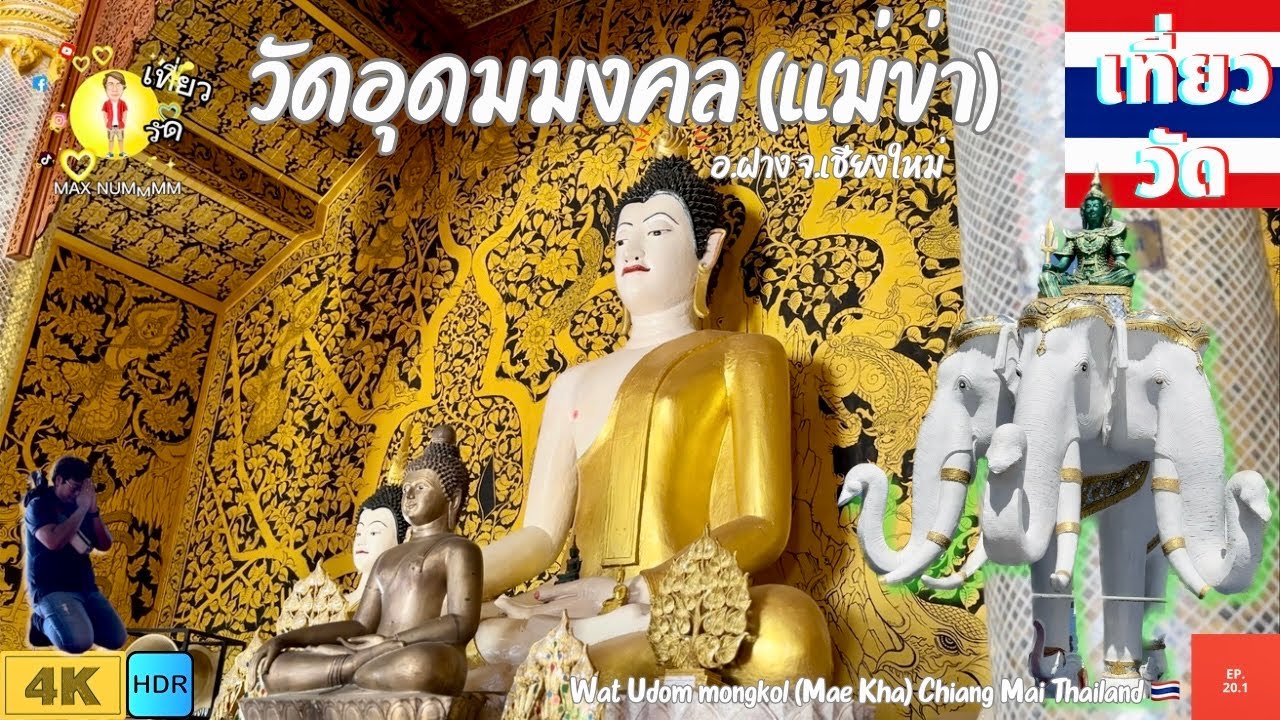
 Click to Access the Navigation Map GPS
Wat Udom Mongkhon Map
Recommend

 Muang Chiang Mai(121)Chom Thong(47)Mae Chaem(25)Chiang Dao(33)Doi Saket(68)Mae Taeng(85)Mae Rim(69)Samoeng(29)Fang(71)Mae Ai(59)Phrao(70)San Pa Tong(103)San Kamphaeng(66)San Sai(73)Hang Dong(73)Hot(32)Doi Tao(22)Omkoi(11)Saraphi(74)Wiang Haeng(15)Chai Prakan(28)Mae Wang(32)Mae On(22)Doi Lo(33)Galyani Vadhana(1)


