
lovethailand home >North Travel Attractions >Chiang Mai Travel Attractions >Fang >Mae Kha > Wat San Ton Pao (Mae Kha)
TL;DR: Wat San Ton Pao (Mae Kha) is located at Moo 7, Ban San Ton Pao, Mae Kha Subdistrict, Fang District, Chiang Mai Province, open Daily, hours 08.00 - 17.00.
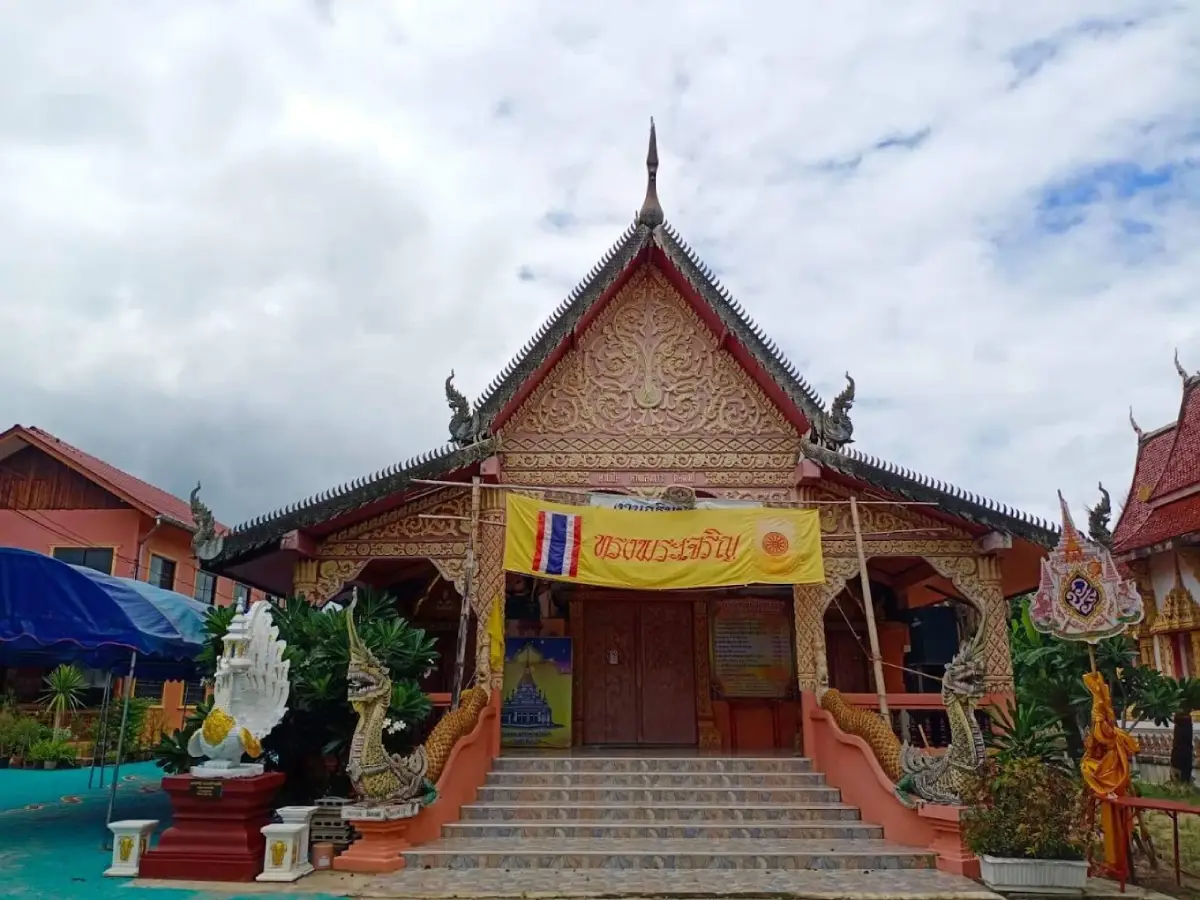
Wat San Ton Pao (Mae Kha)
Open Days: Daily
Opening Hours: 08.00 - 17.00
Wat San Ton Pao (Mae Kha) is located in Moo 7, Ban San Ton Pao, Mae Kha Subdistrict, Fang District, Chiang Mai Province. It is a local Buddhist temple under the Mahanikaya order and an important religious center for the Ban San Ton Pao community. The temple was officially permitted as a Buddhist temple in 1940 and received its royal consecrated boundary on June 18, 1993. These two milestones show that Wat San Ton Pao has a clear historical foundation and a formal role in Buddhist monastic ceremonies in Mae Kha.
Wat San Ton Pao is not a large commercial tourist attraction. Its value lies in its role as a living community temple. Local residents use the temple for merit-making, Buddhist ceremonies, religious gatherings, Kathin, Pha Pa, and seasonal merit-making events. For travelers, the temple offers a calm and grounded view of Fang District beyond mountains, hot springs, and scenic routes. It is suitable for visitors who want to pay respect, observe local Lanna Buddhist culture, and understand how temples continue to support everyday life in northern Thai communities.
The name “San Ton Pao” is closely tied to the village name. In northern Thai place names, “San” often refers to a ridge or raised local terrain, while “Ton Pao” is associated with the village identity. The temple name therefore reflects its direct connection with Ban San Ton Pao. This pattern is common among community temples in northern Thailand, where the temple grows together with the village and becomes one of its main cultural symbols.
The history of Wat San Ton Pao became formally recorded when it was permitted as a temple in 1940. During that period, rural temples in northern Thailand played several roles at once. They were places of worship, moral education, community gathering, and cultural continuity. The granting of the royal consecrated boundary in 1993 was another important milestone because it confirmed the temple’s formal status for key monastic rites. In Thai Buddhism, a consecrated boundary is essential for important ceremonies connected with the monastic community.
Mae Kha Subdistrict has several Buddhist temples distributed across its villages, including Wat Khongkha Ram, Wat Huai Cho, Wat Udom Mongkhon, Wat Hat Samran, Wat Sri Bua Ngoen, and Wat San Ton Pao. These temples form a religious and cultural network that reflects the structure of community life in Mae Kha. Wat San Ton Pao is one part of this wider landscape. Visiting the temple helps travelers understand Fang as a district shaped not only by nature and agriculture but also by long-standing local Buddhist faith.
Wat San Ton Pao has the character of a modest Lanna community temple. The temple compound supports Buddhist worship, local ceremonies, merit-making, and religious activities. Visitors should approach the temple as an active sacred space rather than a photo stop. The main areas of interest include the worship area, ceremonial spaces, temple grounds, and community activity areas. The atmosphere is quiet and simple, making it suitable for visitors who prefer meaningful temple visits over crowded landmark tourism.
Sacred spaces in the temple should be treated with respect. Visitors can begin by paying respect to the Buddha images, keeping a calm manner, and walking around the temple grounds quietly. The strength of Wat San Ton Pao is not spectacle but continuity. It continues to serve the religious needs of Ban San Ton Pao and Mae Kha residents, while also preserving the role of a village temple in Lanna culture.
The current abbot of Wat San Ton Pao is Phra Khru Sri Kittayaphinan, Dr. He also serves as the ecclesiastical subdistrict chief of Mae Kha Area 2. This role gives the temple additional significance within the local monastic structure. The abbot’s position connects Wat San Ton Pao not only with Ban San Ton Pao village but also with the broader Buddhist administration of Mae Kha and Fang District.
Wat San Ton Pao remains closely linked with local Buddhist traditions. Important activities include Buddhist holy days, merit-making, candlelight ceremonies on major Buddhist festivals, Kathin, Pha Pa, and community-based ceremonies. Kathin is especially important because it takes place after the Buddhist Lent and allows laypeople to support monks and temple maintenance. Wat San Ton Pao has appeared in community Kathin project information, showing its continuing role as a place of shared merit and local faith.
In Lanna community life, a temple is more than a religious building. It is a place where older residents gather, families make merit together, younger people learn etiquette, and the village keeps its connection with Buddhist teachings. Wat San Ton Pao continues to represent this function. It is a temple that holds memory, faith, and community participation together in one space.
For travelers, the best time to visit Wat San Ton Pao is in the morning or late afternoon, when the weather is more comfortable and the atmosphere is calm. Buddhist holy days and major Buddhist festivals may bring more community activity, while ordinary weekdays are better for a quiet visit. Visitors should dress modestly, avoid loud behavior, respect monks and local worshippers, and refrain from touching sacred objects unnecessarily.
Getting There from Chiang Mai city is straightforward but takes time. Travelers can take Highway 107 north toward Fang District, passing Mae Taeng, Chiang Dao, and Chai Prakan before continuing to Mae Kha Subdistrict and Ban San Ton Pao in Moo 7. From central Fang or Wiang Fang, the temple can be reached by private car, motorcycle, or local hired transport. When using a map application, search specifically for “Wat San Ton Pao, Mae Kha, Fang, Chiang Mai” because there is more than one temple with the same or similar name in northern Thailand.
Wat San Ton Pao can be included in a Mae Kha temple route with Wat Huai Cho, Wat Khongkha Ram, Wat Udom Mongkhon, Wat Hat Samran, and Wat Sri Bua Ngoen. Travelers who want a fuller Fang itinerary can continue to Fang Hot Springs, Doi Pha Hom Pok National Park, or the First Royal Factory Museum Fang. This creates a balanced route combining Buddhism, local community culture, nature, and regional history.
The temple’s main appeal is its authenticity as a community temple. Visitors should not expect a large tourist complex. Instead, Wat San Ton Pao offers a quieter and more meaningful experience: a local temple with a documented history, continuing religious function, and strong ties to village life in Mae Kha. For travelers interested in cultural depth, it is a worthwhile stop on a Fang route.
In summary, Wat San Ton Pao (Mae Kha) is a long-established community temple in Fang District. It was officially permitted in 1940, received its royal consecrated boundary in 1993, and remains an active Buddhist center for Ban San Ton Pao and Mae Kha. It is suitable for merit-making, respectful temple visits, and learning about Lanna Buddhist life in northern Chiang Mai.
| Name | Wat San Ton Pao (Mae Kha) |
| Location | Moo 7, Ban San Ton Pao, Mae Kha Subdistrict, Fang District, Chiang Mai Province |
| Address | Ban San Ton Pao, Moo 7, Mae Kha Subdistrict, Fang District, Chiang Mai, Thailand |
| Type | Local Buddhist temple under the Mahanikaya order |
| Highlights | A long-established community temple of Ban San Ton Pao with a documented history dating back to 1940 |
| History | Officially permitted as a temple in 1940 and granted its royal consecrated boundary on June 18, 1993 |
| Name Origin | The temple name is linked to Ban San Ton Pao village in Moo 7, Mae Kha Subdistrict |
| Distinctive Features | A peaceful Lanna community temple connected with local faith, merit-making, and village Buddhist life in Fang District |
| Main Areas / Zones | Worship area, main religious space, temple grounds, ceremonial area, and community activity area |
| Traditions / Merit-Making | Buddhist holy days, major Buddhist festivals, Kathin, Pha Pa, and local Lanna merit-making activities |
| Community Role | A spiritual center for Ban San Ton Pao and Mae Kha residents, supporting Buddhist ceremonies and local merit-making |
| Abbot / Caretaker | Phra Khru Sri Kittayaphinan, Dr. |
| Travel Information | From Chiang Mai city, take Highway 107 toward Fang District through Mae Taeng, Chiang Dao, and Chai Prakan, then continue to Mae Kha Subdistrict and Ban San Ton Pao in Moo 7 |
| Current Status | Open as a community Buddhist temple and religious site in Mae Kha, Fang District, Chiang Mai Province |
| Open Days | Daily |
| Opening Hours | 08.00 - 17.00 |
| Fees | No admission fee |
| Facilities | Temple grounds, ceremonial area, and parking area within the temple compound |
| Nearby Tourist Attractions | 1. Wat Huai Cho, about 3 km 2. Wat Khongkha Ram, about 5 km 3. Wat Udom Mongkhon Mae Kha, about 5 km 4. Wat Sri Bua Ngoen Mae Kha, about 7 km 5. Wat Hat Samran, about 8 km 6. Fang Hot Springs, about 24 km 7. Doi Pha Hom Pok National Park, about 28 km 8. First Royal Factory Museum Fang, about 32 km |
| Nearby Restaurants | 1. PunThai Coffee Fang 2, about 4 km, Tel. 062-593-0154 2. Bamee Je Hua Fang Branch, about 10 km, Tel. 064-721-8851 3. Ahan Ran Mai, about 10 km, Tel. 086-114-6858 4. Hong Nung Len Fang, about 11 km, Tel. 083-201-8503, 095-134-6442 5. Kha Mu Krop Kai Yang San Ma Fueang, about 12 km, Tel. 081-882-5589, 081-467-3624 |
| Nearby Accommodations | 1. Fang Modern Hotel, about 12 km, Tel. 086-439-1843 2. Fang Villa Hotel, about 12 km, Tel. 086-451-7682 3. Ban Sathitphon Hotel, about 13 km 4. Huen San Fang Hotel, about 15 km, Tel. 081-881-6430, 063-790-0666 5. Fak Fang Homestay, about 16 km |
Frequently Asked Questions (FAQ)
Q: Where is Wat San Ton Pao located?
A: Wat San Ton Pao is located in Moo 7, Ban San Ton Pao, Mae Kha Subdistrict, Fang District, Chiang Mai Province, Thailand.
Q: What type of temple is Wat San Ton Pao?
A: It is a local Buddhist temple under the Mahanikaya order and serves as a community temple for Ban San Ton Pao and Mae Kha.
Q: Why is Wat San Ton Pao historically important?
A: The temple was officially permitted in 1940 and received its royal consecrated boundary on June 18, 1993, confirming its formal role in local Buddhist practice.
Q: Who is the abbot of Wat San Ton Pao?
A: The abbot is Phra Khru Sri Kittayaphinan, Dr., who also serves as the ecclesiastical subdistrict chief of Mae Kha Area 2.
Q: What kind of travelers will enjoy Wat San Ton Pao?
A: It is suitable for travelers who enjoy peaceful temple visits, merit-making, Lanna community culture, and local Buddhist heritage in Fang District.
Q: How do travelers get to Wat San Ton Pao from Chiang Mai city?
A: Travelers can take Highway 107 toward Fang District through Mae Taeng, Chiang Dao, and Chai Prakan, then continue to Mae Kha Subdistrict and Ban San Ton Pao in Moo 7.
Q: Why should visitors search for “Mae Kha, Fang” when looking up Wat San Ton Pao?
A: There is more than one temple with the same or similar name in northern Thailand. Adding “Mae Kha, Fang, Chiang Mai” helps ensure the correct destination.
Q: What nearby places can be combined with Wat San Ton Pao?
A: Nearby places include Wat Huai Cho, Wat Khongkha Ram, Wat Udom Mongkhon, Wat Sri Bua Ngoen, Fang Hot Springs, Doi Pha Hom Pok National Park, and the First Royal Factory Museum Fang.
 Category: ●Places of Worship
 Group: ●Temple
Last Update : 3 HourAgo
 Last Update : 3 HourAgo
 Click to Access the Navigation Map GPS
Wat San Ton Pao (Mae Kha) Map
Recommend

 Muang Chiang Mai(121)Chom Thong(47)Mae Chaem(25)Chiang Dao(33)Doi Saket(68)Mae Taeng(85)Mae Rim(69)Samoeng(29)Fang(71)Mae Ai(62)Phrao(70)San Pa Tong(105)San Kamphaeng(66)San Sai(73)Hang Dong(74)Hot(32)Doi Tao(22)Omkoi(11)Saraphi(74)Wiang Haeng(15)Chai Prakan(28)Mae Wang(32)Mae On(22)Doi Lo(34)Galyani Vadhana(1)


