
lovethailand home >North Travel Attractions >Chiang Mai Travel Attractions >Doi Saket >Luang Nuea > Wat Wang Than
TL;DR: Wat Wang Than is located at Ban Wang Than, Moo 8, Luang Nuea Subdistrict, Doi Saket District, Chiang Mai Province, open Daily, hours 08.00 – 17.00.

Wat Wang Than
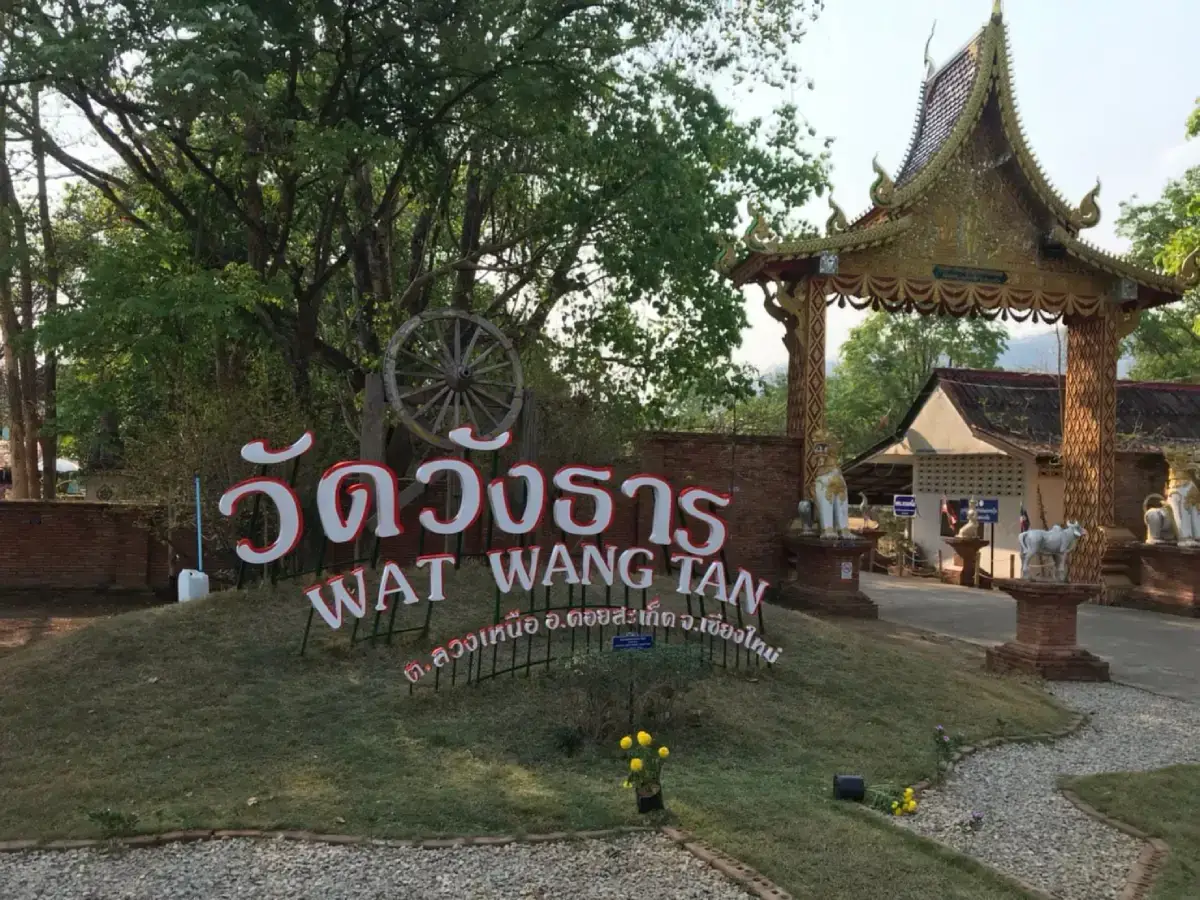
Open Days: Daily
Opening Hours: 08.00 – 17.00
Wat Wang Than, also written as Wat Wang Tharn, is a local Buddhist temple located at No. 153, Moo 8, Luang Nuea Subdistrict, Doi Saket District, Chiang Mai Province. It is a Mahanikaya temple with a deep community history linked to Ban Pha Taek, Ban Wang Than, Doi Long, and the wider Luang Nuea cultural landscape. The temple is especially meaningful for travelers who want to understand how a rural northern Thai temple grows from local faith, practical community needs, and collective Buddhist devotion.
The origin of Wat Wang Than dates back to 1948. In that year, villagers from Ban Pha Taek and Ban Wang Than worked together to build a small viharn led by Pho Ui Noi and Mae Ui Tha Supinta. The first structure was made of wood, roofed with thatch, and measured 5 meters wide and 10 meters long. It stood on the western side of Doi Long. This simple beginning shows that the temple was not founded through grand construction, but through the shared faith and practical religious needs of local villagers.
After the first viharn was built, the villagers invited Luang Pho Tha and Luang Pho Phrom Phrommajaro, who were fellow monks from Wat Pho Thong Charoen, also known locally as Pa Tueng, to spend the Buddhist rains retreat at the place the villagers called “Wat Doi Long.” They stayed there for 1 year. Their presence gave the site a stronger religious function and helped transform it from a community-built shrine into a place of Buddhist practice.
In 1949, the temple site was moved to the southern side of Doi Long. The reason was to place the temple in a more central position between Ban Pha Taek and Ban Wang Than. At that time, both villages did not yet have a temple for Buddhist ceremonies. The move therefore reflected the temple’s role as a shared religious center for more than one village. Wat Wang Than was created not for a single household or group, but for the wider community around Doi Long.
In 1952, Luang Pho Tha passed away, leaving Luang Pho Phrom Phrommajaro to reside at the temple alone for a period. In the same year, the position of district ecclesiastical chief of Doi Saket became vacant. Phra Khru Sangkha Kitjarak, also known as Pho Nan Som Sutthakham, the abbot of Wat Phra That Doi Saket, was appointed acting district ecclesiastical chief. During this time, Pho Saeng Konya, Pho Som Khamyotjai, and Pho Noi Nuan Sunanta submitted a request to move Wat Doi Long to Ban Wang Than.
The reason for moving the temple to Ban Wang Than was the lack of water at the previous site. The earlier location was on higher ground, making it difficult to secure water for daily use. Phra Khru Sangkha Kitjarak inspected the proposed new site and found it suitable for establishing a temple. This decision shows that the temple’s development was closely tied to real community conditions such as water access, daily life, and long-term sustainability.
The new temple site in Ban Wang Than was supported by devoted local donors. Pho Saeng Konya, Pho Som Khamyotjai, and Pho Luang Mun Sahatspaeng donated land with strong faith. Phra Khru Sangkha Kitjarak then permitted the establishment of a monastic residence and reported it to the Department of Religious Affairs. The site became known as “Samnak Song Wang Than” and was registered under the Department of Religious Affairs in 1953.
In 1957, Luang Pho Phrom moved back to his hometown in Wiang Pa Pao District, Chiang Rai Province. In the same year, Pho Saeng invited Luang Pho Muen Yanrangsi from Wat Ban Noi in San Kamphaeng District to serve as abbot. In 1960, Luang Pho Muen Yanrangsi and the community began constructing a new viharn. The building was completed in 1964 after approximately 4 years of work. This viharn marked another important step in the temple’s development from a monastic residence into a stronger community temple.
In 1967, the Department of Religious Affairs elevated 12 monastic residences nationwide to the status of private Buddhist temples. Samnak Song Wang Than was one of those 12 sites. From that point, Wat Wang Than became a formally recognized local temple. In 1968, Luang Pho Muen Yanrangsi moved back to Wat Noi San Kamphaeng, leaving the abbot position vacant until 1978.
From 1968 to 1978, several monks resided at Wat Wang Than, including Phra Athikan Phrom, Phra Athikan Kham Saen, Phra Chiao Chan Panyawuttho, Phra Prasong Methee Wutthikorn, and Phra Wisut. Even when the abbot position was vacant, the presence of monks allowed the temple to continue serving the religious needs of the community. Buddhist practice and merit-making in Ban Wang Than therefore continued without interruption.
In 1978, Phra Kham Pan Kittisophano was appointed acting abbot. In 1985, an ubosot was built with Khun Ampai Buayen as the main donor, and it was completed in 1989. The construction of an ubosot was an important milestone because it provided the temple with a sacred building for formal Buddhist monastic acts and major religious ceremonies.
In 1992, the community built a monk’s residence, which was completed in 1995. The building was named “Kittisophano” in memory of Phra Kham Pan Kittisophano, who passed away in the same year. Naming the residence after him reflects the community’s respect and gratitude toward a monk who played an important role in the temple’s development.
After Phra Athikan Kham Pan Kittisophano passed away in 1995, the community invited Phra Kanit Khanthasilo, then deputy abbot of Wat Khum Yuam in Mae Hong Son Province, to serve as acting abbot. In 1998, the subdistrict ecclesiastical chief appointed Phra Kanit Khanthasilo as abbot of Wat Wang Than. This succession helped maintain continuity in the temple’s administration and religious role.
In 2008, the old viharn, which had become deteriorated, was dismantled, and the foundation stone for a new viharn was laid in the same year. This event shows that Wat Wang Than has continued to adapt over time. The temple has preserved its historical identity while improving its religious buildings so that it can continue to support community Buddhist activities.
Visitors to Wat Wang Than should appreciate the temple as a living community temple rather than a large tourist attraction. Important things to notice include the temple grounds, the local atmosphere, the ubosot, the monk’s residence, and the story of how the temple moved from Doi Long to Ban Wang Than because of the need for water. The temple’s value lies in its connection with villagers, land donors, monks, and the ongoing Buddhist life of the community.
Wat Wang Than plays an important role in the local community. It serves as a place for Buddhist holy day merit-making, offerings to monks, Kathin ceremonies, forest robe offerings, and annual Buddhist activities. In Lanna society, a temple is not only a sacred place. It is also a social and cultural center where villagers gather, preserve shared memories, and pass Buddhist values from one generation to the next.
The temple is also suitable for a cultural route through Luang Nuea and Doi Saket. Nearby places include Mae Kuang Udom Thara Dam, the Tai Lue Mueang Luang Nuea community, Wat Si Mung Mueang, Wat Phra That Doi Saket, and Huai Hong Khrai Royal Development Study Centre. This route combines village temple history, Tai Lue culture, water landscapes, and local nature within one area.
Getting There is most convenient by private car, rental car, or local hired transport. From Chiang Mai city, travel toward Doi Saket District via the Chiang Mai–Doi Saket route or Highway 118. Continue into Luang Nuea Subdistrict and Ban Wang Than, Moo 8. The temple is located within the village area and can be combined with nearby attractions, restaurants, and accommodations in Doi Saket.
A practical half-day trip can begin at Wat Wang Than for a quiet temple visit, then continue to Mae Kuang Udom Thara Dam for scenery, Wat Si Mung Mueang for Tai Lue cultural context, and Wat Phra That Doi Saket for one of the district’s most important Buddhist sites. This route is suitable for travelers interested in temples, local communities, culture, nature, and food in the same trip.
Visitors should follow normal Thai temple etiquette. Dress modestly, keep voices low, remove shoes where required, respect monks and local worshippers, avoid disturbing ceremonies, and do not enter private monastic areas without permission. Because Wat Wang Than is a community temple, respectful behavior is important for maintaining the sacred atmosphere of the place.
In summary, Wat Wang Than is a historically meaningful community temple in Luang Nuea, Doi Saket, Chiang Mai. It began with a small wooden viharn in 1948, developed into Samnak Song Wang Than in 1953, became a private Buddhist temple in 1967, and continued to grow through the construction of a viharn, ubosot, and monk’s residence. Its importance lies in the faith of local villagers, its practical relocation because of water needs, and its continuing role as the spiritual center of Ban Wang Than.
| Name | Wat Wang Than / Wat Wang Tharn |
| Thai Name | วัดวังธาร |
| Location | Ban Wang Than, Moo 8, Luang Nuea Subdistrict, Doi Saket District, Chiang Mai Province |
| Address | No. 153, Moo 8, Luang Nuea Subdistrict, Doi Saket District, Chiang Mai 50220, Thailand |
| Coordinates | 18.92121, 99.14023 |
| Temple Type | Local Buddhist temple under the Mahanikaya order |
| Highlights | A community temple that began with a small wooden viharn in 1948, became Samnak Song Wang Than in 1953, and was elevated to a private Buddhist temple in 1967 |
| History | Founded through the faith of villagers from Ban Pha Taek and Ban Wang Than in 1948; registered as Samnak Song Wang Than in 1953; elevated to a private Buddhist temple in 1967 |
| Name Origin | The name is connected to Ban Wang Than, the village where the temple was established after moving from the Doi Long area |
| Important Structures | First viharn in 1948, later viharn built from 1960 to 1964, ubosot built from 1985 to 1989, Kittisophano monk’s residence built from 1992 to 1995, and new viharn foundation laid in 2008 |
| Abbots / Caretakers In Temple History | Luang Pho Tha, Luang Pho Phrom Phrommajaro, Luang Pho Muen Yanrangsi, Phra Kham Pan Kittisophano, and Phra Kanit Khanthasilo |
| Distinctive Features | A village temple formed by community effort, relocated from Doi Long to Ban Wang Than because of water access, and maintained as the spiritual center of Moo 8 |
| Traditions / Merit-Making | Buddhist holy day merit-making, offerings to monks, Kathin ceremonies, forest robe offerings, and annual Buddhist activities |
| Community Role | A spiritual center for Ban Wang Than and nearby communities, supporting Buddhist ceremonies, sermons, merit-making, and Lanna community life |
| Travel Information | From Chiang Mai city, travel toward Doi Saket via the Chiang Mai–Doi Saket route or Highway 118, then continue into Luang Nuea Subdistrict and Ban Wang Than, Moo 8. Private car or rental car is recommended. |
| Current Status | An active community Buddhist temple listed in temple databases, travel sources, and current mapping sources |
| Open Days | Daily |
| Opening Hours | 08.00 – 17.00 |
| Main Areas / Zones | Temple grounds, courtyard, viharn, ubosot, monk’s residence, and community worship areas |
| Nearby Tourist Attractions | 1. Mae Kuang Udom Thara Dam, about 2 km 2. Tai Lue Mueang Luang Nuea Community, about 4 km 3. Wat Si Mung Mueang, about 4 km 4. Wat Phra That Doi Saket, about 10 km 5. Huai Hong Khrai Royal Development Study Centre, about 14 km |
| Nearby Restaurants | 1. Tha Ruea Lung Charoen Restaurant, about 2 km, Tel. 081-961-4627 2. Lue Yang Luang Nuea, about 4 km, Tel. 098-779-0333 3. Luang Nuea Tam Sang, about 4 km, Tel. 083-259-8202 4. Imphan Tum Isan Luang Nuea Doi Saket, about 4 km, Tel. 080-905-5639 5. Baan Ton Palm Restaurant, about 5 km |
| Nearby Accommodations | 1. Wang Tarn Resort, about 1 km, Tel. 081-021-8080 2. Soulmates Retreat, about 1 km 3. Sak Homestay, about 4 km, Tel. 081-884-0093 4. The Palm Village, about 4 km, Tel. 092-430-3850 5. Tao Garden Health Spa & Resort, about 5 km, Tel. 084-028-0230 |
Frequently Asked Questions (FAQ)
Q: Where is Wat Wang Than located?
A: Wat Wang Than is located at No. 153, Moo 8, Luang Nuea Subdistrict, Doi Saket District, Chiang Mai Province.
Q: How did Wat Wang Than begin?
A: The temple began in 1948 when villagers from Ban Pha Taek and Ban Wang Than built a small wooden viharn near Doi Long before later moving the temple to Ban Wang Than because of water access problems.
Q: When did Wat Wang Than become a private Buddhist temple?
A: Wat Wang Than was elevated from a monastic residence to a private Buddhist temple in 1967.
Q: What important structures are associated with Wat Wang Than?
A: Important structures in the temple’s history include the viharn, ubosot, Kittisophano monk’s residence, and community worship areas.
Q: Who should visit Wat Wang Than?
A: The temple is suitable for travelers interested in quiet village temples, local Buddhist history, Lanna culture, and cultural routes around Luang Nuea and Doi Saket.
Q: What nearby places can be visited with Wat Wang Than?
A: Nearby places include Mae Kuang Udom Thara Dam, the Tai Lue Mueang Luang Nuea Community, Wat Si Mung Mueang, Wat Phra That Doi Saket, and Huai Hong Khrai Royal Development Study Centre.
Q: What are the opening days and hours of Wat Wang Than?
A: The temple is listed as open daily from 08.00 to 17.00.
 Category: ●Places of Worship
 Group: ●Temple
Last Update : 2 MonthAgo
 Last Update : 2 MonthAgo
 Click to Access the Navigation Map GPS

 Muang Chiang Mai(121)Chom Thong(47)Mae Chaem(25)Chiang Dao(33)Doi Saket(68)Mae Taeng(85)Mae Rim(69)Samoeng(29)Fang(71)Mae Ai(59)Phrao(70)San Pa Tong(103)San Kamphaeng(66)San Sai(73)Hang Dong(73)Hot(32)Doi Tao(22)Omkoi(11)Saraphi(74)Wiang Haeng(15)Chai Prakan(28)Mae Wang(32)Mae On(22)Doi Lo(33)Galyani Vadhana(1)


