
lovethailand home >North Travel Attractions >Chiang Mai Travel Attractions >Doi Saket >Choeng Doi > Wat Rangsi Sutthawat
TL;DR: Wat Rangsi Sutthawat is located at Mueang Luang Tai, Village No. 8, Choeng Doi Subdistrict, Doi Saket District, Chiang Mai Province.

Wat Rangsi Sutthawat
Operating day: Daily
Operating time: 08.00 - 17.00
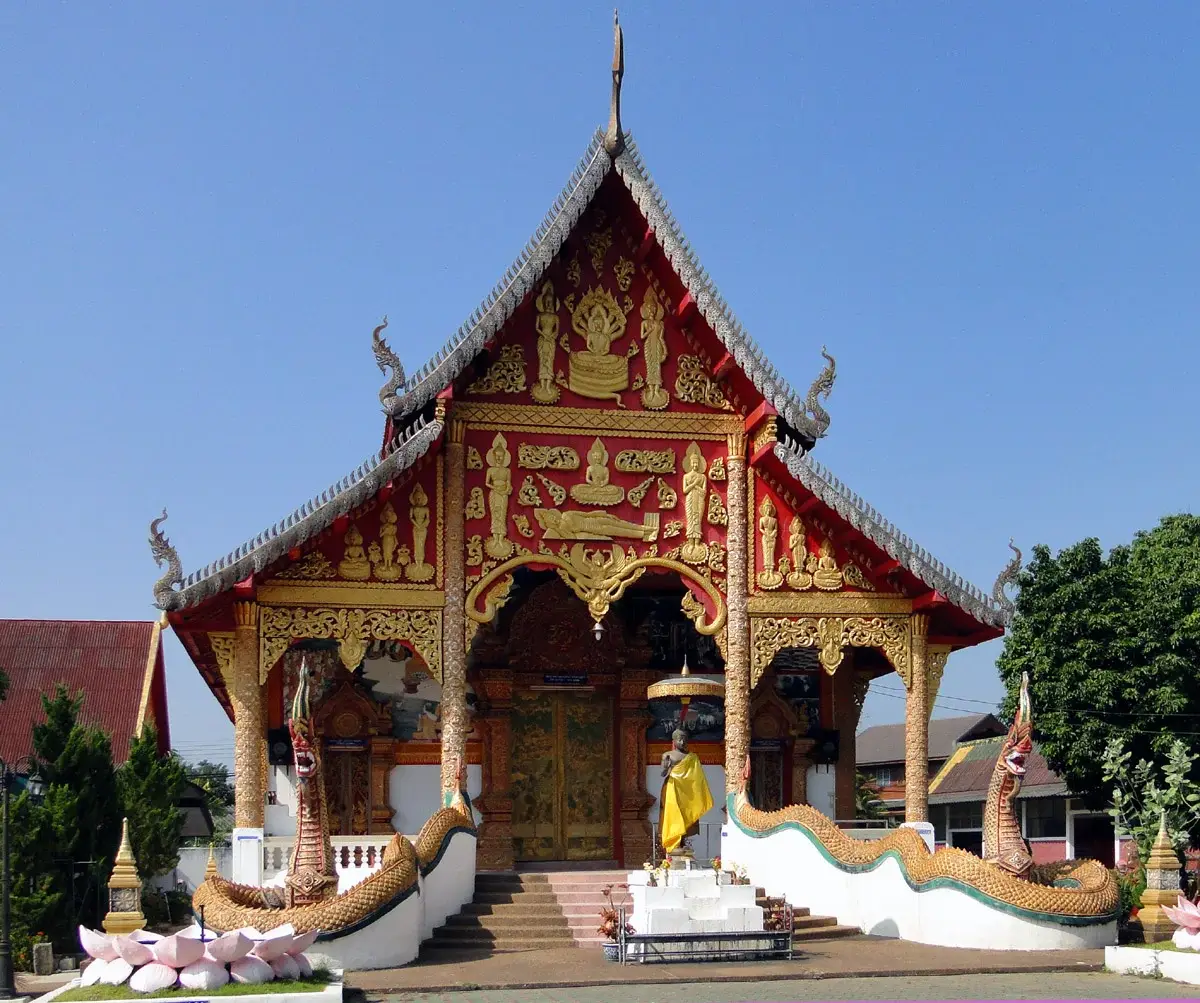
Wat Rangsi Sutthawat is located at No. 121, Village No. 8, Mueang Luang Tai, Choeng Doi Subdistrict, Doi Saket District, Chiang Mai Province. It is a local Buddhist temple under the Maha Nikaya order and one of the most meaningful community temples for the Tai Lue people of Mueang Luang Tai. The temple was officially permitted to be established in B.E. 2317 (1774) and received Wisungkhamsima in B.E. 2481 (1938). Its abbot is Phra Khru Suttham Wichit Wichittadhammo. The temple is not only a place for worship and merit-making, but also a cultural learning center that preserves the heritage of the Tai Lue community in Doi Saket.
Mueang Luang Tai, also known as Ban Luang Tai, is an important Tai Lue community in Choeng Doi Subdistrict. The Tai Lue people in this area have cultural roots connected with Sipsongpanna and preserve distinctive traditions in language, dress, weaving, household objects, rituals, and village life. Wat Rangsi Sutthawat stands at the center of this cultural setting. It serves as a spiritual anchor, a community meeting place, and a repository of local memory.
The name “Rangsi Sutthawat” carries a Buddhist meaning. “Rangsi” suggests radiance or light, while “Sutthawat” suggests a pure dwelling. Together, the name gives the sense of a place of pure light, a temple where people come to worship, listen to Dhamma, cultivate merit, and find peace. This meaning fits the temple’s role as a spiritual and cultural center for the community.
The temple’s establishment in B.E. 2317 (1774) makes Wat Rangsi Sutthawat one of the old temples of Doi Saket. A temple with this length of history has served many generations of local residents through changes in settlement, transport, education, and tourism. It preserves continuity between Buddhist faith and Tai Lue community life from the past to the present.
The temple received Wisungkhamsima in B.E. 2481 (1938). In Thai Buddhism, Wisungkhamsima is a designated sacred boundary for formal monastic acts, especially those connected with the ubosot. This status confirms the temple’s formal religious role and its ability to support important Buddhist ceremonies.
The temple land covers 8 rai and 50 square wah, with title deeds No. 13659 and No. 13660. The area supports the temple’s religious, educational, and community functions. It includes worship areas, monastic spaces, learning zones, community activity areas, and the Tai Lue house and museum that preserve local cultural knowledge.
The abbot of Wat Rangsi Sutthawat is Phra Khru Suttham Wichit Wichittadhammo. In a community temple, the abbot plays an important role in maintaining the temple, leading ceremonies, coordinating with villagers, working with local organizations, and supporting activities related to learning, health, and cultural preservation.
The temple’s important areas include a viharn, multipurpose hall, scripture hall, Tai Lue house, museum space, dining and kitchen areas, and community activity grounds. The viharn supports worship and ceremonies. The multipurpose hall supports community activities. The scripture hall reflects the importance of Buddhist learning. The Tai Lue house and local museum preserve the material culture and memories of the Mueang Luang Tai community.
The Tai Lue house and museum inside the temple are among its most important highlights. The museum presents the everyday life of the Tai Lue people through household items, agricultural tools, traditional kitchen objects, textiles, costumes, ritual objects, and stories from local knowledge holders. This makes the temple a living cultural classroom rather than only a place of worship.
The museum’s educational role is especially valuable because it allows students, young people, and interested visitors to learn directly from real objects and community narratives. Seeing textiles, tools, costumes, and ritual items in their local setting helps visitors understand the relationship between Buddhism, village life, and Tai Lue identity more deeply than reading general information alone.
Textiles and traditional Tai Lue clothing are central to the cultural identity preserved at the temple. Woven skirts, shoulder cloths, traditional garments, and old textile patterns reflect taste, belief, gender roles, ritual use, and community memory. A piece of cloth is not only clothing; it is a cultural language that speaks about identity, skill, and continuity across generations.
The temple and community also support Tai Lue language learning. Language preservation is essential because language carries names, rituals, kinship terms, local knowledge, and a community worldview. When Tai Lue is taught and practiced, the community’s cultural identity remains active in daily life.
One of the key community events is the Tai Lue cultural preservation event held every year on April 6. The event includes a procession, traditional dress, cultural performances, presentations of Tai Lue architecture, and local wisdom from Tai Lue communities in northern Thailand. This event makes Wat Rangsi Sutthawat a cultural gathering point that connects Mueang Luang Tai with wider Tai Lue networks.
The establishment of a Tai Lue association branch and a museum inside the temple strengthens the temple’s role as a cultural center. It supports study visits, community learning, cultural activities, and visitors who want to understand Tai Lue identity. Wat Rangsi Sutthawat therefore functions as both a Buddhist temple and a local cultural institution.
In terms of community wellbeing, the temple gives attention to cleanliness, safety, and public health. The temple grounds include separate toilets for men and women, toilets for people with disabilities, proper wastewater drainage, safe kitchen areas, and clean surroundings. These facilities make the temple suitable for merit-making, learning activities, and community events.
The temple also supports environmental and public health practices. Food scraps are used for biological fertilizer, plant waste is used for compost, and waste burning is avoided. The temple works with local health volunteers and local agencies to survey and remove mosquito breeding sites in order to prevent dengue fever. These activities show how the temple connects Buddhist values with practical community wellbeing.
Wat Rangsi Sutthawat also contributes to safety and local mobility through cooperation on road signs and mirrors at road bends near the temple. This shows that the temple’s role extends beyond religious ceremonies. It also supports the physical safety and everyday life of the surrounding village.
The temple has a newspaper corner for community information and a Dhamma corner for mental development. These spaces continue the traditional role of Thai temples as places of learning. Local people can come to read, receive information, reflect on Buddhist teachings, and participate in a shared public space.
The temple also promotes physical health by providing learning spaces and exercise areas for young people, older residents, and the general public. It encourages appropriate consumption, health awareness, and a balanced way of life based on Buddhist principles. This makes the temple a practical center for both spiritual and physical wellbeing.
Wat Rangsi Sutthawat is a strong example of a temple that combines religion, culture, education, public health, and environmental care. Its importance lies not only in its long history, but also in its continuing ability to respond to community needs while preserving Tai Lue heritage.
The atmosphere of the temple is clean, calm, shaded, and welcoming. It is suitable for visitors who want to worship, make merit, learn about Tai Lue culture, or spend time in a living community temple. The temple remains active because it is used by monks, villagers, volunteers, local leaders, and organizations for real community life.
For visitors interested in Tai Lue culture, Wat Rangsi Sutthawat deserves careful attention. Within one temple area, visitors can learn about Buddhism, village history, textiles, costumes, language, ritual objects, Tai Lue architecture, and local cultural events. A slow visit, especially with community guidance, allows for a much deeper understanding of Mueang Luang Tai.
Getting There is easiest by private car, rental car, or local transport. From Chiang Mai city, take Highway 118 toward Doi Saket, then turn into the local road leading to Ban Luang Tai or Mueang Luang Tai in Choeng Doi Subdistrict. The temple stands at the center of the community. The map code V48G+MG can help with navigation.
Travelers without a private vehicle can take public transport or a songthaew from Chiang Mai to Doi Saket, then continue with local transport to Ban Luang Tai. This requires planning because local village transport may not be frequent throughout the day. Visitors who want to see the museum or Tai Lue house should arrange the visit in advance with the community caretakers.
The best time to visit is in the morning or late afternoon, when the weather is more comfortable and the temple atmosphere is calm. Visitors who want to learn more about Tai Lue culture should coordinate in advance or visit during community cultural events. Those who come during the annual Tai Lue cultural preservation event will see traditional dress, performances, and community participation more clearly.
Visitors should dress politely, speak quietly, keep the temple grounds clean, and avoid entering monastic or museum storage areas without permission. Photography should be done respectfully and should not disturb monks, caretakers, or local worshippers. Wat Rangsi Sutthawat is both a sacred Buddhist space and a cultural learning site of the Tai Lue community, so visitors should respect the temple, the people, and the local heritage preserved there.
Overall, Wat Rangsi Sutthawat is an old Maha Nikaya community temple in Mueang Luang Tai, Choeng Doi Subdistrict, Doi Saket District, Chiang Mai. Established in B.E. 2317, granted Wisungkhamsima in B.E. 2481, and led by Phra Khru Suttham Wichit Wichittadhammo, the temple remains a spiritual and cultural center of the Tai Lue community. It is suitable for worship, merit-making, museum visits, cultural learning, and slow travel through the living heritage of Doi Saket.
| Name | Wat Rangsi Sutthawat |
| Local Name | Wat Rangsi Sutthawat Mueang Luang Tai / Wat Luang Tai |
| Location | Mueang Luang Tai, Village No. 8, Choeng Doi Subdistrict, Doi Saket District, Chiang Mai Province |
| Address | No. 121, Village No. 8, Mueang Luang Tai, Choeng Doi Subdistrict, Doi Saket District, Chiang Mai 50220, Thailand |
| Map Code | V48G+MG, Choeng Doi Subdistrict, Doi Saket District, Chiang Mai |
| Temple Type | Community Buddhist Temple Under The Maha Nikaya Order |
| History | Officially permitted to be established as a temple in B.E. 2317 (1774) and granted Wisungkhamsima in B.E. 2481 (1938) |
| Temple Land | 8 rai and 50 square wah, title deeds No. 13659 and No. 13660 |
| Abbot / Caretaker | Phra Khru Suttham Wichit Wichittadhammo |
| Main Areas / Zones | Viharn, multipurpose hall, scripture hall, Tai Lue house, local Tai Lue museum, dining area, community activity ground, toilets, reading corner, and Dhamma corner |
| Museum / Learning Center | Displays Tai Lue household items, agricultural tools, traditional kitchen objects, textiles, costumes, ritual objects, and local knowledge of Mueang Luang Tai |
| Traditions / Activities | Tai Lue cultural preservation event on April 6 every year, Tai Lue language learning, textile and costume displays, merit-making, and Dhamma activities during festivals |
| Facilities | Temple courtyard, parking area, male toilets, female toilets, toilets for people with disabilities, kitchen, dining area, rest areas, newspaper corner, Dhamma corner, and community exercise space |
| Museum Fee | Generally no admission fee; visitors may make merit or donate to support the museum and community activities |
| Museum Visit | Open by advance appointment with the museum caretakers and Ban Luang Tai community |
| Museum / Community Contact | 083-570-8066 Khun Somboon Sompho, 087-658-3689 Village Headman Somsak Khuean Lom |
| Highlights | Old temple of Mueang Luang Tai, Tai Lue community center, Tai Lue house, local museum, textiles, costumes, and annual Tai Lue cultural event |
| Distinctive Features | A Maha Nikaya temple that brings together Buddhism, Tai Lue culture, community wellbeing, learning, and local heritage preservation |
| Travel Information | From Chiang Mai city, take Highway 118 toward Doi Saket, then turn into the local road to Ban Luang Tai, Village No. 8, Choeng Doi Subdistrict. Best reached by private car, rental car, or local transport. |
| Current Status | Active Maha Nikaya community temple in Mueang Luang Tai and a Tai Lue cultural learning center of Ban Luang Tai |
| Nearby Tourist Attractions | 1. Tai Lue House, Ban Luang Tai, about 0 km 2. Wat Phra That Doi Saket, about 5 km 3. Wat Doi Ku, about 6 km 4. Ban Luang Nuea, about 9 km 5. Mae Kuang Udom Thara Dam, about 16 km |
| Nearby Restaurants | 1. Papa's Garden, about 10 km, Tel. 063-651-9415 2. Baan Na Coffee and Restaurant, about 10 km, Tel. 098-014-3383 3. The Lemontree Garden & Restaurant Doi Saket, about 12 km, Tel. 093-415-0544 4. Pla San Khuean, about 13 km, Tel. 053-865-559, 081-882-9481 5. Sorn's Cafe, Restaurant And Bar, about 13 km, Tel. 081-485-2801 |
| Nearby Accommodations | 1. Srida Resort Lanna & Cafe, about 13 km, Tel. 087-886-0721, 094-431-1431 2. Horizon Village & Resort, about 14 km, Tel. 053-292-381 3. Suwanna Tara Resort & Spa, about 15 km, Tel. 053-291-937 4. Voraman Hut, about 24 km, Tel. 090-994-6648 5. Him Doi House @ Doisaket, about 9 km |
Frequently Asked Questions (FAQ)
Q: Where is Wat Rangsi Sutthawat located?
A: Wat Rangsi Sutthawat is located at No. 121, Village No. 8, Mueang Luang Tai, Choeng Doi Subdistrict, Doi Saket District, Chiang Mai Province.
Q: When was Wat Rangsi Sutthawat officially established?
A: Wat Rangsi Sutthawat was officially permitted to be established as a temple in B.E. 2317 (1774).
Q: When did Wat Rangsi Sutthawat receive Wisungkhamsima?
A: Wat Rangsi Sutthawat received Wisungkhamsima in B.E. 2481 (1938).
Q: Who is the abbot of Wat Rangsi Sutthawat?
A: The abbot of Wat Rangsi Sutthawat is Phra Khru Suttham Wichit Wichittadhammo.
Q: What is the main highlight of Wat Rangsi Sutthawat?
A: The main highlight is its role as an old temple and Tai Lue cultural learning center, with a Tai Lue house, local museum, textiles, costumes, and community cultural activities.
Q: How can visitors see the museum at Wat Rangsi Sutthawat?
A: The museum is open by advance appointment with the museum caretakers and Ban Luang Tai community.
Q: What type of travelers should visit Wat Rangsi Sutthawat?
A: The temple is suitable for travelers who want to worship, make merit, learn about Tai Lue culture, visit a local museum, and experience community life in Mueang Luang Tai.
Q: How can travelers get to Wat Rangsi Sutthawat?
A: From Chiang Mai city, take Highway 118 toward Doi Saket, then turn into the local road to Ban Luang Tai in Choeng Doi Subdistrict. The map code V48G+MG can help with navigation.
 Category: ●Places of Worship
 Group: ●Temple
Last Update : 2 WeekAgo
 Last Update : 2 WeekAgo
 Click to Access the Navigation Map GPS
Wat Rangsi Sutthawat Map
Recommend

 Muang Chiang Mai(121)Chom Thong(47)Mae Chaem(25)Chiang Dao(33)Doi Saket(68)Mae Taeng(85)Mae Rim(69)Samoeng(29)Fang(71)Mae Ai(59)Phrao(70)San Pa Tong(103)San Kamphaeng(66)San Sai(73)Hang Dong(73)Hot(32)Doi Tao(22)Omkoi(11)Saraphi(74)Wiang Haeng(15)Chai Prakan(28)Mae Wang(32)Mae On(22)Doi Lo(34)Galyani Vadhana(1)


