
lovethailand home >North Travel Attractions >Chiang Mai Travel Attractions >Chai Prakan >Si Dong Yen > Wat San Ton Pao (Ban Ai)
TL;DR: Wat San Ton Pao (Ban Ai) is located at No. 171, Moo 5, Ban Ai, Si Dong Yen Subdistrict, Chai Prakan District, Chiang Mai 50320, open Daily, hours 08.00 – 17.00.

Wat San Ton Pao (Ban Ai)
Open Days: Daily
Opening Hours: 08.00 – 17.00
Wat San Ton Pao (Ban Ai) is a community Buddhist temple located at No. 171, Moo 5, Ban Ai, Si Dong Yen Subdistrict, Chai Prakan District, Chiang Mai Province. It is a local temple under the Mahanikaya order. The temple was established in 1939 and received its royal Wisungkhamsima boundary on 19 May 1996. Today, the temple is open daily from 08.00 to 17.00 for worship, merit-making, and cultural visits. It is commonly known among local people as Wat Ban Ai because of its location in Ban Ai.
The importance of Wat San Ton Pao lies not only in its role as a village temple, but also in its history of relocation from an older temple site that was low-lying and difficult to access during the rainy season. Local leaders and villagers decided to build a new temple on a more suitable site about 3 kilometers from the former temple. This makes Wat San Ton Pao a strong example of a community temple shaped by practical needs, local faith, and cooperation among villagers.
The founding story begins with the difficulty of the old temple site. During the rainy season, flooding made travel inconvenient for villagers. Singkham Intakaeo, an assistant village headman, Nai Tha Kaeomala, a temple lay steward, and Nai Sitthisan Sawangthit, a lay ritual leader, discussed the problem with local residents. About 37 households then joined together to create a new temple in a better location. This collective effort reflects the Lanna tradition in which villagers are active caretakers of their own sacred spaces.
The official name of the new temple became Wat San Ton Pao, but local people continued to call it Wat Ban Ai. The word Ai in the local context is associated with the idea of a checkpoint or pass. Local history tells that the present temple area was once linked with a checkpoint of Fang, where a trusted man named Thao Samoechai was assigned by the ruler of Fang to stay at Ban Ai and send important news back to the ruler. This story gives the temple and village a deeper historical identity connected with travel, communication, and local administration.
Ban Ai is therefore more than a village name. It preserves a memory of the area’s earlier role as a local checkpoint. When Wat San Ton Pao was later established in Ban Ai, the temple became closely tied to this place-based history. Visitors can understand the temple not only as a Buddhist site, but also as part of the story of settlement and movement in northern Chiang Mai.
The year 1939 marks the official establishment of Wat San Ton Pao. By 2026, the temple had served the local community for more than 85 years. During this long period, it became part of the shared memory of Ban Ai through Buddhist holy days, Kathin, community ceremonies, and the everyday relationship between villagers and the temple.
The royal Wisungkhamsima boundary granted on 19 May 1996 was another important milestone. In Thai Buddhism, a Wisungkhamsima is a consecrated boundary used for formal acts of the Sangha. Receiving this boundary strengthened the temple’s formal status within the Thai Buddhist monastic system and confirmed its function as a complete religious site for the community.
The temple land covers 6 rai and 18 square wa. It is located only about 10 meters from the main highway, making it much more accessible than the former low-lying site. The temple is about 126 kilometers from Chiang Mai city and about 7.13 kilometers from Chai Prakan District Office. Its convenient location makes it suitable for travelers moving along the Chiang Mai–Fang route or exploring the cultural route of Si Dong Yen.
Wat San Ton Pao is surrounded by several important temples in Si Dong Yen. To the north is Wat Si Dong Yen, about 3.2 kilometers away. To the south is Wat Pratu Mueang Pha Hong, about 3.5 kilometers away. To the east is Wat Sai Khao, about 1 kilometer away, and to the west is Wat Tham Tab Tao, about 3 kilometers away. This setting makes the temple an excellent starting point for understanding the network of village temples in Si Dong Yen.
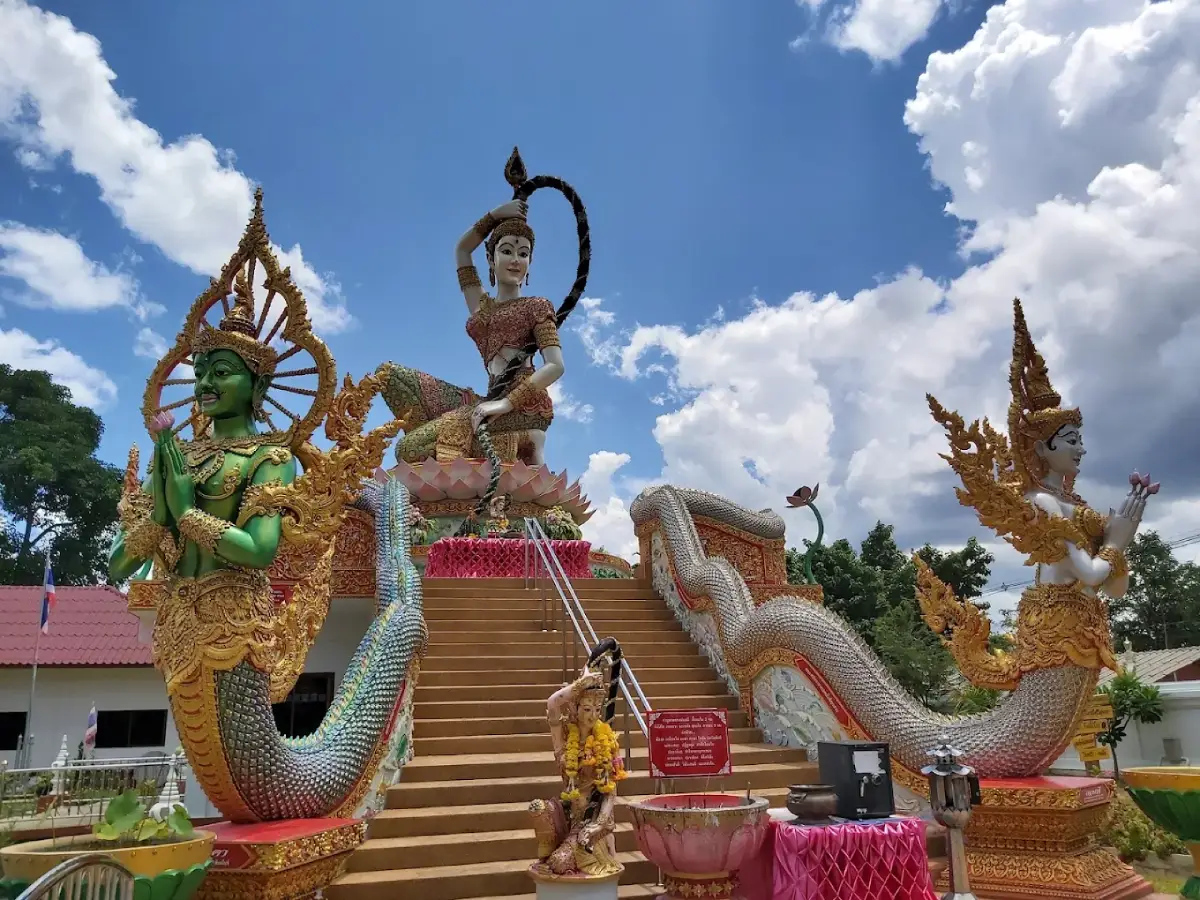
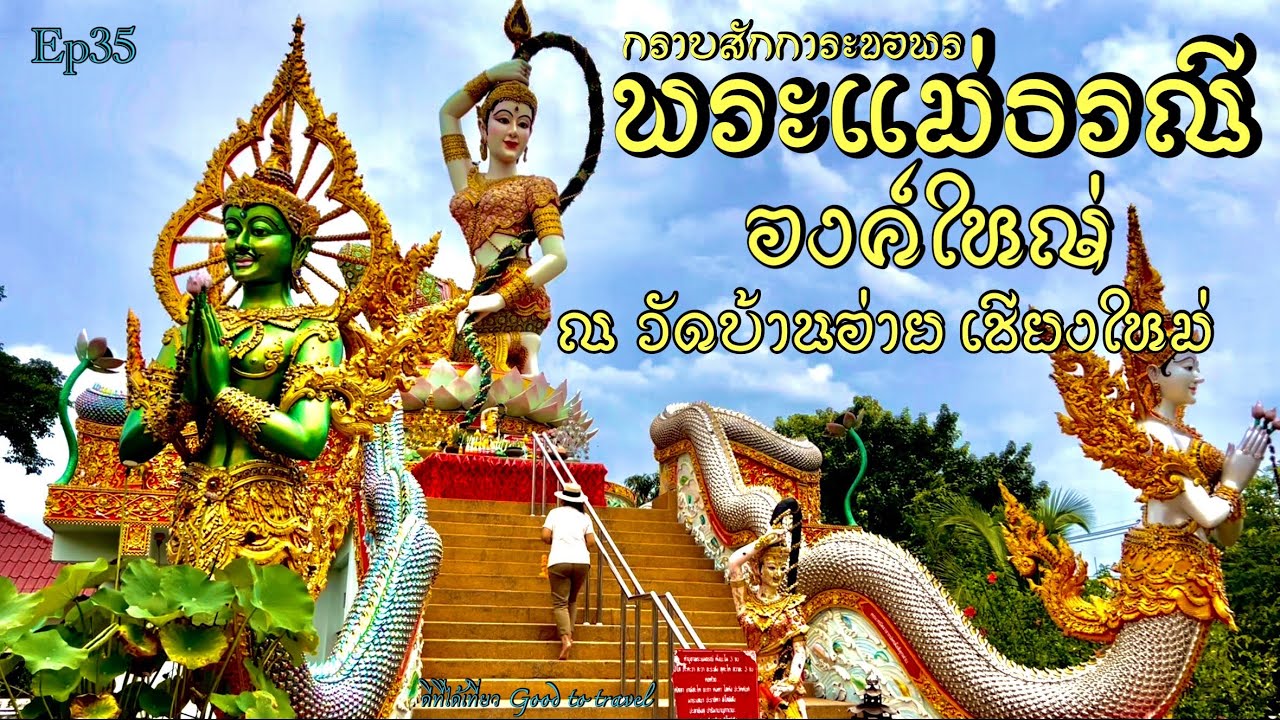
The most striking feature of Wat San Ton Pao is the large stucco statue of Phra Mae Thorani, approximately 14 meters high, together with a meditation building built as a place of worship. Phra Mae Thorani is an important figure in Buddhist narrative, associated with the moment before the Buddha’s enlightenment when she appears as a witness to his accumulated merit. The statue gives the temple a strong visual and symbolic identity.
Another important sacred feature is Luang Pho Phra Muni Si Chai Prakan, the principal Buddha image in the viharn. A replica is also enshrined on the crown area of the large Phra Mae Thorani statue. These sacred objects connect devotion to the Buddha with the symbolic presence of Phra Mae Thorani, creating a distinctive worship area within the temple.
The temple also has a meditation building, which reflects its role not only as a place for ceremonies but also as a space for mental cultivation. Visitors who come here can pay respect, make merit, walk quietly around the temple grounds, and experience the calm rhythm of a northern Thai community temple.
Phra Khru Wimon Bunnyakhom Akkapunyo serves as the abbot of Wat San Ton Pao. Recent Kathin information also records that the temple had 5 resident monks in 2025, confirming that it remains an active Buddhist site. At a community temple, the abbot plays a central role in organizing religious activities, caring for monks, coordinating with lay supporters, and maintaining the temple as a spiritual center for the village.
Wat San Ton Pao is located in Si Dong Yen Subdistrict, an important agricultural and mountain area of Chai Prakan District. The subdistrict includes lowland farming areas, higher terrain, villages, roads, and natural attractions. In this setting, temples are not separate from daily life. They are closely connected with homes, farms, seasonal cycles, and community cooperation.
Within Si Dong Yen, Wat San Ton Pao is part of a wider temple network that includes Wat Si Dong Yen, Wat Sai Khao, Wat Chiang Man, Wat Kio Champi, Wat Tham Tab Tao, Wat Pratu Mueang Pha Hong, and other local temples. This distribution reflects the Lanna village pattern in which each community maintains its own temple while remaining connected to other temples across the subdistrict.
Wat San Ton Pao is suitable for travelers interested in Lanna community temples, local history, and cultural routes beyond mainstream tourist sites. The main points of interest are the large Phra Mae Thorani statue, Luang Pho Phra Muni Si Chai Prakan, the meditation building, the viharn area, and the living village atmosphere of Ban Ai.
Travelers interested in local history should pay attention to the story of Ban Ai as an old checkpoint and the relocation of the temple from a flood-prone lowland site. These stories show that the temple’s location was shaped by landscape, travel routes, water conditions, and the practical needs of villagers.
The large Phra Mae Thorani statue also gives the temple an important contemporary Buddhist art dimension. At about 14 meters high, it is a prominent visual landmark. Its meaning connects the earth, merit, protection, and the triumph of dhamma. Together with Luang Pho Phra Muni Si Chai Prakan, it creates a strong devotional focus within the temple grounds.
Wat San Ton Pao also continues to take part in annual Buddhist activities such as Kathin. Kathin is held after the end of Buddhist Lent and allows lay supporters to offer robes and donations for the maintenance of the temple. This tradition shows how temples continue to depend on the cooperation and faith of local communities.
Si Dong Yen maintains local traditions rooted in Buddhism and agriculture, including Buddhist Lent, the end of Buddhist Lent, Kathin, Salak Phat, Northern Thai New Year, Yi Peng, new rice offerings, and the wooden support ceremony. These traditions keep temples active throughout the year and connect Buddhist practice with seasonal life.
Buddhist Lent involves offerings, candle presentation, and support for monks in residence. The end of Buddhist Lent leads to Kathin and other merit-making events. Salak Phat reflects Lanna-style giving. Northern Thai New Year brings Buddha image bathing and blessings from elders. Yi Peng connects merit-making with candlelight and the full moon. New rice offerings express gratitude for the harvest, while the wooden support ceremony symbolizes support for Buddhism and life. Wat San Ton Pao belongs to this rich cultural environment.
Wat San Ton Pao can be visited as part of a half-day or full-day cultural route through Si Dong Yen. From the temple, visitors can continue east to Wat Sai Khao, west to Wat Tham Tab Tao, north to Wat Si Dong Yen, and south toward Wat Pratu Mueang Pha Hong. This route helps travelers understand how temples are positioned across the local landscape.
Wat Tham Tab Tao is a nearby religious site known for its cave setting and Buddha images. Hinoki Land is a modern attraction in Chai Prakan, while Doi Wiang Pha National Park represents the mountain and natural landscape of Si Dong Yen. Combining these places with Wat San Ton Pao creates a balanced itinerary of religion, local culture, nature, and contemporary tourism.
The best time to visit is in the morning or late afternoon, when the weather is more comfortable and there is enough time to continue to nearby temples or attractions. The cool season is especially pleasant in Chai Prakan. During the rainy season, the agricultural and mountain scenery becomes greener, but visitors should drive carefully on local roads.
Getting There from Chiang Mai city is easiest by private car or rental car. Follow Highway 107 north through Mae Rim, Mae Taeng, Chiang Dao, and Chai Prakan, then continue into Si Dong Yen Subdistrict and Ban Ai, Moo 5. The temple is about 126 kilometers from Chiang Mai city, about 7.13 kilometers from Chai Prakan District Office, and about 10 meters from the main highway. A private vehicle is the most convenient option for combining Wat San Ton Pao with Wat Tham Tab Tao, Wat Sai Khao, Wat Si Dong Yen, Hinoki Land, and nearby attractions.
Travelers without a private vehicle can use public transport along the Chiang Mai–Fang or Chiang Mai–Mae Ai route and continue locally from Chai Prakan. This option requires additional planning because temples and attractions in Si Dong Yen are spread across local roads. A private vehicle is recommended for a complete temple route.
Visitors should dress modestly, remain quiet in the viharn, meditation building, and monk-use areas, and avoid disturbing ceremonies or local activities. If taking photos of people, ask permission first. Wat San Ton Pao is an active community temple, so respectful behavior is an essential part of the visit.
For food and accommodation, travelers can use restaurants, cafés, guest rooms, resorts, and homestays in Si Dong Yen and Chai Prakan. The area is suitable as a stopover between Chiang Mai, Fang, Mae Ai, Doi Ang Khang, and Tha Ton. Staying overnight in Chai Prakan allows more time to explore Wat San Ton Pao, Wat Tham Tab Tao, Hinoki Land, and Doi Wiang Pha National Park without rushing.
In summary, Wat San Ton Pao (Ban Ai) is an important community temple in Si Dong Yen Subdistrict. It combines the history of Ban Ai as an old checkpoint, the relocation of a village temple from a flood-prone site, a large 14-meter Phra Mae Thorani statue, Luang Pho Phra Muni Si Chai Prakan, and an active Buddhist community. The temple is a meaningful stop for travelers who want to understand the quieter, more local side of Chai Prakan and northern Chiang Mai.
| Name | Wat San Ton Pao (Ban Ai) |
| Temple Type | Community Buddhist Temple, Mahanikaya Order |
| Location | No. 171, Moo 5, Ban Ai, Si Dong Yen Subdistrict, Chai Prakan District, Chiang Mai 50320 |
| Local Name | Wat Ban Ai |
| Official Establishment | 1939 |
| Wisungkhamsima | Royal Wisungkhamsima granted on 19 May 1996 |
| Temple Land Area | 6 rai, 18 square wa |
| Abbot | Phra Khru Wimon Bunnyakhom Akkapunyo |
| History | The new temple was built about 3 kilometers from the former low-lying temple site because the old location was difficult to access during the rainy season. Local leaders and about 37 households joined in building the new temple. |
| Name Origin | Ban Ai is associated with an old checkpoint; the word Ai is locally connected with the idea of a checkpoint or pass. |
| Highlights | Large 14-meter Phra Mae Thorani statue, meditation building, Luang Pho Phra Muni Si Chai Prakan, and the local history of Ban Ai as an old checkpoint |
| Main Areas | Viharn, meditation building, temple courtyard, and worship area around the large Phra Mae Thorani statue |
| Sacred Objects | Luang Pho Phra Muni Si Chai Prakan and the Phra Mae Thorani statue |
| Community Role | Spiritual center of Ban Ai, supporting merit-making, dhamma listening, meditation, Kathin, and Buddhist community activities |
| Local Traditions | Buddhist Lent, end of Buddhist Lent, Kathin, Salak Phat, Northern Thai New Year, Yi Peng, new rice offerings, and wooden support ceremony |
| Current Status | Active temple in the current temple registry, with recent Kathin activity information and 5 resident monks recorded in 2025 |
| Open Days | Daily |
| Opening Hours | 08.00 – 17.00 |
| Travel Information | From Chiang Mai city, follow Highway 107 toward Chai Prakan, then continue to Si Dong Yen Subdistrict and Ban Ai, Moo 5. The temple is about 126 km from Chiang Mai city, about 7.13 km from Chai Prakan District Office, and about 10 meters from the main highway. |
| Nearby Tourist Attractions | 1. Wat Sai Khao, About 1 km 2. Wat Tham Tab Tao, About 3 km 3. Wat Si Dong Yen, About 3 km 4. Wat Pratu Mueang Pha Hong, About 4 km 5. Hinoki Land, About 8 km 6. Doi Wiang Pha National Park, About 24 km |
| Nearby Restaurants | 1. Larb Ban Ai, About 1 km, Tel. 085-620-8370 2. Pa Phan Noodle Ban Chiang Man, About 4 km, Tel. 085-864-8001 3. Mor Cafe, About 5 km, Tel. 095-861-5556 4. Cafe' De Mamana, About 6 km, Tel. 099-435-4061, 090-435-4061 5. Cafe Amazon PTT Chai Prakan, About 7 km, Tel. 098-808-1958 6. Pizza & View Pang Chai Prakan, About 10 km, Tel. 082-198-8792 |
| Nearby Accommodations | 1. Ban Ai Resort, About 1 km 2. Pingkhong Resort, About 5 km 3. Baan Suan Ngoon Sirisuk Rooms, About 6 km, Tel. 092-398-8884, 098-750-0115, 086-919-9542 4. Phrom Prathan Resort, About 8 km 5. Anton Place, About 13 km 6. Pang Kham Pom Homestay Chai Prakan, About 18 km, Tel. 084-170-7943 |
Frequently Asked Questions (FAQ)
Q: Where is Wat San Ton Pao (Ban Ai) located?
A: Wat San Ton Pao is located at No. 171, Moo 5, Ban Ai, Si Dong Yen Subdistrict, Chai Prakan District, Chiang Mai Province 50320.
Q: Is Wat San Ton Pao open daily?
A: Yes. Wat San Ton Pao is open daily from 08.00 to 17.00 for worship, merit-making, and temple visits.
Q: When was Wat San Ton Pao established?
A: Wat San Ton Pao was established in 1939 and received its royal Wisungkhamsima boundary on 19 May 1996.
Q: Why is Wat San Ton Pao also called Wat Ban Ai?
A: The temple is located in Ban Ai. Local history connects the word Ai with an old checkpoint, and the temple is commonly known among villagers as Wat Ban Ai.
Q: What are the main highlights of Wat San Ton Pao?
A: The main highlights include the large 14-meter Phra Mae Thorani statue, the meditation building, Luang Pho Phra Muni Si Chai Prakan, and the history of relocating the temple from a former low-lying site.
Q: Who is the abbot of Wat San Ton Pao?
A: The abbot is Phra Khru Wimon Bunnyakhom Akkapunyo.
Q: What kind of travelers should visit Wat San Ton Pao?
A: The temple is suitable for travelers interested in Lanna community temples, Ban Ai local history, the large Phra Mae Thorani statue, merit-making, and temple routes in Si Dong Yen.
Q: What nearby places can travelers visit after Wat San Ton Pao?
A: Nearby places include Wat Sai Khao, Wat Tham Tab Tao, Wat Si Dong Yen, Wat Pratu Mueang Pha Hong, Hinoki Land, and Doi Wiang Pha National Park.
 Category: ●Places of Worship
 Group: ●Temple
Last Update : 1 MonthAgo
 Last Update : 1 MonthAgo
 Click to Access the Navigation Map GPS
Wat San Ton Pao (Ban Ai) Map
Recommend

 Muang Chiang Mai(121)Chom Thong(47)Mae Chaem(25)Chiang Dao(33)Doi Saket(68)Mae Taeng(85)Mae Rim(69)Samoeng(29)Fang(71)Mae Ai(59)Phrao(70)San Pa Tong(103)San Kamphaeng(66)San Sai(73)Hang Dong(73)Hot(32)Doi Tao(22)Omkoi(11)Saraphi(74)Wiang Haeng(15)Chai Prakan(28)Mae Wang(32)Mae On(22)Doi Lo(33)Galyani Vadhana(1)


